
Motorcycle maintenance becomes much more interesting once the motorcycle is actually yours.
Before owning TITAN, a service interval was just another number in a manual.
After almost a year and roughly 10,000 km with my 2021 Yamaha MT-07, those numbers now translate into actual workshop appointments, tyres, brake pads, chain spray and invoices.
My biggest maintenance bill so far was €650.
A few months later, tyres and rear brake pads added another €584.
That doesn’t mean the Yamaha MT-07 is unreliable.
Quite the opposite: my experience so far has mostly been scheduled maintenance and normal wear.
But it has taught me that owning a relatively simple motorcycle doesn’t mean ignoring it until something feels wrong.
The better approach is understanding:
- what Yamaha expects to be serviced;
- which jobs depend on mileage;
- which depend on time;
- which wear items don’t follow a perfect schedule;
- and what you can realistically monitor between workshop visits.
That’s what this guide is about.
My MT-07 maintenance context
Before we get into Yamaha’s schedule, here’s where TITAN currently sits.
| Motorcycle | 2021 Yamaha MT-07 |
| Bought at | ~20,000 km |
| Current odometer | ~30,500 km |
| Distance ridden by me | ~10,000 km |
| Major service | 25,270 km |
| Major service cost | €650 |
| Tyres + rear brake pads | 28,200 km |
| Cost | €584 |
| Typical use | Weekday riding + weekend getaways |
| Environment | Amsterdam / Netherlands |
The used-bike part is important.
I didn’t start with a brand-new MT-07 at zero kilometres and follow every service from the beginning.
I inherited a motorcycle that already had roughly 20,000 km behind it.
That changes the way I think about maintenance.
I’m not only asking:
What is due next?
I’m also asking:
What has already been done, and how confident am I about the history?
That is an important question for anyone buying a used motorcycle.
Yamaha’s 2021 MT-07 maintenance schedule at a glance
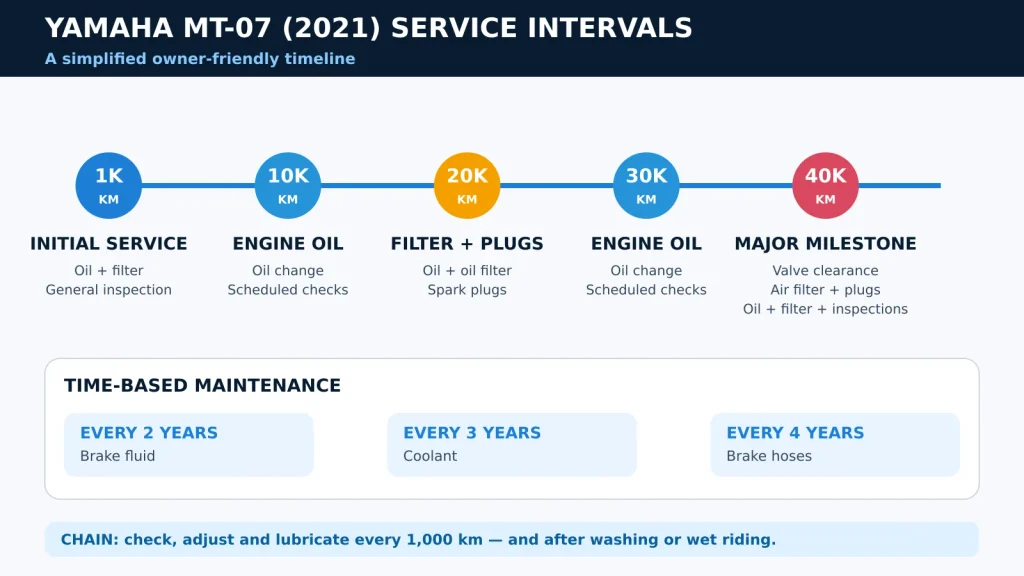
The official schedule is much more detailed than this simplified table, but these are the milestones I think most owners should understand.
| Mileage / time | Important maintenance |
|---|---|
| 1,000 km | Initial service, including engine oil and oil filter plus inspections |
| 10,000 km | Engine oil and broad inspection/check schedule |
| 20,000 km | Engine oil, oil filter, spark plug replacement and inspections |
| 30,000 km | Engine oil and scheduled checks |
| 40,000 km | Larger milestone including oil/filter, spark plugs, valve-clearance check, air filter and scheduled inspections |
| Every 1,000 km / after wet riding or washing | Check/adjust/lubricate drive chain |
| Every 2 years | Brake fluid |
| Every 3 years | Coolant |
| Every 4 years | Brake hoses |
| 50,000 km onward | Repeat Yamaha’s schedule beginning from the 10,000 km interval |
This isn’t a replacement for the owner’s manual.
It is the structure behind it.
There are many other checks at the scheduled intervals—brakes, tyres, bearings, controls, suspension components, fasteners, fuel system and more.
But once you understand the pattern, maintenance becomes much easier to plan.
Engine oil: one of the recurring jobs
For the 2021 MT-07, engine oil sits at the centre of the regular maintenance schedule.
Yamaha’s European chart shows oil changes at the initial service and then at the 10,000 km interval points.
The oil filter follows a slightly different pattern.
After the initial 1,000 km replacement, the chart calls for the filter again at the 20,000 km and 40,000 km milestones.
This is a useful example of why saying:
“Service the bike every 10,000 km.”
doesn’t tell the entire story.
Different components have different schedules.
During my 25,270 km major service, TITAN received fresh engine oil and filter work as part of the larger service.
For me, the important owner habit isn’t memorising every line of the manual.
It’s knowing roughly where the bike sits in the service cycle.
At 30,500 km, I shouldn’t be thinking:
“It was serviced once, so we’re done.”
I’m already thinking about what the next mileage milestone brings.
Spark plugs: check and replacement aren’t the same thing
This is another distinction worth understanding.
Yamaha’s schedule doesn’t treat every 10,000 km interval identically.
For the 2021 MT-07, the spark plugs are inspected/adjusted at intermediate points and replaced at the 20,000 km intervals.
The specified 2021 plug is an NGK LMAR8A-9.
My 25,270 km service included spark-plug work.
Again, that service wasn’t simply me arriving at exactly one Yamaha mileage marker.
TITAN was already a used motorcycle, and I wanted a solid maintenance baseline.
That’s one reason I don’t think used-bike owners should become obsessed with hitting an exact odometer digit while ignoring the motorcycle’s previous history.
A schedule gives you the framework.
The bike’s actual history gives you context.
Valve clearance: the big 40,000 km milestone
One maintenance item that gets discussed a lot among owners is valve clearance.
For the 2021 MT-07, Yamaha specifies a valve-clearance check and adjustment every 40,000 km.
TITAN is currently around 30,500 km.
So this is not an immediate job for me today, but it is now close enough that it belongs on my radar.
This is exactly why I like thinking ahead rather than waiting for a dashboard warning or an obvious problem.
At some point, 40,000 km will stop sounding distant.
It will simply become the next service appointment.
Valve-clearance work is also a good example of something I personally classify as:
Workshop territory
Checking oil level is one thing.
Opening up the engine to measure and potentially adjust valve clearances is another.
Knowing what needs doing does not mean you need to do everything yourself.
Air filter: scheduled replacement versus my BMC filter
The standard 2021 maintenance schedule calls for the original air-filter element to be replaced every 40,000 km, with Yamaha noting that unusually wet or dusty use can require more frequent attention.
TITAN complicates that slightly.
My motorcycle now uses a BMC air filter.
That means I shouldn’t blindly apply cleaning or replacement instructions intended for Yamaha’s standard disposable filter to an aftermarket reusable filter.
This is an important general rule with modified motorcycles:
Once you change a component, its maintenance requirements may change too.
Follow the instructions for the exact component fitted.
Don’t assume every MT-07 maintenance guide on the internet applies perfectly to your particular setup.
Chain maintenance happens far more often than major servicing
If there’s one part of the maintenance schedule that applies constantly to real ownership, it’s the chain.
Yamaha specifies checking chain slack, alignment and condition, then adjusting and lubricating as needed, every:
1,000 km
and also after:
- washing the motorcycle;
- riding in rain;
- riding in wet conditions.
Rain isn’t an unusual event here.
Neither is washing the motorcycle.
So chain care isn’t something I think about only when the next big service arrives.
I already keep chain spray as part of TITAN’s regular consumables.
The other thing worth understanding is that chain slack has an actual specification.
For the 2021 MT-07, Yamaha specifies 51–56 mm measured using its defined procedure, and warns that excessive slack can cause damage.
If you’re unsure how the measurement should be taken, don’t simply copy a number and measure wherever seems convenient.
Use the correct owner’s-manual procedure.
Chain lubrication isn’t the same as endlessly spraying more lube
This is something I’ve become more conscious of as an owner.
Chain maintenance isn’t:
See chain → spray chain → job done.
You want to think about:
Condition
Are there stiff links, corrosion or obvious damage?
Slack
Is it within specification?
Alignment
Is the rear wheel correctly aligned after adjustment?
Cleanliness
Has dirt and old lubricant built up?
Lubrication
Is the chain appropriately lubricated for the conditions?
And eventually:
Wear
Chains and sprockets are consumable components.
They do not last forever.
At my 28,200 km visit, chain and sprocket condition were also something I was conscious of for future maintenance.
I haven’t replaced them simply yet.
Wear varies based on the actual motorcycle and the riding conditions.
Tyres don’t follow the service schedule neatly
My tyres are a perfect example.
At around 28,200 km, TITAN received new tyres.
That wasn’t because Yamaha has a rule saying:
“Replace tyres at 28,200 km.”
Tyres are condition-based wear items.
You monitor:
- tread;
- damage;
- cracking;
- pressure;
- unusual wear;
- age;
- how the motorcycle feels.
My tyre and rear-brake-pad visit cost €584.
That bill happened between the major service milestones.
And that’s exactly why maintenance budgeting needs to include wear items outside the neat scheduled-service table.
A motorcycle can be completely up to date with its scheduled service and still need tyres next month.
Tyre pressure is an owner job
This is one of the simplest maintenance habits and one of the easiest to neglect.
You don’t need to wait for a workshop to tell you the tyres are low.
Pressure should be checked when appropriate using a reliable gauge and adjusted to the specification for your motorcycle, load and tyre setup.
I would put this in the category of:
Basic owner responsibility
along with visually checking tyre condition.
The motorcycle only has two tyres.
They deserve attention.
Brakes: some checks are simple, some aren’t
At 28,200 km, my rear brake pads were replaced.
The front pads still had roughly 50% life remaining according to the inspection at the time.
I like that example because it shows why replacing parts purely according to mileage doesn’t make sense for every wear item.
Front and rear pads don’t necessarily wear at the same rate.
Different riders use their brakes differently.
Traffic conditions differ.
So the useful habit is inspection.
Things I can pay attention to include:
- brake feel;
- fluid level;
- visible pad wear where it can be inspected safely;
- leaks;
- unusual noises;
- changes in braking behaviour.
But the hydraulic system also has time-based maintenance.
Yamaha specifies DOT 4 brake fluid for the 2021 MT-07 and calls for brake-fluid replacement every two years. The maintenance schedule also gives a four-year replacement interval for brake hoses, or sooner if damaged.
This is why a low-mileage motorcycle can still need maintenance.
Mileage isn’t the only clock running.
Coolant: another time-based job
Yamaha specifies checking the cooling system regularly within the service schedule and replacing coolant every:
3 years.
This is another maintenance item that can disappear from your thinking because the motorcycle may appear to be working perfectly.
Nothing dramatic happens every morning to remind you:
“My coolant is getting older.”
That’s why service records matter.
They tell you things the odometer alone cannot.
What should an MT-07 owner check themselves?
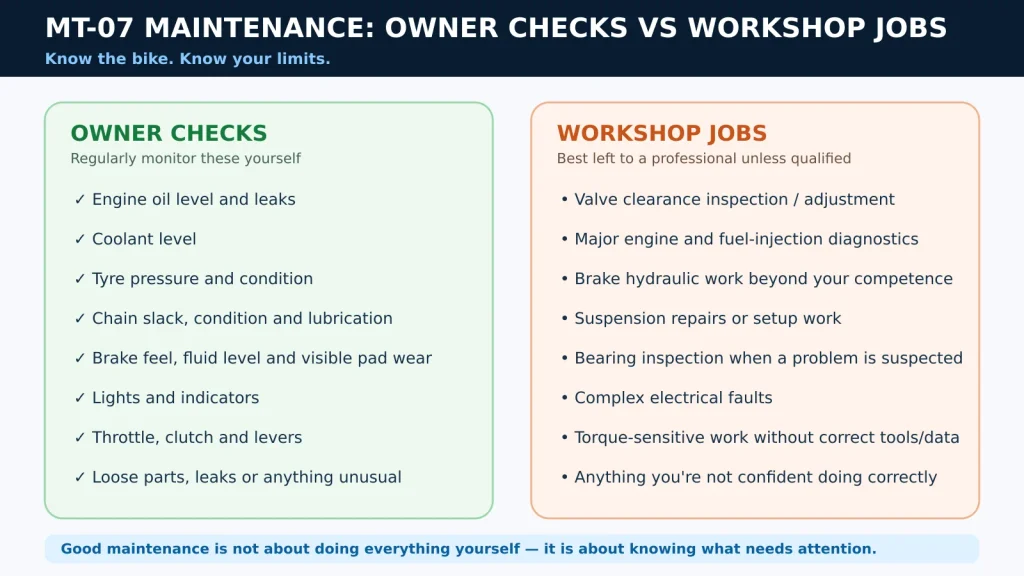
I don’t think motorcycle ownership requires becoming a mechanic.
But I do think being completely disconnected from the condition of your motorcycle is a bad habit.
These are the things I want to remain aware of between services.
Engine oil level
Check the level correctly and look for signs of leakage.
Coolant level
Know where the reservoir is and notice unexplained changes.
Tyre pressure and condition
Pressure, tread, damage and unusual wear.
Chain
Slack, condition, cleanliness and lubrication.
Brakes
Lever/pedal feel, visible pad condition where practical, fluid level and leaks.
Lights and indicators
Headlight, brake light, indicators and other basic electrical functions.
Controls
Throttle, clutch, levers and anything that suddenly feels different.
General leaks or loose components
You don’t need to diagnose everything.
You do need to notice when something changes.
This is where my Free Motorcycle Safety Checklist fits naturally.
A pre-ride check isn’t a substitute for servicing.
It’s the layer between services that helps you notice problems early.
What do I leave to a workshop?
My dividing line is fairly simple.
If a maintenance job requires specialist knowledge, accurate adjustment inside the engine, brake-system work I’m not confident doing, or diagnosis I can’t properly perform, I would rather use a competent workshop.
Examples include:
- valve-clearance inspection/adjustment;
- fuel-injection diagnosis and synchronisation;
- bearing inspection when a problem is suspected;
- major suspension work;
- brake hydraulic work beyond my competence;
- complex electrical faults;
- anything where I’m unsure enough that guessing creates a safety risk.
Could an experienced home mechanic perform some of these jobs?
Absolutely.
That’s not the same question.
The question is whether I can do them correctly.
There’s no prize for turning a straightforward maintenance job into an expensive repair because I was too proud to ask for help.
What about oil changes and basic DIY?
Oil and filter changes sit somewhere in the middle.
They’re common home-maintenance jobs.
So are some chain adjustments and simple consumable replacements.
But “common DIY” doesn’t mean “impossible to do incorrectly.”
You still need:
- the correct parts and fluids;
- the correct procedure;
- proper tools;
- correct tightening specifications;
- somewhere safe to work;
- correct disposal of used oil and other fluids.
I like gradually learning more about TITAN.
But I don’t think becoming a better motorcycle owner means doing every maintenance job personally.
Sometimes being a good owner means knowing exactly what you’re paying a professional to do.
My €650 major service: what did I learn?
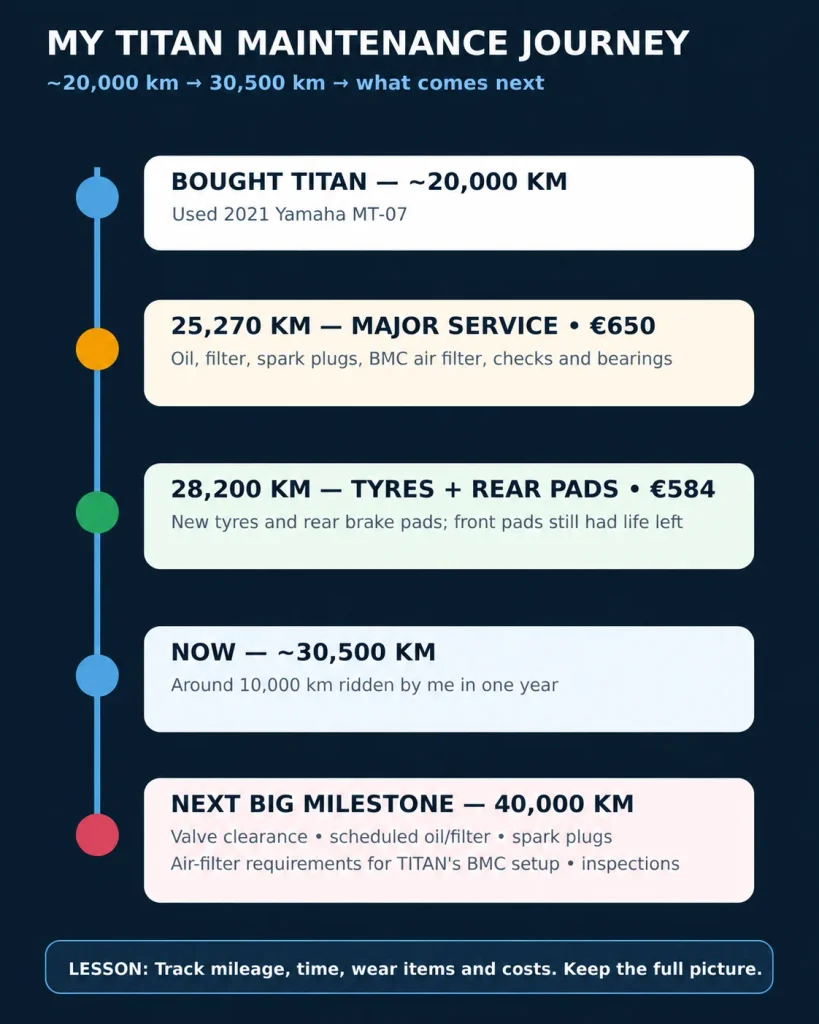
When TITAN went in at 25,270 km, the bill came to €650.
The service included items in my records such as:
- BMC air filter;
- spark plug work;
- engine oil;
- filters;
- general inspections;
- bearing-related checks;
- other maintenance work.
The most useful thing that service gave me wasn’t only fresh consumables.
It gave me a baseline.
I had bought TITAN used at close to 20,000 km.
After that larger service, I had a much clearer idea of where the motorcycle stood.
That’s something I’d budget for again when buying a used bike.
If the service history isn’t completely clear, a thorough inspection/service can buy peace of mind as much as it buys parts.
Then €584 arrived three months later
The other lesson came at 28,200 km.
New tyres.
Rear brake pads.
€584.
This happened despite having spent €650 on a major service only a few thousand kilometres earlier.
At first, that can feel frustrating.
Didn’t I just service the motorcycle?
Yes.
But tyres and pads don’t care when your last engine-oil change happened.
They’re separate wear systems.
That is one of the biggest things I’ve learned about motorcycle maintenance:
“Recently serviced” does not mean “nothing will need money for another year.”
A service schedule and wear-item condition overlap.
They’re not the same thing.
My maintenance approach after 30,500 km
At this point, I’m trying to follow a simple system.
1. Know the next scheduled milestone
For TITAN, 40,000 km is starting to become relevant because it includes some larger scheduled items such as valve-clearance inspection.
2. Watch wear items continuously
Tyres.
Brakes.
Chain.
Sprockets.
These don’t wait for a convenient service milestone.
3. Track time as well as mileage
Brake fluid.
Coolant.
Hoses.
A motorcycle that doesn’t travel huge distances still ages.
4. Keep records
Date.
Odometer.
Work performed.
Cost.
That makes future maintenance much easier to understand.
It’s also one reason I was able to calculate my actual first-year MT-07 running costs rather than estimating everything from memory.
5. Don’t wait for something to feel broken
Maintenance is cheaper and safer when it remains maintenance.
I’d rather notice deterioration before it becomes failure.
What does my next 10,000 km look like?
TITAN is currently at roughly 30,500 km.
That means the next phase takes me toward the 40,000 km milestone.
The things I’m thinking about include:
- routine oil servicing;
- chain and sprocket condition;
- brake condition;
- tyre wear;
- fluid age;
- the 40,000 km valve-clearance requirement;
- air-filter requirements for my specific BMC setup;
- the other inspections in Yamaha’s schedule.
I’m not replacing all of those things tomorrow.
I’m simply aware they’re coming.
That is probably the biggest difference between how I thought about maintenance before ownership and how I think about it now.
Maintenance used to be:
Something I dealt with when the motorcycle went to the garage.
Now it’s:
An ongoing picture of the motorcycle’s condition.
Is the MT-07 expensive to maintain?
Based on my first 10,000 km, I wouldn’t call TITAN especially complicated to maintain.
But I also wouldn’t describe motorcycle maintenance as cheap simply because the MT-07 has a reputation for simplicity.
I’ve spent:
€650 on a major service.
Then:
€584 on tyres and rear brake pads.
Those are real costs.
The more useful advantage of the MT-07, in my experience, is that the maintenance structure is understandable.
There are regular intervals.
There are predictable consumables.
And so far, my spending has mostly been related to servicing and wear rather than chasing mysterious mechanical problems.
That’s the kind of ownership experience I value.
The maintenance habit I would recommend most
If you’re a newer owner, you don’t need to memorise the entire manual.
Start with this:
Know five things
When was the last service?
What mileage is the next one?
How are the tyres and brakes?
What condition is the chain in?
How old are the important fluids?
If you can answer those questions, you’re already far more connected to your motorcycle than someone who simply waits for a warning light.
Then build from there.
FAQs
What are the Yamaha MT-07 service intervals?
For the 2021 MT-07 European schedule, Yamaha specifies an initial 1,000 km service followed by maintenance at 10,000 km intervals. From 50,000 km, the schedule repeats beginning with the 10,000 km interval.
How often should engine oil be changed on a 2021 MT-07?
Yamaha’s schedule calls for engine-oil changes at the initial 1,000 km service and at the subsequent 10,000 km mileage intervals.
How often should the MT-07 oil filter be changed?
The 2021 schedule shows oil-filter replacement at 1,000 km, then 20,000 km and 40,000 km within the displayed schedule.
How often should brake fluid be changed?
Yamaha specifies replacing brake fluid every two years for the 2021 MT-07.
When are MT-07 spark plugs replaced?
The 2021 Yamaha schedule replaces the spark plugs at the 20,000 km intervals, with intermediate inspection/adjustment.
When does the MT-07 need a valve-clearance check?
For the 2021 MT-07, Yamaha specifies checking and adjusting valve clearance every 40,000 km.
How often should I lubricate the MT-07 chain?
Yamaha specifies checking and servicing the drive chain every 1,000 km, and after washing the motorcycle or riding in rain or wet conditions.
How often is coolant replaced?
The Yamaha maintenance schedule specifies coolant replacement every three years.
Related Reads
Continue the MT-07 ownership series:
What Does a Yamaha MT-07 Cost to Own in the Netherlands?
Living With a Yamaha MT-07: My 10,000 km Ownership Guide