Fuel economy wasn’t one of the main reasons I bought my Yamaha MT-07.
But after roughly 10,000 km with TITAN, it has become one of the things I appreciate about owning it.
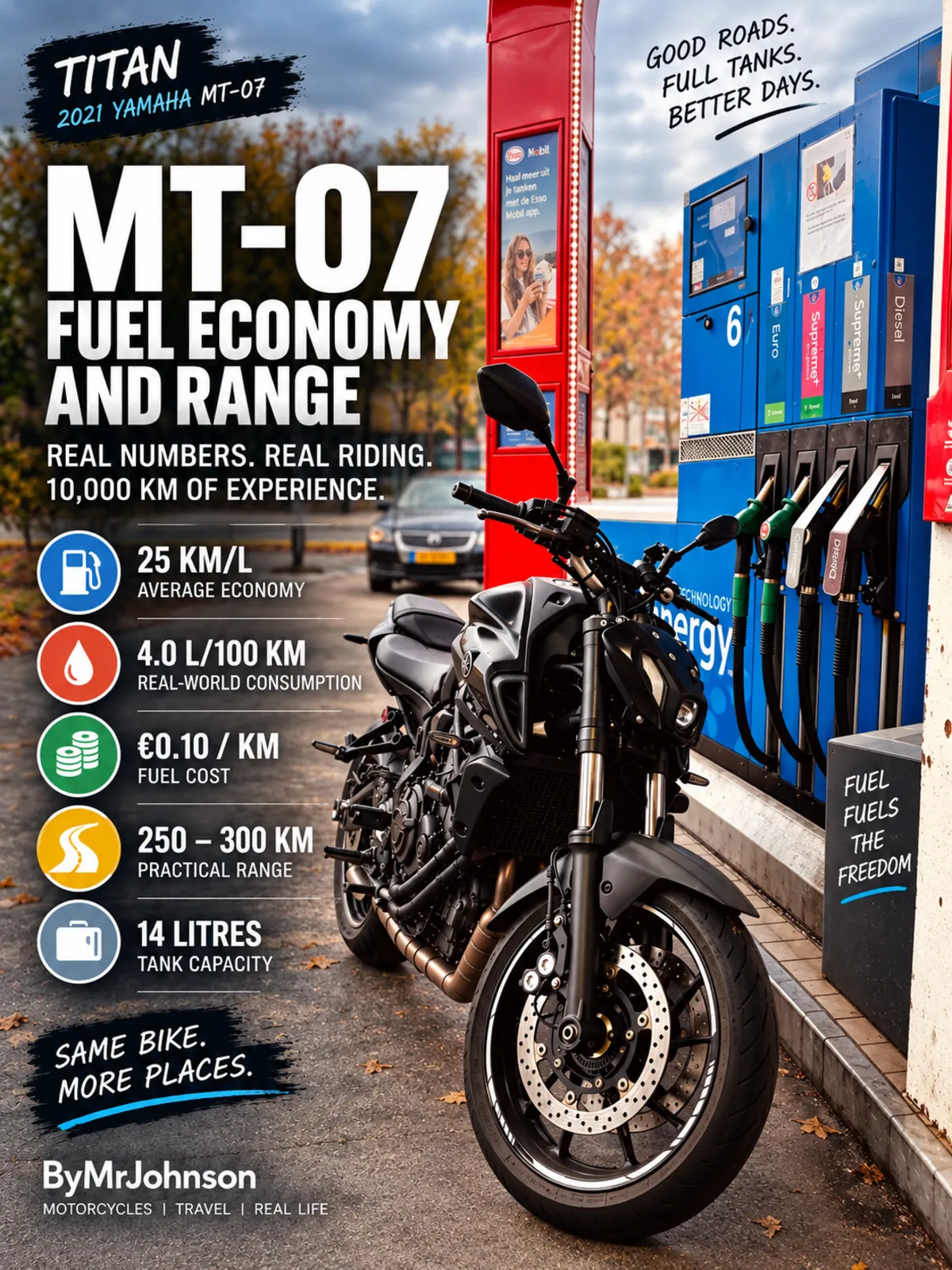
My 2021 MT-07 gives me enough performance to make ordinary rides entertaining, yet my real-world fuel economy has been around:
25 km/L
That’s approximately:
4.0 L/100 km
Across roughly 10,000 km, I’ve spent around:
€998 on fuel
Which works out to almost exactly:
€0.10 per kilometre
or:
€9.98 per 100 km
Those numbers make fuel use much easier to understand than simply saying the MT-07 is “economical.”
So let’s look at what they mean in actual ownership.
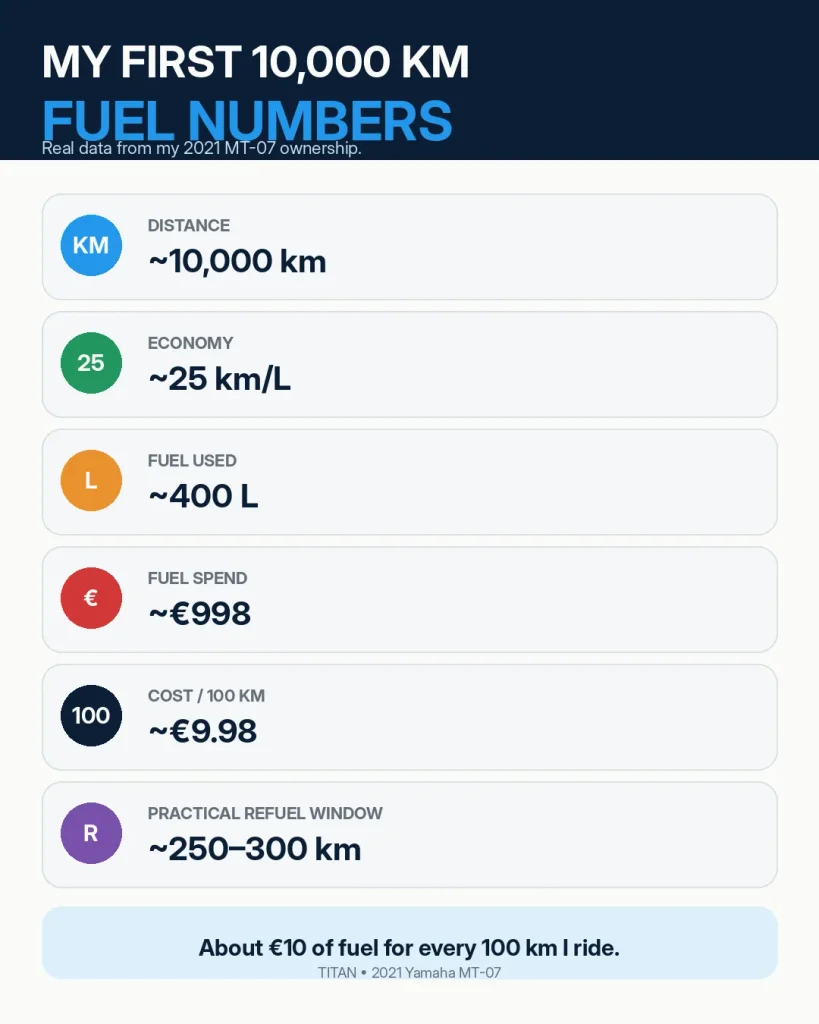
My MT-07 fuel numbers at a glance
| Field | My 2021 Yamaha MT-07 |
|---|---|
| Distance covered | ~10,000 km |
| Average economy | ~25 km/L |
| Equivalent consumption | ~4.0 L/100 km |
| Fuel tank capacity | 14 L |
| Fuel used across 10,000 km | ~400 L |
| Total fuel cost | ~€998 |
| Average cost per kilometre | ~€0.10 |
| Average cost per 100 km | ~€9.98 |
| Theoretical range at 25 km/L | ~350 km |
| Range I would actually plan around | roughly 250–300 km |
Yes, the maths says 350 km.
No, that doesn’t mean I plan every ride around arriving at the petrol station with fumes left in the tank.
How does my fuel economy compare with Yamaha’s figure?
Yamaha lists official fuel consumption for the 2021 MT-07 at:
4.2 L/100 km
That’s equivalent to approximately:
23.8 km/L
My real-world figure has been around:
4.0 L/100 km
or:
25 km/L
So my experience has been very close to Yamaha’s official number.
I like that.
Fuel-economy claims can sometimes feel disconnected from how a vehicle actually gets used.
In my case, the difference isn’t dramatic.
TITAN has simply been reasonably consistent with what the specification sheet suggests.
Of course, that doesn’t mean every MT-07 owner will see 25 km/L.
How you ride matters.
Where you ride matters.
Traffic matters.
Weather matters.
Speed matters.
And modifications, luggage and riding style can all influence consumption.
My number is exactly that:
my number.
What does 25 km/L actually mean?
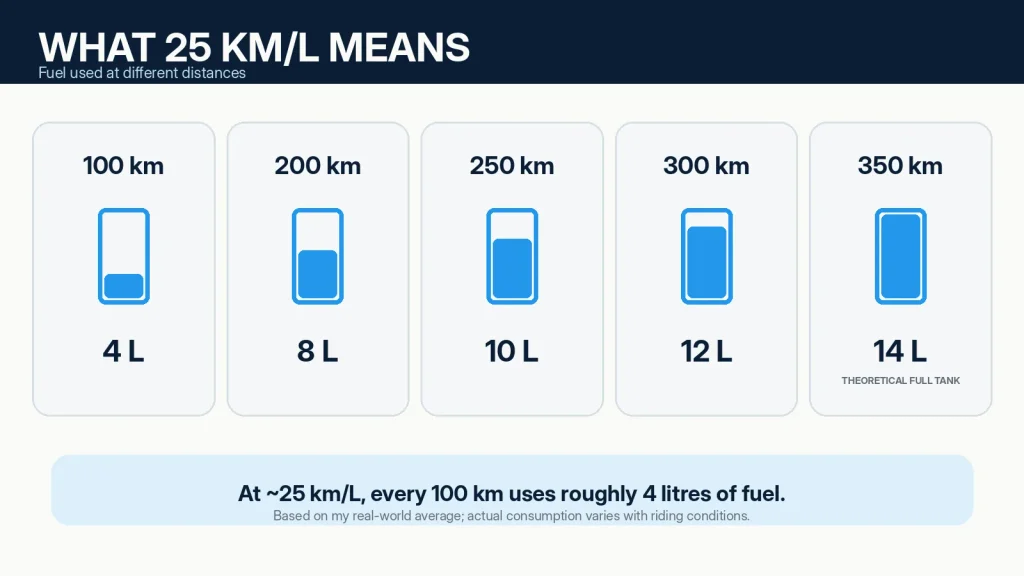
I find km/L easier to understand if I turn it into actual rides.
At roughly 25 km per litre:
100 km uses about 4 litres
200 km uses about 8 litres
250 km uses about 10 litres
300 km uses about 12 litres
350 km would theoretically use the full 14 litres
That makes the MT-07’s fuel use relatively easy to plan.
If I’m heading out for a 200 km ride with plenty of fuel in the tank, I’m not particularly worried about range.
Once a ride starts moving toward 250–300 km without a refill, fuel becomes something I’m more conscious of.
And that’s why I think 250–300 km is the more useful real-world planning number for me.
Not 350 km.
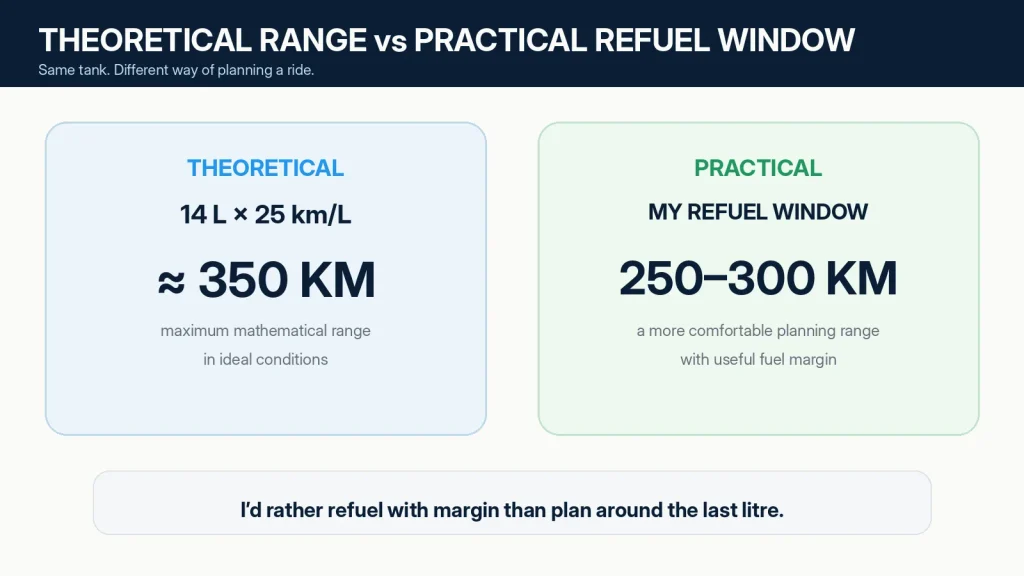
Theoretical range: around 350 km
The 2021 MT-07 has a 14-litre fuel tank.
At my average:
14 L × 25 km/L =
350 km
That’s the theoretical calculation.
Yamaha’s own official 4.2 L/100 km figure would imply roughly:
333 km
from 14 litres.
So a rough 330–350 km theoretical range makes sense on paper depending on consumption.
But a theoretical tank range is not the same as a sensible riding range.
I don’t want my fuel strategy to depend on using every last usable drop.
Traffic changes.
Wind changes.
Motorway speed changes.
Fuel stations aren’t always exactly where you want them.
And concentrating on whether you’re going to run out of fuel isn’t exactly improving a motorcycle ride.
My more realistic planning range: 250–300 km
This is the range I find much more useful.
At 25 km/L:
250 km = around 10 litres
That leaves a reasonable amount of fuel in a 14-litre tank.
At:
300 km = around 12 litres
you’re naturally getting closer to the point where I’d rather find fuel than keep experimenting with the remaining range.
That doesn’t mean TITAN suddenly stops at kilometre 301.
It’s simply the difference between:
How far could the motorcycle theoretically go?
and:
When would I rather refuel?
For everyday ownership, the second question matters more.
Most of my fills are nowhere near 14 litres
Looking back through my fuel records, many of my individual fills are around the 9–12 litre area rather than a full 14 litres.
That makes sense.
I don’t normally run TITAN completely empty before stopping for fuel.
And I wouldn’t recommend treating tank capacity as a target.
The useful approach is simply knowing roughly how much range you’ve normally got and topping up when it fits the ride.
Motorcycling is much more enjoyable when the fuel gauge isn’t creating unnecessary stress.
What does fuel cost me per 100 km?
My first 10,000 km cost approximately:
€998 in fuel
Divide that by 100 blocks of 100 km:
€998 ÷ 100 =
€9.98 per 100 km
That’s probably my favourite number from the fuel log.
Why?
Because I can immediately apply it to a ride.
100 km ride
Approximately:
€10
200 km ride
Approximately:
€20
300 km ride
Approximately:
€30
500 km weekend
Approximately:
€50
Obviously fuel prices change, so those aren’t permanent guarantees.
But as a personal budgeting shortcut, they’re extremely useful.
At my current riding pattern:
Every 100 km costs me roughly €10 in fuel.
That’s easy to remember.
Around €0.10 per kilometre
The same calculation gives:
€998 ÷ 10,000 km =
€0.0998/km
So essentially:
10 cents per kilometre
in fuel.
Again, that’s fuel only.
It doesn’t include:
- insurance;
- road tax;
- tyres;
- servicing;
- brake pads;
- chain maintenance;
- depreciation;
- gear.
My first-year MT-07 running-cost breakdown shows why the actual cost of motorcycle ownership is much higher than simply the fuel going into the tank.
But for planning a ride, €0.10/km is a useful little number.
How much fuel did 10,000 km use?
At roughly 25 km/L:
10,000 km ÷ 25 km/L =
400 litres
That sounds like a lot when you see it in one number.
But spread across an entire year, it arrives in relatively small amounts.
Ten litres.
Another ten litres.
Maybe twelve.
Then another fill a week or two later depending on how much I’m riding.
That’s partly why fuel never felt like my biggest motorcycle expense.
The larger maintenance bills were much more noticeable.
A €25 petrol stop disappears psychologically much faster than a €650 workshop invoice.
But over a full year:
€998 is still real money.
Tracking it makes that visible.
Why I often use 98-octane fuel
If you’ve seen my fuel log, you’ll notice names such as:
- Esso Supreme+ 98;
- Shell V-Power RON 98;
- BP Ultimate;
- TotalEnergies 98.
That’s what I’ve often chosen to use in TITAN.
I wouldn’t turn that into a recommendation that every MT-07 owner should automatically buy the most expensive premium fuel available.
Fuel requirements can vary by market and model specification, so the correct reference is always the owner’s manual for your exact motorcycle.
The important distinction here is:
My fuel log reflects what I actually bought—not necessarily the cheapest way somebody could run an MT-07.
That also means another rider’s cost per kilometre could be lower even with identical fuel economy.
What changes MT-07 fuel economy?
My ~25 km/L figure is an average rather than something I expect to see every single tank.
Several things can shift it.
Riding speed
Higher sustained speeds generally require more energy to overcome aerodynamic drag.
And on a naked motorcycle like the MT-07, motorway riding makes aerodynamics fairly obvious.
Throttle use
A smooth ride and an enthusiastic ride aren’t necessarily going to consume fuel at exactly the same rate.
The CP2 engine makes acceleration fun.
Repeatedly using that acceleration has a cost.
Traffic
Stop-start riding changes the pattern completely compared with steady open-road riding.
Amsterdam gives me plenty of opportunities to discover that.
Wind
A strong headwind can make the motorcycle work harder even though the speedometer hasn’t changed.
Luggage and passenger load
Extra load and aerodynamic bulk can influence consumption.
Tyre pressure and motorcycle condition
Fuel consumption is another reason basic maintenance matters.
Correct tyre pressures and a motorcycle running properly are useful for more than just chasing an economy number.
If you’re interested in that side of ownership, I’ve put the service intervals and owner checks into my MT-07 maintenance guide.
City riding versus weekend riding
My fuel figure isn’t based on one type of ride.
TITAN gets used during weekdays and on weekend getaways.
That’s important because I don’t think quoting an extraordinary “best-ever tank” is particularly useful.
If I rode gently on one perfect road under perfect conditions, I could probably produce a number that looked impressive.
But that wouldn’t describe my motorcycle ownership.
I’m more interested in:
What does the bike average across the kind of riding I actually do?
For me, that’s around:
25 km/L
And I’m happy with it.
Should you chase maximum fuel economy on an MT-07?
Personally, no.
I don’t want to turn every ride into an economy challenge.
Fuel economy matters because it affects cost and range.
But I bought the motorcycle to enjoy riding it.
There’s little point saving a tiny amount of petrol if doing so makes every ride feel like an efficiency experiment.
My goal is simpler:
Ride smoothly.
Maintain the motorcycle properly.
Avoid unnecessary waste.
And accept that sometimes I’m going to enjoy the CP2 engine.
That’s part of why TITAN exists.
Range anxiety isn’t really an issue for my riding
With a sensible usable planning range somewhere around 250–300 km, I don’t find the MT-07 particularly difficult to live with.
For normal weekday riding, fuel stops aren’t a major concern.
For weekend rides, the range is usually long enough that I naturally want a break somewhere within the same general window anyway.
That’s another useful way to think about motorcycle range.
My body and concentration may want a break before the motorcycle absolutely needs fuel.
So on a longer ride, stopping somewhere around that point isn’t exactly a hardship.
Fuel.
Drink.
Stretch.
Then continue.
Would I want a bigger tank?
For the way I currently ride?
Not particularly.
A larger tank would obviously extend range.
But it would also add size and weight when full.
For my combination of Amsterdam riding and weekend getaways, the existing 14 litres feels like a reasonable compromise.
If I were regularly riding huge distances through areas with very limited fuel availability, I’d think differently.
But that’s not my normal use.
Again, the question isn’t:
Is 14 litres good or bad?
It’s:
Does 14 litres work for the way I actually ride?
For me, yes.
What my fuel log has taught me
Before recording fuel consistently, I mostly thought about petrol in terms of individual fills.
€23.
€25.
€27.
Done.
Tracking it over 10,000 km changes the perspective.
Now I know that:
- TITAN averages roughly 25 km/L for me;
- 10,000 km requires around 400 litres;
- that fuel cost me around €998;
- fuel therefore costs roughly €0.10/km;
- a 300 km ride is roughly a €30 fuel day;
- and I can comfortably think about refuelling somewhere in the 250–300 km region rather than trying to maximise every tank.
Those are useful ownership numbers.
Not because everybody else’s MT-07 will match them.
Because I now understand my own motorcycle better.
Is the MT-07 fuel efficient?
For the performance it gives me, I’d say yes.
The official Yamaha number for the 2021 MT-07 is 4.2 L/100 km.
I’m seeing around 4.0 L/100 km.
That’s enough efficiency that fuel hasn’t become something I resent paying for.
And at the same time, TITAN still feels like a motorcycle I ride for fun rather than an appliance built around economy.
That’s a combination I appreciate more after 10,000 km than I did when I bought it.
My practical MT-07 fuel rule
If I had to reduce this entire article to one simple rule, it would be:
25 km/L. About €10 per 100 km. Start thinking about fuel somewhere around 250–300 km.
That’s not a laboratory result.
It’s not a promise.
It’s simply the practical mental model I’ve developed from a year of riding TITAN.
And for everyday ownership, that’s far more useful to me than knowing the absolute maximum distance I could theoretically squeeze out of a tank.
FAQs
What fuel economy do I get from my Yamaha MT-07?
My 2021 Yamaha MT-07 averages roughly 25 km/L, equivalent to approximately 4.0 L/100 km, across my mixture of weekday riding and weekend getaways.
What is Yamaha’s official MT-07 fuel consumption?
Yamaha lists the 2021 MT-07 at 4.2 L/100 km, equivalent to around 23.8 km/L.
How far can an MT-07 travel on a tank?
At my roughly 25 km/L average, 14 litres mathematically works out to approximately 350 km.
I don’t plan rides around using every litre, however. For my riding, I consider roughly 250–300 km a more useful window for thinking about refuelling.
How much did I spend on fuel over 10,000 km?
Approximately €998.
That’s roughly €9.98 per 100 km, or essentially €0.10/km.
How much fuel does an MT-07 use over 10,000 km?
At approximately 25 km/L, around:
400 litres.
Is my MT-07 more economical than Yamaha’s official figure?
Slightly, based on my current average. Yamaha lists 4.2 L/100 km while I’m seeing around 4.0 L/100 km. The difference is small enough that I would describe my real-world consumption as broadly consistent with Yamaha’s official figure.
Does every MT-07 get 25 km/L?
No. Riding style, road type, speed, weather, load, motorcycle condition and other factors can change fuel consumption.
Related Reads
Continue the MT-07 ownership series:
What Does a Yamaha MT-07 Cost to Own in the Netherlands?
Yamaha MT-07 Maintenance: Service Intervals and Checks Owners Should Know