The Yamaha MT-07 is good at a lot of things.
Carrying your stuff isn’t really one of them.
There is no useful built-in storage.
A bottle of water, rain layer, lock, camera equipment, spare gloves or weekend clothes immediately creates another question:
Where exactly am I putting all of this?
For short rides, it’s easy to ignore.
Use a backpack.
Carry less.
Done.
But as I’ve spent more time using TITAN for normal weekday riding around Amsterdam and weekend getaways, I’ve started thinking more carefully about luggage.
Not:
“What’s the biggest luggage system I can bolt onto an MT-07?”
But:
“What am I actually trying to carry?”
That’s a much better starting point.
Because someone commuting with a laptop needs a different solution from someone going away for three days.
Someone carrying rain gear needs less space than someone carrying camping equipment.
And someone who wants completely removable luggage probably shouldn’t build the same setup as someone who wants permanent lockable storage.
So this guide isn’t about finding one “best MT-07 luggage system.”
It’s about choosing the least complicated setup that solves the way you actually ride.
Where TITAN currently stands
Luggage isn’t part of TITAN’s permanent modification setup right now.
My 2021 MT-07 is mainly used for:
weekday riding
and:
weekend getaways
That means I don’t want to permanently turn the bike into something it’s not.
I like the relatively compact, simple nature of the MT-07.
So any luggage setup I choose needs to preserve that as much as possible.
That is also the philosophy behind my complete MT-07 everyday setup and the MT-07 accessories I think are actually worth considering.
The luggage should support the motorcycle.
Not take over the motorcycle.
Start with what you’re carrying
Before choosing the bag, I’d answer one question:
What’s going inside it?
That sounds almost too simple.
But it changes everything.
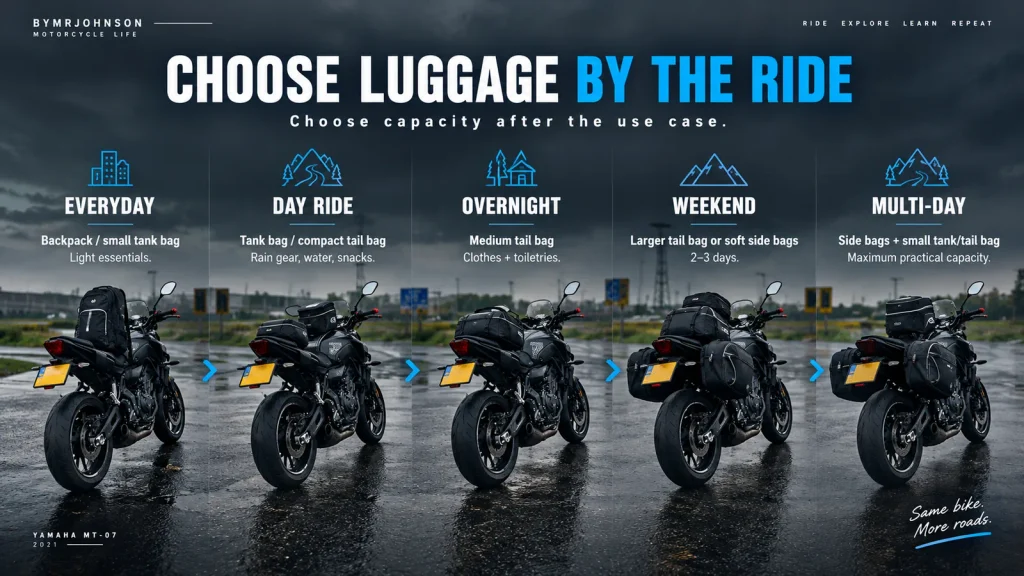
| Riding situation | What I would consider first |
|---|---|
| Phone, wallet, keys, small items | Small tank bag |
| Rain layer + small everyday items | Tank bag or compact tail bag |
| Work commute with more gear | Tail bag or top box |
| One-night trip | Medium tail bag |
| Weekend trip | Larger tail bag or side bags |
| Multi-day travel | Side bags + small tank/tail bag |
| Regular passenger + luggage | Side bags / top box become more attractive |
| Occasional luggage only | Removable soft luggage |
That’s much more useful to me than starting with litres.
The amount of space should come after the use case.
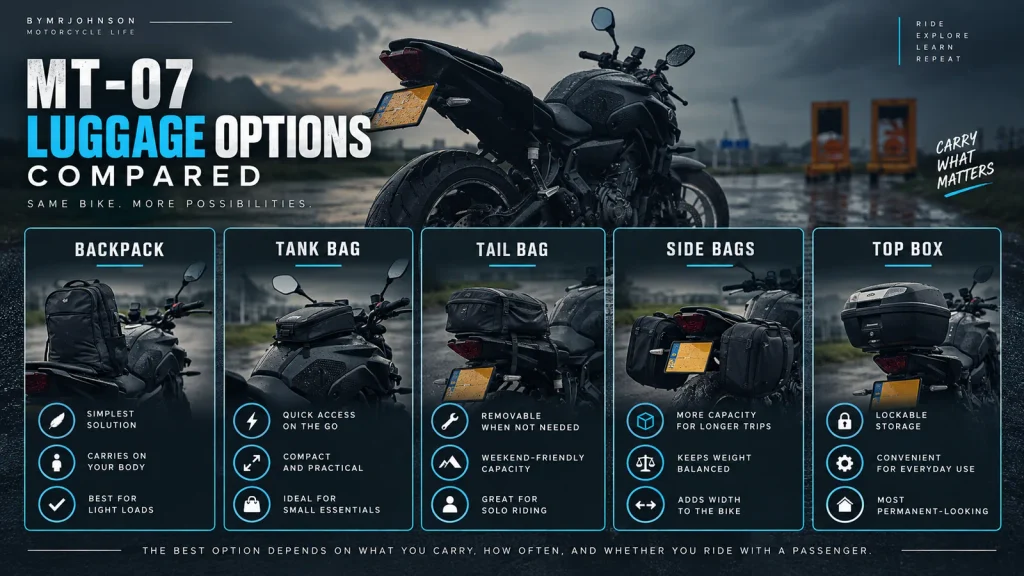
Option 1: backpack — the simplest solution
A backpack requires almost nothing from the motorcycle.
Put it on.
Ride.
Take it with you when you park.
No racks.
No brackets.
No installation.
No change to TITAN’s appearance.
That’s why I think a backpack remains perfectly sensible for light everyday loads.
If all I need is:
- a small rain layer;
- water;
- a few personal items;
- maybe basic work or camera equipment;
then there’s no need to engineer a luggage system simply because luggage systems exist.
Where backpacks start making less sense
The problem appears when the load becomes heavier or the ride becomes longer.
Weight sitting on my shoulders for several hours is very different from carrying the same weight on the motorcycle.
And once a backpack becomes large enough that I’m stuffing everything into it, I’ve probably reached the point where motorcycle-mounted luggage deserves consideration.
So my rule would be:
Light and short? Backpack can be fine.
Heavy or long? Let the motorcycle carry more of it.
Option 2: tank bag — excellent for things you want close
A small tank bag is one of the luggage types I find easiest to understand.
It’s best for items I might actually want during the ride or immediately after stopping.
Phone.
Wallet.
Power bank.
Earplugs.
Visor cleaner.
Small camera.
Snacks.
Documents.
Things that don’t need 30 litres of space.
Why a small tank bag suits the MT-07 idea
A tank bag keeps luggage relatively close to the motorcycle’s centre.
It doesn’t dramatically change the rear of the bike.
And you can keep the size modest.
For the 2021–2024 MT-07, Givi currently lists a bike-specific BF60 mounting flange and a compatible 6 L ST611 tank bag, as one example of how model-specific ring-mounted systems can be fitted.
That’s useful to know even if you ultimately choose another brand.
The important part is:
check the mounting system for your exact model year.
Don’t assume every “universal MT-07 tank bag” attaches the same way.
What I wouldn’t put in a tank bag
Heavy equipment.
Huge cameras.
A week’s clothes.
Anything so bulky that it interferes with steering or controls.
The 2021 owner’s manual explicitly warns that luggage or accessories must not interfere with steering travel, controls, lights or other motorcycle functions.
The tank bag should make the ride simpler.
If it’s getting in my way, I’ve chosen the wrong solution.
Option 3: tail bag — probably the most natural weekend solution
For the way I currently use TITAN, this is the luggage category I find particularly interesting.
A tail bag can add useful capacity without permanently installing large hard cases.
Strap it securely to the passenger seat or a suitable rack.
Use it for the trip.
Remove it afterwards.
The motorcycle goes back to normal.
That fits my ownership philosophy well.
Why a tail bag works for weekend rides
The passenger seat gives you an obvious area to carry luggage when you’re riding solo.
And tail bags exist across a huge range of capacities.
A smaller one can handle:
- spare gloves;
- rain gear;
- water;
- tools;
- an extra layer.
A larger one can move into proper weekend-trip territory.
As one researched example, SW-Motech currently offers a bike-specific rack and tail-bag package for the 2021 MT-07 with a 32–42 L expandable bag.
It simply shows that a useful 30–40 L weekend capacity is commercially available without moving straight into hard panniers.
Soft tail bag versus rack-mounted tail bag
There are really two approaches.
Direct-to-seat
Simpler.
Cheaper.
More removable.
But you need to make absolutely sure the straps are secure and nothing can reach the wheel, chain, exhaust or moving parts.
Rack-supported
More hardware.
More cost.
But usually gives the luggage a more stable, purpose-built platform.
This is another case where the answer depends on frequency.
If I needed luggage twice a year, I might tolerate more setup each time.
If I used it every week, I’d value convenience much more.
Option 4: side bags — better when capacity starts growing
Side bags make more sense once one bag on the passenger seat stops being enough.
The advantage is obvious.
Capacity goes up without stacking everything vertically.
You can also distribute the load between both sides.
That matters because Yamaha’s 2021 owner’s manual specifically recommends keeping cargo low and close to the motorcycle, with heavier items near the centre and weight distributed as evenly as possible.
That’s good luggage advice regardless of brand.
How much space can side bags provide?
As one current compatibility example, Givi lists its TE2140 side-bag supports for the 2021–2024 MT-07 along with expandable 25 + 25 L side bags.
That’s 50 litres total before adding anything else.
SW-Motech also lists bike-specific side carriers for the 2021 MT-07, with compatible options ranging from roughly 13.5 L soft bags to larger waterproof or ABS cases depending on the system.
The downside: width
Side luggage changes how wide the motorcycle is.
That’s a significant consideration for an MT-07 used around a city.
The motorcycle itself is relatively compact.
Large side bags reduce that advantage.
So I’d ask:
Do I need this capacity often enough to accept the extra width?
For long-distance trips?
Maybe.
For every weekday ride around Amsterdam?
Probably less compelling for the way I use TITAN.
Soft side bags versus hard panniers
I think this comes down to priorities.
Soft luggage
Usually:
- lighter;
- easier to remove;
- less visually dominant;
- flexible when packing;
- often cheaper.
But it generally offers less theft resistance and may depend more heavily on liners or waterproof construction.
Hard luggage
Usually gives:
- better structure;
- more convenient opening;
- stronger weather resistance;
- better lockability;
- easier repeated daily use.
But it adds:
- weight;
- mounting hardware;
- width;
- more permanent visual bulk.
I wouldn’t choose based on which one looks more “adventure-ready.”
I’d choose based on what problem I’m trying to solve.
Option 5: top box — possibly the most practical, and the least subtle
The top box is interesting because it may be the least glamorous luggage solution in the article…
and potentially one of the most useful.
For commuting, it has obvious advantages.
Lockable storage.
Weather protection.
Quick access.
Leave the mounting hardware on the motorcycle and use the box when needed.
You can also carry something to your destination and leave the motorcycle without carrying the bag around with you.
That’s genuinely useful.
Why I haven’t automatically decided I need one
Because practicality isn’t the only thing I care about.
I like the way TITAN looks.
A large box mounted behind the passenger seat changes that appearance significantly.
That’s not an argument against top boxes.
It’s simply part of the decision.
The same item can be:
perfect for somebody else’s use
and:
more luggage than I currently need.
The rack limit matters more than the box size
This is where luggage buying gets slightly more technical.
A 47-litre top case does not mean you can simply fill it with 47 litres of the heaviest objects you own.
The supporting rack has its own load limit.
For example, Givi currently lists its MT-07 2021–2024 2140FZ rear rack with a maximum permitted load of 6 kg, even though the system can be paired with much larger-volume cases.
That is a perfect illustration of:
Volume and permissible weight are not the same thing.
Always check the limit of the actual rack, plate, box and motorcycle.
The motorcycle itself also has a load limit
This is one of the most important parts of the article.
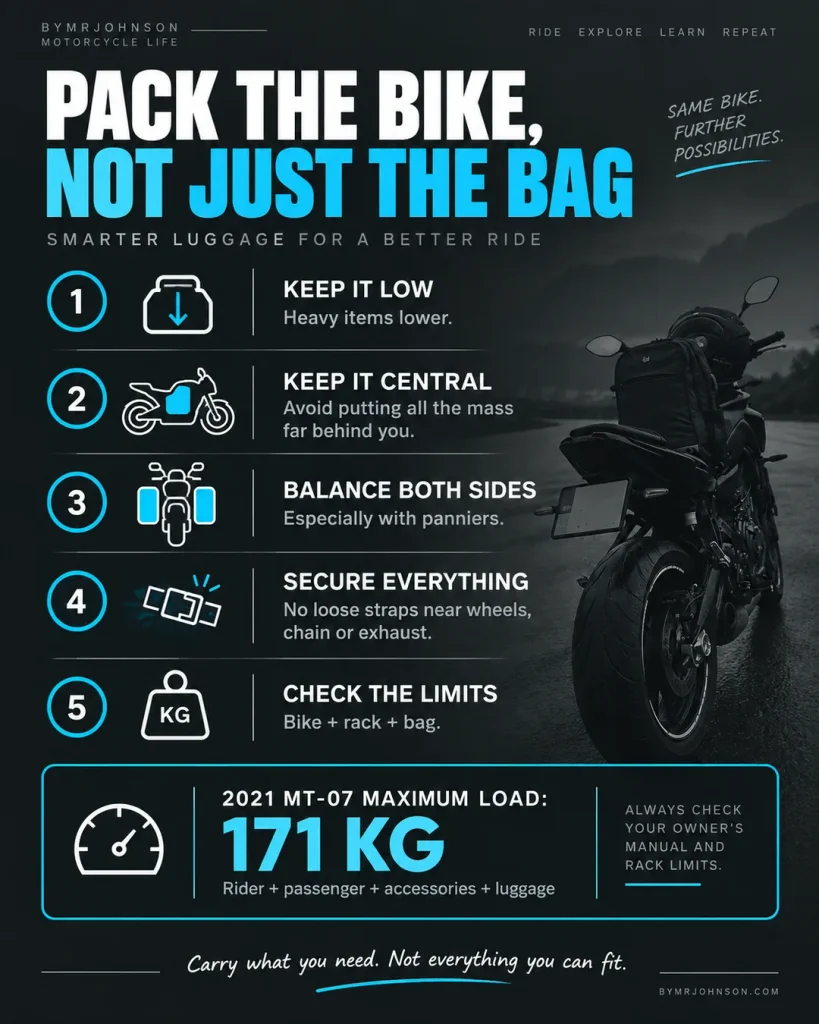
Yamaha’s 2021 MT-07 manual specifies a maximum vehicle load of 171 kg.
And that isn’t 171 kg of luggage.
It is the combined total of:
rider + passenger + cargo + accessories.
That distinction matters.
Especially if you are:
- carrying a passenger;
- fitting racks and hard cases;
- filling those cases;
- adding other accessories.
All of that counts.
How Yamaha says luggage should be loaded
The manual’s guidance is very sensible.
Keep luggage:
low
close to the motorcycle
balanced between the sides
securely attached
and place heavier items as close to the motorcycle’s centre as possible.
Yamaha also advises checking cargo restraints and accessory mounts regularly because shifting weight can suddenly affect balance.
Heavy things go low and central
This is probably the packing rule I want to remember most.
If I have:
- tools;
- locks;
- liquids;
- heavy camera gear;
I don’t want all of that sitting as high and as far behind me as possible.
A motorcycle already responds noticeably to changes in weight.
Put that weight high and far from the centre and you’ll notice it even more.
So I would use the biggest luggage spaces for volume, not automatically for the heaviest objects.
Waterproof and water-resistant are not the same thing
If I’m packing:
- clothes;
- electronics;
- documents;
then “mostly keeps the rain out” may not be good enough.
There are several ways luggage handles water.
Some bags use waterproof construction.
Some use internal waterproof liners.
Some need external rain covers.
Some are only intended to resist light showers.
I would check the actual manufacturer’s wording instead of assuming a textile motorcycle bag is waterproof because it looks rugged.
Rain covers have their own annoyance
They’re useful.
But they also become another thing to:
- store;
- fit when rain starts;
- secure;
- dry afterwards.
A genuinely waterproof roll-top or waterproof-inner-bag setup may be simpler for frequent wet-weather use.
This isn’t something I’d decide purely from a product photo.
Security changes with luggage type
Soft luggage is convenient partly because it’s easy to remove.
That also means I wouldn’t leave expensive equipment inside and assume the bag itself provides meaningful security.
Hard cases generally offer more resistance to casual access.
But even a locked top case isn’t a bank vault.
So if I’m carrying:
- passport;
- phone;
- wallet;
- camera;
- expensive electronics;
I still think carefully about what stays on the motorcycle when I walk away.
What about carrying a laptop?
This is where commuting becomes very personal.
A laptop creates three questions.
Is it protected from impact?
Is it protected from rain?
Can I take it with me quickly after parking?
A backpack answers that naturally.
A top box can be very convenient.
A padded tail bag could work.
Side luggage could work.
The “best” option depends on what else you’re carrying and how often.
That’s why generic luggage recommendations are so difficult.
Passenger riding changes everything
If you’re riding with a passenger, using the passenger seat as luggage space is obviously no longer an option.
That’s when:
- top boxes;
- racks;
- side luggage;
become much more relevant.
It also means your available payload is being used by both the passenger and the luggage.
Remember the MT-07’s 171 kg maximum load includes both.
That’s something I’d calculate before packing rather than after.
What luggage would I choose for TITAN?
For my current riding, I don’t think I need one permanent answer.
I’d think in three levels.
Everyday / short ride
Very little luggage.
A small backpack or small tank bag is probably enough.
I don’t want to bolt a huge storage system onto the motorcycle to carry a bottle of water.
Longer day / light overnight
A medium tail bag makes a lot of sense to me.
Enough space for clothes, rain gear and essentials.
Still removable.
Still reasonably simple.
Proper weekend or multi-day trip
This is where I would consider a larger tail bag or side luggage.
If the amount I’m carrying begins forcing me to stack things badly or overload one bag, moving the weight into a better luggage system becomes the sensible choice.
What I would probably not do first
I wouldn’t immediately fit:
Maximum-capacity panniers
before taking any trips.
A huge top box
before discovering whether I actually need permanent storage.
Multiple luggage systems at once
because a YouTube touring build used them.
Cheap universal straps without thinking about routing
because anything close to the rear tyre, chain or exhaust deserves attention.
Heavy luggage mounted as far rearward as possible
simply because there is space there.
The right luggage setup should feel boringly secure.
That’s a compliment.
Model compatibility really matters
A luggage product saying:
“Fits motorcycles”
isn’t enough for me.
The 2021 MT-07 has specific luggage hardware available from major manufacturers.
Givi lists model-specific tank-bag, side-bag and rear-rack fittings for 2021–2024 bikes.
SHAD currently lists both top-case and side-bag hardware compatible with the 2021 MT-07.
SW-Motech likewise lists bike-specific rack and side-carrier systems for the 2021 model.
That tells me there is no reason to guess.
If I’m buying mounting hardware, I want confirmation for:
2021 Yamaha MT-07
not merely:
Yamaha MT-07
because generations differ.
My Akrapovič exhaust adds another compatibility check
TITAN isn’t completely standard.
He has an Akrapovič Titanium exhaust.
That means I wouldn’t assume every luggage system designed around a completely stock MT-07 automatically clears every component on my motorcycle.
This principle applies to any modified bike.
Before buying side bags, racks or mounting frames:
check the actual motorcycle.
Exhaust.
Indicators.
Tail tidy.
Rear lighting.
Passenger pegs.
Existing accessories.
A product can be compatible with a stock 2021 MT-07 and still conflict with something else you’ve changed.
Luggage can affect how the bike feels
A loaded MT-07 will not feel exactly like an unloaded MT-07.
More mass affects:
- low-speed balance;
- braking;
- acceleration;
- suspension behaviour;
- direction changes.
And if the luggage is wide, you also need to remember that the back of the motorcycle may now be wider than the handlebars.
None of that makes luggage dangerous.
It means the motorcycle has changed.
So I’d give myself a few minutes to adjust before riding a heavily packed bike like nothing happened.
Pack the bike, then test it
Before heading onto the motorway or leaving for a weekend trip, I’d rather do a short ride close to home.
Check:
Does anything move?
Do straps loosen?
Does the luggage touch anything?
Can I turn the bars completely?
Are the indicators visible?
Can the suspension move freely?
Does the motorcycle feel noticeably different?
Then stop.
Check everything again.
The first motorway exit is not the ideal place to discover a strap is slowly working loose.
My luggage hierarchy for the MT-07
If I were building TITAN’s luggage setup today, I’d probably progress like this:
Small everyday need → tank bag / backpack
Day trip or overnight → tail bag
Regular commuting with equipment → top box becomes interesting
Multi-day trips → larger tail bag or side luggage
Passenger + longer travel → racks / side luggage / top-case combination deserves consideration
That order keeps the system proportional to the problem.
Which is exactly what I want.
Do I want to turn TITAN into a touring bike?
No.
But that doesn’t mean I can’t travel on him.
I think there’s an important difference between:
making an MT-07 better at carrying luggage
and:
trying to turn an MT-07 into a completely different category of motorcycle.
The first makes sense.
The second can become expensive very quickly.
If my riding eventually changes enough that I need:
- huge luggage capacity;
- much more weather protection;
- two-up long-distance comfort;
- long motorway days;
then maybe the answer isn’t another accessory.
Maybe it’s eventually another type of motorcycle.
I don’t see that as admitting the MT-07 failed.
It means choosing the right tool for the job.
What I would prioritise in an MT-07 luggage system
Not capacity.
Not looks.
Not brand.
My order would be:
Secure mounting
Nothing moves.
Correct compatibility
It fits the actual motorcycle.
Sensible capacity
Enough space, not automatically maximum space.
Weather protection
Appropriate to what I’m carrying.
Easy removal
Particularly if luggage isn’t something I need every ride.
Minimal effect on normal riding
Because most of my kilometres still happen without a week’s belongings on the bike.
That’s what makes sense for TITAN.
The bigger lesson: carry less before buying more luggage
There’s another solution nobody selling luggage wants to talk about.
Take less stuff.
I notice this whenever I travel generally.
More capacity has a strange habit of creating more things to carry.
A 20-litre bag encourages 20 litres of packing.
A 50-litre setup somehow finds 50 litres of belongings.
So before deciding I need larger luggage, I also want to ask:
Could I just pack better?
Motorcycles reward simplicity.
That’s part of their appeal.
FAQs
What luggage fits a 2021 Yamaha MT-07?
There are model-specific tank-bag, tail-bag, side-bag and top-case systems available for the 2021 MT-07. Current examples include Givi, SW-Motech and SHAD fitment systems specifically listed for the 2021 generation. Always verify the exact product against your motorcycle and existing modifications.
What’s the best luggage for an MT-07?
I don’t think there’s one universal answer. For small everyday loads, a tank bag or backpack can be enough. For weekends, a tail bag is attractive. Side bags or a top box make more sense once you need greater or more regular carrying capacity.
Can you put panniers on a Yamaha MT-07?
Yes. Bike-specific side-bag mounting systems exist for the 2021 MT-07. Givi, for example, lists 25+25 L side bags with its specific supports, while SW-Motech and SHAD also offer model-specific side mounting options.
Can you put a top box on a 2021 MT-07?
Yes. Model-specific rear carriers and top-case fittings are available. Givi’s 2021–2024 MT-07 rear rack, for example, has a stated maximum load of 6 kg, so rack load limits must be checked separately from case volume.
How much weight can a 2021 MT-07 carry?
Yamaha specifies a maximum load of 171 kg, including the rider, passenger, cargo and accessories combined.
Where should heavy luggage go on a motorcycle?
Yamaha recommends keeping cargo low and close to the motorcycle, placing heavier items near the centre and distributing weight evenly between the sides.
Is a tail bag good for an MT-07?
For solo day trips or weekend riding, I think a removable tail bag is one of the most logical options because it adds useful capacity without necessarily requiring permanent large cases.
Is a backpack better than motorcycle luggage?
For small, light loads and short rides, a backpack can be simpler. As the load becomes heavier or trips become longer, letting the motorcycle carry the weight becomes increasingly attractive.
Are hard cases better than soft motorcycle bags?
They solve different problems. Hard cases generally offer more structure, convenience and lockability. Soft bags are usually lighter, simpler and easier to remove. Which is preferable depends on how often you use the luggage and what you carry.
Related Reads
Continue the MT-07 ownership series:
MT-07 Accessories Worth Considering for Everyday Riding
My Yamaha MT-07 Setup for Everyday Riding
Is the Yamaha MT-07 Good for Commuting and City Riding?