Last reviewed: August 2026
A motorcycle dash cam is most useful when you can forget about it until you actually need the footage.
That is the main difference between a permanently installed dash cam and an action camera you mount for selected rides.
A good motorcycle dash cam starts recording when the motorcycle powers up, records continuously in a loop, saves important clips and covers both the road ahead and what is happening behind you.
It should not become another device demanding attention while you ride.
And it is important to keep its role in perspective.
A dash cam does not make you more visible, improve your braking or stop another driver from entering your lane. It is primarily a recording and evidence tool.
This guide compares motorcycle dash cams worth considering in 2026 and explains the features that matter before installing one permanently on your bike.
These are researched recommendations. I have not personally installed or tested every system listed, so manufacturer specifications are clearly separated from personal experience.
Affiliate Disclosure: This article may contain affiliate links. If you buy through one, I may earn a commission at no extra cost to you. See my disclosure for more info.
Quick Comparison: Motorcycle Dash Cams for 2026
| Dash Cam | Best For | Front / Rear Recording |
|---|---|---|
| INNOVV K7 | Best dedicated all-round system | 2K / 2K |
| Vantrue F1 | High-resolution front recording | 4K / 1080p |
| CHIGEE XR-1 | Discreet automatic recording | 1080p / 1080p up to 60fps |
| INNOVV K6 | Simpler lower-cost dual system | 2K / 1080p |
| CHIGEE AIO-6 + Camera Kit | Navigation display plus recording | 1080p / 1080p at 60fps |
The right choice depends on more than pixel count.
You should also compare:
- Automatic start-up
- Front and rear coverage
- Night performance
- Vibration control
- Waterproofing
- GPS
- Parking recording
- Storage capacity
- Footage access
- Installation complexity
- Replacement-camera availability
1. Best Dedicated All-Rounder: INNOVV K7
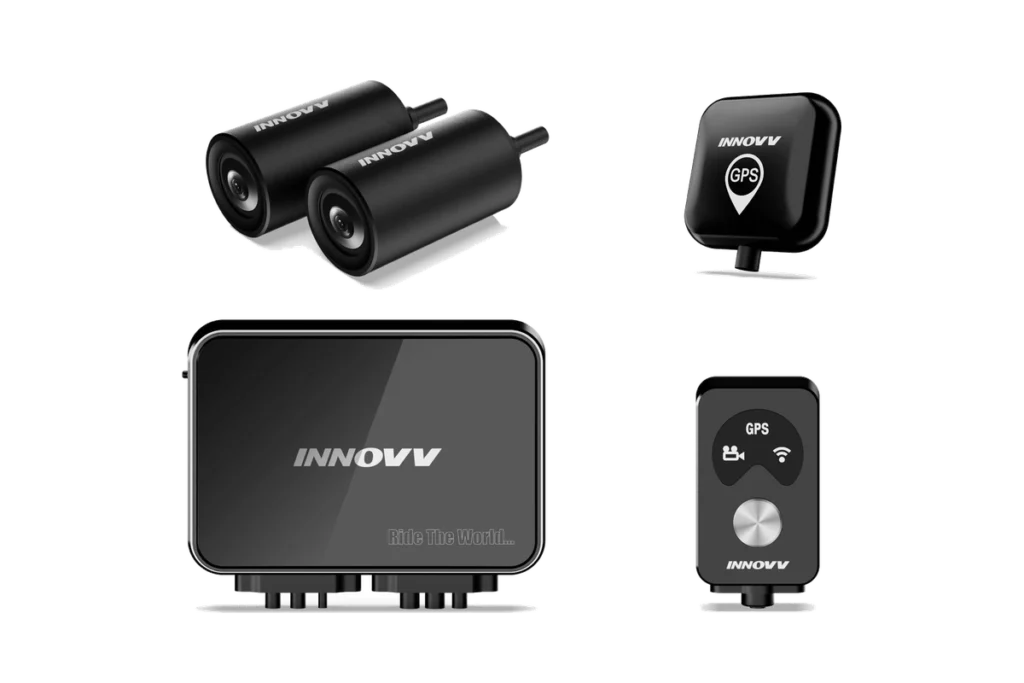
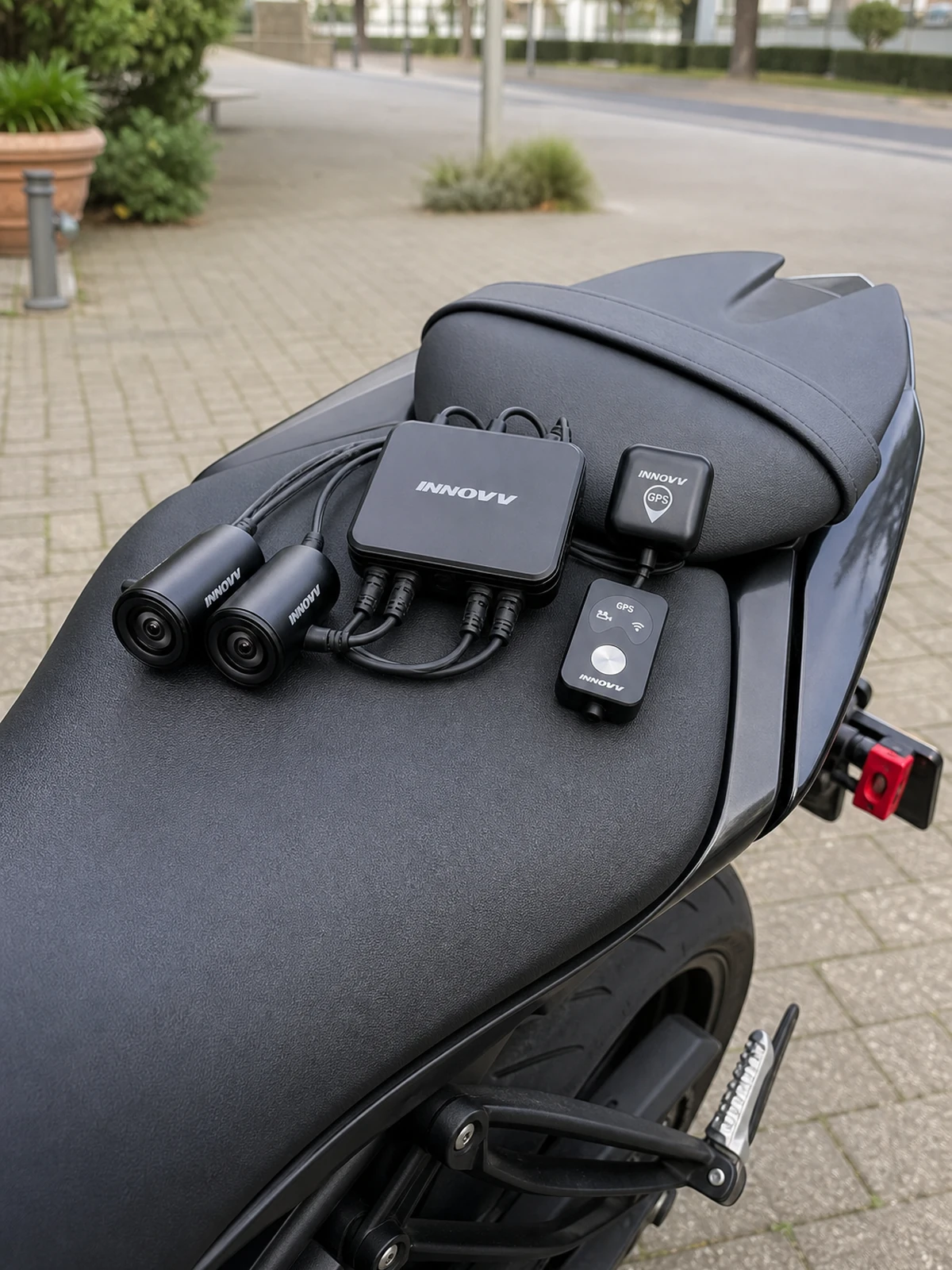
The INNOVV K7 is one of the strongest dedicated motorcycle dash-cam systems currently available.
It records simultaneously at 2K front and rear using Sony STARVIS IMX335 sensors. Riders can alternatively select 1080p recording at 60fps on both cameras.
The system also includes electronic image stabilisation, GPS, a G-sensor parking mode, app access and IP67-rated cameras. It starts recording automatically with the motorcycle’s ignition.
Why it stands out
- Dual 2K recording
- Front and rear Sony STARVIS sensors
- 1080p/60fps alternative
- Electronic image stabilisation
- GPS
- Parking mode
- Handlebar remote
- Automatic ignition-controlled recording
- IP67 cameras
For an evidence-focused dash cam, having similar quality from the rear camera matters.
A collision or lane-change dispute may depend on what happened behind you rather than what the front camera captured.
Consider before buying
The K7 requires permanent wiring and space for the DVR, cables, cameras and associated components.
Installation on a simple naked motorcycle may be relatively straightforward, while a motorcycle with limited space, fairings or multiple existing electronic accessories can require more planning. INNOVV itself documents more involved installations on motorcycles with restricted under-seat space.
Best suited to: Riders wanting a dedicated set-and-forget front/rear system with strong recording specifications.
Check current price, motorcycle compatibility and mounting options.
2. Best High-Resolution Front Camera: Vantrue F1
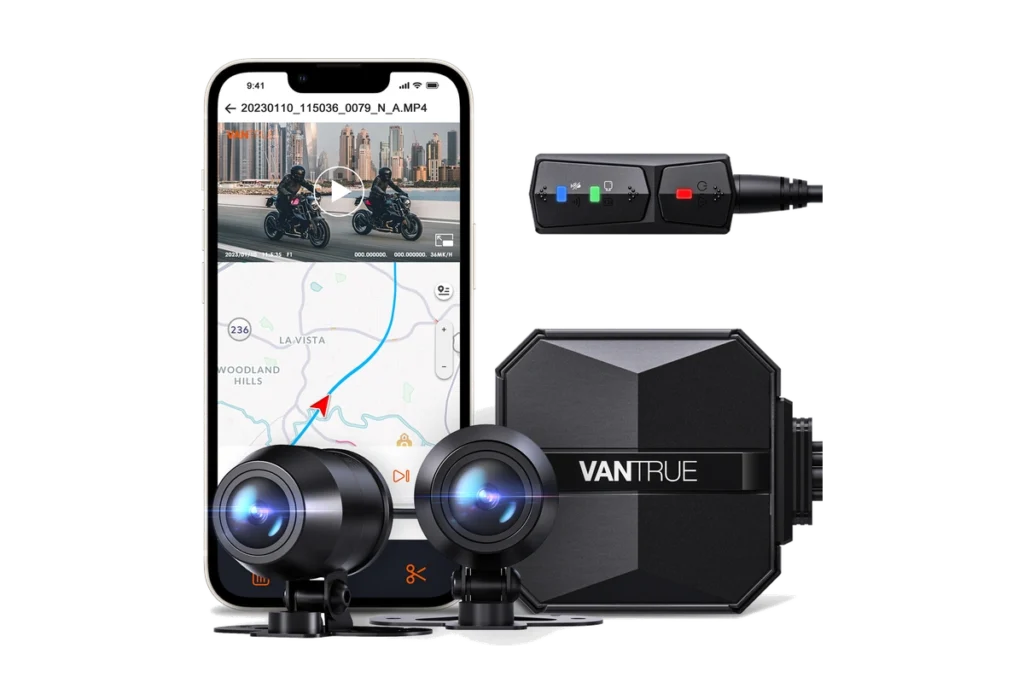
Vantrue’s F1 takes a different approach.
The front camera records at up to 4K while the rear records at 1080p. Vantrue also includes GPS and speed tracking, dual-band Wi-Fi, parking monitoring and support for microSD cards up to 1TB.
Why it stands out
- 4K front camera
- 1080p rear camera
- Sony STARVIS front sensor
- GPS
- 2.4GHz and 5GHz Wi-Fi
- Parking mode
- Large supported storage capacity
- Permanent motorcycle installation
The higher front resolution may be attractive when the primary goal is preserving maximum detail from vehicles, signs or events ahead.
Consider before buying
Do not assume 4K automatically makes this the better evidence system.
Rear-camera quality, exposure, vibration, lens cleanliness and lighting conditions also determine whether useful details are visible.
Storage requirements are also higher when recording large files continuously.
Vantrue’s official store currently shows the F1 as sold out, which is a useful reminder that this guide should be checked periodically for European stock and replacement-camera availability.
Best suited to: Riders prioritising front-camera resolution and large storage capacity.
3. Best Discreet System: CHIGEE XR-1
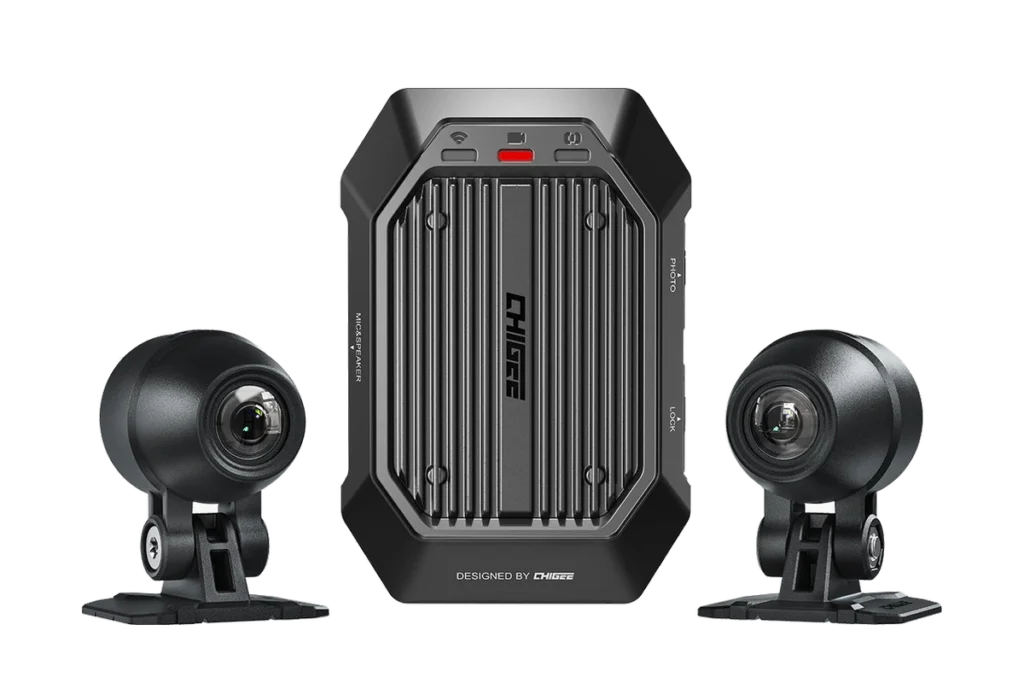
The CHIGEE XR-1 is designed to disappear into the motorcycle rather than add another screen to the cockpit.
Its DVR can sit under the seat or inside the bodywork while front and rear cameras remain permanently mounted.
The system automatically records when the bike powers on, supports loop recording, emergency clip locking and parking monitoring, and records front and rear at up to 1080p/60fps. Its cameras are rated IP68.
Why it stands out
- Small screen-free system
- Front and rear recording
- Up to 1080p/60fps
- Smart HDR
- Automatic recording
- Collision clip locking
- Parking guard
- Voice status alerts
- IP68 cameras
- App access
The voice-status function is particularly interesting.
One weakness of a completely hidden dash cam is that you may not notice a card or recording problem until you try to retrieve footage. CHIGEE designed the XR-1 to issue status prompts for recording or system problems.
Important extra
GPS is not included in the standard setup.
CHIGEE sells a separate wired GPS handlebar controller that can add route data, allow manual clip locking and show basic device status. A microSD card is also required separately.
Best suited to: Commuters and riders wanting automatic front/rear recording without adding a visible screen to the handlebars.
4. Best Simpler Dual-Camera Option: INNOVV K6
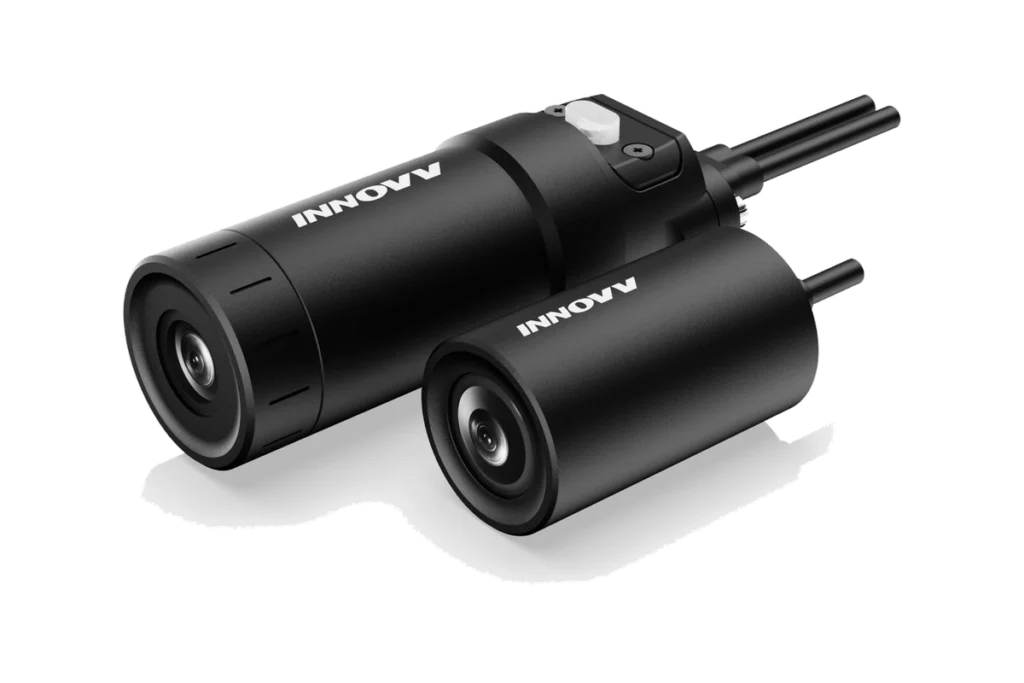
The K6 sits below the K7 in INNOVV’s current range.
It records at 2K from the front and 1080p from the rear. INNOVV positions it as the simpler option in its range, while the K7 adds features including GPS, parking mode, a G-sensor and remote control.
Why it stands out
- 2K front recording
- 1080p rear recording
- Dual-camera coverage
- Simpler specification than the K7
- Lower current purchase price than the K7
- Compact dedicated-camera approach
This can make sense if your priority is simply to have every ride recorded front and rear rather than paying for additional tracking and parking features.
Consider before buying
The K6 does not offer the same feature set as the K7.
According to INNOVV’s current comparison, the K6 lacks GPS, parking mode, G-sensor functionality and the remote included with the K7.
That is not necessarily a problem.
Paying less for features you genuinely do not need can be the better decision.
Best suited to: Riders wanting a straightforward permanent dual-camera system without the K7’s full specification.
Compare the K6 and K7 total installed cost before choosing.
5. Best Navigation + Dash-Cam System: CHIGEE AIO-6 Max
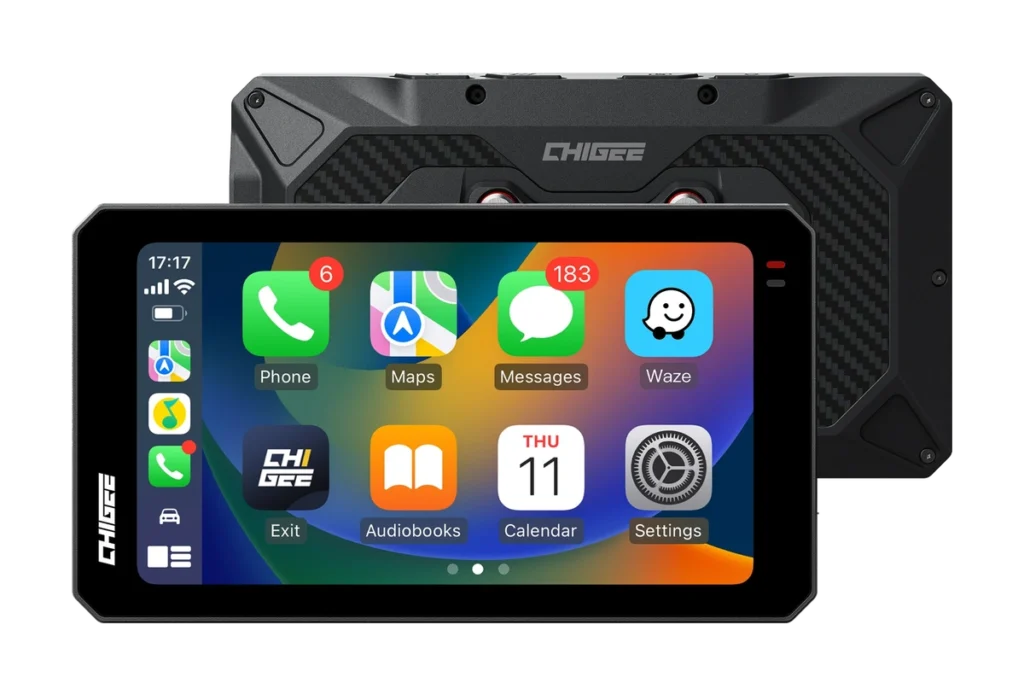
The CHIGEE AIO-6 Max is not primarily a dash cam.
It is a six-inch smart motorcycle display designed around phone-powered navigation and other riding information. Front and rear cameras can be added through CHIGEE’s optional camera kit.
The current camera kit provides 1080p HDR recording at 60fps from both directions and adds dash-cam recording and camera-based blind-spot alerts to the AIO-6 system.
Why it stands out
- Large 6-inch display
- Apple CarPlay and Android Auto integration
- Optional dual dash-cam kit
- Front and rear 1080p/60fps HDR cameras
- Camera-based blind-spot alerts
- Navigation and camera information on one display
- Modular system
This makes more sense when you already want to upgrade the motorcycle’s navigation setup.
Buying an AIO-6 purely to obtain dash-cam footage would be unnecessary for many riders.
Consider before buying
The cameras are an additional purchase.
So compare the cost of the complete AIO-6 + camera setup, not only the display price.
The added screen also changes your cockpit layout and may be more equipment than a rider wants on a simple naked motorcycle.
Best suited to: Riders already considering a dedicated navigation display who also want permanent front/rear recording.
Check the complete display, camera-kit and mounting cost.
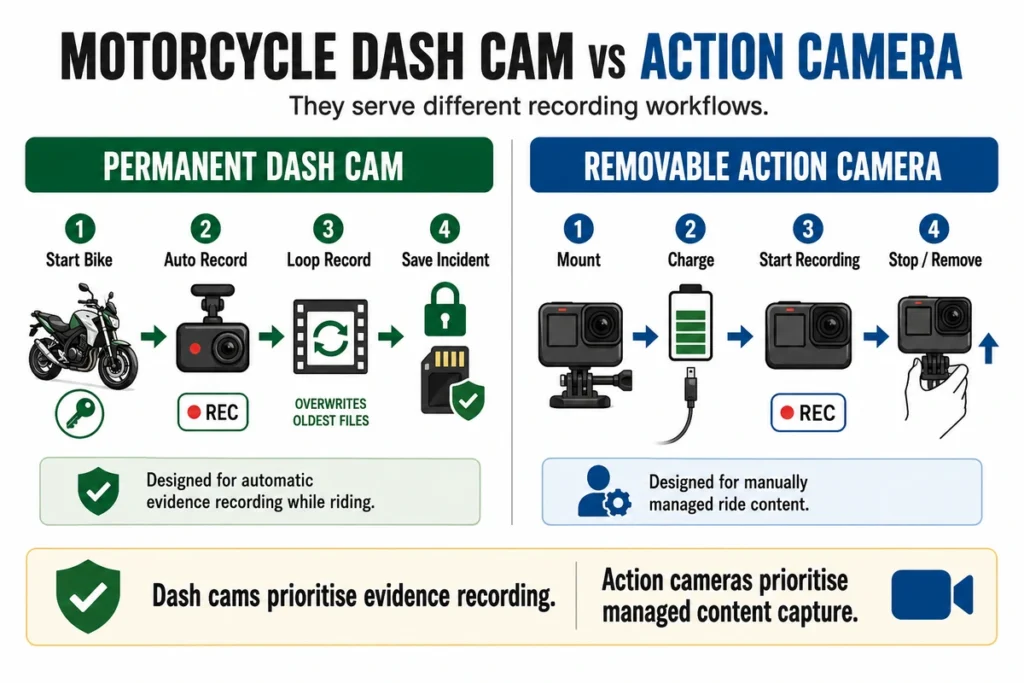
Dash Cam or Action Camera?
They solve different problems.
Motorcycle dash cam
Best when you want:
- Automatic recording every ride
- Permanent front/rear coverage
- Loop recording
- Automatic incident locking
- Parking monitoring
- No daily mounting or charging routine
Action camera
Better when you primarily want:
- Motovlogging footage
- High-quality creative video
- Different camera angles
- Helmet or chest perspectives
- Manual control over what gets recorded
An action camera can record an incident.
But it only helps when it is mounted, charged, switched on and recording.
A permanent dash cam should simply start with the motorcycle.
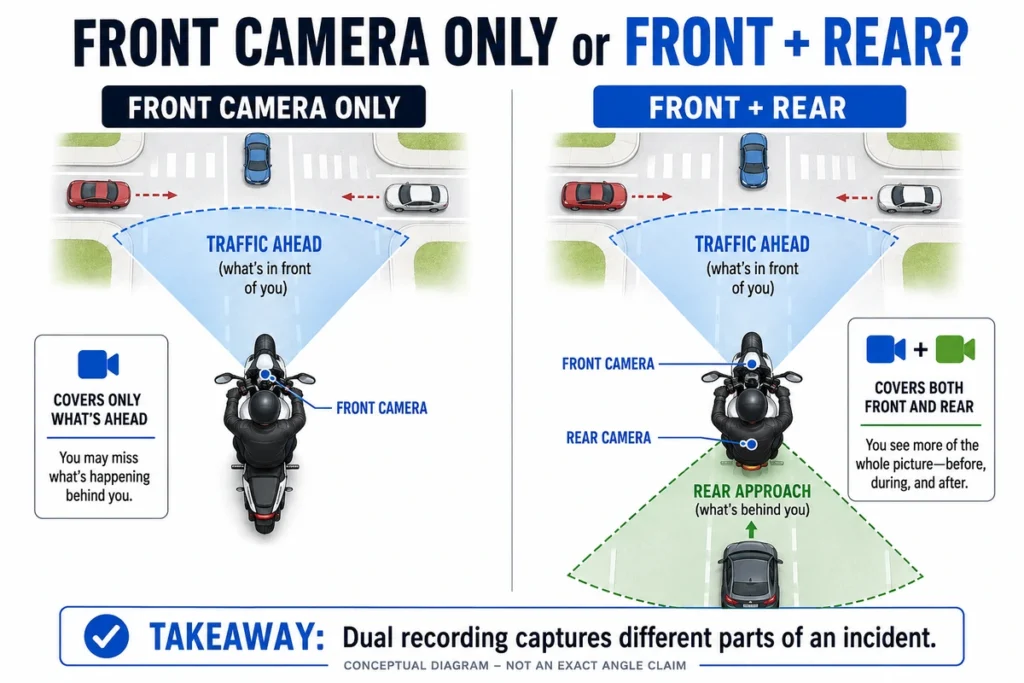
Front Camera Only or Front and Rear?
For a permanently installed motorcycle system, I would prioritise dual-camera recording.
Front footage may capture:
- Vehicles pulling out
- Oncoming traffic
- Junctions
- Road conditions
- Traffic lights
Rear footage can capture:
- Tailgating
- Rear impacts
- Vehicles approaching during a lane change
- Events that began behind you
That additional context can be valuable when reconstructing an incident.
A rear camera also makes more sense on a motorcycle than relying on a rider-mounted camera whose view changes every time you turn your head.
4K or 2K: How Much Resolution Do You Need?
Higher resolution can preserve more image detail.
But usable evidence depends on much more:
- Frame rate
- Exposure
- Sensor performance
- Lens quality
- Vibration
- Mounting angle
- Water or dirt on the lens
- Distance from the vehicle
- Lighting
- Compression
This is why I would not choose between the Vantrue F1 and INNOVV K7 simply by comparing “4K” with “2K.”
The F1 gives the front camera more resolution, while the K7 provides 2K on both cameras.
Decide whether maximum forward detail or more balanced front/rear quality is more useful for you.
Do You Need Parking Mode?
Parking mode can be useful when the motorcycle spends time:
- On urban streets
- In public parking areas
- Outside hotels
- At work
- In shared garages
But parking recording requires power management.
A system should not be allowed to drain the motorcycle battery simply because it is monitoring for impacts.
Check how the specific dash cam manages standby power and whether its parking feature requires additional hardware or configuration.
The K7 and XR-1 both advertise parking functions, while INNOVV’s current K6 comparison does not list parking mode for that model.
Choose the Memory Card Carefully
Continuous dual-camera recording creates a lot of write cycles.
Use the card type and capacity recommended by the manufacturer rather than installing the cheapest card with the correct number printed on it.
For example, CHIGEE recommends U3/A2/V30 or better and specifically advises a high-speed, high-endurance or industrial-grade microSD card for the XR-1.
Good habits include:
- Use a high-endurance card
- Format it according to the manufacturer
- Check recording periodically
- Replace the card if errors become frequent
- Save important incident footage immediately
- Do not assume loop recording means the storage system never needs checking
A dash cam whose card stopped recording months ago is not much help after an accident.
Installation Matters as Much as the Camera
A strong camera badly installed can produce poor footage.
Before permanently mounting the system:
- Check steering movement
- Keep cables away from hot components
- Avoid moving suspension parts
- Keep wiring away from sharp edges
- Make sure the camera cannot rotate
- Keep the lens away from excessive vibration
- Check that luggage does not block the rear camera
- Confirm the electrical connection is appropriate
- Waterproof exposed connections as instructed
- Test the camera view before reinstalling body panels
When you are uncertain about motorcycle wiring, professional installation can be worth the additional cost.
The goal is to create a system you do not need to think about once the motorcycle starts.
Common Mistakes
Common Motorcycle Dash-Cam Buying Mistakes
| Mistake | Why It Creates a Problem | Better Approach |
|---|---|---|
| Buying only by resolution | Image quality depends on more than pixels | Compare the full recording system |
| Using only a front camera | Important context may happen behind you | Prefer front and rear coverage |
| Using a cheap memory card | Continuous recording can expose card weaknesses | Use high-endurance storage |
| Ignoring night performance | Most specifications look good in daylight | Check sensor and HDR performance |
| Mounting where the bike vibrates heavily | Footage may become difficult to use | Choose a stable mounting point |
| Forgetting lens cleaning | Dirt or water can ruin important footage | Check lenses regularly |
| Assuming parking mode is free electrically | It may consume battery power | Understand power management |
| Buying a large display when you only need recording | Adds cost and cockpit clutter | Choose a discreet DVR system |
| Publishing incident footage immediately | Privacy rules may apply | Preserve evidence and consider privacy first |
| Treating the dash cam as a safety device | It cannot replace defensive riding | Use it primarily as an evidence tool |
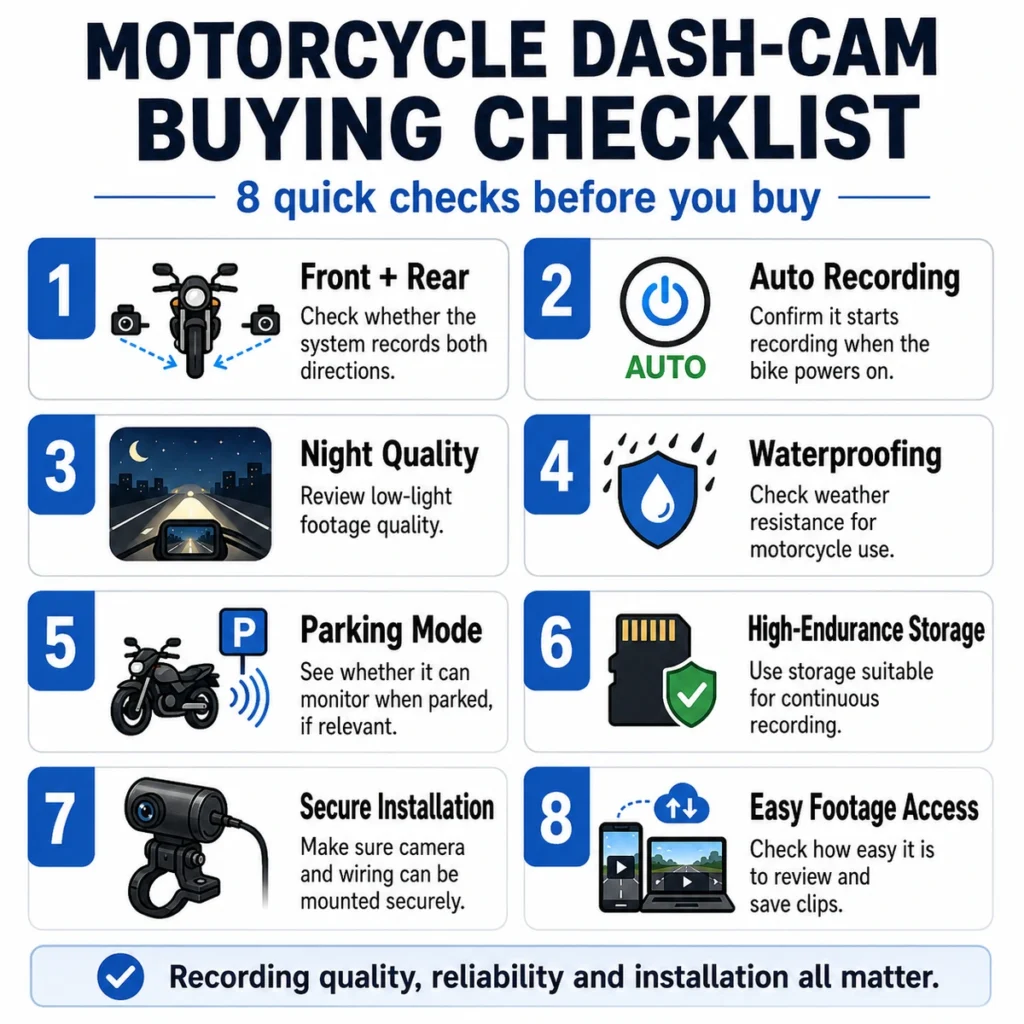
Motorcycle Dash-Cam Buying Checklist
Before buying:
- Check front and rear resolution
- Confirm automatic ignition recording
- Check waterproof ratings
- Compare low-light performance
- Check GPS requirements
- Decide whether you need parking mode
- Check maximum storage capacity
- Budget for a high-endurance microSD card
- Confirm replacement-camera availability
- Check installation space
- Understand the motorcycle’s power requirements
- Review the app and footage-transfer process
After installation:
- Check both camera angles
- Set the correct date and time
- Confirm loop recording
- Test emergency clip locking
- Check the rear view with luggage fitted
- Clean both lenses regularly
- Confirm recording status periodically
- Save important footage before it is overwritten
Final Thoughts: The Best Dash Cam Is the One That Quietly Records Every Ride
The INNOVV K7 offers the strongest balanced dedicated specification here with dual 2K recording, GPS and parking features.
Vantrue’s F1 focuses on higher front-camera resolution.
The CHIGEE XR-1 is attractive when you want something discreet and automatic, while the INNOVV K6 keeps the system simpler.
And if you already want a larger navigation display, the CHIGEE AIO-6 can combine navigation and front/rear recording in one ecosystem.
Do not buy purely by resolution.
Think about what happens six months after installation.
Will it start automatically?
Will you know when it is not recording?
Can you retrieve the footage easily?
Can you replace the camera or memory card?
And will the system keep working without demanding attention while you ride?
That is what makes a motorcycle dash cam useful.
It records quietly in the background.
Then, on the one ride where the footage really matters, it is already there.
FAQs
Are motorcycle dash cams worth it?
They can be worthwhile for riders who want automatic incident and journey recording without mounting and charging an action camera for every ride.
Is a motorcycle dash cam better than an action camera?
For automatic evidence recording, usually yes. For motovlogging and creative video, an action camera is more flexible.
Should a motorcycle dash cam record front and rear?
Dual recording provides more context around an incident, particularly for rear impacts, lane changes and vehicles approaching from behind.
Can motorcycle dash cams record while parked?
Some can. Check whether the specific system offers parking mode and how it manages motorcycle-battery power.
How large a microSD card does a motorcycle dash cam need?
Follow the manufacturer’s limits and use high-endurance storage. Required capacity depends on resolution, number of cameras and how much footage you want to retain before loop recording overwrites older files.
Is 4K necessary for a motorcycle dash cam?
No. Resolution is only one part of usable image quality. Sensor performance, lighting, frame rate, vibration and mounting also matter.
Related Reads
Motorcycle Accident Survival: What to Do After a Crash
Riding in Heavy Traffic: Safety Tips for Urban Motorcyclists
Night Riding Safety: How to Ride a Motorcycle Safely After Dark