Long motorcycle rides rarely become unsafe because concentration disappears in one obvious moment.
Focus usually fades gradually.
You may stop scanning far ahead, follow traffic more closely or miss a sign you would normally notice. The motorcycle can still feel under control while your judgement and reaction quality are already declining.
Staying focused is not about forcing yourself to concentrate for hours.
It is about beginning rested, planning realistic stages, reducing unnecessary mental workload and stopping before fatigue takes away your safety margin.
This guide explains how to stay focused on long motorcycle rides without depending on willpower, caffeine or the pressure to reach the destination on schedule.
Quick Answer
How Do You Stay Focused on a Long Motorcycle Ride?
To maintain concentration on a long ride:
- Begin only when you are properly rested.
- Divide the route into realistic riding stages.
- Plan breaks before your attention starts fading.
- Drink regularly and eat light, familiar food.
- Reduce strain from wind, noise, heat, cold and poor posture.
- Keep your eyes moving through an active scanning routine.
- Protect your following distance.
- Stop before changing navigation settings.
- End or delay the ride when alertness does not recover after a break.
The best break is usually the one you take before you feel desperate for it.
Why Focus Fades on Long Rides
Motorcycle riding combines physical control with continuous mental processing.
You are managing balance, throttle, braking and road position while judging traffic, road surfaces, weather and other road users.
Fatigue can slow reactions, reduce alertness and concentration, weaken decision-making and gradually pull attention away from the riding task. European road-safety guidance also associates fatigue with poorer steering performance and reduced ability to maintain a safe following distance.
Long journeys can add:
- Repetitive scenery
- Motorway monotony
- Wind pressure
- Helmet noise
- Heat or cold
- Dehydration
- Muscular tension
- Hunger
- Arrival pressure
These factors often overlap.
You do not need to identify one exact cause while riding. You need to notice that your performance is changing and respond early.
Read : Mental Preparedness For Motorcycle Riding
1. Start the Ride Rested
A roadside break cannot fully repair a journey that began with serious sleepiness.
Before leaving, ask:
- Did I sleep properly?
- Am I already yawning?
- Do my eyes feel heavy?
- Am I struggling to concentrate?
- Am I beginning after a demanding workday?
- Will I be riding during the hours when I normally sleep?
Do not start simply because accommodation, friends, a ferry or a planned arrival time is waiting at the other end.
Change the departure time, shorten the route or stay overnight when necessary.
Use the Free Motorcycle Pre-Ride Safety Checklist for the motorcycle, then make a separate check of the rider.
2. Plan Riding Stages, Not Just Arrival Time
A navigation app may estimate four hours of travel.
That does not mean you should plan four uninterrupted hours in the saddle.
Allow time for:
- Rest and fuel
- Water and food
- Toilets
- Traffic and roadworks
- Weather changes
- Navigation mistakes
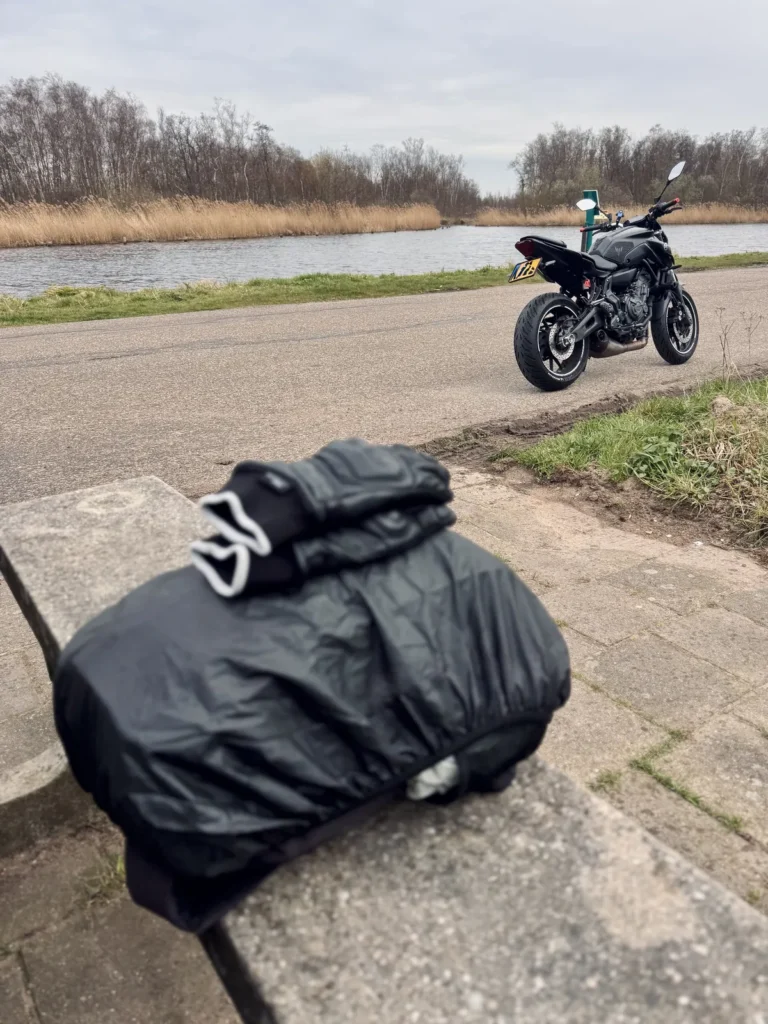
Choose possible stopping places before leaving. Service areas, petrol stations and cafés are easier to use than searching for somewhere safe after concentration has already dropped.
The Highway Code recommends a break of at least 15 minutes after every two hours of driving or riding. Treat two hours as an outside planning reference, not a target you must reach. A motorcyclist may need to stop much sooner because of weather, discomfort, experience or route difficulty.
3. Stop Before You Feel Exhausted
Waiting until you are exhausted makes every remaining kilometre feel longer.
Consider stopping early when:
- Your neck or shoulders begin to ache
- Wind or rain increases the workload
- You miss a turn or sign
- Your vision settles on the vehicle ahead
- You become unusually irritated
- Your speed or lane position becomes inconsistent
Break frequency should change with the conditions.
A quiet motorway stage in mild weather may feel easier than an unfamiliar city, wet night ride or exposed road in strong wind.
Do not turn the break schedule into another challenge.
The planned stop matters less than your current ability to ride well.
4. Make Each Stop Useful

Stopping the engine does not automatically create recovery.
During a break:
- Park somewhere safe and legal.
- Get off the motorcycle.
- Walk for a few minutes.
- Drink water.
- Eat something light when needed.
- Check the route and weather.
- Reassess how alert you feel.
Avoid spending the whole break answering work messages or scrolling through your phone.
That replaces one mental task with another.
Before leaving, ask whether you genuinely feel clearer. When you still feel sleepy, confused or unusually slow, do not continue merely because you have already taken a break.
5. Manage Water, Food and Physical Comfort
Dehydration can contribute to tiredness, headaches, thirst, dizziness and light-headedness. Carry water and drink during stops rather than waiting until you feel unwell.
Choose familiar food that leaves you comfortable.
A light meal or snack may be easier to manage than one heavy lunch followed immediately by another motorway stage.
Do not use repeated coffee or energy drinks as proof that you are fit to continue.
Caffeine may make you feel temporarily more awake, but it does not replace sleep or make serious fatigue safe. Official guidance describes caffeine and a short nap only as temporary emergency measures rather than substitutes for proper rest.
Physical discomfort also competes for attention. Before a long journey, check:
- Helmet and visor
- Ear protection
- Jacket and glove fit
- Luggage security
- Mirror position
- Windscreen adjustment, when available
Keep your shoulders relaxed and elbows flexible.
When pain becomes persistent or begins affecting control, stop instead of repeatedly shifting position while moving.
Read Motorcycle Safety Gear Explained: What Each Piece Actually Does when reviewing comfort and protection for longer journeys.
6. Keep Your Observation Active
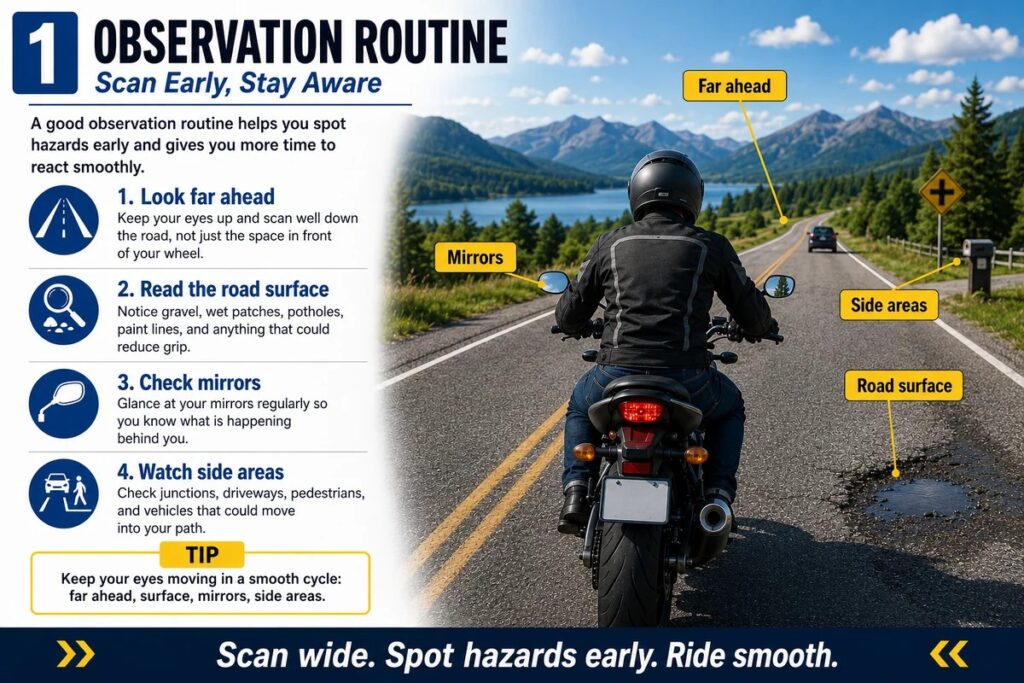
Monotony can cause your eyes to settle on the vehicle directly ahead.
Use a simple observation cycle:
Far ahead → near road surface → mirrors → side areas → far ahead
Look for:
- Changes in traffic speed
- Junctions and slip roads
- Brake lights several vehicles ahead
- Surface damage
- Debris
- Weather changes
- Vehicles entering your blind spots
- Available escape space
Do not follow the sequence mechanically.
Use it as a reminder to keep gathering information from the whole road environment.
The techniques in Motorcycle Vision Techniques: How to Look Through the Corner Correctly also apply on long rides
Look towards useful information rather than staring at one object.
7. Protect Your Following Distance
Fatigue often affects small decisions before obvious sleepiness appears.
You may begin matching the vehicle ahead without noticing that the gap has become smaller.
Create enough distance to:
- See beyond the next vehicle
- Notice slowing traffic early
- Avoid constant braking and acceleration
- Reduce road spray in rain
- Stop progressively
- Change position without rushing
When you repeatedly close the gap without intending to, treat it as a warning sign.
Rebuild the distance and look for a suitable place to stop.
The space-management habits in the Beginner’s Guide to Defensive Motorcycle Riding become even more important as your mental workload increases.
8. Keep Navigation and the Route Simple
Set the destination, review the first major directions and identify fuel or rest stops before moving.
Do not type a new destination, search for fuel or zoom into maps while riding.
Continue safely until you can stop.
If you use your phone for directions, a well-positioned motorcycle phone mount for navigation can make the instructions easier to glance at.
Missing an exit is usually less dangerous than making a rushed lane change.
Navigation instructions can also be wrong, delayed or unclear. Confirm them against road signs, lane markings and the road in front of you.
Adjust the plan when darkness, rain, cold or strong wind makes the journey more demanding than expected.
A distance that felt realistic in daylight may no longer be sensible later.
Use Night Riding Safety and Wet Weather Motorcycle Riding Tips when those conditions form part of the route.
9. Recognise When It Is Time to Stop
Warning signs include:
- Repeated yawning
- Heavy or sore eyes
- Wandering lane position
- Inconsistent speed
- Missing signs or exits
- Forgetting recent sections of road
- Late braking
- Following too closely
- Irritation with normal traffic
- Staring instead of scanning
- Repeated small mistakes
Do not wait until you are fighting to keep your eyes open.
Find a service area, petrol station, car park or another safe location away from moving traffic.
End or delay the journey when:
- Sleepiness continues after a proper break
- Pain affects normal control
- The weather has become too demanding
- Your concentration keeps disappearing
- You cannot maintain a predictable lane position
- You are continuing only to keep up with other riders
- The remaining route exceeds your realistic energy
A successful long ride is not defined by completing the original plan.
Common Mistakes
| Mistake | Why It Creates Risk | Better Habit |
|---|---|---|
| Starting after poor sleep | The journey begins without enough alertness | Delay or shorten the ride |
| Planning only fuel stops | The motorcycle may be ready before the rider is | Plan rider breaks separately |
| Treating two hours as a goal | Conditions may require an earlier stop | Adapt the interval |
| Spending breaks on the phone | Mental workload continues during the stop | Walk, drink and reassess |
| Using caffeine to override sleepiness | It does not replace proper rest | Stop, sleep or end the ride |
| Staring at the vehicle ahead | Reduces hazard awareness | Keep an active scan |
| Following too closely | Removes reaction time | Rebuild the gap early |
| Changing navigation while moving | Divides visual and mental attention | Stop before adjusting it |
| Continuing to meet an arrival time | Turns the schedule into pressure | Tell others you will arrive later |
| Keeping up with a group | Hides individual fatigue | Ride your own plan |
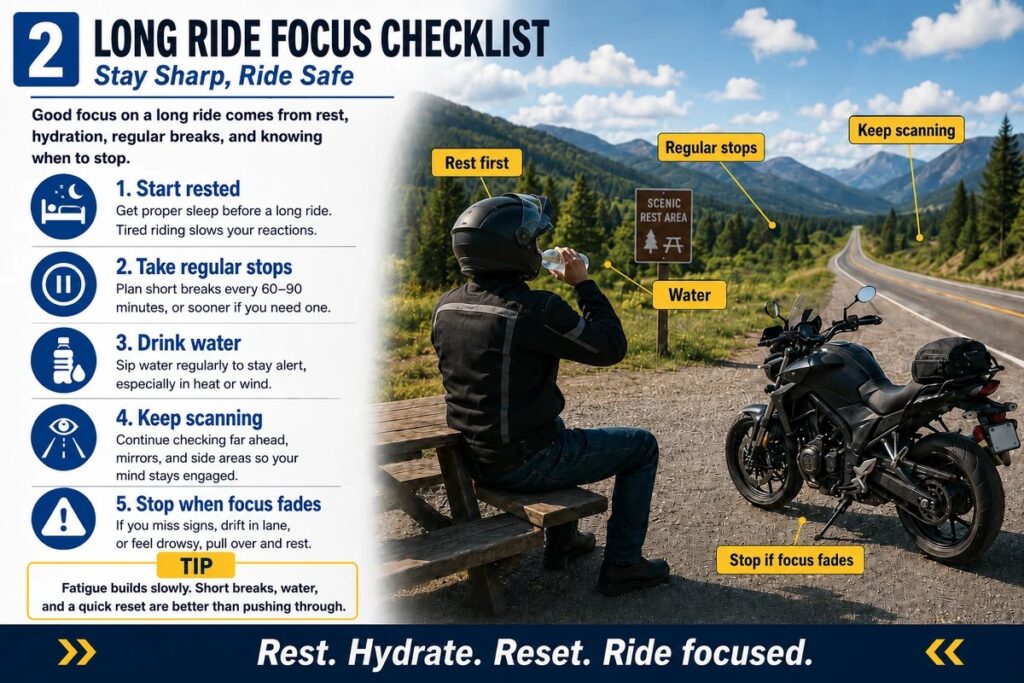
Long-Ride Focus Checklist
Before leaving:
- Sleep properly
- Check your mental and physical readiness
- Plan realistic stages and stopping places
- Review the weather
- Set navigation
- Carry water and suitable food
- Check gear comfort
- Secure luggage
- Allow extra journey time
During the ride:
- Scan far ahead
- Protect your following distance
- Relax your hands and shoulders
- Drink during stops
- Stop when concentration narrows
- Adapt for traffic and weather
- Never adjust navigation while moving
- Ride your own pace
After each break:
- Am I genuinely more alert?
- Is the next stage realistic?
- Can I control the motorcycle comfortably?
- Have the weather or traffic conditions changed?
- Am I continuing because it is safe or because I feel committed?
Final Thoughts: Protect Your Attention Early
Long-distance riding should not become a contest between the rider and fatigue.
Start rested. Break the route into realistic stages. Stop before your attention becomes unreliable and use the break to recover rather than simply pause the engine.
Keep drinking, reduce physical discomfort and stay actively involved in reading the road.
Most importantly, remain willing to change the plan.
Arriving later, booking a room or completing the route another day is not failure.
It is how a rider protects the attention needed for the next safe decision.
Ride smart. Take the break. Come home safe.
FAQs
How often should you stop on a long motorcycle ride?
The Highway Code recommends a break of at least 15 minutes after every two hours of driving or riding. Motorcyclists may need to stop sooner because of weather, discomfort, experience or route difficulty.
How long can you ride a motorcycle without a break?
There is no safe universal duration. Use two hours as an outside planning reference rather than a target, and stop earlier whenever concentration or control begins to decline.
How do you avoid getting tired on a long motorcycle ride?
Begin rested, plan realistic stages, drink regularly, eat sensibly, reduce physical strain and stop before fatigue becomes severe. No technique replaces proper sleep.
Does caffeine help with motorcycle fatigue?
Caffeine may temporarily make you feel more awake, but it does not replace sleep or make serious tiredness safe.
What are the early signs of losing focus?
Missing signs, narrowing your visual scan, inconsistent following distance, irritability and repeated small mistakes can indicate declining concentration.
What should you do if you feel sleepy?
Reduce your speed smoothly and find a safe place to stop away from moving traffic. Do not try to push through sleepiness until the next planned destination.
Is riding at night more tiring?
It can be more demanding because visibility is reduced and the journey may overlap with your normal sleeping hours. Shorten your stages when darkness increases the workload.
When should I postpone a motorcycle ride?
Postpone when you are very tired, emotionally overwhelmed, impaired, unwell or unable to concentrate. Also reconsider when the route or conditions exceed your current confidence.
Related Reads
Beginner’s Guide to Defensive Motorcycle Riding
Motorcycle Vision Techniques: How to Look Through the Corner Correctly
Night Riding Safety: How to Ride a Motorcycle Safely After Dark
Wet Weather Motorcycle Riding Tips: How to Ride Safely in the Rain