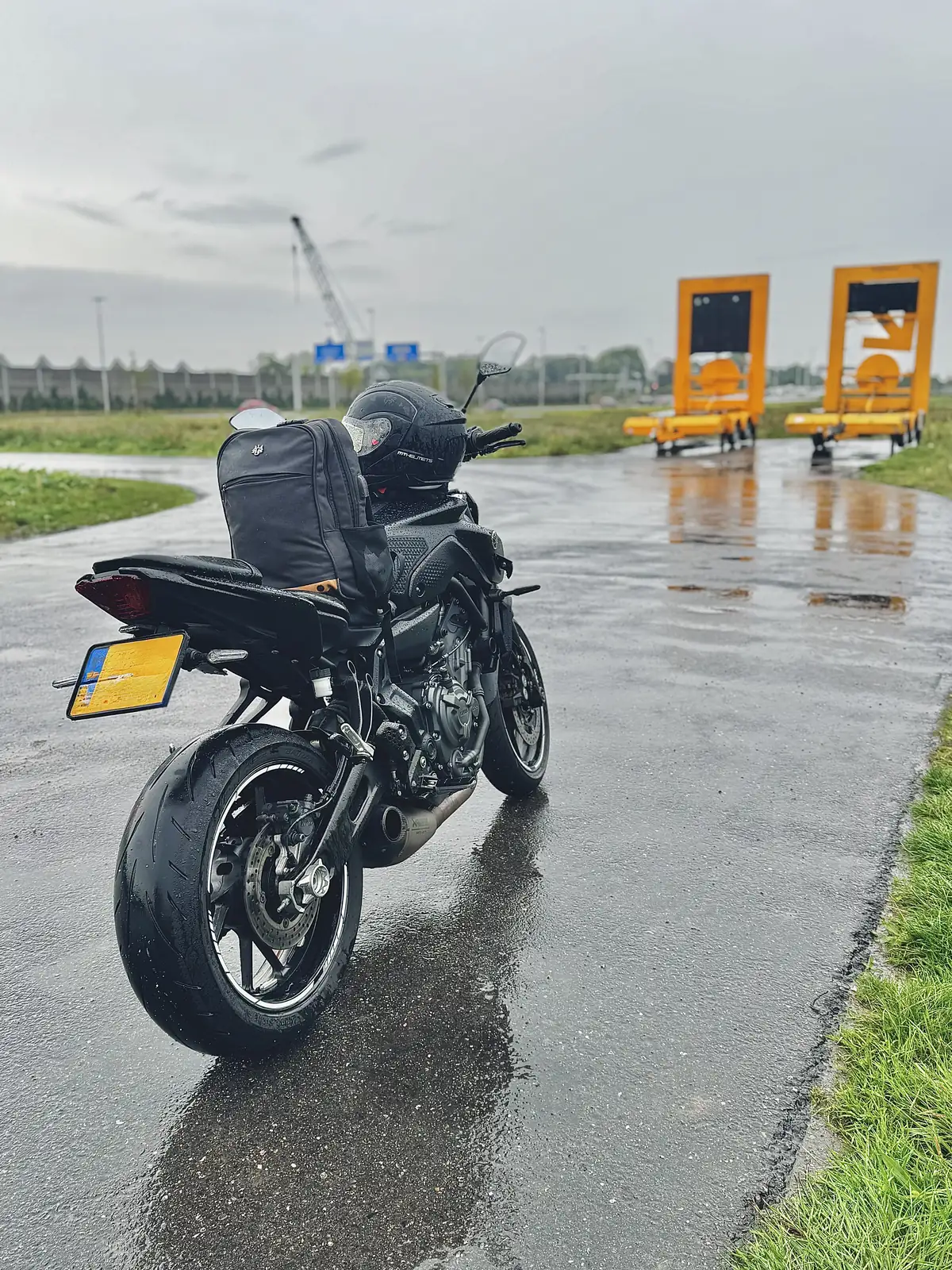
Rain changes almost everything about a motorcycle ride.
Your tyres have less grip. Your visor becomes harder to see through. Road markings, metal covers and tram tracks become more slippery. Other vehicles throw spray into your face, and drivers may struggle to see you.
Even your own body begins to work differently. Cold hands become less precise. Wet clothing becomes distracting. Tension builds in your shoulders, and every small movement from the motorcycle can feel more serious than it really is.
I used to think wet-weather riding was mainly about confidence.
It is not.
It is about margin.
You need more space, more time, better vision and smoother control inputs. You also need the judgement to recognise when the conditions have moved beyond your ability, equipment or comfort level.
These wet weather motorcycle riding tips will help you prepare for rain, maintain traction, brake and corner more smoothly, manage visibility and recognise when continuing the ride is no longer the smart decision.
Quick Answer
How Do You Ride a Motorcycle Safely in the Rain?
To ride a motorcycle safely in the rain:
- Reduce your speed before corners and hazards.
- Increase the distance between you and other vehicles.
- Keep your throttle, braking and steering inputs smooth.
- Use both brakes progressively.
- Avoid sudden acceleration or direction changes.
- Cross paint, metal and tram tracks with minimal lean.
- Look farther ahead for standing water and slippery surfaces.
- Keep your visor clear and your lights visible.
- Wear waterproof gear that keeps you warm and comfortable.
- Stop somewhere safe when visibility or grip becomes dangerously poor.
Wet-weather riding does not require you to become afraid of the motorcycle.
It requires you to remove unnecessary urgency from the ride.
In the rain, smoothness creates the time and grip that panic takes away.
Is It Safe to Ride a Motorcycle in the Rain?
Motorcycles can be ridden in rain, but the safety of a particular journey depends on more than whether water is falling from the sky.
Before riding, consider:
- How heavily it is raining
- Your wet-weather experience
- The condition of your tyres
- The amount of standing water
- Wind strength
- Visibility
- Temperature
- Traffic density
- The route
- Whether you have suitable gear
- Whether the journey is genuinely necessary
A light, steady shower on familiar roads is very different from heavy rain combined with strong wind, darkness, motorway spray and unfamiliar roads.
There is no shame in postponing a recreational ride or stopping somewhere safe.
Good riders do not prove themselves by continuing through every condition.
They protect their available margin.
1. Check the Weather and Plan the Route
Wet-weather riding begins before you start the engine.
Check:
- Rain intensity
- Expected duration
- Wind speed and direction
- Thunderstorm warnings
- Temperature
- Sunset time
- Known roadworks
- Flood-prone areas
A route that is enjoyable in dry weather may not be the best choice in heavy rain.
Narrow country roads may collect mud, leaves and standing water. City routes may include tram tracks, painted cycle crossings and polished road surfaces. Motorways can expose you to heavy spray, high speeds and crosswinds.
Consider choosing:
- Familiar roads
- A shorter route
- Roads with good drainage
- Routes with petrol stations or sheltered stopping points
- Roads that avoid known flooding areas
- A route with fewer complicated junctions
Planning a simpler route is not being overly cautious.
It reduces the number of problems you may need to solve while visibility and grip are already reduced.
Learn : How To Ride In Strong Winds
2. Check Your Motorcycle Before Riding
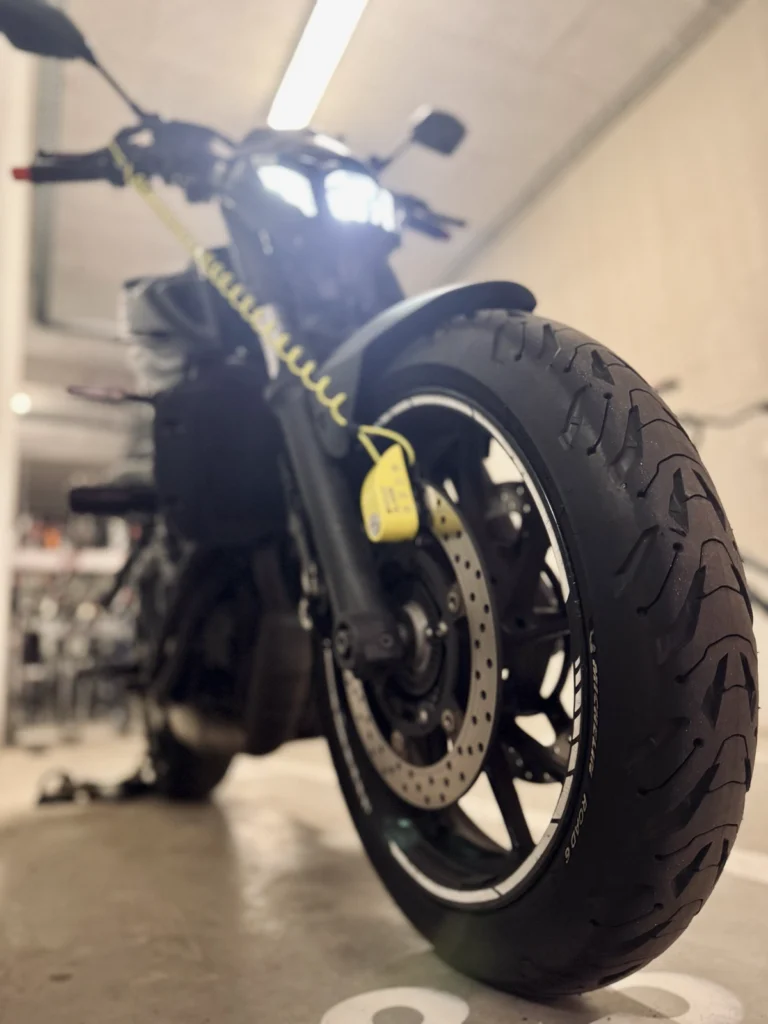
Your tyres are the motorcycle’s only points of contact with the road, so their condition matters even more when grip is reduced.
Before a wet ride, check:
- Tyre pressure
- Tread depth
- Cracks, cuts or embedded objects
- Uneven tyre wear
- Brake operation
- Brake-light operation
- Headlight and indicators
- Chain condition and tension
- Fluid leaks
- Mirrors
- Luggage security
Use the tyre pressures recommended by the motorcycle or tyre manufacturer. Do not lower the pressure simply because the road is wet.
Also check that your controls move freely. A stiff brake lever, poorly adjusted clutch or slippery foot control becomes more difficult to manage with cold or wet hands.
Official rider guidance consistently recommends checking tyres, brakes, lights, controls and potential leaks before riding.
3. Wear Gear That Keeps You Dry and Warm
For More Gear Info, Read : Motorcycle Safety Gear Explained and CE Ratings Explained: Helmets, Jackets, Gloves & Armor
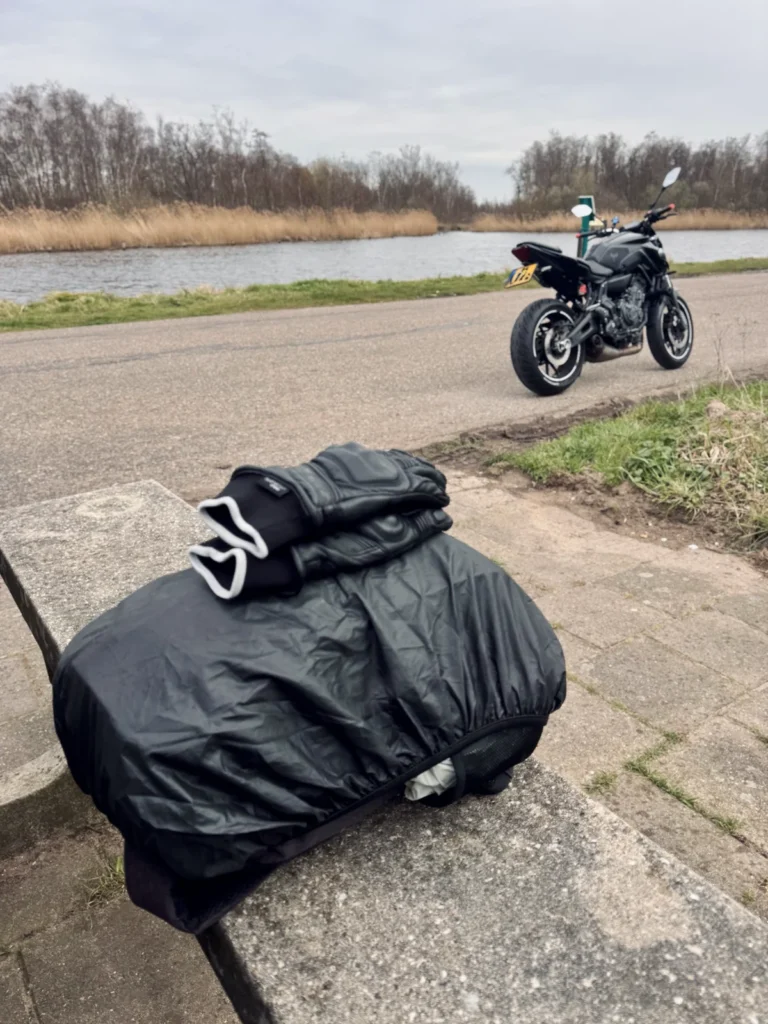
Waterproof gear is not only about comfort.
Being soaked and cold can affect your concentration, movement and ability to operate the controls precisely. Proper wet-weather clothing helps you remain alert and reduces the urge to rush home simply because you are uncomfortable.
Your setup may include:
- Waterproof motorcycle jacket and trousers
- A dedicated rain suit worn over protective gear
- Waterproof gloves or glove covers
- Waterproof boots
- A neck covering
- Moisture-wicking base layers
- Reflective or high-visibility details
Rain gear should fit over your normal protective clothing without restricting your arms, knees or access to the controls.
Check that trouser legs overlap your boots correctly. If the trousers sit inside the boots, rainwater may run directly into them.
Your gloves should still allow you to feel the brake, clutch and throttle. Thick gloves that are too large can reduce precision.
The Motorcycle Safety Foundation recommends rain gear that keeps the rider dry and comfortable, along with conspicuous or reflective clothing to improve visibility.
Check : Waterproof Motorcycle Boots
4. Prepare Your Visor Before the Rain Starts
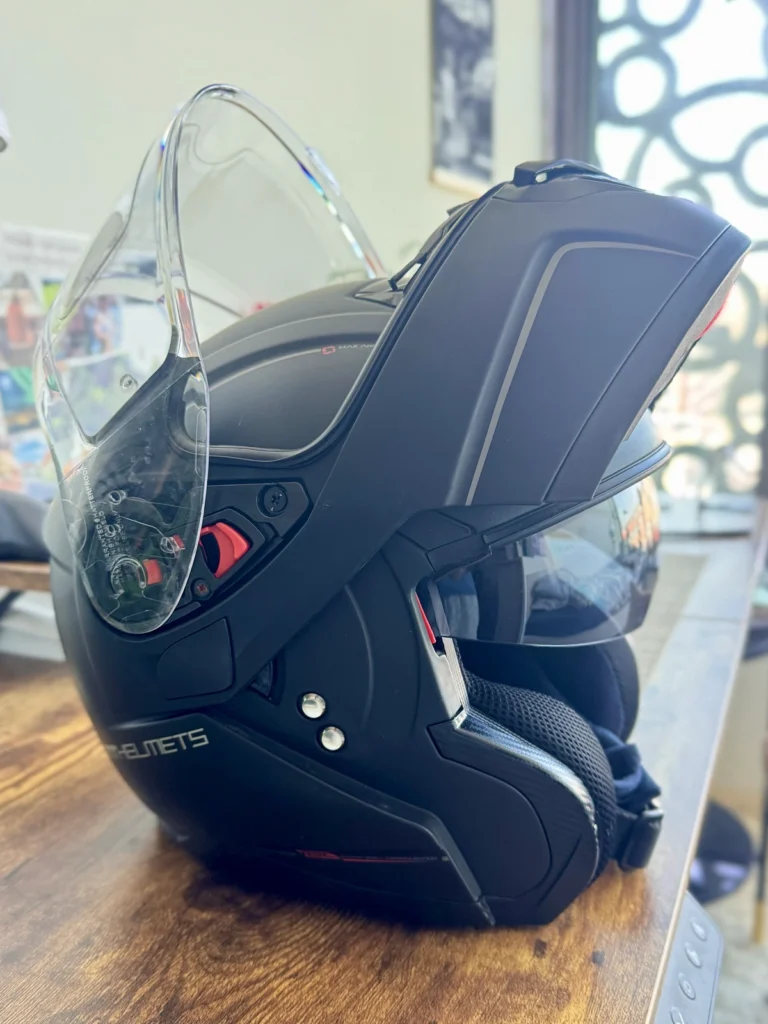
Clear vision is one of the biggest challenges in wet-weather riding.
You may have to deal with:
- Rain on the outside of the visor
- Fog on the inside
- Spray from other vehicles
- Dirt mixed with road water
- Reflections from headlights
- Reduced contrast
- Darkness under clouds or at night
Before the ride:
- Clean the visor
- Check it for deep scratches
- Fit a compatible anti-fog insert if available
- Check that the helmet vents operate correctly
- Carry a clean microfibre cloth
- Avoid using products not approved for the visor material
Opening the visor slightly may improve airflow at low speeds, but it can also allow water inside. Use your helmet’s ventilation system first and adjust based on the conditions.
Avoid wiping a dirty visor repeatedly with a dry glove. Road spray may contain grit that can scratch the surface and make visibility worse during future night rides.
When stopping safely, rinse or gently clean the visor rather than grinding the dirt across it.
5. Be Especially Careful When Rain Begins
The road can be particularly slippery when rain begins after a dry period.
Water mixes with dust, dirt and oily residue already present on the road. This can create a slippery surface before sustained rainfall begins to wash some of the contamination away.
Pay particular attention around:
- Junctions
- Roundabouts
- Petrol stations
- Toll areas
- Bus stops
- Traffic lights
- Industrial areas
- Roads used by heavy vehicles
These are places where fuel, oil or other residue may have accumulated.
Do not assume the road has suddenly become safe because the rain has been falling for longer. Painted markings, leaves, metal covers and diesel spills may remain slippery throughout the rain.
The correct response is not to test the grip.
Reduce your speed, increase your following distance and keep the motorcycle as upright as possible across questionable surfaces.
6. Increase Your Following Distance
Rain reduces grip and makes it harder to see what is happening ahead.
The Highway Code states that wet-weather stopping distances can be at least double those required on dry roads and recommends keeping well back to improve visibility and planning time.
You do not need to calculate the exact distance while riding.
The practical lesson is simple:
Leave significantly more room than usual.
A larger gap gives you:
- More time to notice brake lights
- More space for progressive braking
- Better visibility around the vehicle
- Less spray from its tyres
- More time to identify puddles and road debris
- An escape route if the vehicle stops suddenly
Avoid sitting directly behind a large vehicle.
Its spray may block your view, while the vehicle itself hides the surface ahead. You might only see a puddle, pothole or object after the vehicle has passed over it.
Move to a safe lane position that improves your view without placing you in another vehicle’s blind spot.
7. Make Every Control Input Smoother
Wet-road riding punishes abruptness.
A sudden input can ask the tyre for more grip than the surface can provide.
Avoid:
- Snapping the throttle open
- Closing the throttle abruptly
- Grabbing the front brake
- Stamping on the rear brake
- Releasing the clutch suddenly
- Making rushed gear changes
- Steering sharply
- Changing lane aggressively
Smooth does not mean slow reactions or weak control.
It means applying an input progressively.
Build brake pressure instead of grabbing it. Roll the throttle open instead of snapping it. Release the clutch in a controlled way. Begin a direction change early rather than swerving at the last moment.
Try to keep your hands relaxed and your elbows slightly bent.
When riders become nervous, they often hold the grips too tightly. This transfers tension into the handlebars and makes every small movement from the front wheel feel larger.
Let the motorcycle breathe underneath you.
Guide it rather than trying to freeze it.
8. Brake Earlier and More Progressively
You can still use both motorcycle brakes in the rain.
The important difference is how quickly you apply them.
Begin braking earlier than you would on a dry road. Apply the front and rear brakes progressively while keeping the motorcycle as upright as possible.
Official motorcycle guidance continues to recommend both brakes on slippery surfaces, with gradual front-brake pressure and gentle rear-brake pressure.
A simple wet-road braking sequence is:
- Look ahead and identify the need to slow early.
- Close the throttle smoothly.
- Apply both brakes progressively.
- Keep your eyes up.
- Increase pressure only as the motorcycle settles.
- Release brake pressure smoothly as needed.
Avoid relying only on the rear brake because you are afraid of the front brake.
The front brake remains an important part of stopping the motorcycle. The mistake is not using it; the mistake is applying it suddenly or carelessly.
ABS can help reduce the chance of a wheel remaining locked, but it cannot create unlimited traction. It also cannot compensate for excessive entry speed, poor tyres or a badly chosen line.
Read How to Brake Safely on a Motorcycle to strengthen your progressive-braking technique.
9. Reduce Speed Before Wet Corners
Do most of your slowing while the motorcycle is upright and before entering the corner.
Entering too fast creates a series of problems:
- You may need to brake while leaned over
- You may need more lean angle
- You have less time to inspect the surface
- You have less margin if the corner tightens
- You may make a sudden steering correction
Approach at a speed that allows you to:
- Look through the corner
- Maintain a smooth line
- Keep a neutral or gentle throttle
- Avoid unnecessary lean
- Respond to a hidden hazard
Once in the corner, avoid abrupt throttle, brake or steering changes.
You do not need to ride completely upright through every wet corner. Modern motorcycle tyres can provide useful wet grip when they are in good condition.
However, this is not an invitation to search for the limit.
Use less speed and lean than you might use in the dry. Keep some grip in reserve for the unexpected.
Read How to Corner Safely on a Motorcycle for a deeper explanation of entry speed, vision and line choice.
10. Look Farther Ahead
Good vision becomes even more important in rain.
By the time a hazard reaches the front wheel, it is often too late to create a smooth solution.
Scan for:
- Standing water
- Shiny road surfaces
- Dark oil patches
- Rainbow-coloured fuel spills
- Wet leaves
- Mud
- Gravel
- Potholes
- Metal covers
- Painted markings
- Tram tracks
- Vehicles braking ahead
- Pedestrians hiding under umbrellas
- Cyclists changing direction
Do not stare at the surface directly in front of the tyre.
Looking too close makes the ride feel faster and gives you less planning time.
Move your eyes between:
- The far road ahead
- The developing traffic situation
- The surface you will cross
- Your mirrors
- Possible escape paths
If you notice a hazard, identify it and then direct your attention towards the safe path around or across it.
This reduces the risk of target fixation.
Read Motorcycle Vision Techniques and How to Avoid Target Fixation While Riding for more practical exercises.
11. Choose Your Lane Position Carefully
There is no single lane position that works for every wet road.
Your position should give you the best combination of:
- Visibility
- Space
- Grip
- Predictability
- Escape options
Avoid following the exact same position for the entire ride.
The centre of a traffic lane may collect oil, diesel and other vehicle residue, particularly near junctions where vehicles frequently stop.
However, the centre is not automatically dangerous on every road, and the wheel tracks are not automatically safe. Wheel tracks may collect standing water or become polished.
Look at the actual road.
Choose the cleanest, most visible and most predictable path available.
Do not weave suddenly between dry-looking patches. A smooth line across a slightly wet surface is generally safer than a sharp last-second movement.
12. Treat Paint, Metal and Leaves as Low-Grip Surfaces
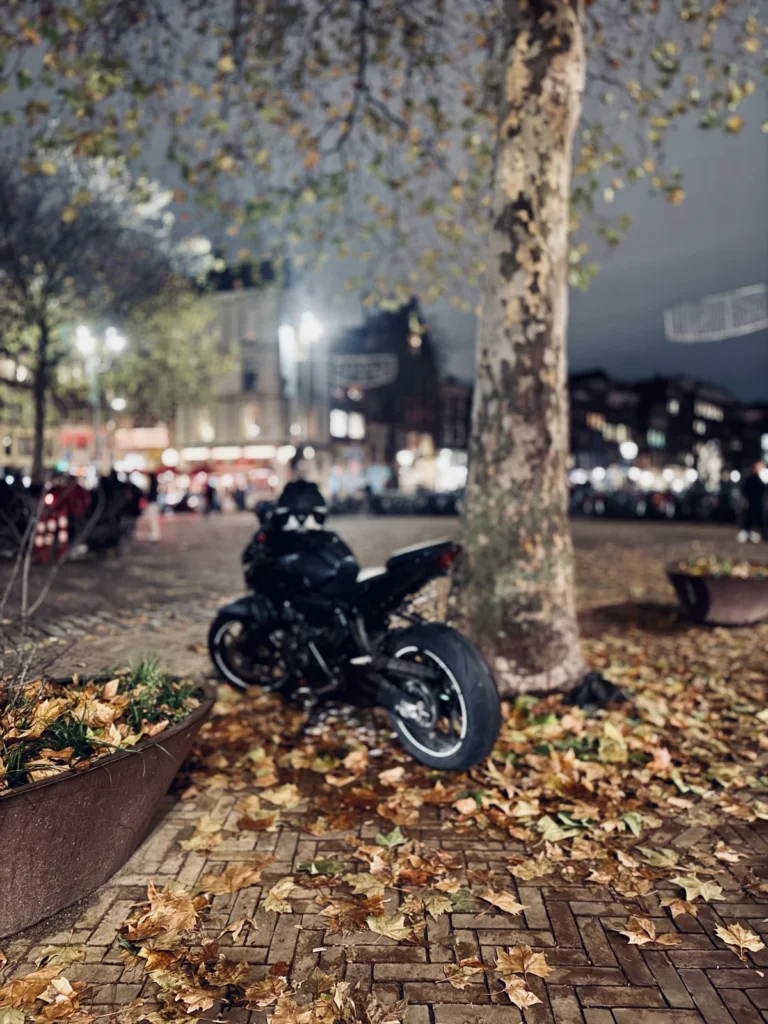
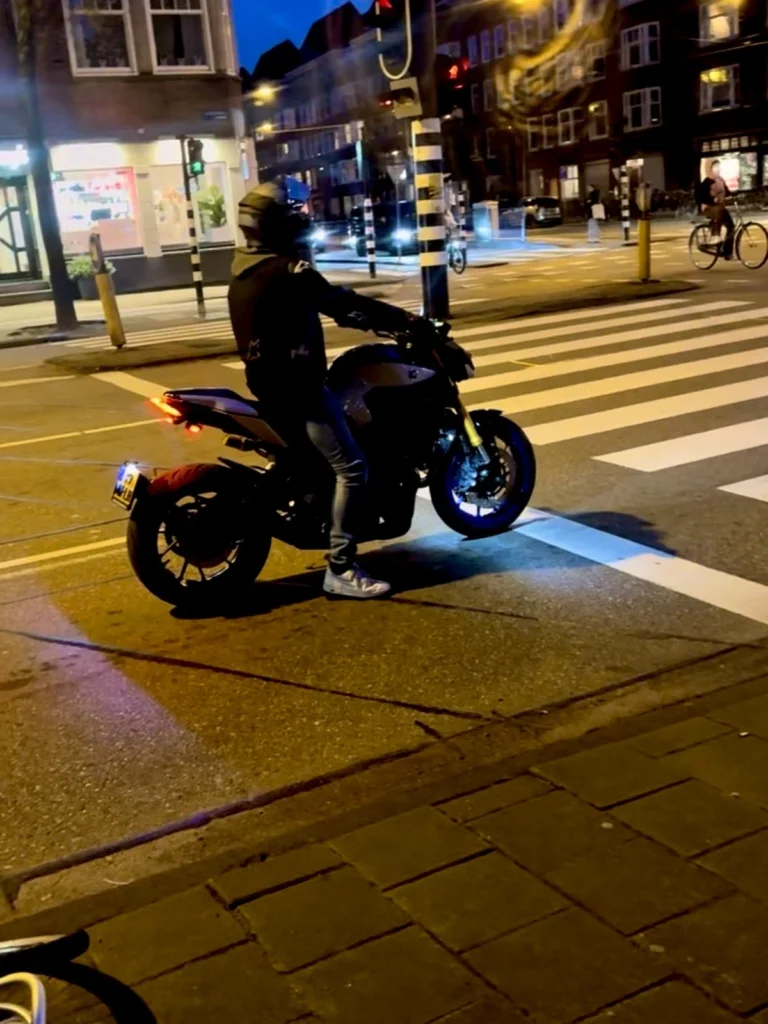
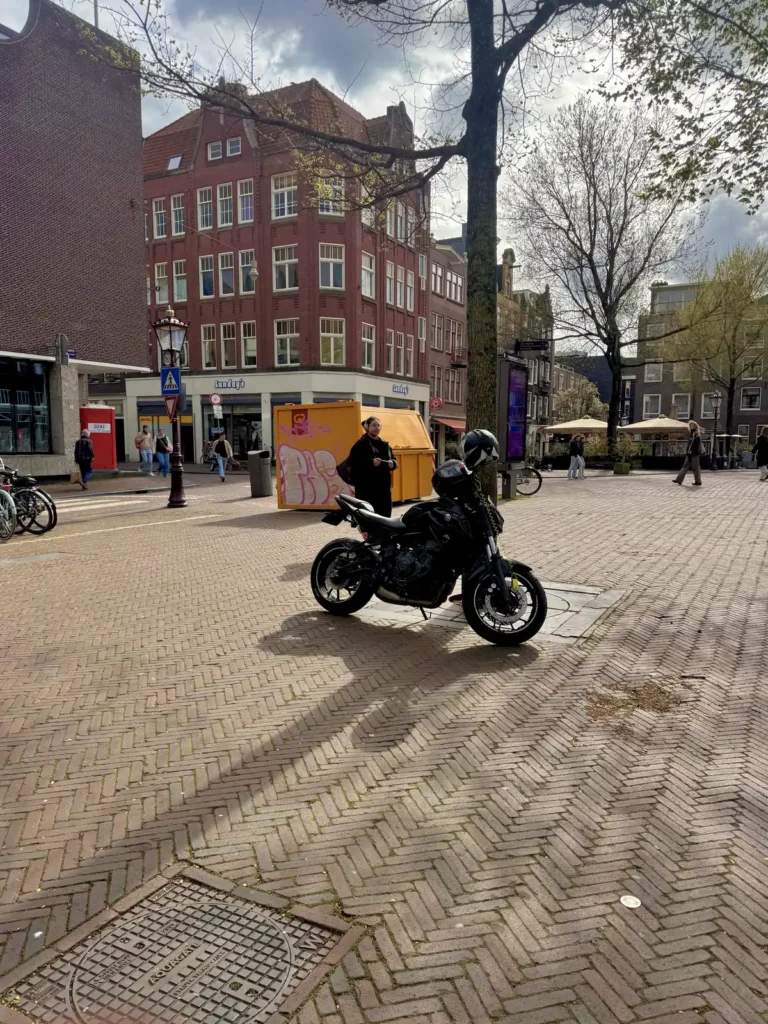
Some surfaces become noticeably more slippery when wet.
These include:
- Road markings
- Pedestrian crossings
- Direction arrows
- Manhole covers
- Metal construction plates
- Bridge joints
- Tram tracks
- Wet leaves
- Mud
- Fuel or oil
- Smooth repaired asphalt
Official motorcycle manuals specifically identify wet lane markings, steel plates and manhole covers as low-traction surfaces.
When you need to cross one:
- Reduce speed beforehand.
- Choose a predictable path.
- Keep the motorcycle as upright as possible.
- Maintain a neutral or gentle throttle.
- Avoid hard braking while directly on it.
- Avoid sharp steering.
- Wait until normal grip returns before accelerating harder.
For a full explanation of loose and low-grip surfaces, read How to Handle Gravel, Sand & Slippery Roads.
13. Cross Tram Tracks Deliberately
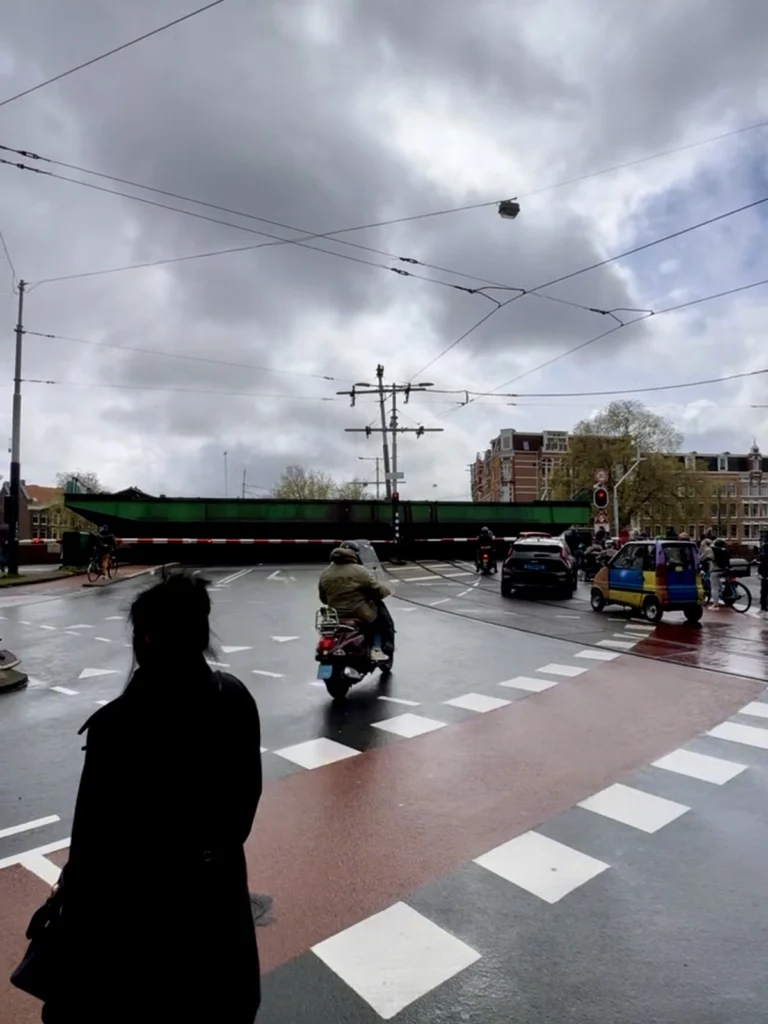
Wet tram tracks deserve particular attention when riding in Amsterdam.
The smooth metal surface can offer less grip than the surrounding road. A motorcycle tyre can also be affected if it travels almost parallel to the rail.
Plan the crossing early.
When traffic conditions allow:
- Create a clear crossing angle
- Reduce speed before reaching the track
- Keep the motorcycle controlled and relatively upright
- Use steady throttle
- Avoid braking sharply on the rail
- Look towards the road beyond the track
- Cross without hesitation or a sudden steering flick
Do not focus only on the ideal crossing angle.
You must still account for:
- Cyclists
- Pedestrians
- Oncoming traffic
- Parked vehicles
- Other tram lines
- Vehicles beside you
A theoretically perfect crossing is not safe if achieving it requires a sudden move into another road user.
Look ahead, establish your road position early and remain predictable.
14. Avoid Deep or Unclear Standing Water
A puddle may hide:
- A pothole
- A damaged road edge
- Loose stones
- A drain
- A deep depression
- Mud
- A raised object
Avoid standing water when you can do so safely and predictably.
Do not make a sharp swerve into another lane just to avoid a shallow puddle. Check your mirrors and surroundings, then adjust your path early.
When crossing unavoidable water:
- Reduce speed beforehand
- Keep the bike upright
- Use a steady throttle
- Avoid harsh braking
- Avoid sudden steering
- Keep your eyes on the exit
At higher speeds, deeper water can interfere with tyre contact and make steering feel lighter or less responsive. The Highway Code advises easing off the accelerator and slowing gradually if steering becomes unresponsive in wet conditions.
Do not grab the brakes or snap the throttle closed.
Allow the motorcycle to slow progressively while keeping it pointed along a safe path.
Never ride into moving floodwater when you cannot judge its depth or strength.
Turning around is the correct decision.
15. Make Yourself Easier to See
Rain and road spray reduce contrast.
A driver may see only a grey road, grey sky and a small dark motorcycle blending into the background.
Improve your visibility by:
- Checking that all lights work
- Keeping the headlight and brake light clean
- Using reflective areas on your gear
- Avoiding long periods in blind spots
- Creating space around the motorcycle
- Signalling early
- Avoiding unpredictable lane movements
- Positioning where drivers are more likely to see you
Do not assume a driver has noticed you simply because your light is on.
Watch the vehicle’s wheels, road position and speed. Look for evidence that the driver is actually responding to your presence.
The MSF recommends bright or retroreflective equipment to improve a rider’s visibility, particularly in poor light.
This is where defensive riding becomes especially important. Read Beginner’s Guide to Defensive Motorcycle Riding for more guidance.
16. Be Careful Around Cars and Large Vehicles
Other vehicles create additional wet-weather hazards.
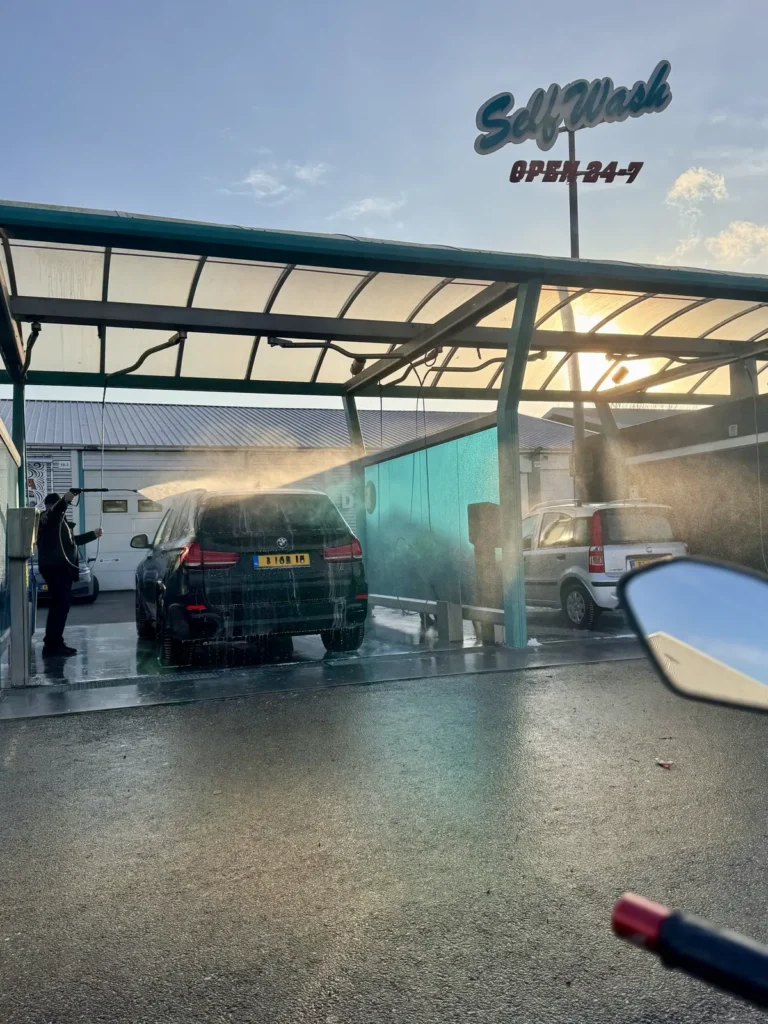
They may:
- Throw spray onto your visor
- Hide puddles and debris
- Change lanes without seeing you
- Brake suddenly
- Create turbulence
- Drive through standing water beside you
Avoid riding alongside another vehicle for longer than necessary.
When overtaking, make sure you can see the road ahead and have enough space to complete the manoeuvre without rushing.
Passing a large vehicle may temporarily expose you to:
- Heavy spray
- A change in wind pressure
- Turbulence
- Reduced visibility
Keep your grip relaxed and expect the motorcycle to move slightly.
Do not accelerate aggressively simply to escape the spray. Wait for a safe, visible opportunity and make the manoeuvre smoothly.
17. Reduce Speed in Heavy Rain and Motorway Spray
Heavy rain can reduce visibility faster than it reduces traction.
On a motorway, speed may feel normal until you enter spray from several vehicles. Suddenly, you can no longer see the lane markings, road surface or traffic ahead clearly.
Reduce speed before visibility becomes critical.
Increase your following distance and avoid using the vehicle ahead as your only guide. Following its rear lights can give you false confidence when you cannot see what lies beyond it.
Your speed must allow you to stop within the distance you can clearly see.
Consider leaving the motorway or stopping somewhere safe when:
- You cannot see lane markings clearly
- Water is accumulating across the road
- Your visor will not remain clear
- Crosswinds are moving you across the lane
- You are becoming tense or fatigued
- Traffic is travelling too fast for the conditions
- Lightning or extreme weather is approaching
Stopping safely is better than continuing simply because your destination is close.
18. Stay Relaxed, Warm and Mentally Alert
Rain increases your workload.
You are processing visibility, grip, wind, cold, traffic and the road surface at the same time.
Signs that your performance is declining include:
- Tight shoulders
- Locked elbows
- Holding your breath
- Shivering
- Numb fingers
- Missing road signs
- Staring at the vehicle ahead
- Rushing gear changes
- Feeling angry or overwhelmed
- Wanting to “get it over with”
Take those signs seriously.
Find a safe place to stop, warm up and reassess the ride.
Cold and wet conditions can contribute to fatigue and reduced control, which is why official motorcycle guidance recommends clothing that keeps riders both warm and dry.
A ten-minute break can restore more safety than trying to save ten minutes by continuing while tense and cold.
Riding in Rain at Night
Night rain combines several visibility problems:
- Glare from headlights
- Reflections from wet asphalt
- Fogging inside the visor
- Water droplets scattering light
- Less visible road markings
- Hidden standing water
- Reduced ability to read the road surface
Reduce your speed further than you would during daylight.
Avoid looking directly at oncoming headlights. Use the visible edge and lane markings to help maintain your path without staring at the light source.
Keep your visor clean and avoid using a dark or heavily tinted visor.
A scratched visor that feels acceptable in daylight may produce distracting glare at night. Replace it when damage begins affecting your vision.
Most importantly, do not ride faster than the distance illuminated clearly by your headlight.
Riding in Rain With a Passenger
A passenger adds weight and changes the way the motorcycle accelerates, brakes and turns.
Before riding:
- Explain that the ride will be slower
- Ask the passenger to remain relaxed
- Tell them to avoid sudden body movements
- Make sure they have waterproof protective gear
- Confirm that both feet can remain securely on the pegs
- Increase your braking distance further
- Use especially smooth clutch and throttle control
Do not continue if your passenger becomes cold, frightened or uncomfortable.
Their tension can transfer into the motorcycle and make your own control more difficult.
Common Mistakes
| Mistake | Why It Creates Risk | Better Habit |
|---|---|---|
| Riding at normal dry-road speed | Leaves less time and grip for unexpected hazards | Reduce speed based on visibility and surface conditions |
| Following too closely | Reduces braking and planning time | Increase the gap significantly |
| Grabbing the front brake | Can overwhelm available grip | Apply both brakes progressively |
| Avoiding the front brake completely | Reduces effective braking ability | Use the front and rear smoothly |
| Entering corners too fast | May force braking or extra lean mid-corner | Slow while upright before the turn |
| Looking directly in front of the wheel | Limits hazard detection | Scan farther ahead |
| Tensing the arms | Transfers instability into the handlebars | Relax your hands and bend your elbows |
| Swerving around every wet patch | Adds sudden steering inputs | Choose a smooth path early |
| Trusting ABS completely | ABS cannot create traction | Manage speed, line and inputs first |
| Wearing non-waterproof gear | Cold and discomfort reduce focus | Use waterproof, protective layers |
| Staying beside large vehicles | Increases spray and blind-spot exposure | Create space and pass only when safe |
| Riding through unknown puddles | Water may hide deep hazards | Avoid or cross slowly and upright |
| Continuing when visibility is poor | Removes the ability to plan safely | Stop somewhere safe and reassess |
What to Do After a Wet Ride
Rainwater, road dirt and salt can remain on the motorcycle after the ride.
Once the bike has cooled:
- Rinse away road dirt where appropriate
- Dry exposed metal surfaces
- Clean the lights
- Clean the visor
- Check the chain
- Lubricate the chain when required
- Inspect the tyres
- Check the brakes
- Allow wet gear to dry completely
- Remove damp liners from the helmet if designed to be removable
- Avoid storing gloves or clothing while still wet
Do not apply lubricant immediately before riding if excess product could reach the tyre or brake components.
Follow the motorcycle, chain and cleaning-product manufacturer’s instructions.
A few minutes of care after a wet ride helps keep the motorcycle ready for the next one.
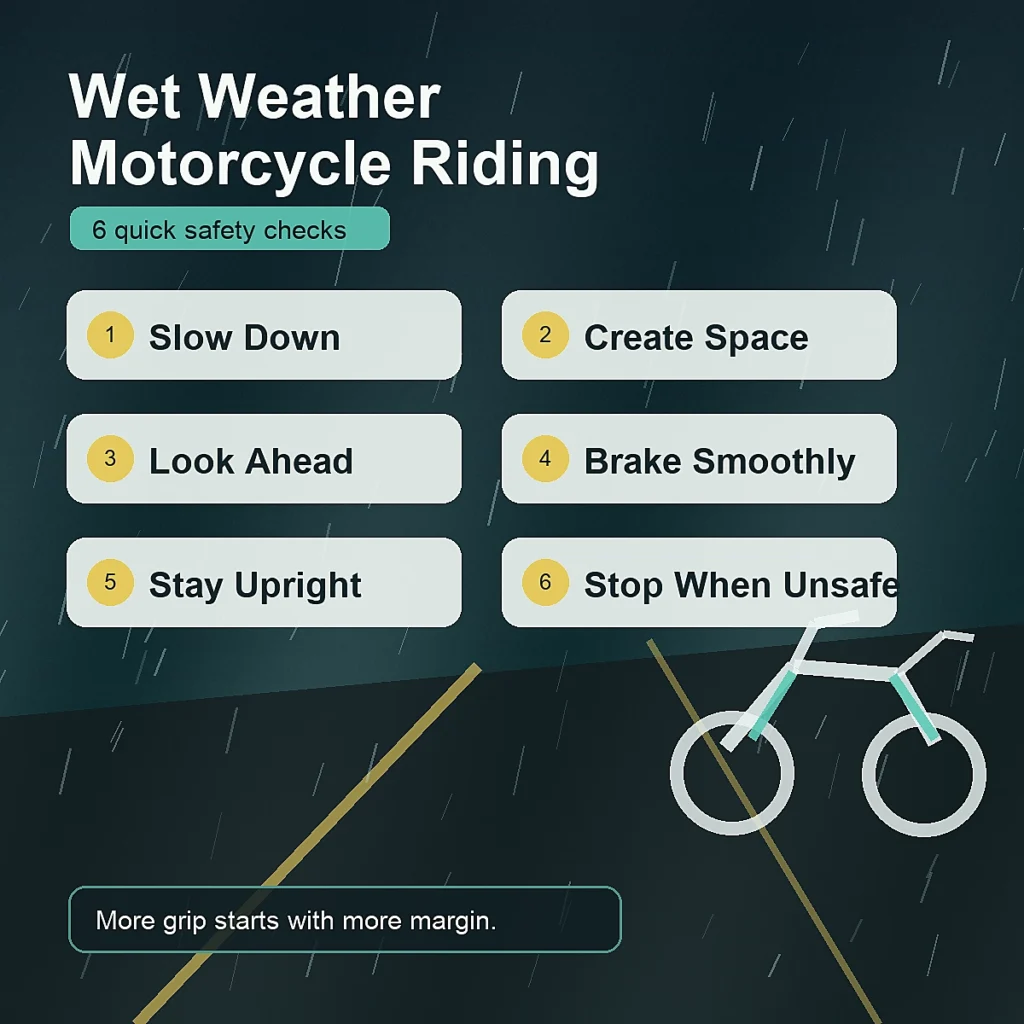
Wet Weather Motorcycle Riding Checklist
Before the ride:
- Check the forecast
- Choose a suitable route
- Inspect tyres and pressures
- Test the brakes
- Check all lights
- Clean and prepare the visor
- Wear waterproof protective gear
- Secure luggage
- Allow extra travel time
During the ride:
- Reduce speed
- Increase following distance
- Look farther ahead
- Brake earlier
- Use both brakes progressively
- Keep the throttle smooth
- Slow before corners
- Cross paint and metal upright
- Avoid deep standing water
- Stay out of blind spots
- Monitor your temperature and concentration
- Stop when visibility becomes unsafe
After the ride:
- Clean the visor and lights
- Inspect tyres and brakes
- Clean and lubricate the chain as required
- Dry your gear fully
- Note any equipment that failed to keep you dry
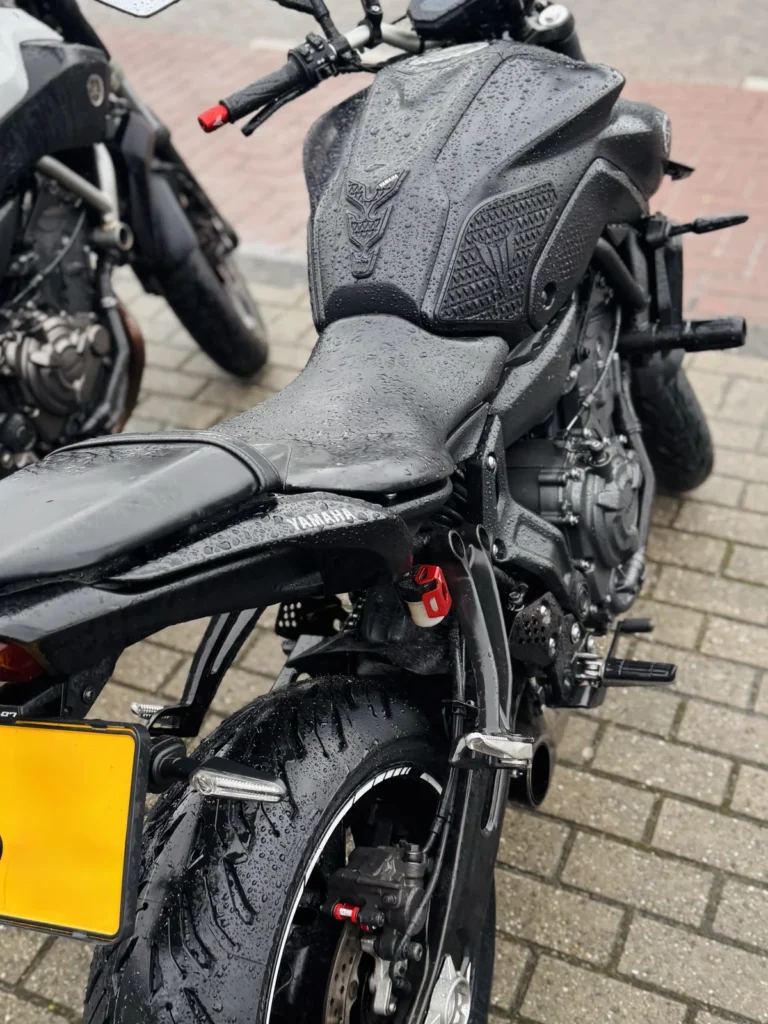
Final Thoughts: Rain Rewards Calm Riders
Wet-weather riding is not about showing how fearless you are.
It is about recognising that the road has changed and changing your riding with it.
You need more time.
More space.
More vision.
More patience.
Slow down before the corner. Brake earlier. Keep your hands relaxed. Look beyond the spray and give every control input time to work.
Some wet rides will still feel uncomfortable.
That is normal.
Confidence in the rain should not come from pretending the road has the same grip as it does in the dry. It should come from knowing that you have adjusted your speed, line, distance and mindset to suit the conditions.
The aim is not to ride through rain as quickly as possible.
The aim is to arrive with your concentration, motorcycle and confidence intact.
Ride smart. Stay smooth. Come home safe.
FAQs
Is it safe to ride a motorcycle in the rain?
A motorcycle can be ridden in rain when the rider, motorcycle, equipment and conditions are suitable. Reduce speed, increase following distance, use smooth controls and stop when visibility, wind or standing water makes the ride unsafe.
How much should I slow down when riding in rain?
There is no single correct speed reduction. Your speed should depend on visibility, grip, traffic, standing water, wind and your experience. Ride slowly enough to stop within the distance you can clearly see.
Should I use the front brake in the rain?
Yes. Use the front and rear brakes progressively while keeping the motorcycle upright where possible. Do not grab the front brake suddenly or rely only on the rear.
Are motorcycle tyres safe in the rain?
Road-legal motorcycle tyres in good condition can provide useful wet grip, but their performance depends on tread, pressure, temperature, surface condition and rider inputs. Check them before riding and maintain the manufacturer’s recommended pressures.
Is the road more slippery when rain first starts?
It can be. Early rain may mix with oil, dust and dirt on the road, creating a slippery film. Reduce speed and use extra caution, particularly near junctions and heavily used traffic areas.
How should I corner a motorcycle in the rain?
Reduce speed before entering the corner, look through the turn, use a smooth line and avoid abrupt braking or throttle changes. Use less lean and keep more traction in reserve.
How do I stop my motorcycle visor from fogging?
Use a compatible anti-fog insert, keep the visor clean, open the helmet vents and increase airflow. Opening the visor slightly at low speed may help, but take care not to allow excessive water inside.
Are wet tram tracks dangerous for motorcycles?
Wet rails can provide less grip than asphalt and may affect a tyre travelling almost parallel to them. Cross at a clear angle when traffic allows, keep the motorcycle controlled and avoid braking or steering sharply on the rail.
Should I use rain mode on my motorcycle?
Rain mode may soften throttle response or adjust electronic assistance, depending on the motorcycle. It can be helpful, but it does not replace smooth control, lower speed or good judgement. Follow the owner’s manual.
When should I stop riding in the rain?
Stop somewhere safe when you cannot see the road clearly, water is flooding the route, wind is pushing you off line, your visor will not remain clear, you are too cold or you no longer feel able to make calm decisions.
Related Reads
Continue improving your wet-road control with:
How to Handle Gravel, Sand & Slippery Roads
How to Brake Safely on a Motorcycle
How to Corner Safely on a Motorcycle