One of the biggest lessons motorcycling teaches you is this:
Where your eyes go, the motorcycle wants to follow.
At first, that sounds too simple. Almost too obvious.
But once you start riding, you realize how powerful it is.
If you stare at the outside of a corner, the corner feels tighter.
If you stare at a pothole, your body wants to guide the bike toward it.
If you look only a few meters ahead, everything feels faster and more stressful.
If you look through the corner, the bike feels calmer, smoother and easier to control.
Good vision is one of the most important motorcycle riding skills you can build.
It affects your cornering, braking, lane positioning, hazard awareness, traffic riding and confidence. It also helps prevent one of the most dangerous beginner mistakes: target fixation.
This guide is about how to use your eyes properly on a motorcycle — not just where to look, but how to scan, how to read the road and how to train yourself to look where you actually want to go.
Because safe riding does not only happen in your hands.
It starts with your eyes.
Start with the basics : Motorcycle safety for beginners
Quick Answer: What Are Motorcycle Vision Techniques?
Motorcycle vision techniques are the habits riders use to look farther ahead, scan for hazards, look through corners, avoid target fixation and guide the motorcycle smoothly. The main idea is simple: look where you want to go, not at what you are afraid of hitting.
Good vision gives you more time, better balance, smoother control and safer decisions.
Why Vision Matters So Much on a Motorcycle
On a motorcycle, your eyes are not just for seeing.
They are part of your control system.
The direction you look affects your head, shoulders, arms, hands, body position and steering inputs. When your eyes focus on the right place, your body naturally becomes better aligned with where the motorcycle needs to go.
When your eyes focus on the wrong place, your body can work against you.
That is why vision matters so much.
Good vision helps you:
- Spot hazards earlier
- Choose better lines through corners
- Brake sooner and smoother
- Avoid target fixation
- Stay calmer in traffic
- Maintain better lane position
- Reduce panic reactions
- Ride more smoothly
- Build confidence as a beginner
Many beginner riders try to fix riding problems with their hands first.
They grip harder.
They steer harder.
They brake later.
They tense up.
They try to force the bike.
But often, the problem started with the eyes.
If you look too close, you react late.
If you look at danger, you move toward danger.
If you do not look through the corner, the bike feels harder to turn.
If you do not scan ahead, traffic surprises you.
Better vision makes everything else easier.
The Golden Rule: Look Where You Want to Go
The most important motorcycle vision rule is:
Look where you want to go.
Not where you are afraid of going.
Not at the obstacle.
Not at the curb.
Not at the gravel.
Not at the car that is making you nervous.
Look at the path you want the motorcycle to take.
This is easy to understand, but harder to do when something scares you.
If you suddenly see a pothole, your eyes naturally want to stare at it. If a corner feels too tight, your eyes may lock onto the outside edge. If traffic stops suddenly, you may stare at the bumper in front of you instead of looking for your stopping zone or escape path.
That is the moment you need to train your eyes.
The bike follows your focus.
So give it the right focus.
Look at the safe path.
Look through the turn.
Look toward the exit.
Look where you want the bike to go.
Your eyes should search for solutions, not freeze on problems.
Look Farther Ahead Than Feels Natural
Beginner riders often look too close to the motorcycle.
This makes the ride feel faster because hazards appear suddenly. You notice the pothole late. You see the traffic slowing late. You realize the corner is tightening late. Then everything becomes rushed.
Looking farther ahead gives you time.
Time to slow down.
Time to choose your line.
Time to adjust your lane position.
Time to avoid bad road surfaces.
Time to read traffic patterns.
Time to stay calm.
A simple habit is to look as far ahead as you can clearly use.
That does not mean ignoring the road directly in front of you. It means your main attention should not be trapped near your front wheel.
Your vision should work in layers:
- Far ahead: What is coming next?
- Mid-distance: What needs my attention soon?
- Near road surface: Is there anything I need to avoid now?
- Mirrors and sides: What is happening around me?
Do not stare at one point. Scan.
A good rider’s eyes are always moving.
Read : Top 10 Motorcycle Safety Tips Every Rider Should Know
How to Look Through a Corner
Looking through the corner is one of the most important motorcycle cornering skills.
When you approach a corner, your eyes should not stop at the entry point. They should search deeper into the bend and toward the exit.
The basic process looks like this:
- Look ahead before the corner
- Read the shape of the turn
- Slow down before entering
- Turn your head toward where you want to go
- Look through the corner
- Keep your eyes moving toward the exit
- Let the motorcycle follow your vision
The key is to turn your head, not just your eyes.
If you only move your eyes while your head stays fixed forward, your body may remain stiff. Turning your head helps your shoulders and upper body align naturally with the direction of the turn.
Think of pointing your chin toward the exit.
That small habit can change how cornering feels.
Instead of staring at the road directly in front of you, you guide the bike with your vision.
The corner feels slower.
The line feels clearer.
The bike feels easier to steer.
Your body feels less tense.
Good cornering starts with good eyes.
Do Not Stare at the Outside of the Corner
One of the most common beginner mistakes is staring at the outside edge of the corner.
This usually happens when the rider feels they are going too fast or the corner is tighter than expected. The brain sees the outside curb, barrier, road edge or oncoming lane and thinks, “Do not go there.”
But the eyes stay locked on it.
That is the problem.
When you stare at the outside, your body may guide the bike toward the outside. You become stiff. Your arms lock. You stop looking through the corner. The bike feels like it does not want to turn.
In many cases, the motorcycle could still make the corner, but the rider’s vision and tension make it harder.
If a corner starts to feel uncomfortable, remind yourself:
Look through. Stay smooth. Breathe.
Do not stare at the danger.
Look at the path.
The motorcycle needs your direction, not your fear.
Check : How to corner safely on a motorcycle
Target Fixation: The Vision Mistake Every Rider Must Respect
Target fixation is when you focus so strongly on a hazard that you unintentionally move toward it.
It can happen with:
- Potholes
- Gravel
- Curbs
- Barriers
- Parked cars
- Oncoming vehicles
- Road edges
- Wet patches
- Metal covers
- The outside of a corner
Target fixation is dangerous because it feels natural in the moment. Your brain wants to look at the thing that scares you.
But on a motorcycle, staring at the danger can make the danger worse.
The solution is not to ignore hazards. You need to see them. But once you have identified the hazard, your eyes must move to the safe path.
For example:
If there is gravel in the road, notice the gravel, then look at the clean line around it.
If a pothole appears, notice it, then look at the path beside it.
If a corner tightens, notice the problem, then turn your head and look deeper into the turn.
A simple rule:
See the hazard. Choose the path. Look at the path.
That is how you fight target fixation.
Scanning: Do Not Lock Your Eyes in One Place
Good motorcycle vision is not about staring far ahead and ignoring everything else.
It is about scanning.
Your eyes should move constantly but calmly.
Look far ahead.
Check the road surface.
Check mirrors.
Watch junctions.
Notice side roads.
Read traffic lights.
Watch vehicle wheels.
Check pedestrians.
Return to the road ahead.
This should not feel frantic. It should feel like building a picture.
You are asking:
- What is happening ahead?
- What could happen next?
- What is changing?
- What can I not see yet?
- Where is my escape path?
- What is the road surface doing?
- Who might move into my space?
The better your scanning, the fewer surprises you get.
And fewer surprises usually means safer riding.
Use Your Peripheral Vision
When riding, you do not need to stare directly at everything to be aware of it.
Peripheral vision helps you notice movement around you while your main focus stays on the road ahead.
For example, you may notice:
- A car moving beside you
- A cyclist approaching from the side
- A pedestrian stepping near the curb
- Brake lights appearing in another lane
- A vehicle drifting toward your lane
- A scooter filtering through traffic
Your central vision is for detail.
Your peripheral vision is for movement and awareness.
This is another reason why staring at one object is dangerous. If your eyes lock onto one thing, your wider awareness reduces.
Keep your gaze soft enough to notice the environment, but focused enough to guide the motorcycle.
That balance takes practice.
Watch the Wheels, Not Just the Vehicle
When reading traffic, watch vehicle wheels.
A car’s wheels often reveal movement before the whole vehicle does. This is especially useful at junctions, roundabouts, parking exits and side roads.
If a front wheel starts turning, the vehicle may be about to move.
If a parked car’s wheel turns outward, it may pull out.
If a vehicle creeps forward, the driver may not have seen you.
If a car drifts toward the lane line, it may change lanes.
Indicators help, but they are not always reliable.
Wheels and body movement often tell the truth earlier.
This is a defensive riding vision technique that becomes very useful in city traffic.
Do not only see vehicles.
Read their intentions.
Look for Gaps in Traffic
Traffic gaps are important clues.
A gap can mean someone is about to move into it.
If traffic slows and a gap opens in the next lane, expect a car to change lanes.
If there is a gap near a junction, expect a vehicle to turn through it.
If cars stop and leave space, expect a pedestrian, cyclist, or turning vehicle.
If a parked vehicle has space to pull out, prepare for movement.
Beginner riders often watch only the vehicles.
Experienced riders also watch the spaces between them.
Movement often happens into empty space.
So when you ride in traffic, ask yourself:
What gap might someone try to use?
That one question helps you anticipate danger earlier.
Vision in City Riding
City riding demands active eyes.
In a city, hazards come from everywhere: cars, bicycles, pedestrians, buses, trams, delivery vans, scooters, road markings, traffic lights, parked vehicles and impatient people.
You cannot stare at one thing for long.
In city riding, scan for:
- Pedestrians near crossings
- Cyclists moving unpredictably
- Parked cars with people inside
- Car doors opening
- Delivery vans stopping suddenly
- Taxi movements
- Tram tracks
- Painted lines
- Traffic lights changing
- Vehicles turning without indicating
- Drivers looking at phones
- Gaps in traffic
Your eyes should work ahead of your motorcycle.
Do not ride into a situation and then figure it out.
Read it before you arrive.
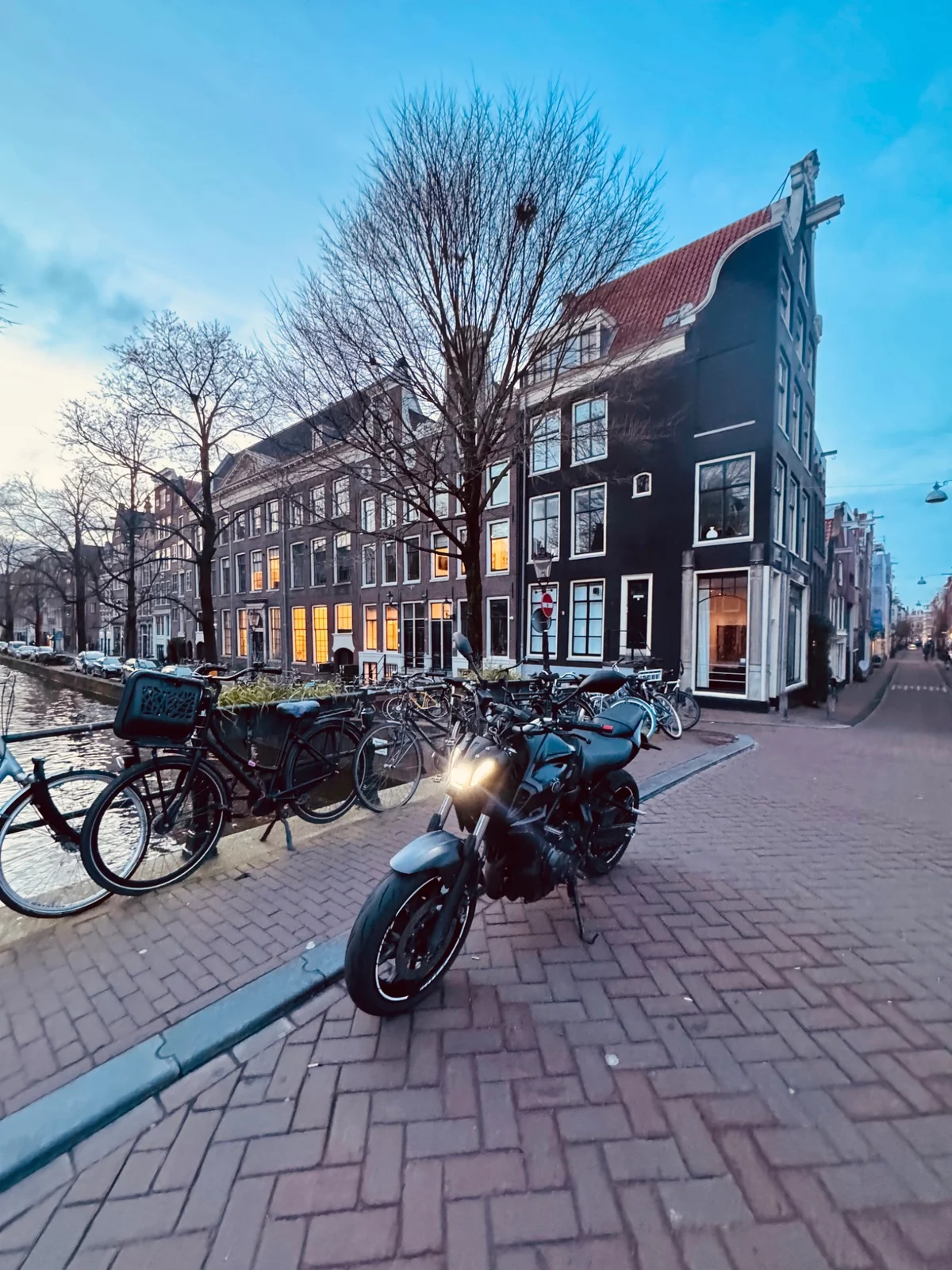
In places like Amsterdam, this matters even more. The traffic environment can be busy and layered, with cyclists, scooters, pedestrians, cars and trams all sharing space. Good vision helps you stay calm instead of overwhelmed.
The goal is not to see everything perfectly.
The goal is to notice the important clues early enough to ride smoothly.
Vision on Country Roads
Country roads can feel peaceful, but they require strong vision.
Corners may be blind.
Road surfaces may change quickly.
Gravel may collect near the edge.
Mud may appear after farm traffic.
Cyclists may be around the bend.
Animals may cross.
The road may tighten unexpectedly.
On country roads, look as far through the road as visibility allows.
If you cannot see the exit of a corner, treat it with respect.
Do not assume the road is clear just because it looks quiet.
Use your eyes to ask:
- Can I see the exit?
- Could the corner tighten?
- Is there debris near the edge?
- Is the road shaded or damp?
- Is there oncoming traffic?
- Is my lane position giving me enough visibility?
- Do I have space if something appears?
The less you can see, the more margin you need.
Vision and patience go together.
Vision in the Rain
Rain makes vision harder and more important.
Your visor may collect water. Car windows may fog. Road markings may shine. Lights may reflect. Grip may change. Other road users may behave more unpredictably.
In the rain, your eyes need to work earlier.
Look farther ahead so you can brake sooner and smoother. Watch for shiny surfaces, painted lines, tram tracks, metal covers, puddles, wet leaves and oil patches.
Avoid staring directly at slippery hazards. See them, then look for the cleanest path.
In wet conditions:
- Scan earlier
- Brake earlier
- Reduce lean
- Keep more following distance
- Avoid sudden inputs
- Keep your visor clean
- Use smooth vision through corners
Rain rewards riders who see early and act calmly.
If you see late, you react late.
Vision at Night
Night riding reduces the amount of information your eyes can collect.
You cannot see as far. Road surfaces are harder to read. Corners can feel different. Oncoming headlights can distract you. Pedestrians and cyclists may be harder to spot.
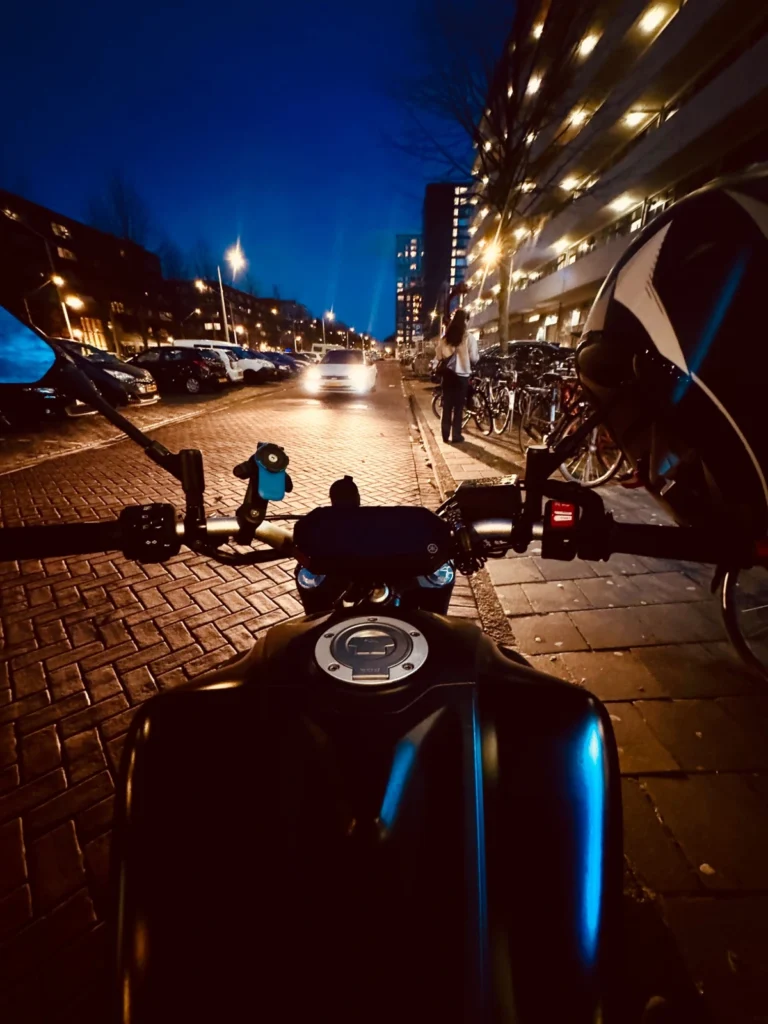
At night, do not ride faster than your vision allows.
If you cannot see far enough to stop safely, you are going too fast for the conditions.
Use your headlight, but do not depend only on it. Scan for reflections, movement, shadows, brake lights, road signs, lane markings and changes in surface texture.
Keep your visor clean. A dirty visor at night can scatter light and make visibility worse.
Night riding requires humility.
When vision is reduced, speed should reduce too.
How Vision Helps With Braking
Good braking starts before your fingers touch the brake lever.
If you look far ahead, you notice slowing traffic earlier. That means you can roll off the throttle sooner, brake smoother and avoid panic.
Poor vision creates late braking.
Late braking creates stress.
Stress creates sudden inputs.
That is why braking and vision are connected.
Learn : How to brake safely on a motorcycle
In traffic, do not only watch the car directly in front of you. Look through and around traffic if possible. Watch brake lights several vehicles ahead. Notice when the flow of traffic is changing.
If traffic ahead compresses, prepare early.
Good riders brake before the situation becomes urgent.
That starts with seeing early.
How Vision Helps With Cornering
Cornering becomes much easier when your vision is correct.
If you look through the corner, the motorcycle feels like it has a clear direction. If you stare near the front wheel or at the outside edge, the corner feels tighter and more stressful.
Before a corner, your eyes help you choose:
- Entry speed
- Lane position
- Line
- Braking point
- Throttle timing
- Exit direction
Inside the corner, your eyes help you stay calm and guide the bike.
After the corner, your eyes should already be looking toward the next part of the road.
This is why cornering is not only a lean skill.
It is a vision skill.
If you want better corners, train better eyes.
A Simple Vision Routine for Every Ride
Here is a simple routine you can practice on every ride:
1. Look Far Ahead
Keep your main focus ahead of where you are, not just where the bike is now.
2. Scan Back Toward Yourself
Briefly check the mid-distance and near road surface for hazards.
3. Check Mirrors
Know what is happening behind you, especially before braking or changing position.
4. Check Side Roads and Junctions
Expect movement from places where vehicles, cyclists, or pedestrians can enter your path.
5. Look for Escape Paths
Always know where you could go if something changes suddenly.
6. Return Your Eyes Ahead
Do not let your eyes get stuck too long in one place.
This routine becomes smoother with practice.
Eventually, you will not think about each step separately. Your eyes will naturally scan and return.
That is when riding starts to feel calmer.
How to Practice Motorcycle Vision Techniques
You can practice vision on almost every ride, even at low speed.
Start with simple exercises.
Practice 1: Look Farther Ahead
On a familiar road, consciously look farther ahead than usual. Notice how much earlier you see traffic lights, corners, brake lights and road surface changes.
Practice 2: Turn Your Head Through Corners
On slow, safe corners, practice turning your head and pointing your chin toward the exit. Do not just move your eyes.
Practice 3: Name Hazards Early
While riding calmly, mentally name potential hazards: side road, pedestrian, gravel, parked car, cyclist, junction, brake lights.
This trains your brain to see clues earlier.
Practice 4: Find Escape Paths
In traffic, ask yourself: “Where would I go if the vehicle ahead stopped suddenly?”
Do this without panic. It is just awareness training.
Practice 5: Notice Target Fixation
When you see a pothole or hazard, notice if your eyes want to lock onto it. Then deliberately move your eyes to the safe path.
This is one of the most valuable habits you can train.
Common Mistakes
Mistake 1: Looking Too Close
If you look only near the front wheel, everything feels faster and hazards appear late.
Better habit: look farther ahead and scan back.
Mistake 2: Staring at Hazards
Staring at potholes, gravel, or curbs can pull you toward them.
Better habit: see the hazard, then look at the safe path.
Mistake 3: Not Turning the Head in Corners
Only moving your eyes may not guide your body enough.
Better habit: turn your head and point your chin through the corner.
Mistake 4: Fixating on the Vehicle Ahead
If you only watch the car directly in front, you miss traffic patterns beyond it.
Better habit: look through traffic and watch several vehicles ahead when possible.
Mistake 5: Ignoring Mirrors
Good vision includes knowing what is behind you.
Better habit: check mirrors regularly, especially before slowing or changing position.
Mistake 6: Looking at the Outside of a Corner
Staring at potholes, gravel, or curbs can pull you toward them.
Better habit: see the hazard, then look at the safe path.
Mistake 7: Not Reading Road Surface
Grip changes matter on a motorcycle.
Better habit: scan for paint, gravel, oil, water, metal covers, tram tracks and debris.
Motorcycle Vision Checklist for Beginners
Use this checklist while riding:
- Am I looking far enough ahead?
- Am I scanning instead of staring?
- Am I turning my head through corners?
- Am I looking where I want to go?
- Am I avoiding target fixation?
- Am I watching road surface changes?
- Am I checking mirrors regularly?
- Am I reading traffic gaps?
- Am I watching vehicle wheels at junctions?
- Do I know my escape path?
You do not need perfect vision.
You need active vision.
That alone will make you a safer rider.
Final Thoughts: Your Eyes Lead the Ride
Motorcycle vision techniques are simple, but they are not small.
They change the way you ride.
When your eyes improve, your riding becomes smoother. You brake earlier. You corner better. You notice hazards sooner. You panic less. You stop fighting the bike and start guiding it.
That is the kind of riding I want to build.
Calm. Smooth. Aware. Intentional.
Not because I want to ride slowly forever, but because I want to ride well for a long time.
The next time you ride, pay attention to your eyes.
Are you looking far enough ahead?
Are you staring at hazards?
Are you turning your head through corners?
Are you scanning for escape paths?
Are you seeing problems early enough to stay calm?
Your hands control the motorcycle.
But your eyes lead the ride.
Look where you want to go.
Ride smart. Stay calm. Come home safe.
FAQs
What are motorcycle vision techniques?
Motorcycle vision techniques are riding habits that help you look farther ahead, scan for hazards, look through corners, avoid target fixation, and guide the motorcycle smoothly through traffic and turns.
Where should I look when riding a motorcycle?
You should look far ahead, scan the road surface, check mirrors, watch junctions and look where you want the motorcycle to go. Avoid staring only at the road directly in front of your wheel.
How do I look through a corner on a motorcycle?
To look through a corner, turn your head and point your chin toward the corner exit. Keep your eyes moving through the turn instead of staring at the entry point, curb or outside edge.
Why does a motorcycle go where you look?
Your eyes influence your head, shoulders, arms, body position and steering inputs. When you look in a direction, your body naturally starts guiding the motorcycle that way.
How do I avoid target fixation?
To avoid target fixation, notice the hazard, then immediately move your eyes to the safe path around it. Do not stare at the thing you are trying to avoid.
Should I look at the road surface while riding?
Yes, but do not stare only at the road surface. Scan for hazards like gravel, oil, water, painted lines, tram tracks and debris, then return your vision farther ahead.
Related Reads
Train Your Eyes Before Your Next Ride
If you are building your riding foundation, read these next:
Motorcycle Safety for Beginners: The Complete Guide to Riding Smart and Staying Alive
How to Corner Safely on a Motorcycle: Step-by-Step Guide
How to Brake Safely on a Motorcycle: Front vs Rear Explained