One of the scariest things about motorcycling is how quickly your eyes can betray you.
You see a pothole, and suddenly you cannot stop looking at it.
You enter a corner too fast, and your eyes lock onto the outside edge.
A car pulls out, and your whole focus freezes on the danger.
There is gravel in the road and even though you want to avoid it, your bike seems to move straight toward it.
That is target fixation.
It is one of those riding mistakes that sounds simple when you read about it, but feels very real when it happens on the road.
Target fixation is dangerous because motorcycles tend to follow your eyes. Where you look affects your head, shoulders, arms, hands, steering, body tension and decision-making. If your eyes lock onto the thing you are afraid of hitting, your body can accidentally guide the motorcycle toward it.
The good news is that target fixation can be trained.
Start with the basics : Motorcycle safety for beginners
You can learn to notice hazards without staring at them. You can train your eyes to find the safe path. You can build calm habits that help you ride toward the solution instead of freezing on the problem.
This article explains how to avoid target fixation on a motorcycle, why it happens and how beginner riders can train better vision before panic takes over.
Because on a motorcycle, your eyes do not just watch the ride.
Your eyes lead the ride.
Quick Answer
How Do You Avoid Target Fixation on a Motorcycle?
To avoid target fixation on a motorcycle, train yourself to look where you want to go, not at the hazard. Notice the danger, then immediately move your eyes to the safe path or escape route. Keep your head turned, stay relaxed, slow down early and practice scanning so your eyes do not freeze under pressure.
A simple rule is:
See the hazard. Choose the path. Look at the path.
What Is Target Fixation?
Target fixation is when a rider focuses too strongly on a specific object or hazard and unintentionally moves toward it.
The “target” can be anything that grabs your attention:
- A pothole
- Gravel
- A curb
- A guardrail
- A parked car
- A car pulling out
- The outside of a corner
- A wet patch
- A road sign
- A barrier
- A cyclist
- Oncoming traffic
- A metal cover
- Tram tracks
- The edge of the road
The problem is not noticing the hazard.
You need to see hazards.
The problem is when your eyes stay locked on the hazard instead of moving to the safe path around it.
A good rider sees danger, understands it, then looks where they want the motorcycle to go.
A rider caught in target fixation sees danger, freezes on it and may unintentionally steer toward it.
That difference matters.
Why Target Fixation Happens
Target fixation happens because the brain is trying to protect you.
When something feels dangerous, your attention naturally locks onto it. That makes sense for survival. If there is a threat, your brain wants to study the threat.
But riding a motorcycle is different from standing still and observing danger.
On a motorcycle, your focus influences your direction.
When you stare at a hazard, several things can happen at the same time:
- Your head points toward the hazard
- Your shoulders follow your head
- Your arms become tense
- Your hands make small steering inputs
- Your body stops looking for alternatives
- Your breathing becomes shallow
- Your decision-making narrows
- The motorcycle drifts toward the thing you want to avoid
This can happen very quickly.
Target fixation is not a sign that you are a bad rider. It is a normal human reaction. But if you ride a motorcycle, you need to train a better response.
You need to teach your brain:
The hazard is information. The escape path is the goal.
Why Target Fixation Is So Dangerous on a Motorcycle
Motorcycles are sensitive to vision, body position and small inputs.
If you are driving a car and stare at a pothole, the car may still stay mostly straight because it has four wheels, more stability and a steering wheel that requires more deliberate input.
On a motorcycle, your body is part of the control system.
Your eyes guide your head.
Your head influences your shoulders.
Your shoulders affect your arms.
Your arms affect the handlebars.
The motorcycle responds.
This is why target fixation can become dangerous in corners, traffic and emergency situations.
If you look at the outside of a corner, you may run wide.
If you look at a pothole, you may hit it.
If you look at a curb, you may drift toward it.
If you look at a car pulling out, you may forget to look for your escape path.
If you look at gravel, your body may guide the bike straight into it.
The motorcycle often has more ability than the rider believes in that moment.
But fear narrows vision.
And narrow vision reduces options.
Avoiding target fixation is about keeping options alive.
Read : Motorcycle Safety Tips
The Golden Rule: Look Where You Want to Go
The most important rule is simple:
Look where you want to go.
Not where you are afraid of going.
Not at the thing you want to miss.
Not at the outside edge of the road.
Not at the barrier.
Not at the pothole.
Look at the path.
If there is a pothole, look at the clean line around it.
If there is gravel, look at the safest route through or around it.
If a corner feels tight, turn your head and look deeper through the corner.
If traffic suddenly slows, look at your stopping zone or escape route.
If a car pulls out, look where you need the motorcycle to go next.
Your eyes should give the motorcycle instructions.
If your eyes keep shouting “danger,” your body may freeze.
If your eyes show the bike a way out, your body has something useful to follow.
See the Hazard, Then Move Your Eyes
Avoiding target fixation does not mean ignoring hazards.
That would be dangerous.
You need to see the pothole.
You need to see the gravel.
You need to see the car.
You need to see the outside edge of the corner.
But once you identify the hazard, your eyes must move.
Use this three-step process:
1. See the Hazard
Notice what could hurt you or reduce your grip.
Example: gravel in the corner.
2. Choose the Safe Path
Decide where the motorcycle should go instead.
Example: the clean strip of road just inside the gravel.
3. Look at the Safe Path
Move your eyes and head toward the solution.
Example: look through the clean line and continue riding smoothly.
The mistake is getting stuck on step one.
You are allowed to notice danger.
You are not allowed to stare at it until it becomes your destination.
Read : Defensive Motorcycle Riding
Target Fixation in Corners
Corners are one of the most common places where target fixation happens.
A beginner rider enters a corner and suddenly feels the bike is going too wide. The outside edge of the road starts to look scary. The rider stares at the curb, barrier or oncoming lane.
Then the motorcycle drifts closer to it.
This can feel like the bike is refusing to turn. But often, the motorcycle could still make the corner if the rider looked through the turn and stayed smooth.
The problem is not always lean angle.
Sometimes the problem is vision.
If a corner feels uncomfortable:
- Keep your eyes up
- Turn your head
- Look through the corner
- Point your chin toward the exit
- Stay relaxed on the bars
- Avoid staring at the outside edge
- Avoid sudden panic braking
- Focus on the path you want
A simple cornering reminder:
Outside edge is information. Exit is direction.
Notice the outside edge, but do not give it your full attention.
Your focus belongs on the way out.
Target Fixation During Braking
Target fixation can also happen during braking.
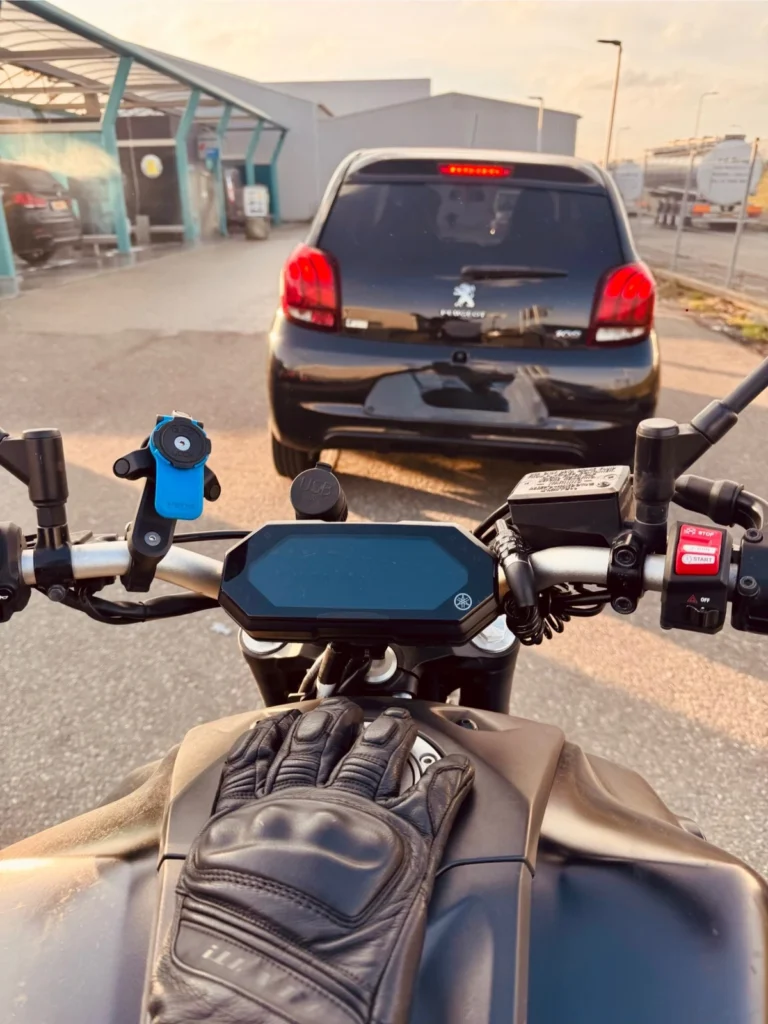
Imagine traffic suddenly slows in front of you. A beginner rider may stare directly at the rear bumper of the car ahead.
The problem is that staring at the bumper can reduce awareness of everything else.
You may miss:
- The escape path beside the car
- The road surface
- The vehicle behind you
- Another lane opening
- A cyclist moving nearby
- A safer stopping zone
When braking, keep your eyes up.
Look at where you want to stop, not only at what you are afraid of hitting.
In an emergency stop, your vision should still search for options.
Ask:
- Can I stop in time?
- Is there a cleaner path?
- Is there space to the side?
- Is the surface safe?
- Is the vehicle behind stopping?
Good braking is connected to good vision.
If your eyes freeze, your braking becomes more panicked.
Read : How to brake safely on a motorcycle
Target Fixation in City Traffic
City riding gives you many things to stare at.
Cars.
Cyclists.
Scooters.
Pedestrians.
Buses.
Trams.
Delivery vans.
Parked cars.
Opening doors.
Traffic lights.
Road markings.
In busy cities, target fixation can happen because your brain becomes overloaded.
You might stare at one unpredictable cyclist and miss the car door opening ahead.
You might stare at a bus and miss the pedestrian near the crossing.
You might stare at the tram tracks and forget to scan the traffic around you.
In city traffic, your eyes need to keep moving.
Do not let one hazard steal all your attention.
Use a soft scanning pattern:
- Far ahead
- Road surface
- Side roads
- Mirrors
- Pedestrians
- Cyclists
- Escape path
- Back ahead
You are not trying to stare harder.
You are trying to see wider.
That is especially important in Amsterdam-style traffic, where cars, cyclists, pedestrians, scooters and trams can all overlap in a small space.
Calm scanning beats tunnel vision.
Target Fixation on Road Hazards
Road hazards are classic target fixation triggers.
Examples include:
- Potholes
- Gravel
- Wet leaves
- Oil patches
- Painted lines
- Tram tracks
- Metal covers
- Sand
- Debris
- Broken asphalt
When you see a hazard, your instinct may be to stare at it. That makes sense because you want to avoid it.
But staring is not avoiding.
Looking for the clean path is avoiding.
If you see a pothole, do not keep your eyes glued to the hole. Look beside it.
If you see gravel, look at the cleanest line.
If you see tram tracks, look at your crossing angle and exit path.
If you see a wet patch, look at the dry line around it if available.
The habit is:
Hazard identified. Eyes move to solution.
Train this on small hazards first.
Every small pothole, leaf patch, painted line or bit of gravel is a chance to practice moving your eyes.
Target Fixation and Fear
Target fixation is often connected to fear.
When fear rises, vision narrows.
You stop scanning.
You stop breathing properly.
Your hands tighten.
Your shoulders rise.
Your eyes lock onto the threat.
The bike feels harder to control.
That is why avoiding target fixation is not only a vision skill. It is also an emotional control skill.
When you feel fear while riding, do this:
- Breathe out
- Relax your grip
- Keep your eyes moving
- Look for the safe path
- Reduce speed smoothly if needed
- Avoid sudden panic inputs
- Remind yourself: “Look where I want to go.”
A calm body helps calm your vision.
A calm vision helps calm your body.
They work together.
How to Train Yourself to Avoid Target Fixation
You cannot wait until a scary moment to fix target fixation.
You need to practice when things are calm.
Here are simple ways to train it.
Practice 1: Look Past Small Hazards
On a quiet ride, when you see a small pothole or patch of gravel, notice it, then immediately look at the safe path around it.
Do this consciously.
You are training your eyes to move.
Practice 2: Turn Your Head Through Corners
On safe, familiar corners, practice turning your head and pointing your chin toward the exit.
Do not just move your eyes.
Turn your head enough that your body understands where you want to go.
Practice 3: Name the Escape Path
In traffic, quietly ask:
“Where would I go if something changed?”
Then look at the space, not just the danger.
This trains your brain to search for solutions.
Practice 4: Scan Instead of Stare
Practice moving your eyes through a calm routine:
- Far ahead
- Road surface
- Mirrors
- Side roads
- Escape path
- Back ahead
This reduces the habit of staring at one object.
Practice 5: Slow Down Earlier
Many target fixation moments happen because the rider is going faster than their brain can process.
Slowing down earlier gives your eyes more time.
More time means less panic.
Less panic means better vision.
Practice 6: Reflect After Rides
After a ride, ask:
- Did I stare at any hazards?
- Did I look through corners properly?
- Did I freeze in traffic?
- Did I notice escape paths?
- What situation made me tense?
Reflection turns experience into skill.
What to Do When You Catch Yourself Fixating
Sometimes you will notice it happening in real time.
You are staring at the curb.
You are staring at gravel.
You are staring at a car.
You are staring at the outside of a bend.
The moment you notice it, act.
Use this quick reset:
- Breathe out
- Loosen your grip
- Move your eyes to the safe path
- Turn your head where you want to go
- Keep inputs smooth
- Ride toward the solution
Do not panic because you noticed target fixation.
Noticing it is good.
That moment of awareness gives you a chance to correct it.
The goal is not to never feel the pull of target fixation.
The goal is to catch it earlier and recover faster.
What Not to Do
When target fixation happens, avoid these mistakes.
Do Not Stare Harder
Staring harder does not solve danger.
It usually makes your vision narrower.
Check : Motorcycle Vision Techniques
Do Not Grab the Brakes Suddenly
If you are leaned over or on a slippery surface, sudden braking can make the situation worse.
Brake smoothly if needed.
Do Not Freeze Your Arms
A stiff upper body makes the bike harder to guide.
Relax your grip and let the motorcycle respond.
Do Not Look Down
Looking down makes the situation feel faster and reduces balance.
Keep your eyes up.
Do Not Give Up on the Corner
Many riders panic before the motorcycle actually runs out of ability.
Look through the corner and stay smooth.
Check : How to corner safely on a motorcycle
Do Not Follow Someone Else’s Pace
Target fixation becomes more likely when you are riding faster than your comfort level.
Ride your own ride.
How Speed Affects Target Fixation
Speed makes target fixation worse because everything happens faster.
At a comfortable speed, your eyes have time to scan, process, and choose a safe path.
At too much speed, your brain gets overloaded. The corner arrives too quickly. The hazard appears too suddenly. Your focus narrows.
Then panic becomes more likely.
This is why beginner riders should not rush speed.
Good riding is not about entering every corner fast. It is about having enough margin to see, think and respond.
If you often feel like hazards are surprising you, you may be riding faster than your vision can manage.
Slow down until your eyes can stay ahead of the bike.
That is not weakness.
That is skill development.
How Body Position Helps Your Vision
Your body and eyes are connected.
If your shoulders are tense, your head may not turn freely.
If your arms are locked, you may stare forward.
If your grip is too tight, the bike feels harder to steer.
If you are holding your breath, your vision may narrow.
A relaxed body helps your eyes move.
In corners, try to:
- Relax your shoulders
- Keep your elbows slightly bent
- Hold the grips lightly
- Turn your head
- Point your chin toward the exit
- Breathe through the corner
The more relaxed you are, the easier it is to look where you want to go.
Do not underestimate breathing.
Sometimes one deep breath can break the freeze.
Target Fixation Checklist for Riders
Use this checklist when practicing:
- Am I looking where I want to go?
- Did I notice the hazard without staring at it?
- Can I see the safe path?
- Am I turning my head through the corner?
- Am I keeping my eyes up while braking?
- Am I scanning instead of staring?
- Am I relaxed on the handlebars?
- Do I know my escape route?
- Am I riding at a speed my eyes can manage?
- Am I riding my own pace?
This checklist is simple, but it builds the right habit:
Find the path. Follow the path.
Common Mistakes
| Mistake | Why It’s Risky | Better Habit |
|---|---|---|
| Staring at potholes | The bike may drift toward them | Look at the clean path around them |
| Looking at the outside of a corner | Increases the chance of running wide | Look through the corner toward the exit |
| Freezing during braking | Reduces awareness and options | Keep eyes up and search for escape paths |
| Riding too fast | Gives your brain less time to process | Slow down until vision feels calm |
| Gripping the bars tightly | Makes steering less smooth | Relax your hands and shoulders |
| Only noticing hazards | Keeps your brain stuck on danger | Notice hazard, then choose path |
| Following faster riders | Pushes you beyond your visual comfort | Ride your own ride |
| Looking down | Makes balance and control worse | Keep your eyes up |
Final Thoughts: Your Motorcycle Follows Your Focus
Target fixation is one of the clearest examples of how mental riding really is.
Your hands matter.
Your brakes matter.
Your throttle matters.
Your body position matters.
But your eyes lead all of it.
If your eyes freeze on danger, the rest of your body may follow. If your eyes search for the safe path, your body has a better chance of guiding the motorcycle there.
This is why I believe every rider should take vision seriously.
Not as a small tip.
As a core safety skill.
The next time you ride, pay attention to your eyes.
Are you staring at hazards?
Are you looking through corners?
Are you scanning far enough ahead?
Are you seeing escape paths?
Are you riding at a speed where your brain can stay calm?
Do not wait for a scary moment to train this.
Practice on every ride.
See the hazard.
Choose the path.
Look at the path.
Ride the path.
That one habit can change everything.
Ride smart. Stay calm. Come home safe.
FAQs
What is target fixation on a motorcycle?
Target fixation is when a rider focuses too strongly on a hazard and unintentionally moves toward it. It often happens with potholes, gravel, curbs, barriers, cars or the outside edge of a corner.
How do I avoid target fixation while riding?
To avoid target fixation, notice the hazard, then immediately move your eyes to the safe path. Look where you want the motorcycle to go, turn your head, stay relaxed and avoid staring at the danger.
Why do motorcycles go where you look?
Your eyes influence your head, shoulders, arms, hands, body position and steering inputs. When you look in a direction, your body naturally starts guiding the motorcycle that way.
What should I do if I stare at a hazard?
As soon as you notice yourself staring, breathe out, relax your grip, move your eyes to the safe path, turn your head where you want to go and keep your inputs smooth.
Does riding slower help prevent target fixation?
Yes. Riding at a manageable speed gives your eyes and brain more time to process the road, choose a safe path and avoid panic. Speed should match your skill and visibility.
Can target fixation happen in corners?
Yes. Corners are one of the most common places for target fixation. Riders may stare at the outside edge of the turn instead of looking through the corner toward the exit.
Related Reads
Train Your Eyes Before Your Next Ride
Motorcycle Safety for Beginners: The Complete Guide to Riding Smart
Motorcycle Vision Techniques: How to Look Through the Corner Correctly
How to Corner Safely on a Motorcycle: Step-by-Step Guide
How to Brake Safely on a Motorcycle: Front vs Rear Explained