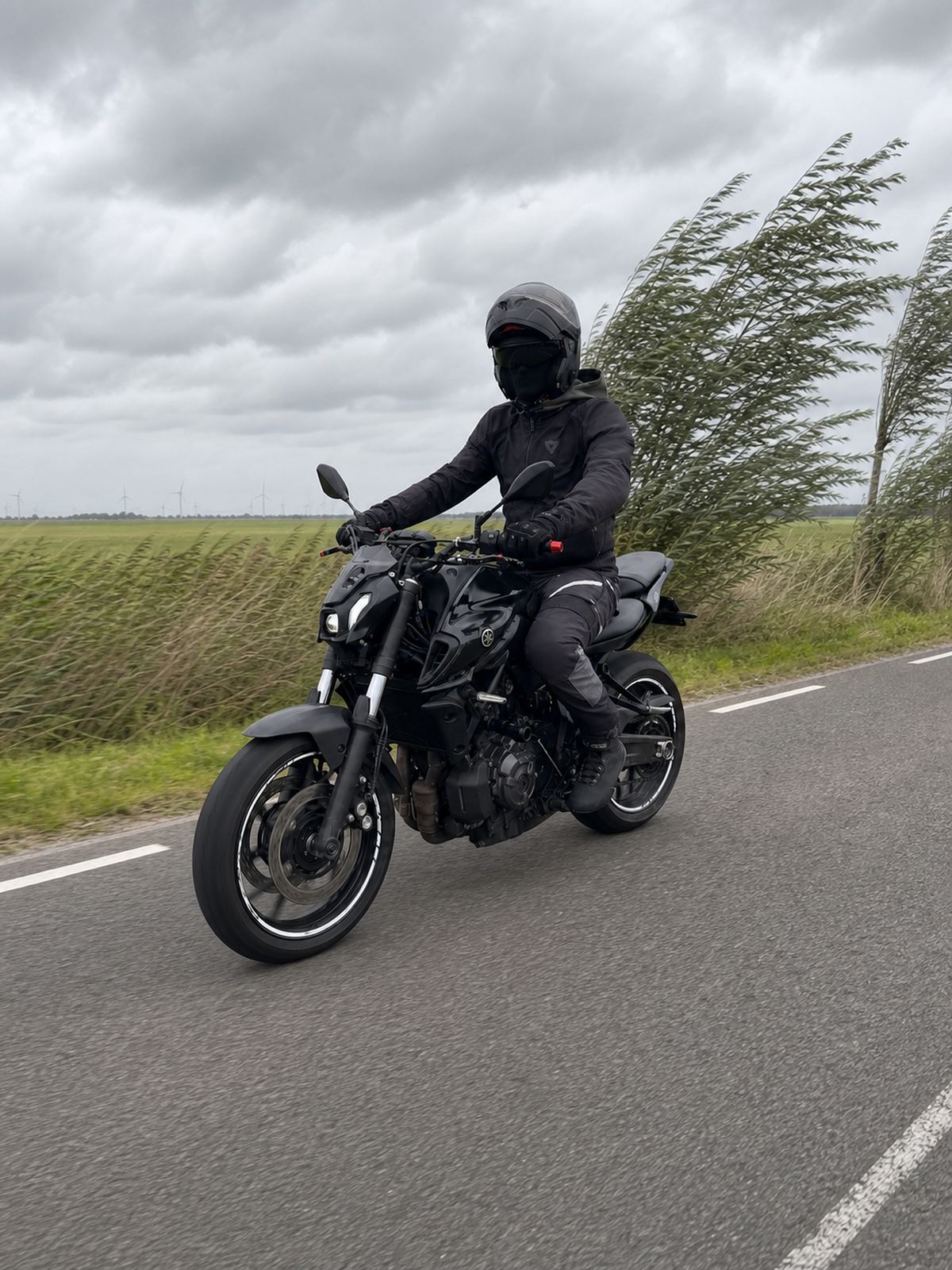
Strong wind can turn an otherwise simple motorcycle ride into a physically and mentally demanding one.
The motorcycle may drift across the lane. Your helmet can be pushed sideways. A sudden gust may arrive as you cross a bridge, pass a building or ride alongside a truck.
The most unsettling part is often the unpredictability.
A steady crosswind gives you time to adjust. Gusty wind repeatedly changes strength and direction, forcing you to make small corrections while still watching traffic, corners and the road surface.
Riding safely in strong wind is not about holding the handlebars as tightly as possible.
It is about reducing your speed, creating space, staying relaxed and making controlled adjustments without fighting every movement of the motorcycle.
This guide explains how to ride a motorcycle safely in strong wind, including crosswind technique, lane position, turbulence from large vehicles and the warning signs that tell you it is time to stop.
Quick Answer
How Should You Ride a Motorcycle in Strong Wind?
When riding a motorcycle in strong wind:
- Reduce your speed before entering an exposed area.
- Keep your hands secure but avoid locking your arms.
- Hold the motorcycle against a crosswind using gentle steering pressure.
- Keep enough lane space on both sides for unexpected movement.
- Stay away from trucks, buses and other large vehicles.
- Expect gusts near bridges, buildings, trees and gaps in shelter.
- Keep the throttle, braking and steering smooth.
- Avoid sudden overtakes and rushed lane changes.
- Stop carrying unnecessary or poorly secured luggage.
- Find somewhere safe to stop when you can no longer hold a predictable line.
Strong wind does not always require a dramatic reaction. It requires more space for small reactions.
Why Wind Affects a Motorcycle So Much
A motorcycle has less mass and a narrower contact area than most cars, while the rider and motorcycle present a relatively large surface to the wind.
The effect depends on:
- Wind speed
- Gust strength
- Wind direction
- Motorcycle weight
- Riding speed
- Rider size and position
- Windscreen and fairing design
- Luggage and passenger weight
- Surrounding vehicles and buildings
A headwind mainly increases pressure against you and may make the motorcycle feel slower.
A tailwind can reduce the amount of wind you feel, sometimes making your actual speed less obvious.
A crosswind pushes from the side and can move the motorcycle away from its intended line.
Gusts are usually more difficult than steady wind because the pressure changes suddenly.
1. Check the Forecast Before Leaving
Strong-wind riding begins before the motorcycle moves.
Check both the average wind speed and the expected gusts. Gusts can be considerably stronger than the steady wind shown in a basic forecast.
Also consider:
- Wind direction
- Rain or thunderstorms
- Your planned route
- The amount of motorway riding
- Bridges and exposed roads
- The motorcycle you are riding
- Whether you will carry luggage or a passenger
There is no single wind-speed limit that is safe for every rider and motorcycle.
A manageable wind on a heavy touring motorcycle may feel far more difficult on a light naked bike. An experienced rider on a familiar road may also make a different decision from a beginner facing the same conditions.
Do not base the decision only on whether riding is technically possible.
Ask whether you can complete the entire journey calmly and predictably.
2. Prepare the Motorcycle
Before leaving, check:
- Tyre condition and pressure
- Steering and suspension
- Windscreen and fairing mounts
- Mirrors
- Luggage straps
- Top box and pannier attachments
- Loose clothing or covers
- Fuel level
Poor tyre pressure or loose luggage can make an already unstable ride feel worse.
Remove unnecessary luggage where possible. A top box, large backpack or loosely covered load can catch additional wind.
Make sure your jacket is fully closed and adjusted. Loose material that repeatedly flaps against you creates distraction and fatigue.
3. Reduce Your Speed
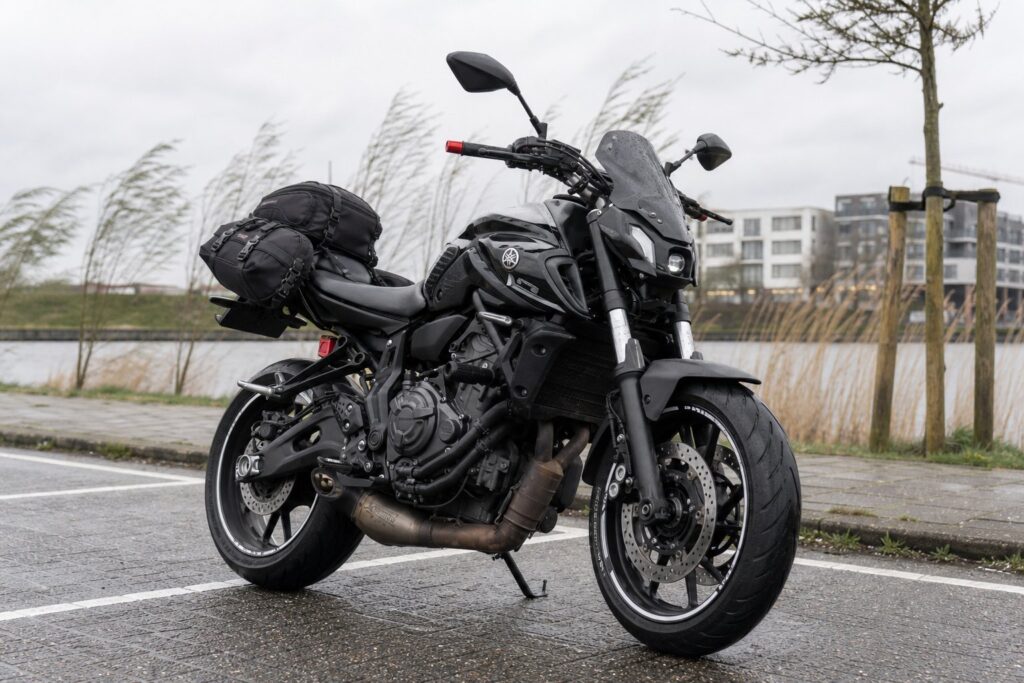
The faster you ride, the more quickly wind-related movement develops and the less time you have to correct it.
Reducing your speed gives you:
- More time to respond to gusts
- More lane space before reaching an edge
- Less aggressive turbulence around vehicles
- More time to recognise exposed sections
- A lower mental workload
Slow down progressively rather than closing the throttle suddenly.
Use a speed that allows you to maintain a steady lane position without making constant large corrections.
Do not allow a faster vehicle behind you to pressure you into riding beyond your comfort. Create space, change lanes when safe or let it pass.
4. Keep Your Upper Body Relaxed
Wind naturally makes riders tense.
You may grip the handlebars harder, lock your elbows and raise your shoulders. This feels protective, but it can make the motorcycle more difficult to control.
Keep your:
- Hands secure but not clenched
- Elbows slightly bent
- Shoulders relaxed
- Knees gently against the tank
- Feet firmly on the pegs
- Head and eyes directed ahead
Your knees and core should help support your body so that your arms remain available for steering.
Do not use the handlebars to hold your entire body against the wind.
A secure but flexible position allows the motorcycle to make small movements without transferring every gust directly through your arms.
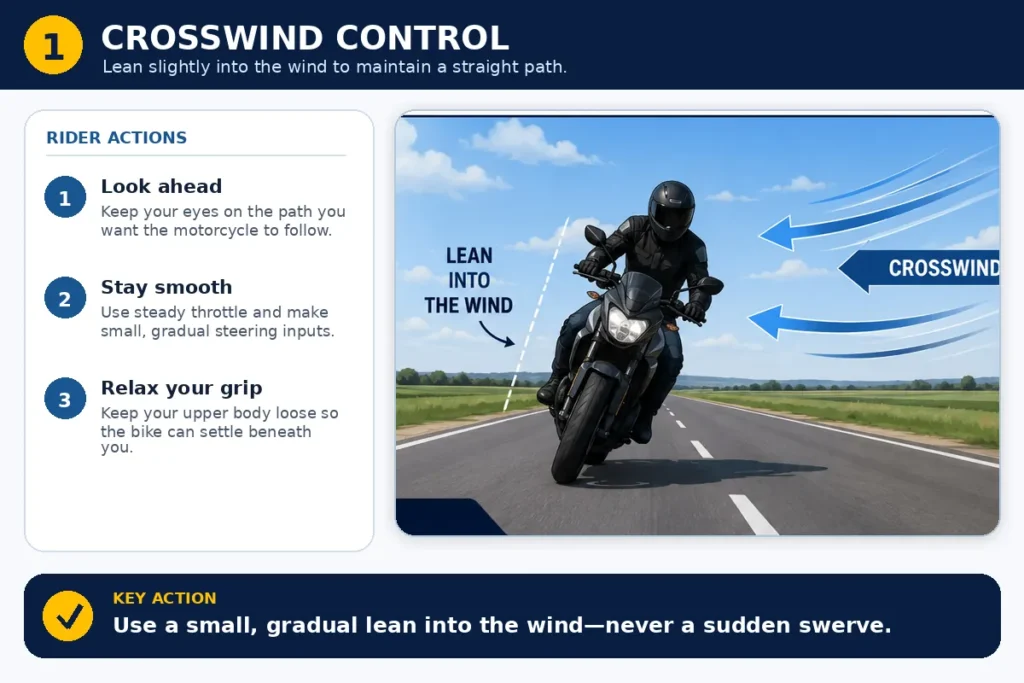
5. Lean Into a Crosswind Smoothly
When a steady crosswind pushes the motorcycle sideways, you may need a small amount of lean towards the wind to maintain a straight path.
This is created through gentle steering pressure.
For example, when wind pushes from your left towards your right, controlled pressure on the left handlebar helps the motorcycle lean slightly left into the wind.
The required lean may be very small.
Do not make a sudden steering movement or attempt to force the motorcycle completely upright.
As the wind changes, adjust the pressure smoothly.
The most important moment often occurs when the wind suddenly disappears. If you remain leaned into a crosswind after entering a sheltered area, the motorcycle may begin moving towards the windward side.
Be ready to reduce your steering pressure as conditions change.
6. Give Yourself More Lane Space
There is no fixed lane position that works for every crosswind.
Choose the position that gives you the most usable space if the motorcycle is pushed sideways.
Consider:
- Wind direction
- Oncoming traffic
- Vehicles beside you
- Barriers and kerbs
- Road edges
- Cyclists
- Available escape space
Avoid riding close to the edge towards which the wind is pushing you.
However, do not place yourself dangerously close to oncoming traffic simply to create more room on the other side.
The correct position balances both risks.
Keep adjusting your position as the road and traffic change. This is part of the flexible road strategy explained in Beginner’s Guide to Defensive Motorcycle Riding.
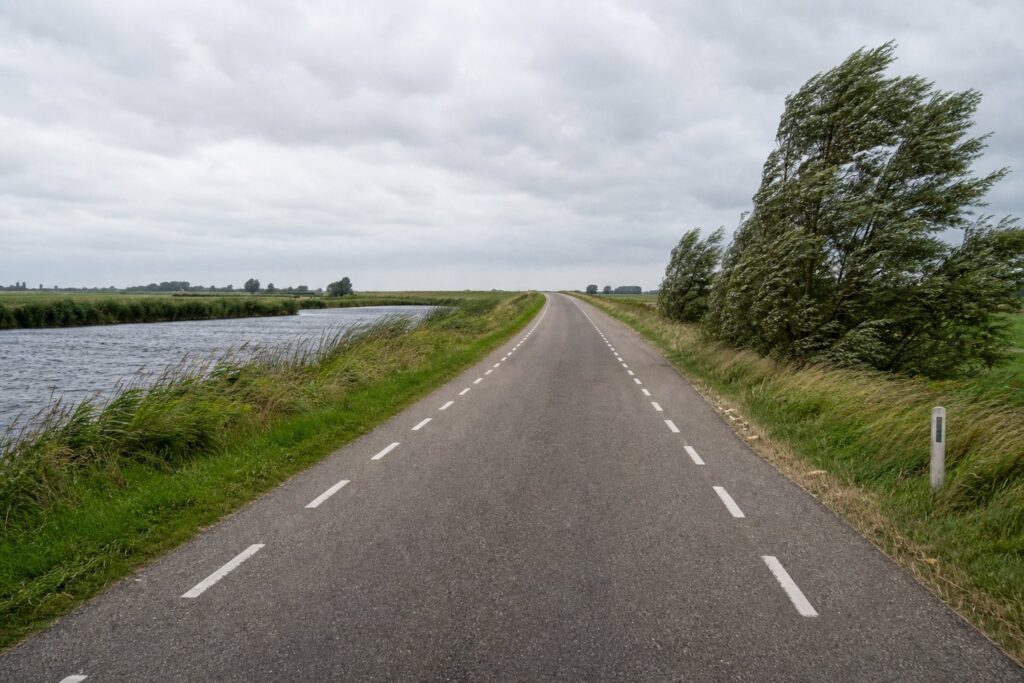
7. Expect Gusts in Exposed Areas
Wind does not affect every section of road equally.
Prepare for stronger gusts when approaching:
- Bridges
- Dikes
- Open fields
- Coastal roads
- Gaps between buildings
- Gaps in trees or hedges
- Mountain passes
- Elevated motorway sections
The opposite can also happen.
A building, line of trees or large vehicle may temporarily block the wind. When the shelter ends, the crosswind can return instantly.
Look ahead for changes in the surrounding landscape.
A tree line ending beside the road is not just a change in scenery. It may mark the point where the motorcycle suddenly becomes exposed.
Reduce your speed before reaching these transitions rather than reacting after the motorcycle has already moved.
8. Be Careful Around Trucks and Buses
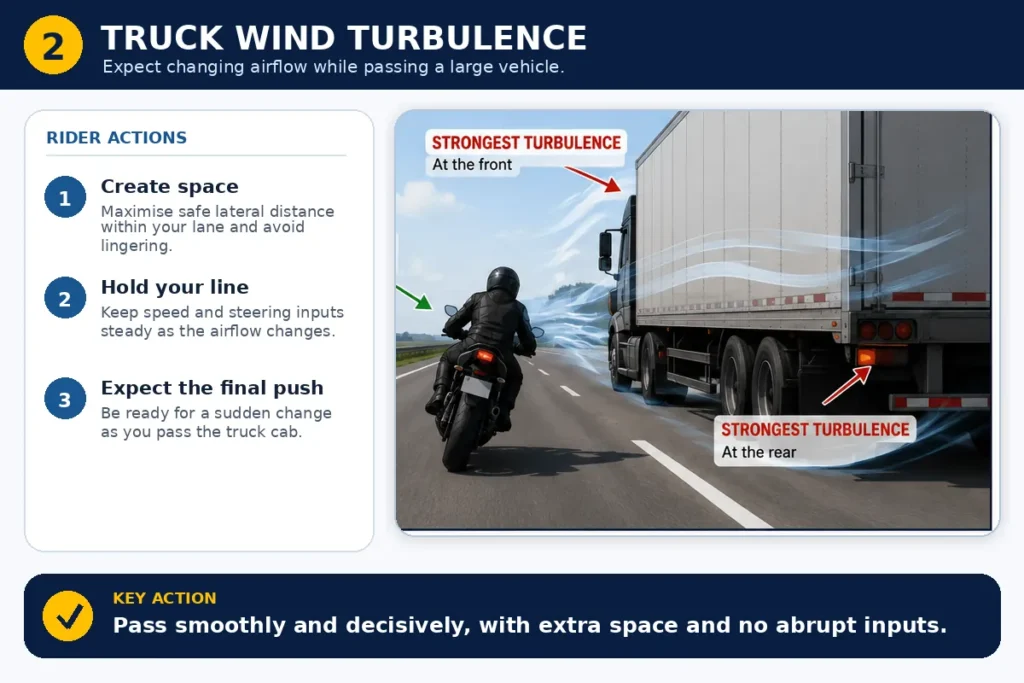
Large vehicles create their own moving areas of disturbed air.
When approaching, riding beside or passing a truck, you may experience:
- Turbulence
- A sudden loss of crosswind while sheltered
- A strong gust as you leave the shelter
- Wind blast from the front of the vehicle
- Reduced space for sideways movement
Do not ride close beside a truck for longer than necessary.
Before overtaking:
- Check that you have enough clear road.
- Leave space between yourself and the vehicle.
- Expect the wind pressure to change.
- Keep your arms relaxed.
- Pass smoothly and predictably.
- Allow extra room before returning to the lane.
Do not accelerate aggressively simply because the turbulence feels uncomfortable.
When another large vehicle is passing you, maintain a stable speed and maximise your distance from it without leaving your lane.
9. Keep Throttle, Braking and Steering Smooth
Strong wind already places additional forces on the motorcycle.
Avoid adding unnecessary instability through abrupt controls.
Try to:
- Maintain a smooth throttle
- Change gear progressively
- Brake earlier
- Keep the bike upright during heavy braking
- Begin lane changes early
- Use controlled steering pressure
- Avoid sudden acceleration
If you need to slow significantly, check your mirrors first and apply both brakes progressively.
Avoid grabbing the brakes immediately after a gust moves the motorcycle. First stabilise your direction, then reduce speed smoothly when the available space allows it.
Read How to Brake Safely on a Motorcycle for more guidance on progressive braking.
10. Slow Down Before Corners
A crosswind can change your cornering line.
Wind from the outside of a corner may push you inward. Wind from the inside may push you towards the outer edge.
The wind may also change partway through the turn when you pass trees, buildings or barriers.
Before entering a windy corner:
- Reduce speed while upright
- Look through the turn
- Leave extra line margin
- Avoid riding near the centre line
- Keep the throttle steady
- Prepare for the wind to change
Do not use a line that depends on the motorcycle staying within a narrow strip of road.
Leave space for an unexpected gust.
Read How to Corner Safely on a Motorcycle to improve your entry speed, vision and line choice.
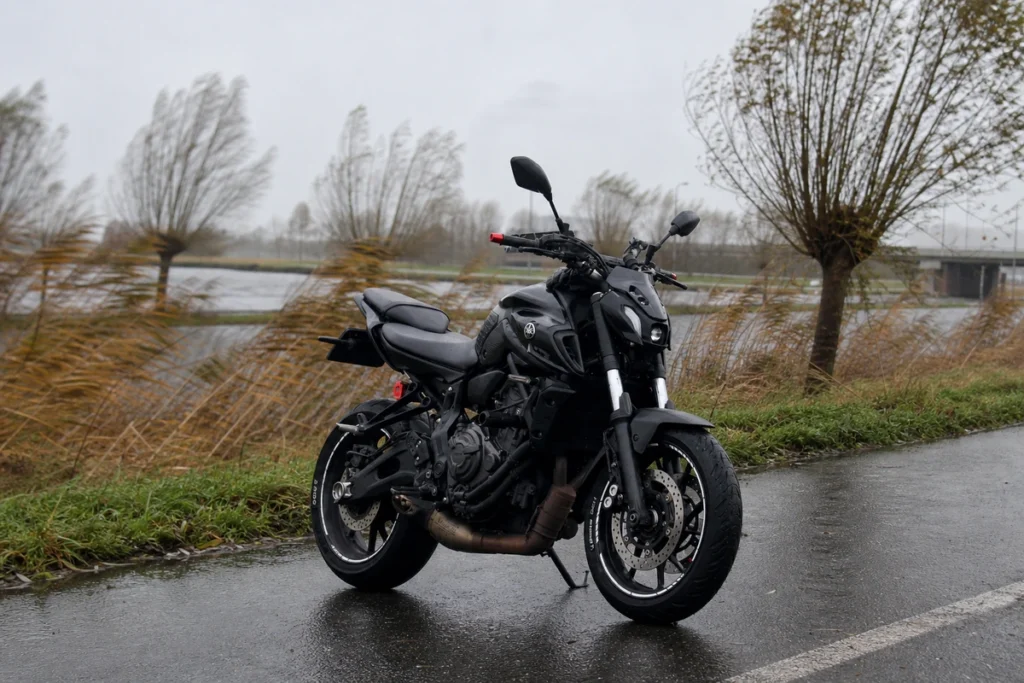
11. Be Extra Careful When Wind Is Combined With Rain
Strong wind becomes more demanding when the road is also wet.
You may be dealing with:
- Reduced traction
- Limited visibility
- Road spray
- Cold hands
- Wet tram tracks
- Standing water
- Debris blown onto the road
Avoid making a sharp steering correction simply because a gust moves you towards a wet marking or metal cover.
Look ahead, reduce speed and choose a wider, smoother path before reaching the hazard.
Read Wet Weather Motorcycle Riding Tips for more advice about braking, grip and visibility in rain.
12. Watch for Blown Debris
Wind does not only move the motorcycle.
It can also move objects into your path.
Watch for:
- Leaves
- Branches
- Plastic bags
- Cardboard
- Construction materials
- Rubbish bins
- Temporary road signs
- Sand and dirt
- Objects falling from vehicles
Increase your following distance so that you can see hazards before the vehicle ahead reaches them.
Be especially cautious near construction zones, tree-lined roads and urban streets with temporary signs or unsecured objects.
Do not follow a moving object with your eyes. Identify its direction, choose your safe path and look where you want the motorcycle to go.
13. Consider the Effect of a Passenger
A passenger changes the motorcycle’s weight, balance and wind profile.
Before riding in strong wind:
- Explain that the motorcycle may move
- Ask the passenger to remain relaxed
- Tell them not to make sudden body movements
- Check that they can hold securely
- Increase your following distance
- Reduce your speed further
- Avoid unnecessary motorway sections
Make sure the passenger’s clothing and luggage are secured.
A nervous passenger may grip tightly or move suddenly when a gust arrives. Smooth communication before the ride reduces surprise for both of you.
14. Know When to Stop
Sometimes the wind is simply too strong to continue safely.
Find a safe stopping place when:
- You cannot maintain a predictable lane position
- Gusts repeatedly push you towards other traffic
- You are using most of the lane just to stay upright
- Debris is moving across the road
- Your neck or arms are becoming exhausted
- Trucks are creating uncontrollable turbulence
- Wind is combined with severe rain or poor visibility
- You feel frightened enough that your control becomes tense and reactive
Do not stop on an exposed bridge, narrow shoulder or beside falling branches.
Look for a petrol station, car park, service area or another sheltered location away from traffic.
Turning around or delaying the ride is not a lack of skill.
It is a correct response when the conditions have removed your safety margin.
Common Mistakes
| Mistake | Why It Creates Risk | Better Habit |
|---|---|---|
| Holding the handlebars too tightly | Transfers tension and wind movement into the steering | Keep a secure but flexible grip |
| Riding at normal speed | Gives you less time and space to respond | Reduce speed before exposed sections |
| Riding beside trucks | Exposes you to turbulence and changing wind pressure | Create space and pass smoothly |
| Staying near the lane edge | Leaves little room when a gust moves the bike | Choose a position with usable space |
| Making sharp steering corrections | Can send the motorcycle towards the opposite side | Use gradual steering pressure |
| Braking immediately during a gust | Adds another force while the bike is moving sideways | Stabilise your line and slow progressively |
| Ignoring changes in shelter | Wind may return suddenly after trees or buildings end | Scan the landscape ahead |
| Carrying loose luggage | Creates distraction and additional wind resistance | Secure or remove unnecessary items |
| Following too closely | Hides debris and reduces reaction time | Increase your following distance |
| Continuing while exhausted | Reduces precise steering and judgement | Stop somewhere safe and recover |
| Treating every wind speed equally | Gusts, direction and route exposure vary | Assess the whole journey |
| Trying to prove you can continue | Pride removes sensible decision-making | Stop when control is no longer predictable |
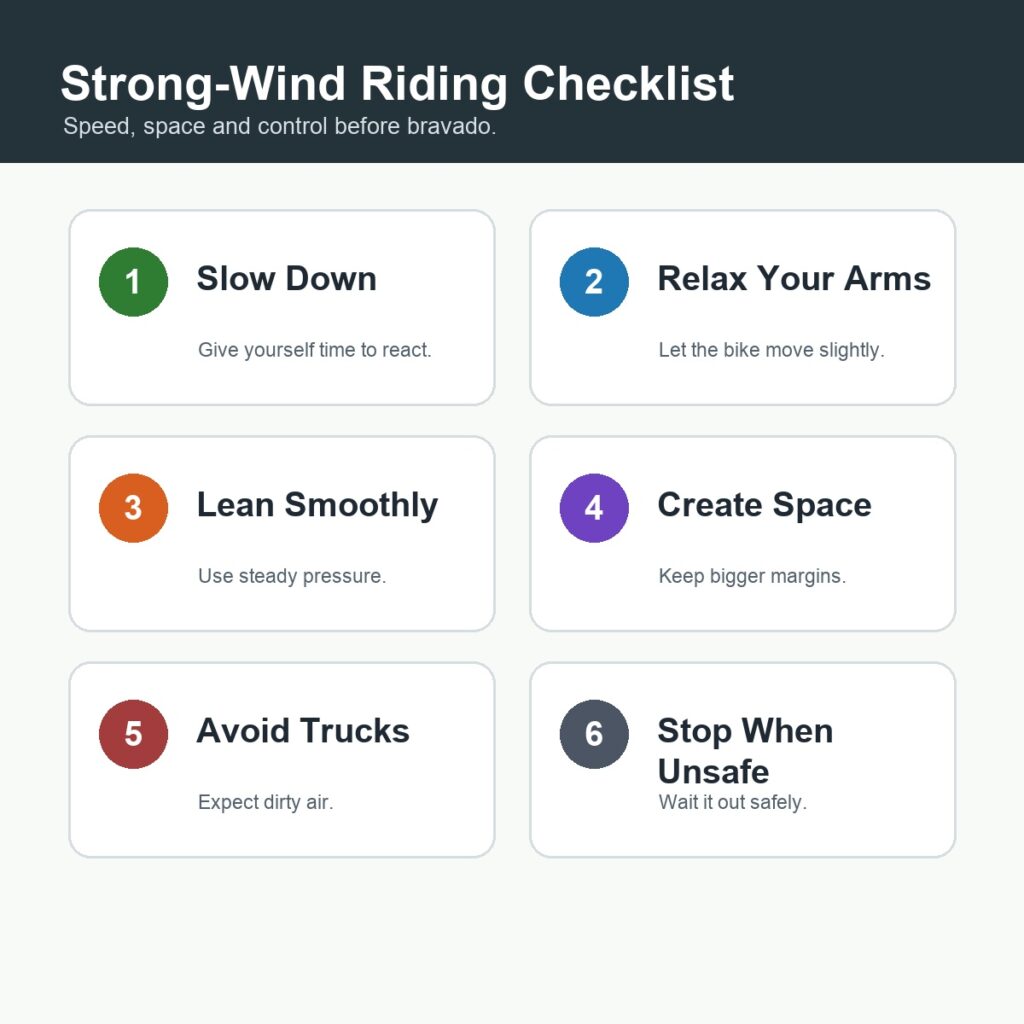
Strong-Wind Riding Checklist
Before the ride:
- Check the wind and gust forecast
- Consider the direction of the wind
- Inspect tyres and pressures
- Secure or remove luggage
- Check the windscreen and fairing
- Close and adjust riding gear
- Plan a less exposed route
- Avoid unnecessary motorway riding
- Reconsider carrying a passenger
During the ride:
- Reduce speed
- Keep your shoulders and arms relaxed
- Hold the tank gently with your knees
- Lean into steady crosswinds smoothly
- Leave space on both sides
- Expect gusts near open areas
- Stay away from large vehicles
- Brake and steer progressively
- Watch for blown debris
- Stop when you cannot maintain your line
After the ride:
- Check luggage and mounting points
- Inspect the windscreen and mirrors
- Note which roads felt most exposed
- Rest if the ride caused neck or arm fatigue
- Adjust future routes based on what you learned
Final Thoughts: Work With the Wind, Not Against It
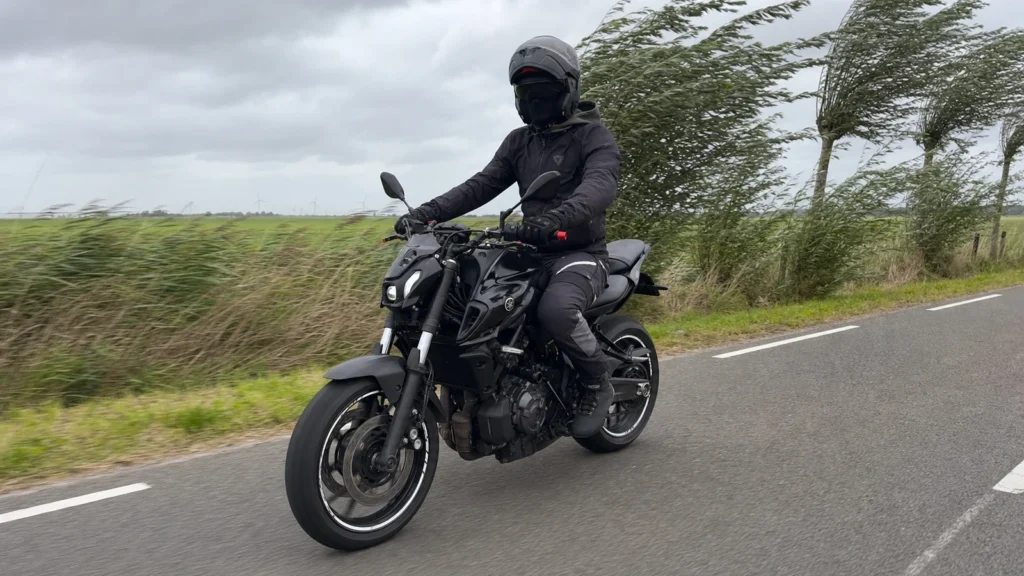
Strong wind makes a motorcycle feel less settled, but constant movement does not always mean you are losing control.
The bike may lean slightly. Your helmet may move. Your lane position may require small adjustments.
Stay calm enough to separate normal wind movement from a genuinely unsafe situation.
Reduce your speed. Relax your arms. Look farther ahead and create enough space for the motorcycle to move without immediately reaching another vehicle, barrier or road edge.
Most importantly, remember that you do not have to complete every ride in the conditions you started it.
When the wind takes away your ability to hold a predictable line, the responsible decision is to stop.
The goal is not to defeat the weather.
The goal is to work with the available conditions, protect your margin and arrive safely.
Ride smart. Stay relaxed. Come home safe.
FAQs
Is it safe to ride a motorcycle in strong wind?
It can be safe when the wind is manageable for the rider, motorcycle and route. Reduce speed, create more space and stop when gusts prevent you from maintaining a predictable lane position.
Should I lean into the wind on a motorcycle?
A steady crosswind may require a small lean towards the wind, created through controlled handlebar pressure. Adjust smoothly because the required lean can change when the wind weakens or shelter ends.
Should I grip the handlebars tightly in strong wind?
Hold the handlebars securely, but avoid clenching your hands or locking your arms. Excessive tension makes smooth steering corrections more difficult and transfers wind movement into the controls.
What is the safest lane position in a crosswind?
There is no single position for every situation. Choose a position that gives you usable space in the direction the wind may push you while maintaining safe separation from oncoming traffic and other hazards.
Why do trucks affect motorcycles in strong wind?
Large vehicles disturb the surrounding air and can temporarily block a crosswind. A rider may experience turbulence beside the vehicle and another gust when leaving its sheltered area.
Should I ride faster to make the motorcycle more stable?
Increasing speed also reduces your reaction time and can make turbulence more aggressive. Use a controlled speed that allows you to maintain a predictable lane position.
How should I ride across a windy bridge?
Reduce your speed before entering, create space from other vehicles, relax your arms and prepare for stronger crosswinds. Avoid sudden steering, braking or overtaking on the exposed section.
Can luggage make a motorcycle more affected by wind?
Large or poorly secured luggage can increase the motorcycle’s side area and change its response to wind. Secure all luggage properly and remove anything unnecessary.
What should I do if a gust suddenly pushes my motorcycle?
Keep looking ahead, avoid panicking and guide the motorcycle back with smooth steering pressure. Do not make a sharp correction that could send you too far in the opposite direction.
When should I stop riding because of wind?
Stop when you cannot hold a predictable line, gusts repeatedly move you towards traffic, debris is blowing across the road or physical fatigue is reducing your control.
Related Reads
Beginner’s Guide to Defensive Motorcycle Riding
How to Corner Safely on a Motorcycle
How to Brake Safely on a Motorcycle
Wet Weather Motorcycle Riding Tips
Night Riding Safety: How to Ride a Motorcycle Safely After Dark