You are riding along a normal road when the surface suddenly changes.
There is loose gravel near the corner.
Sand has collected beside a junction.
A wet metal cover appears in your line.
The road is covered with leaves, mud or shiny paint.
The motorcycle begins to feel lighter underneath you, and your first instinct is to tighten your grip and try to force it back under control.
That reaction is understandable.
But it is often the opposite of what the motorcycle needs.
Loose and slippery surfaces do not always require dramatic corrections. They usually require less drama from the rider.
Slow down early.
Keep the motorcycle as upright as possible.
Look at the safe path.
Use every control smoothly.
Let the bike make small movements without fighting it.
This guide explains how to handle gravel, sand and slippery roads on a motorcycle, including what to do when the hazard appears in a corner, how to brake with reduced grip and which common mistakes make the situation worse.
If you are still building your overall riding foundation, begin with Motorcycle Safety for Beginners
Quick Answer
Should You Ride Over Gravel, Sand or a Slippery Road?
When approaching gravel, sand or another low-grip surface, reduce your speed before reaching it, keep the motorcycle as upright as possible and cross using a smooth, predictable line.
Avoid sudden braking, sharp steering, aggressive acceleration and abrupt gear changes. Keep your eyes up, relax your grip and allow the motorcycle to move slightly beneath you without trying to correct every small wobble.
The basic sequence is:
- See the surface early.
- Check the traffic around you.
- Reduce speed before reaching it.
- Choose the cleanest and straightest safe path.
- Keep the motorcycle upright.
- Hold a relaxed grip.
- Use gentle, progressive controls.
- Wait until normal grip returns before accelerating or turning harder.
Low grip demands high discipline.
Why Gravel and Sand Feel So Unstable
On clean, dry asphalt, your tyres have a relatively consistent surface to work against.
Gravel and sand are different.
Instead of rolling directly over solid pavement, the tyre may move across loose material that shifts underneath it. The front wheel can wander slightly, the handlebars can move and the rear of the motorcycle may feel less planted.
That movement can feel like the motorcycle is losing control.
Sometimes it is simply the bike finding its way across an uneven surface.
The danger begins when the rider becomes frightened and responds with:
- A sudden grab of the brake
- A sharp steering correction
- A closed throttle
- Locked elbows
- A tight grip
- Looking down at the hazard
Those reactions transfer more instability into the motorcycle.
Your job is not to make the bike feel completely motionless.
Your job is to keep it travelling calmly in the direction you have chosen.
The Four Principles That Work on Almost Every Slippery Surface
Different hazards require slightly different responses, but four principles apply almost everywhere.
1. Reduce Speed Before the Surface
The best time to slow down is while your tyres still have reliable grip.
If you see gravel, sand, wet leaves or a metal plate ahead, check your mirrors and reduce your speed before reaching it.
This gives you more time and reduces the amount of braking or steering you need to do once you are on the slippery section.
Late detection creates late braking.
Late braking creates sudden inputs.
Good vision gives you options.
Read Motorcycle Vision Techniques to improve how early you notice changes in the road.
2. Keep the Motorcycle Upright
A tyre has a limited amount of available grip.
When the motorcycle is heavily leaned over, more of that grip is already being used to turn. There is less margin available for braking, acceleration or an unexpected change in surface.
Straighten the bike as much as the road safely allows before crossing the hazard.
You may still need a small amount of lean to follow the road, but avoid adding unnecessary lean angle.
3. Keep Every Input Smooth
Grip can be lost when the tyre is asked to do too much too suddenly.
Avoid:
- Snapping the throttle open or closed
- Grabbing the front brake
- Stamping on the rear brake
- Dropping the clutch
- Making a sharp steering correction
- Changing direction abruptly
Smooth does not mean passive.
You can still brake, steer and adjust your speed. You simply need to build each input progressively.
4. Relax and Look at the Path
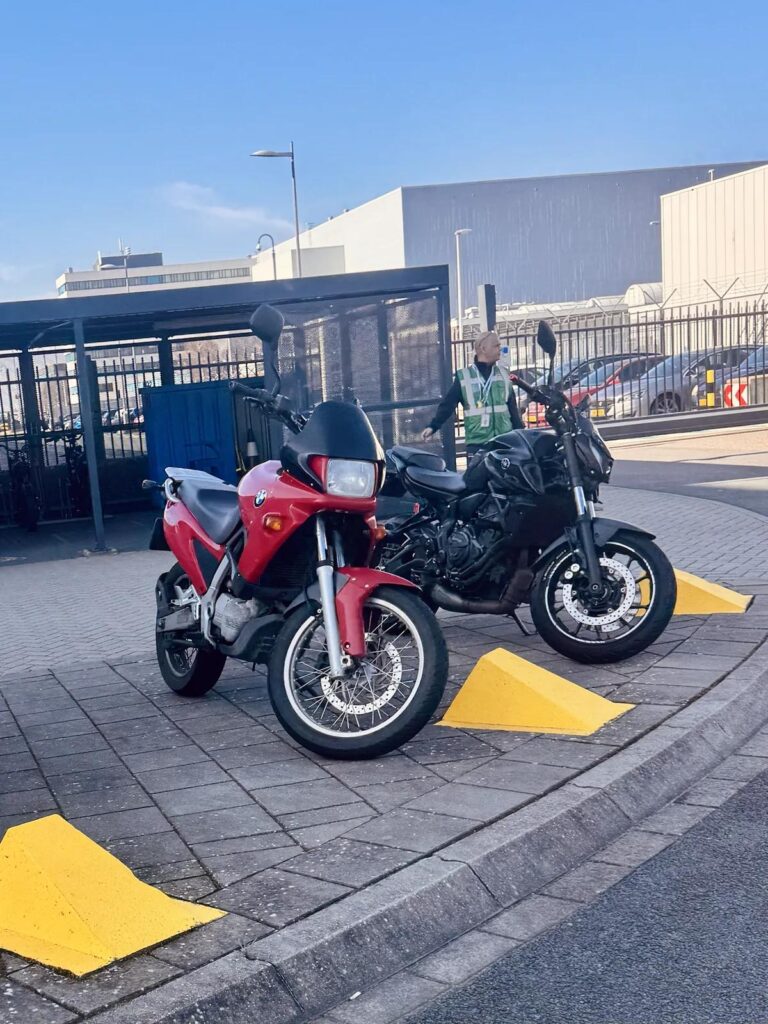
A tight grip makes your arms rigid.
Rigid arms can transfer every small movement of the front wheel into the handlebars, making the motorcycle feel more unstable.
Keep your elbows slightly bent. Hold the grips securely but lightly. Let the front wheel make small corrections without trying to overpower it.
At the same time, keep your eyes on the path you want to take.
Do not stare at the gravel, kerb, ditch or outside of the corner.
See the hazard. Choose the path. Look at the path.
That is the same habit explained in How to Avoid Target Fixation While Riding
How to Ride a Motorcycle Over Gravel
Gravel can appear almost anywhere:
- Roadworks
- Country roads
- Driveways
- Car parks
- Junctions
- Mountain roads
- The outside of corners
- Areas where vehicles have dragged stones onto the road
A light scattering of gravel is different from a deep gravel road, but the basic approach remains similar.
Slow Down Before Reaching It
Use your normal grip to reduce speed.
Do not wait until the front tyre is already on the gravel before grabbing the brakes.
Check behind you before slowing, especially when traffic is close.
Choose the Cleanest Safe Line
Look for:
- Exposed asphalt
- Vehicle tyre tracks
- Shallower gravel
- A straighter path
- An area without deep ruts
- Enough space away from oncoming traffic
Do not make a sudden swerve just to avoid a small patch. A predictable straight crossing may be safer than an aggressive last-second direction change.
Keep a Light Grip
The front tyre may move slightly from side to side.
Let it.
A small amount of movement does not automatically mean you are about to fall. Keep your upper body relaxed and continue looking ahead.
The more you fight the handlebars, the larger those movements can become.
Maintain Gentle Momentum
A motorcycle is generally easier to balance while it is moving than when it is almost stopped.
Use a calm, steady throttle where appropriate. Avoid accelerating hard, but do not panic and completely close the throttle if doing so would create a sudden weight transfer.
The goal is controlled momentum, not speed.
Avoid Sharp Direction Changes
Make any necessary steering adjustments progressively.
If the gravel section is long, accept a wider and smoother line rather than trying to make the bike follow every small correction instantly.
The motorcycle may not feel as precise as it does on asphalt.
That is normal.
How to Ride a Motorcycle Through Sand
Sand can be more difficult than gravel because the front tyre may sink or push through the surface instead of rolling cleanly over it.
A thin layer of sand on asphalt may feel slippery.
Deep, loose sand can make the front wheel wander significantly and requires specialist off-road technique.
For a beginner riding a road motorcycle, the safest option may be to stop before a deep sandy section when traffic conditions allow and choose another route.
When crossing a short or unavoidable patch:
- Reduce speed beforehand
- Keep the bike upright
- Look beyond the sand
- Maintain gentle momentum
- Avoid sharp steering
- Avoid sudden braking
- Let the front wheel find its path
- Keep your arms relaxed
Do not stare directly in front of the tyre. Looking down makes the surface feel faster and makes balance more difficult.
Look toward the firm ground beyond the sand.
Do not accelerate aggressively in an attempt to “power through.” That may spin the rear tyre or push the bike farther off line.
At the same time, avoid a frightened, instant throttle closure.
Smooth and steady is the goal.
Deep sand is not the place to experiment with techniques you have only read about.
Sustained sand riding, standing on the foot pegs and advanced weight positioning are skills best learned during proper off-road or adventure-bike training.
What to Do When Gravel Appears in a Corner
Gravel in a corner is one of the most frightening road hazards for a rider.
The motorcycle is already leaned over. The tyres are already being asked to turn. Then the available grip changes.
The best response depends on when you see it.
When You See the Gravel Before Entering the Corner
You still have options.
- Check your mirrors.
- Reduce speed while the motorcycle is upright.
- Choose a line that avoids the deepest gravel.
- Enter with less lean angle.
- Look through the clean path.
- Keep the throttle and steering smooth.
Do not focus so hard on avoiding the gravel that you ride into the opposite lane, towards a kerb or off the road.
Your escape path must still be legal and safe.
For more on choosing a safe entry speed and line, read How to Corner Safely on a Motorcycle.
When You Are Already Leaned Over
This is where panic can make the situation worse.
Avoid:
- Grabbing the front brake
- Snapping the throttle closed
- Making a sudden steering correction
- Looking at the outside of the road
- Locking your elbows
Instead:
- Keep your eyes on the safest available exit.
- Relax your hands and shoulders.
- Keep your inputs as neutral and smooth as possible.
- Reduce lean angle gently if your line and road position allow it.
- Wait until you have cleared the gravel before making a stronger correction.
The tyres may slide or move slightly and then regain grip.
Do not automatically assume that every movement requires a major response.
The priority is to avoid adding another sudden force while grip is already reduced.
Common Slippery Road Hazards
Gravel and sand are not the only surfaces that reduce grip.
Some of the most common hazards are found on normal city roads.
Wet Road Paint
Lane markings, pedestrian crossings, arrows and other painted areas can become noticeably more slippery when wet.
Try to cross them:
- With minimal lean
- Using a steady throttle
- Without braking sharply
- At a controlled speed
Painted markings are especially important around roundabouts and junctions, where you may already be turning or braking.
Manhole Covers and Metal Plates
Metal surfaces can become very slippery in rain or cold weather.
Slow before reaching them and cross as upright as possible.
Avoid turning, accelerating or braking sharply while your tyre is directly on the metal.
Tram Tracks
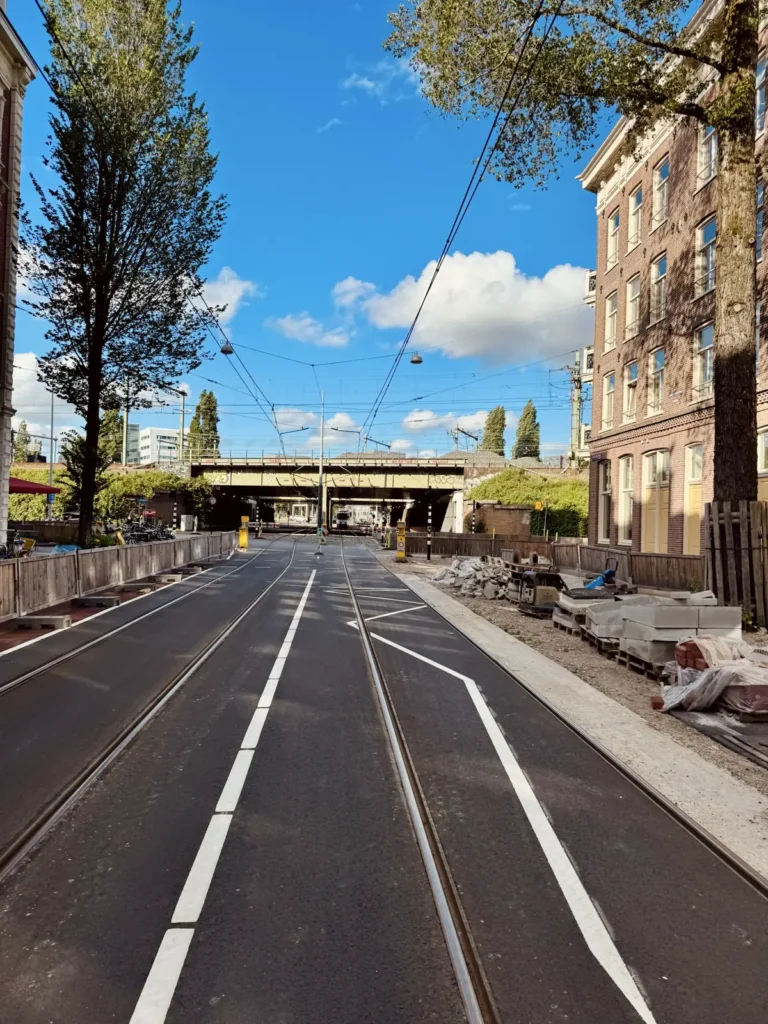
Tram tracks deserve special attention in Amsterdam.
A tyre can lose grip on a wet rail or become caught if it travels almost parallel to the track.
Plan your crossing early.
Move far enough away from the rail to create a clear crossing angle, then cross deliberately and smoothly when it is safe.
Do not make a sudden movement into another lane or towards a cyclist just to achieve a perfect angle. Traffic awareness still comes first.
Keep your eyes on the path beyond the track rather than staring down at the rail.
Wet Leaves
Wet leaves can hide the road surface and move underneath the tyres.
Treat a heavy layer of wet leaves like any other low-grip surface:
- Reduce speed before reaching it
- Keep the motorcycle upright
- Avoid braking or turning sharply
- Look for a cleaner path
Mud and Farm Debris
Mud may be dragged onto country roads by tractors and other agricultural vehicles.
It can be difficult to see, particularly in shaded corners or after rain.
Expect it near:
- Farm entrances
- Field crossings
- Narrow country lanes
- Construction areas
- Roads following heavy rain
Reduce your speed whenever visibility through a country-road corner is limited.
Oil, Diesel and Fuel
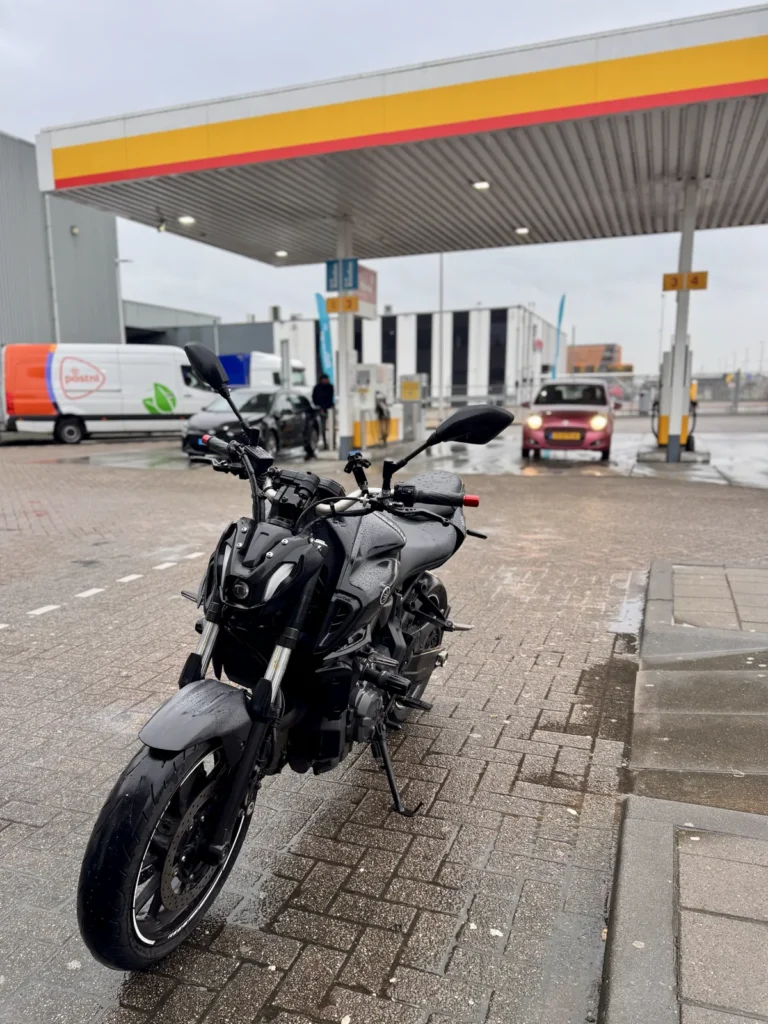
Fuel or oil can create an extremely slippery patch.
It may appear as:
- A rainbow-coloured shine
- A dark patch
- A strong fuel smell
- A trail near a junction or roundabout
- Spillage near a petrol station
Avoid it where possible.
When avoidance is not possible, slow beforehand, keep the motorcycle upright and minimise braking, acceleration and steering while crossing it.
Tar Strips and Road Repairs
Raised repair strips and tar lines can feel slippery, especially when warm or wet.
Cross them smoothly rather than following them lengthwise when possible.
A small movement is usually less dangerous than a sudden attempt to force the motorcycle away from the line.
How to Brake on Gravel or a Slippery Road
Braking on a low-grip surface is not about avoiding the brakes completely.
It is about applying them progressively.
Whenever possible, complete most of your braking before the slippery section.
When you must brake on it:
- Keep the motorcycle upright
- Apply both brakes smoothly
- Build pressure gradually
- Avoid grabbing the front brake
- Avoid stamping on the rear brake
- Give yourself more stopping distance
- Keep your eyes up
The front brake remains an important part of stopping the motorcycle, but it must be applied progressively.
Do not become so afraid of the front brake that you depend entirely on the rear. A locked rear wheel can still slide, move sideways and reduce control.
The correct balance depends on the motorcycle, surface, speed and available grip. The universal principle is smooth pressure.
Read How to Brake Safely on a Motorcycle to build stronger progressive-braking habits.
What About ABS and Traction Control?
ABS and traction control can help, but they cannot create grip where very little exists.
ABS may reduce the chance of a wheel remaining locked under braking. Traction control may reduce excessive rear-wheel spin during acceleration.
Neither system guarantees that you cannot slide.
They also do not protect you from:
- Excessive corner entry speed
- Too much lean on a slippery surface
- Abrupt steering
- Poor tyre condition
- Target fixation
- Riding into deep sand
- Ignoring the road ahead
On a normal road motorcycle, do not switch off ABS simply because you see gravel.
Some adventure motorcycles have specialised off-road modes, but those settings should be used according to the owner’s manual and with the proper training.
Electronics are a backup.
Your vision, speed and control inputs remain the first line of defence.
Body Position on Loose Surfaces
For a short section of gravel, sand or slippery road on a street motorcycle, focus on a neutral and relaxed position.
- Keep your head and eyes up
- Keep your elbows bent
- Avoid locking your arms
- Hold the tank gently with your knees
- Keep your weight balanced
- Allow the motorcycle to move slightly underneath you
- Keep your feet on the foot pegs
Avoid putting a foot down while travelling at normal road speed.
A foot can catch the ground, be pulled backwards or become trapped beneath the motorcycle.
Putting a foot down may occasionally help at walking pace, but it is not a substitute for balance or correct control.
Standing on the foot pegs can be useful during sustained off-road riding, but it should not become an improvised response every time you see a small patch of gravel.
Learn that technique in a controlled environment.
What to Do When the Handlebars Wiggle
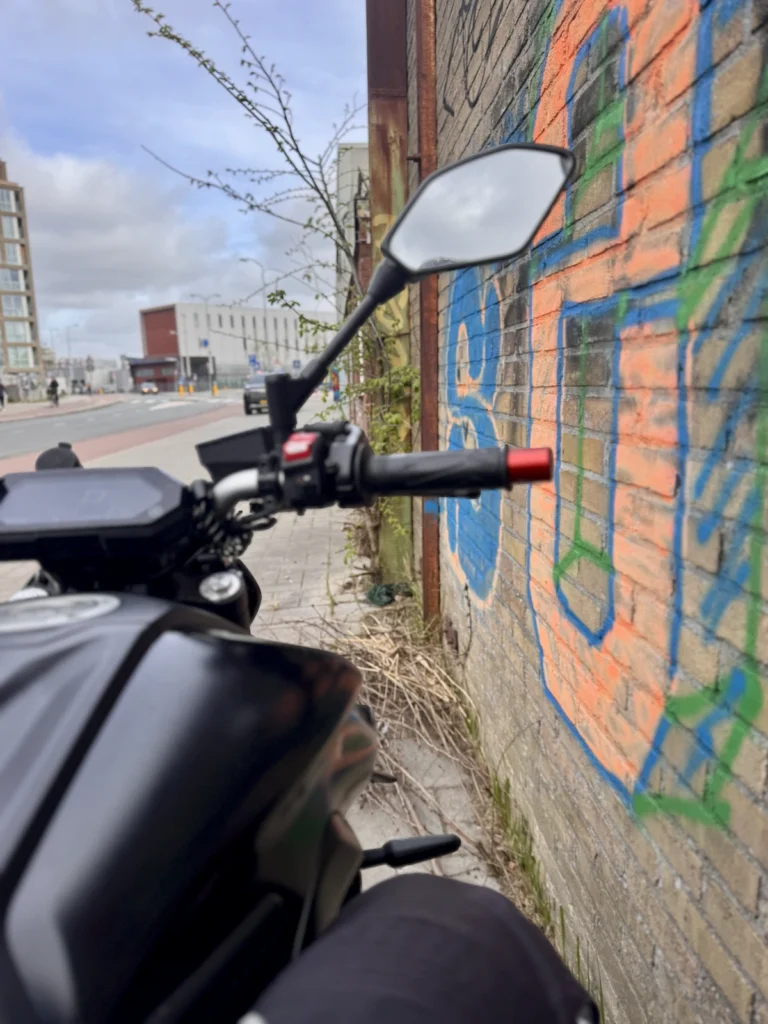
Grooves, gravel, bridge gratings and uneven surfaces may cause the handlebars to move or the motorcycle to wander slightly.
Do not immediately try to stop every movement.
Instead:
- Look ahead
- Hold a steady line
- Keep your grip relaxed
- Avoid sudden acceleration
- Avoid abrupt braking
- Let the tyres work across the surface
The bike may feel uncomfortable without being out of control.
Fighting the handlebars can turn a small movement into a larger one.
Your hands should guide the motorcycle.
They should not try to freeze it.
Prepare the Motorcycle Before You Need the Grip
Technique matters, but the motorcycle also needs to be ready.
Check:
- Tyre pressure
- Tyre tread
- Tyre age and condition
- Brake condition
- Suspension condition
- Fluid leaks
- Wheel alignment
- Loose luggage
Follow the motorcycle and tyre manufacturers’ pressure recommendations.
Do not lower your tyre pressure for one short gravel section unless you understand the consequences and are preparing for proper off-road riding.
A pressure that works off-road may be unsuitable for normal road speed, tyre heat and carrying load.
Your road setup should remain safe for the whole ride, not just one short section.
Common Mistakes
| Mistake | Why It Creates Risk | Better Habit |
|---|---|---|
| Staring at the gravel | Can cause target fixation | Look at the clean path beyond it |
| Braking too late | Forces hard braking on low grip | Reduce speed before the surface |
| Grabbing the front brake | Can overwhelm available grip | Apply both brakes progressively |
| Locking the arms | Transfers instability into the handlebars | Keep elbows bent and grip relaxed |
| Making a sudden swerve | Adds sharp steering when grip is uncertain | Choose a smooth, predictable line |
| Snapping the throttle closed | Creates abrupt weight transfer | Adjust the throttle progressively |
| Following another rider closely | Reduces time to see the hazard | Increase following distance |
| Accelerating hard to escape | May spin the rear tyre | Maintain gentle, controlled momentum |
| Putting a foot down at speed | Can injure or destabilise the rider | Keep feet on the pegs |
| Trusting ABS completely | Electronics cannot create grip | Manage speed and surface first |
How to Practise Without Taking Unnecessary Risks
Do not search for a dangerous gravel road just to test yourself.
Begin with the skills that support low-grip riding:
Practise Looking Farther Ahead
Train yourself to recognise surface changes before you reach them.
Notice:
- Colour changes
- Shiny patches
- Loose stones
- Roadworks
- Mud
- Leaves
- Metal covers
- Vehicle tyre tracks
Practise Progressive Braking
Use a safe, clean and empty area.
Start slowly and practise building brake pressure rather than grabbing it.
Practise Relaxed Steering
Pay attention to how tightly you hold the grips during normal riding.
Try to reduce unnecessary tension while keeping full control.
Practise Choosing a Path
When you see a harmless road imperfection, identify it, choose the clean line and move your eyes towards that line.
This builds the habit before you encounter something more serious.
Take Professional Training
A good riding course gives you a controlled environment, an instructor and immediate feedback.
Reading can explain the principle.
Training helps turn it into a physical skill.
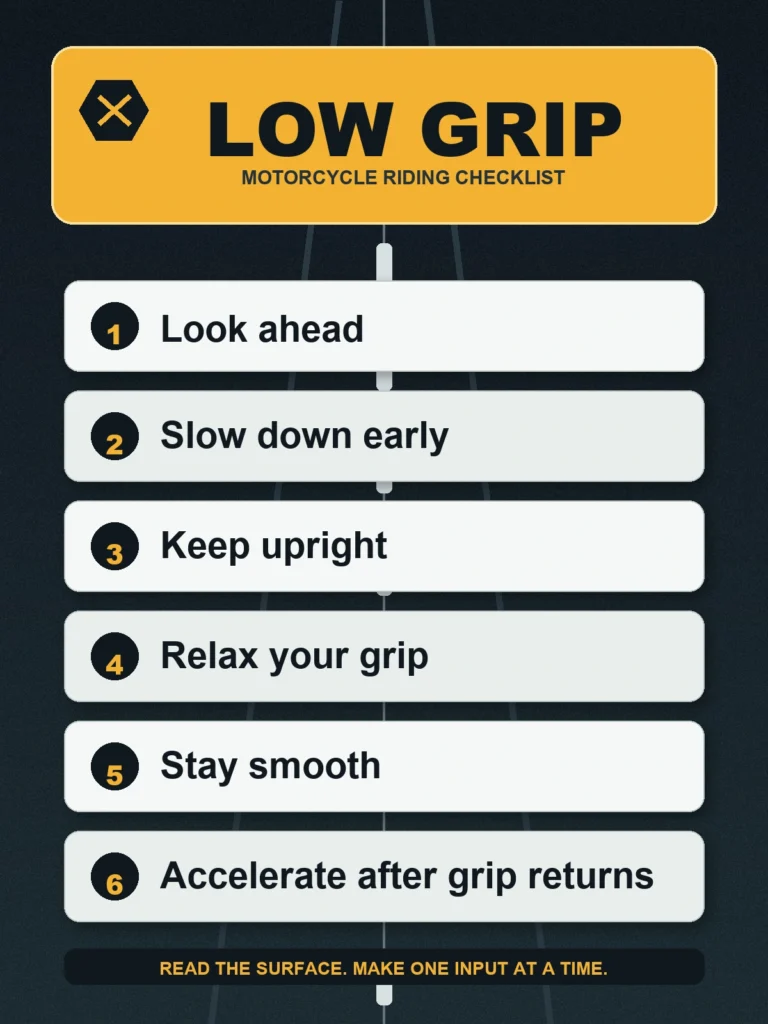
Gravel and Slippery Road Checklist
When the road surface changes, remember:
- Look ahead
- Check your mirrors
- Slow down before the hazard
- Choose the cleanest safe path
- Keep the bike upright
- Relax your grip
- Keep your eyes on the exit
- Use smooth throttle
- Use progressive braking
- Avoid sharp steering
- Allow small movements
- Wait for normal grip before accelerating
- Turn back if the surface exceeds your skill
The final point matters.
You do not have to continue simply because the road is there.
A calm decision to turn around is better than riding into deep sand, mud, ice or gravel you are not prepared to handle.
That is not failure.
That is good judgement.
Final Thoughts: Smoothness Protects Your Grip
Gravel, sand and slippery roads are part of real-world motorcycling.
You cannot guarantee that every road will be clean, dry and predictable.
But you can improve the way you respond.
See the hazard early.
Slow down before it.
Keep the motorcycle upright.
Relax your arms.
Look at the safe path.
Use every control smoothly.
The bike may move underneath you.
That does not mean you have lost control.
Stay calm enough to understand what the motorcycle is telling you before trying to correct it.
The safest riders are not the ones who never encounter difficult surfaces.
They are the ones who leave enough margin to handle them without panic.
That is the kind of rider I want to become.
Calm when the road changes.
Smooth when the grip disappears.
Humble enough to slow down.
Confident enough not to fight the motorcycle.
Ride smart. Stay smooth. Come home safe.
FAQs
Should I use the front brake on gravel?
Yes, but apply it progressively and with the motorcycle as upright as possible. Avoid grabbing the lever suddenly. Use both brakes smoothly and allow more stopping distance than you would on dry asphalt.
Should I accelerate through gravel?
Maintain gentle momentum where appropriate, but do not accelerate aggressively. Hard acceleration may spin the rear tyre, while an abrupt throttle closure may create sudden weight transfer. Keep the throttle smooth.
What should I do if my motorcycle starts wobbling on gravel?
Keep your eyes ahead, relax your grip and avoid sudden braking or steering. Small movements can be normal on loose surfaces. Do not fight every movement of the handlebars.
Should I put my feet down when riding through sand?
Keep your feet on the pegs at normal riding speeds. Putting a foot down can cause it to catch the ground or become trapped. A foot may occasionally help at walking pace, but it should not replace balance and smooth control.
Are wet road markings dangerous for motorcycles?
Wet road markings can provide less grip than the surrounding asphalt. Cross them with minimal lean, a steady throttle and no sudden braking or steering.
How should I cross tram tracks on a motorcycle?
Plan the crossing early and create a clear crossing angle where traffic conditions safely allow it. Keep the motorcycle controlled, use steady inputs and look towards the path beyond the rail. Avoid travelling almost parallel to a wet track.
What should I do if I see gravel halfway through a corner?
Keep your eyes on the safest exit, relax your grip and avoid grabbing the brakes or making a sudden steering correction. Reduce lean gently if your line allows it and wait until normal grip returns before making stronger inputs.
Can ABS prevent a motorcycle from sliding on gravel?
ABS can help prevent prolonged wheel lock during braking, but it cannot create grip or protect you from excessive speed, lean angle or abrupt steering. Manage your speed and line before depending on electronics.