A motorcycle may be mechanically ready while the rider is not.
Your tyres can be correctly inflated. The chain can be adjusted. Your helmet can be fastened and the weather can look manageable.
But if you are exhausted, distracted, angry or unable to concentrate, the ride may still begin without enough safety margin.
Motorcycle riding requires continuous decisions. You are watching traffic, reading the road surface, controlling the motorcycle, checking mirrors and anticipating what other people may do next.
Mental preparedness for motorcycle riding means checking whether you are genuinely ready to manage those demands before you leave.
It does not mean eliminating every nervous thought or waiting until you feel completely fearless.
It means recognising your current condition, adjusting the ride when necessary and being willing to postpone it when your attention or judgement is not reliable.
Quick Answer
How Do You Mentally Prepare for a Motorcycle Ride?
Before riding:
- Check whether you are properly rested.
- Notice whether you feel angry, distressed or mentally overwhelmed.
- Make sure alcohol, drugs or medication are not affecting you.
- Deal with urgent distractions before putting on your helmet.
- Choose a route that matches your current confidence and energy.
- Give yourself time instead of starting the ride in a rush.
- Begin calmly and use the first few minutes to settle into the motorcycle.
- Stop somewhere safe if your concentration begins to deteriorate.
Being able to ride does not always mean that this is the right moment to ride.
Why Your Mental State Matters on a Motorcycle
A motorcycle gives you less room to become mentally absent.
Missing a mirror check, noticing a junction late or entering a corner while distracted can quickly reduce your available options.
Your mental condition can influence:
- How far ahead you look
- How quickly you recognise hazards
- How smoothly you operate the controls
- How closely you follow other traffic
- Whether you take unnecessary risks
- How you react when another road user makes a mistake
- Whether you recognise your own fatigue
You do not need perfect concentration every second.
You do need enough awareness to notice when your attention has drifted and bring it back before the situation becomes urgent.
This is one reason motorcycle safety begins before the engine starts.
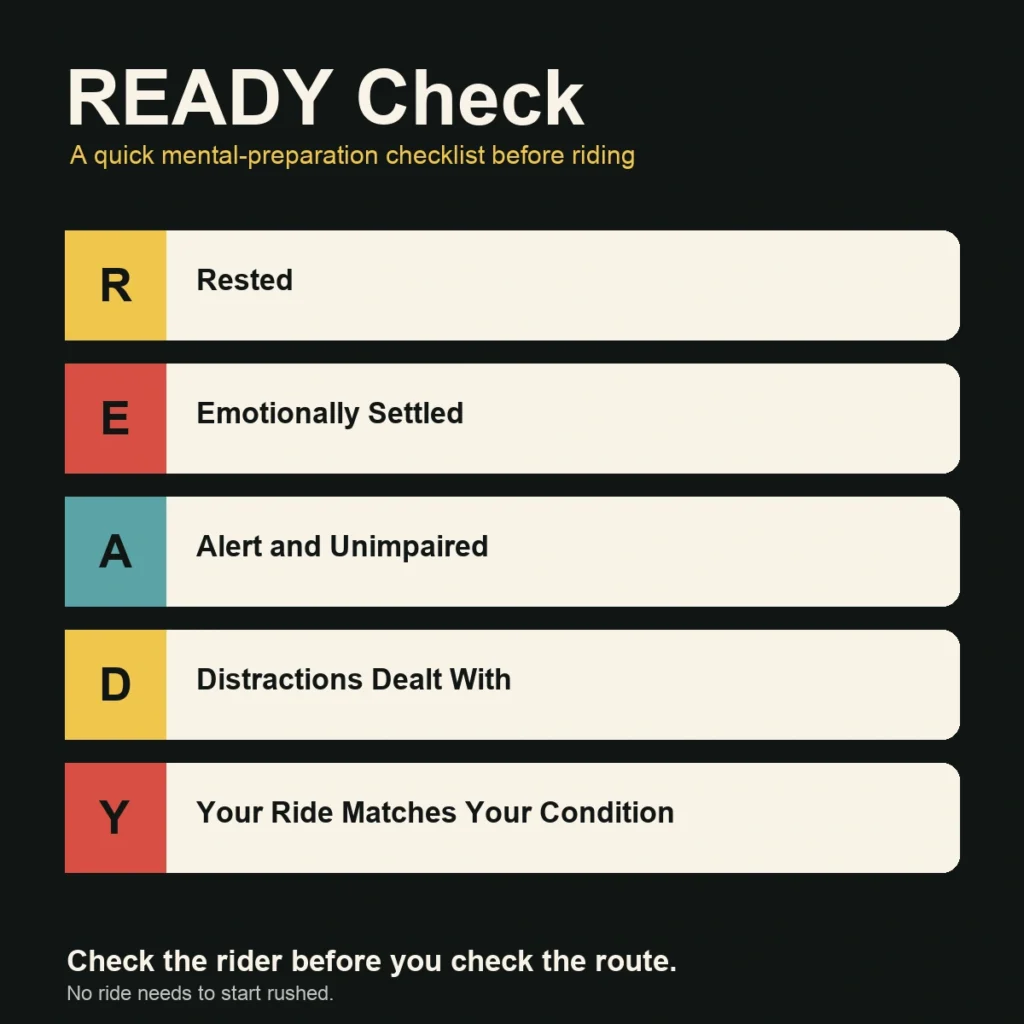
Use the READY Pre-Ride Mental Check
A simple routine makes it easier to assess yourself honestly.
Before every ride, ask whether you are READY.
R — Rested
Did you sleep well enough to remain alert?
Also consider physical tiredness from:
- A long working day
- Exercise
- Illness
- Poor sleep
- A night shift
- Several hours of previous riding
- A demanding journey home
You do not need to be falling asleep for tiredness to affect the ride.
Difficulty concentrating, repeated yawning, heavy eyes and unusually slow thinking are enough reasons to reconsider.
E — Emotionally Settled
Are you calm enough to make patient decisions?
Strong anger, sadness, stress or frustration may follow you onto the motorcycle.
You may become less tolerant of slow traffic, follow another vehicle too closely or make an overtake that you would normally reject.
A motorcycle ride can feel calming, but it should not be used as the immediate response to an intense argument or emotional shock.
Allow yourself time to settle first.
A — Alert and Unimpaired
Have you consumed anything that could affect your coordination, alertness or judgement?
Do not ride after drinking alcohol or using recreational drugs.
Check warnings on prescription and over-the-counter medication. Some medicines can cause drowsiness, dizziness, slower reactions or difficulty concentrating.
Ask a doctor or pharmacist when you are uncertain about whether a medicine is compatible with riding.
D — Distractions Dealt With
Is your attention already occupied by something else?
Examples include:
- An urgent work problem
- A difficult conversation
- Repeated phone notifications
- Running late
- Trying to remember complicated directions
- Worry about the motorcycle
- Pressure to keep up with other riders
Deal with what you can before leaving.
Set the navigation, silence unnecessary notifications and tell other people that you will respond after the ride.
If navigation is part of the ride, set the route before leaving and use a secure phone mount for motorcycle navigationrather than handling the phone on the move.
Y — Your Ride Matches Your Condition
Does the planned ride suit how you feel today?
A short ride on familiar roads places different demands on you than:
- Heavy motorway traffic
- Night riding
- Strong wind
- Rain
- An unfamiliar city
- A fast group ride
- Carrying a passenger
- Several hours in the saddle
Changing the route is not avoiding the challenge.
It is matching the challenge to the rider who is actually getting on the motorcycle today.
Normal Nerves Do Not Automatically Mean You Should Stay Home
Many beginners feel nervous before riding.
You may notice a faster heartbeat, tense shoulders or thoughts about everything that could go wrong.
Some nervousness can make you more cautious and attentive.
The important question is whether you can still think clearly and control the motorcycle smoothly.
Consider reducing the difficulty when you feel uncertain:
- Ride at a quieter time
- Use a familiar route
- Avoid motorways
- Keep the ride short
- Practise in a low-traffic area
- Ride alone instead of joining a group
- Choose good weather
- Avoid carrying a passenger
Confidence should be built through manageable experience rather than forced through one overwhelming ride.
A professional refresher lesson can also help when your confidence has dropped or you have not ridden for a long time.
Motorcycle Safety Courses: Are They Worth It?
Do Not Begin the Ride in a Rush
Rushing creates problems before the motorcycle moves.
You may skip a safety check, forget to fasten something, enter traffic aggressively or spend the first part of the journey thinking about being late.
Give yourself enough time to:
- Inspect the motorcycle
- Put on your gear properly
- Set the route
- Secure your luggage
- Adjust your mirrors
- Check the fuel level
- Think about the first part of the journey
Use the Free Motorcycle Pre-Ride Safety Checklist to separate the mechanical checks from your mental check.
When you are already late, accept the delay.
Trying to recover time on a motorcycle usually removes the space you need for safe decisions.
Use a One-Minute Reset Before Starting
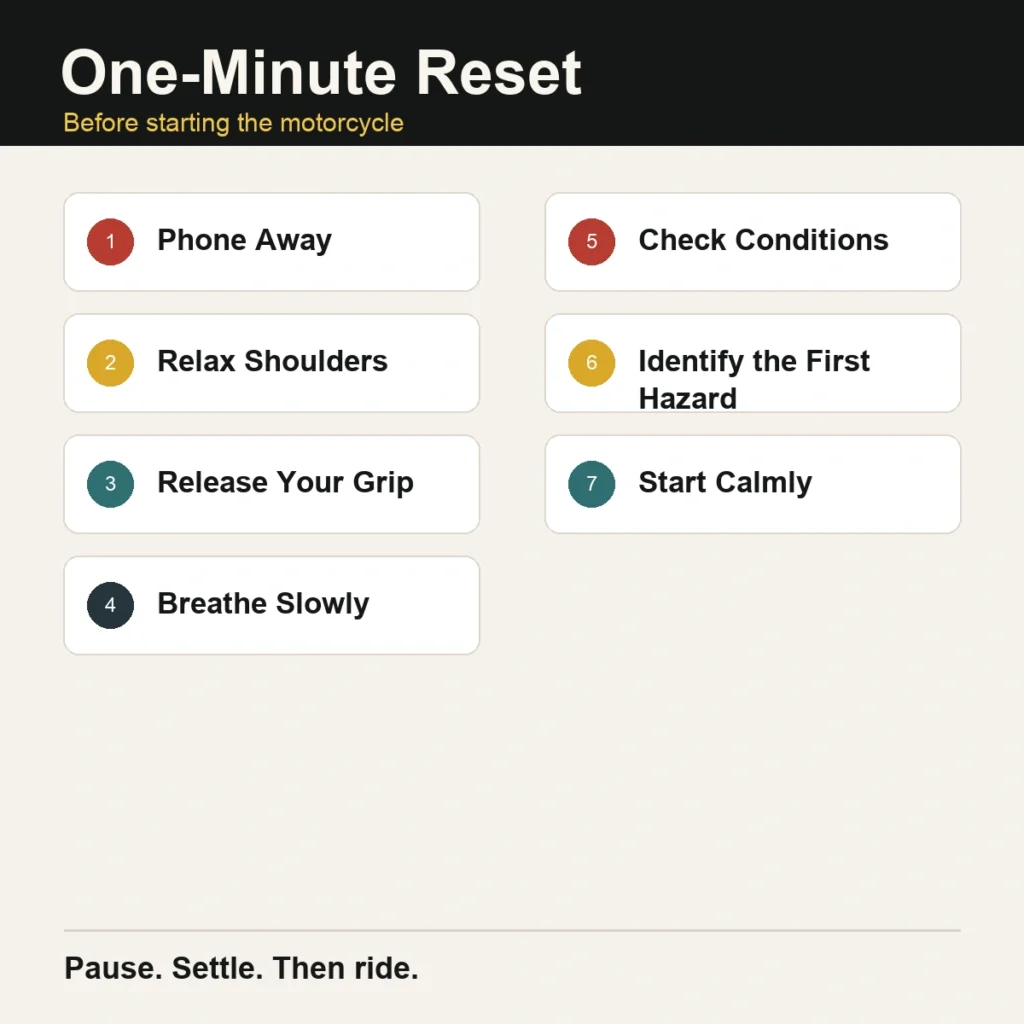
A short pause can help separate the ride from whatever happened before it.
While the motorcycle is still parked:
- Put the phone away.
- Relax your jaw and shoulders.
- Release unnecessary pressure from your hands.
- Take several slow, comfortable breaths.
- Look at the road and weather conditions.
- Identify the first major hazard on your route.
- Decide what a calm first five minutes will look like.
This is not a guarantee that you are ready.
It is simply a final opportunity to notice tension, tiredness or distraction before entering traffic.
Do not perform breathing exercises or close your eyes while the motorcycle is moving.
Treat the Beginning of the Ride as a Warm-Up
You do not need to prove anything during the first few minutes.
Use the beginning of the ride to reconnect with:
- Clutch feel
- Brake pressure
- Throttle response
- Low-speed balance
- Mirror use
- Road observation
- Your normal riding position
Keep your speed controlled and leave extra following distance.
Notice whether your arms are relaxed and whether you are looking far enough ahead.
When something feels unfamiliar, do not immediately increase the difficulty. Stay on simpler roads until your attention and control feel settled.
Read Motorcycle Vision Techniques for practical ways to improve scanning, mirror use and forward observation.
Notice When Your Attention Has Left the Ride
Distraction is not limited to phones.
You can be looking at the road while mentally replaying a conversation, planning tomorrow’s work or worrying about something that happened earlier.
Warning signs include:
- Missing a mirror check
- Braking later than normal
- Forgetting to cancel an indicator
- Becoming surprised by obvious hazards
- Staring at one vehicle for too long
- Following traffic without actively scanning
- Repeatedly thinking about something unrelated
- Being unable to remember the previous section of road
When you recognise this, bring your attention back to a simple sequence:
Look ahead. Check mirrors. Create space. Identify the next hazard.
When your mind repeatedly leaves the ride, find somewhere safe to stop.
Watch for Tension and Target Fixation
Mental tension often appears physically.
You may begin to:
- Grip the handlebars tightly
- Lock your elbows
- Raise your shoulders
- Hold your breath
- Stare at a pothole or road edge
- Make sharp steering corrections
Relax your grip and direct your vision towards the safe path.
Looking at the danger for too long can make it harder to recognise the space around it. This is explored in more detail in How to Avoid Target Fixation While Riding.
If you cannot release the tension while moving, slow down smoothly and stop somewhere safe.
Do Not Let Other Riders Set Your Mental Pace
Group pressure can make a rider ignore warning signs.
You may continue because:
- Everyone else appears comfortable
- You do not want to delay the group
- The route has already been planned
- You are embarrassed to admit that you are tired
- You believe stopping will make you look inexperienced
Ride at a pace that gives you time to think.
Tell the group when you need a break or when the route is beyond your current comfort. A responsible group should not require you to prove that you can keep up.
The principles in Motorcycle Group Riding Safety Tips can help set clearer expectations before leaving.
Recognise Mental Fatigue During the Ride
A rider can begin the journey feeling prepared and become mentally tired later.
Watch for:
- Repeated yawning
- Heavy eyes
- Slower hazard recognition
- Missed road signs
- Inconsistent speed
- Poor lane position
- Irritation with other road users
- Repeated small mistakes
- Difficulty remembering the last few kilometres
Do not try to solve serious tiredness by increasing your speed, opening your visor or turning up music.
Find a proper place to stop away from moving traffic.
Take a real break and reassess whether continuing is sensible. When you remain sleepy or mentally slow, end or delay the journey.
The destination will still be there later.
Know When Not to Ride
Postpone the ride when:
- You are struggling to stay awake
- Your thoughts feel confused or unusually slow
- You are extremely angry or emotionally overwhelmed
- Alcohol, drugs or medication may be affecting you
- You cannot concentrate on a simple pre-ride check
- You feel pressured into conditions beyond your ability
- Anxiety is preventing smooth control or clear decisions
- You are physically unwell
- You repeatedly ignore your own warning signs
Cancelling a ride is not evidence that you are a bad motorcyclist.
It shows that you understand the difference between motivation and readiness.
When anxiety repeatedly becomes overwhelming or stops you from riding safely, consider speaking with a qualified motorcycle instructor and an appropriate health professional.
Common Mistakes
| Mistake | Why It Creates Risk | Better Habit |
|---|---|---|
| Riding immediately after an argument | Strong emotion may remain focused on the conflict | Allow time to settle before deciding |
| Using the ride to recover lost time | Encourages rushed checks and impatient decisions | Accept the delay and ride normally |
| Assuming coffee removes fatigue | You may still be too tired to ride safely | Rest properly or postpone the journey |
| Ignoring medication warnings | Some medicines can affect alertness or coordination | Read the label and ask a professional |
| Forcing yourself through severe nerves | Tension can interfere with observation and smooth control | Reduce the difficulty or postpone |
| Following a faster group | Moves decisions beyond your own comfort and ability | Ride your own pace |
| Beginning with a difficult road | Gives you no time to settle into the motorcycle | Start on a calmer, familiar section |
| Riding while thinking about work or messages | Divides attention before hazards appear | Deal with urgent distractions first |
| Treating mental fatigue as weakness | Encourages you to hide warning signs | Stop and reassess honestly |
| Continuing after repeated mistakes | Small errors may show that concentration is declining | Find somewhere safe to rest |
Pre-Ride Mental Checklist
Before riding, ask:
- Am I properly rested?
- Am I calm enough to be patient?
- Is anything affecting my alertness?
- Have I checked my medication warnings?
- Am I free from alcohol and drugs?
- Is my phone dealt with?
- Have I set the route?
- Am I giving myself enough time?
- Does the route match my current confidence?
- Am I willing to stop if conditions feel wrong?
During the ride:
- Look far ahead
- Check mirrors regularly
- Keep your shoulders and arms relaxed
- Maintain a safe following distance
- Notice repeated mistakes
- Do not react emotionally to other road users
- Ride at your own pace
- Stop when concentration begins to fade
After the ride:
- Think about when your focus felt strongest
- Note moments when you felt rushed or distracted
- Identify skills that need more practice
- Adjust the next route accordingly
- Rest before riding again when the journey was demanding
Final Thoughts: Check the Rider as Well as the Motorcycle
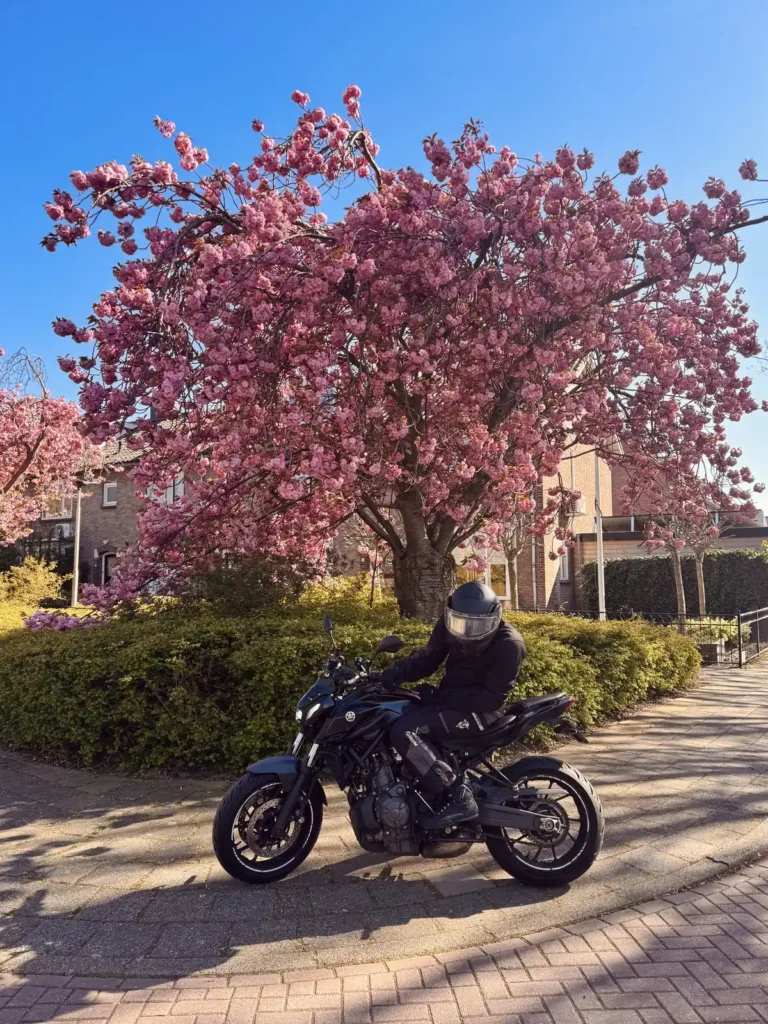
Pre-ride inspections normally focus on the machine.
That matters, but the rider is part of the safety system too.
You do not need to feel fearless, energetic and perfectly calm before every journey. You do need enough attention, patience and physical control to manage the road ahead.
Be honest about tiredness. Notice when stress is following you onto the motorcycle. Reduce the route when your confidence is lower and postpone the ride when your judgement is not reliable.
The decision not to ride can be just as responsible as any decision you make on the road.
Check the bike.
Check the conditions.
Then check yourself.
Ride smart. Stay focused. Come home safe.
FAQs
How do you mentally prepare for a motorcycle ride?
Check whether you are rested, emotionally settled, alert, unimpaired and free from urgent distractions. Choose a route that matches your current confidence and begin the ride calmly.
Should you ride a motorcycle when stressed?
Mild everyday stress does not always prevent safe riding, but intense stress can occupy your attention and make patient decisions more difficult. Postpone the ride when you cannot focus clearly on the road.
Is it normal to feel nervous before riding a motorcycle?
Yes. Many beginners and returning riders feel nervous. Reduce the difficulty by choosing familiar roads, lighter traffic, good weather and a shorter ride.
How does fatigue affect motorcycle riding?
Fatigue can reduce concentration, slow hazard recognition and contribute to repeated mistakes. Stop somewhere safe when you become sleepy, mentally slow or unable to maintain consistent control.
Can you ride a motorcycle after taking medication?
Some prescription and over-the-counter medicines can cause drowsiness, dizziness or other effects that interfere with riding. Read the warning information and ask a doctor or pharmacist when uncertain.
How can I calm down before riding?
Give yourself time, put away distractions, relax your upper body and take several slow, comfortable breaths while the motorcycle is parked. Then begin on a simple, familiar section of road.
What should I do when I lose focus while riding?
Return your attention to looking ahead, checking mirrors, creating space and identifying the next hazard. Stop somewhere safe when your attention repeatedly drifts away.
When should I postpone a motorcycle ride?
Postpone when you are very tired, emotionally overwhelmed, impaired, unwell or unable to concentrate. Also reconsider when the route or conditions exceed your current confidence.
Related Reads
Motorcycle Safety for Beginners: Complete Guide