Riding alone teaches you control.
Riding in a group teaches you discipline.
A solo ride gives you freedom to choose your own pace, stop when you want and focus only on your own decisions. But a group ride is different.
Your actions affect everyone around you.
Your speed, spacing, lane position, overtakes, braking, and communication all influence the safety of the riders behind and ahead of you.
That is why group riding etiquette matters.
A good group ride is not about showing off. It is not about proving who is the fastest, loudest or most confident rider. It is about riding together in a way that keeps everyone safe, calm and predictable.
For beginner riders, group rides can be exciting but also overwhelming. You may feel pressure to keep up. You may not know where to position yourself. You may worry about braking too early, losing the group or making a mistake in formation.
The truth is simple:
A safe group ride is built on communication, patience, spacing and respect.
This guide explains the most important motorcycle group riding safety tips, including formation riding, hand signals, overtaking etiquette, beginner mistakes and what to do if the group gets separated.
Because the goal of a group ride is not to arrive first.
The goal is for everyone to arrive safely.
Start with the basics : Motorcycle safety for beginners
Quick Answer
What Are the Most Important Motorcycle Group Riding Safety Tips?
The most important motorcycle group riding safety tips are to ride in a staggered formation when appropriate, keep enough space, avoid sudden moves, communicate clearly, ride your own pace, do not overtake inside the group unless agreed, respect the road captain and never pressure beginner riders to keep up.
Group riding works best when every rider is predictable.
Why Group Riding Needs Etiquette
When you ride alone, your mistake mostly affects you.
In a group, your mistake can affect several riders.
If you brake suddenly, the rider behind you has to react.
If you change position unpredictably, another rider may be surprised.
If you follow too closely, you reduce your own reaction time.
If you overtake aggressively, you can disturb the whole formation.
If you ride beyond your skill to keep up, you put yourself and others at risk.
Group riding etiquette exists to prevent confusion.
It helps everyone know what to expect.
Good etiquette makes the ride smoother because riders are not constantly guessing what others will do. Everyone understands the pace, the formation, the plan and the signals.
A safe group ride should feel calm, not chaotic.
The best group riders are not the ones trying to dominate the ride.
They are the ones who make the group safer by being smooth, aware and predictable.
Before the Ride: Agree on the Basics
A safe group ride starts before anyone starts the engine.
Before riding, the group should agree on the basics:
- Route
- Destination
- Fuel stops
- Rest stops
- Pace
- Formation
- Lead rider
- Sweep rider
- Overtaking rules
- What to do if separated
- How to communicate
- Beginner riders in the group
- Emergency plan
Read : Top 10 Motorcycle Safety Tips Every Rider Should Know
This does not need to become a formal meeting, but a short pre-ride conversation can prevent confusion later.
If the group is small and everyone knows each other, this may take only two minutes.
If the group is larger, mixed-skill, or riding unfamiliar roads, it matters even more.
The worst time to figure out group rules is while riding.
Decide early.
Know the Role of the Lead Rider
The lead rider sets the tone for the group.
This person should not be chosen only because they are the fastest. A good lead rider is calm, experienced, predictable and familiar with the route.
The lead rider’s job is to:
- Set a safe pace
- Choose the route
- Signal early
- Watch road conditions
- Avoid sudden changes
- Keep the group together
- Adjust speed for slower riders
- Make safe decisions at junctions
- Avoid pressuring the group
A bad lead rider turns the ride into a chase.
A good lead rider makes everyone feel calm.
If you are leading a group, your responsibility is not to enjoy your perfect solo pace. Your responsibility is to ride in a way that the group can safely follow.
The pace should suit the least experienced rider, not the most confident one.
That is real leadership.
Know the Role of the Sweep Rider
The sweep rider rides at the back of the group.
This person helps make sure no one is left behind. Like the lead rider, the sweep rider should be experienced and calm.
The sweep rider’s job is to:
- Stay behind the group
- Watch for riders falling back
- Help if someone has a problem
- Communicate if the group separates
- Make sure newer riders are not abandoned
- Keep the rear of the group organized
The sweep rider is especially important when beginner riders are present.
A beginner should not feel like one mistake or slow corner will cause them to be left alone on an unfamiliar route.
Knowing there is a calm rider at the back can reduce pressure.
And less pressure means safer riding.
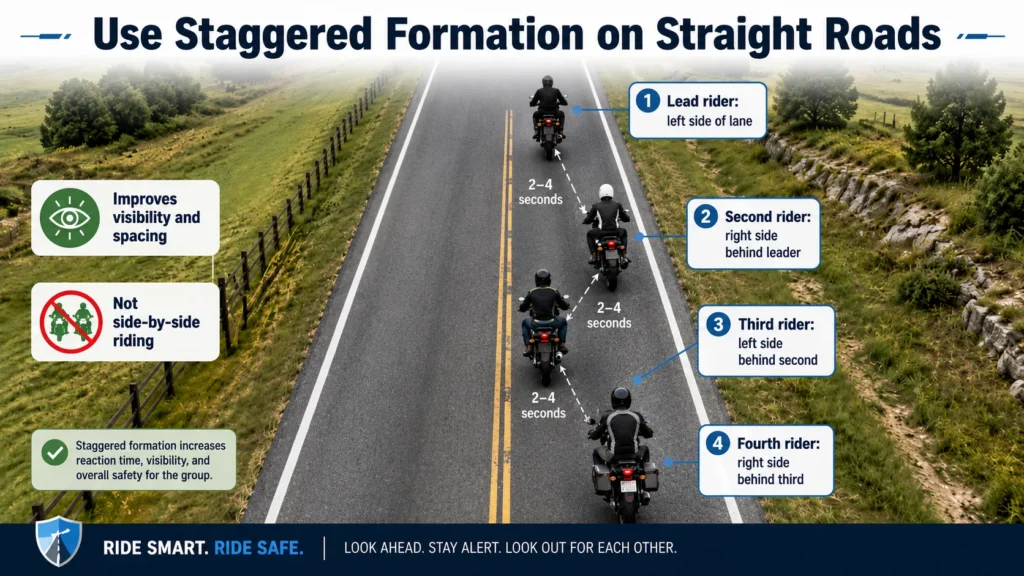
Use Staggered Formation on Straight Roads
A staggered formation is one of the most common group riding formations.
In a staggered formation, riders alternate left and right within the lane. This gives each rider more space while keeping the group compact.
For example:
- Lead rider: left side of lane
- Second rider: right side of lane, behind the leader
- Third rider: left side of lane, behind the second rider
- Fourth rider: right side of lane, behind the third rider
This formation helps improve visibility and spacing.
But remember:
A staggered formation is not side-by-side riding.
You should not ride directly next to another rider in the same lane unless specifically needed and safe. Riding side by side reduces escape space.
In staggered formation, each rider should still have enough room to brake, adjust and avoid hazards.
Formation should support safety.
It should not feel tight or forced.
Switch to Single File When Needed
Staggered formation is useful on straight, open roads, but it is not right for every situation.
Switch to single file when the road becomes more demanding.
Use single file for:
- Corners
- Narrow roads
- Roundabouts
- Poor road surfaces
- Roadworks
- Heavy traffic
- Wet or slippery conditions
- Gravel or debris
- Low visibility
- Overtaking
- Tight city streets
In these situations, each rider needs the full lane to choose their line, avoid hazards and maintain control.
Do not force staggered formation through corners.
A corner requires space.
When the road opens again, the group can return to staggered formation if appropriate.
Good group riding is flexible.
The formation should change with the road.
Keep Enough Space
Space is one of the most important motorcycle group riding safety tips.
Beginner riders often think they need to stay close so they do not lose the group. But riding too close creates risk.
If the rider ahead brakes suddenly, you need time to react.
If they swerve around a pothole, you need time to see it.
If they make a mistake, you need enough space not to copy it.
Leave enough room.
In staggered formation, you are not directly behind the rider ahead, but you still need a safe gap. In single file, increase that gap even more.
Never let the group pressure you into tailgating.
If you are constantly rushing to keep up, the pace is wrong for you.
A safe group does not require everyone to ride on top of each other.
A safe group gives every rider space to think.
Read : Beginner’s Guide to Defensive Motorcycle Riding
Ride Your Own Ride
This is one of the most important rules in group riding:
Ride your own ride.
Do not copy another rider’s speed, braking point, corner entry, overtaking decision, or lane position if it does not feel safe for you.
The rider ahead may have more experience.
They may know the road better.
They may have better tires.
They may have different braking skill.
They may simply be taking more risk.
Their decision is not automatically your decision.
If they overtake, you do not have to overtake.
If they enter a corner faster, you do not have to match them.
If they filter through a gap, you do not have to follow.
If they ride aggressively, you do not need to join.
A good group respects individual limits.
If you are a beginner, tell the group before the ride. Let them know you are building confidence and will ride at your own pace.
The right riders will respect that.
The wrong riders are not your group.
Read : Staying Mentally Ready To Ride
Do Not Overtake Inside the Group Unless Agreed
Overtaking inside the group can create confusion and risk.
If riders suddenly pass each other without warning, the formation becomes unpredictable. A rider may move position at the same moment another rider tries to overtake. This can quickly become dangerous.
As a general rule:
Do not overtake other riders inside the group unless the group has agreed it is acceptable.
If someone is riding slower than expected, stay patient. Wait for a safe stop or a clear group decision.
A group ride is not a race.
If the group wants a faster section, that should be discussed clearly beforehand, with a plan for regrouping.
Random overtakes inside the group are not impressive.
They are usually unnecessary.
Signal Early and Clearly
Communication matters in group riding.
Use your indicators early. Use hand signals if the group uses them. Signal hazards when safe to do so.
Make your intentions obvious.
Good communication includes:
- Early indicators
- Brake lights
- Hand signals where appropriate
- Clear lane positioning
- Smooth speed changes
- Pointing out road hazards if safe
- Signaling fuel or stop needs
- Communicating before the ride
Do not make sudden decisions and expect everyone to understand.
The rider behind you may be using your behavior to prepare. If you brake late, turn suddenly, or change lane without warning, the effect can ripple backward through the group.
Clear signals reduce surprise.
Less surprise means safer riding.
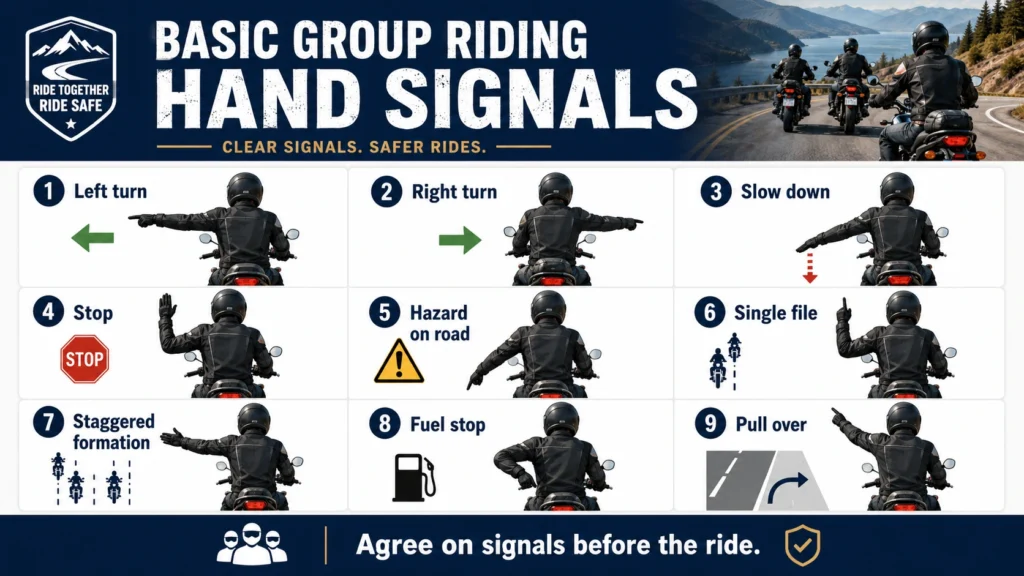
Learn Basic Group Riding Hand Signals
Not every group uses hand signals, and local habits can vary. But basic signals can be useful, especially when communication systems are not available.
Common group riding signals include:
- Left turn
- Right turn
- Slow down
- Stop
- Hazard on the road
- Single file
- Staggered formation
- Fuel stop
- Pull over
Before the ride, agree which signals the group will use.
Do not assume everyone knows the same system.
If you are unsure, ask before leaving.
That question may feel small, but it prevents confusion later.
Do Not Fixate on the Rider Ahead
A common beginner mistake in group riding is staring at the motorcycle directly ahead.
This can lead to target fixation.
If you stare only at the rider in front, you may copy their mistakes, react late to hazards and stop reading the road for yourself.
You should be aware of the rider ahead, but your eyes still need to scan.
Look through the group.
Watch traffic ahead.
Read the road surface.
Check mirrors.
Notice side roads.
Look for escape paths.
Keep your own awareness active.
The rider ahead is not your autopilot.
You are still responsible for your own ride.
Learn : How to Avoid Target Fixation While Riding.
Be Smooth With Braking and Throttle
Smoothness matters even more in a group.
Sudden braking or sharp acceleration can create stress behind you. The rider behind may not expect your movement and may have to react quickly.
Use smooth throttle.
Brake early and progressively.
Avoid sudden lane changes.
Avoid unpredictable speed changes.
If you need to slow down, do it early and clearly.
If traffic ahead is changing, give the riders behind you time to notice.
Your riding affects the rhythm of the group.
A smooth rider makes the whole group safer.
For better braking habits, read : How to Brake Safely on a Motorcycle: Front vs Rear Explained.
Be Careful at Junctions and Roundabouts
Junctions and roundabouts can split a group quickly.
They also create risk because riders may feel pressure to follow the person ahead even when the situation is no longer safe.
Never blindly follow another rider through a junction.
If the rider ahead goes, but your gap is not safe, wait.
The group can regroup later.
Do not rush through a junction because you are afraid of being left behind.
A good group has a plan for this.
Options include:
- Waiting safely after the junction
- Using a marker system
- Sharing the route beforehand
- Having a sweep rider
- Regrouping at planned stops
The rule is simple:
Safety first. Group second.
Missing a turn is better than forcing a dangerous move.
What to Do If the Group Gets Separated
Group separation happens.
Traffic lights change.
Cars enter the group.
Someone misses a turn.
A rider slows down.
The route becomes confusing.
The key is to have a plan.
Before the ride, agree what to do if separated.
Good options include:
- Share the route beforehand
- Use GPS
- Set planned regroup points
- Exchange phone numbers
- Have a lead and sweep rider
- Wait safely after turns when needed
- Do not panic if you lose visual contact
If you get separated, do not ride aggressively to catch up.
That is one of the biggest group riding mistakes.
Trying to catch up can make you ride faster than your skill, ignore traffic, rush corners and take unnecessary risks.
Stay calm. Follow the route. Regroup safely.
The group is not worth a crash.
Keep Beginner Riders Near the Front
If there are beginner riders in the group, place them near the front, behind the lead rider.
This helps the lead rider set a pace that suits them. It also prevents beginners from being stretched at the back, where they may feel pressure to catch up after every junction, corner, or traffic light.
A common mistake is putting new riders at the very back.
That can make the ride harder for them because the back of the group often experiences more speed variation. They may need to accelerate harder to keep up, brake more often and deal with separation anxiety.
A good group protects beginner riders.
Not by treating them like a problem, but by setting them up to succeed.
Everyone was new once.
Do Not Show Off
Group rides can bring out ego.
Someone revs too much.
Someone overtakes aggressively.
Someone takes corners faster than necessary.
Someone tries to prove their bike or skill.
This is where group rides become dangerous.
Showing off has no place in safe group riding.
If you want to ride fast, do it in the right environment with proper training and people who agreed to that kind of ride.
Do not turn a normal group ride into a pressure test.
The safest riders are often the calmest ones.
They do not need to prove anything.
Their riding speaks for itself.
Respect Fuel, Food, and Rest Needs
A good group ride includes realistic stops.
People have different fuel ranges, comfort levels, bladder limits, hunger, energy, and experience. Ignoring that can make the ride less safe.
Tired riders make mistakes.
Hungry riders lose focus.
Cold riders become tense.
Dehydrated riders react slower.
Low fuel creates stress.
Plan stops before people become uncomfortable.
If someone asks for a break, respect it.
Group riding is not only about the moving part.
The rest stops matter too.
They keep the group calm, focused and enjoyable.
Communicate Problems Early
If something feels wrong, communicate early.
This includes:
- Low fuel
- Fatigue
- Discomfort
- Bike issues
- Gear problems
- Feeling overwhelmed
- Wanting a slower pace
- Needing a stop
- Losing confidence
Do not suffer silently just because you do not want to disturb the group.
A good group would rather stop early than deal with a bigger problem later.
If you are a beginner and the pace feels too fast, say it.
If you are tired, say it.
If your bike feels strange, say it.
Group riding works best when riders are honest.
Silence can become unsafe.
Group Riding in the Rain
Rain makes group riding more demanding.
Visibility drops. Braking distances increase. Road markings become slippery. Riders need more space and smoother inputs.
In wet conditions:
- Increase spacing
- Reduce speed
- Use smoother braking
- Avoid sudden lane changes
- Switch to single file when needed
- Avoid painted lines and metal covers
- Keep visibility clear
- Do not pressure slower riders
Rain also increases fatigue.
A group should be willing to slow down, stop or change plans if conditions become uncomfortable.
A safe ride is better than a completed route.
Group Riding in City Traffic
City group riding can be stressful because traffic breaks the group apart easily.
Cars, cyclists, pedestrians, lights, roundabouts, buses, delivery vehicles and narrow streets all create complexity.
In city traffic:
- Keep the group smaller if possible
- Avoid aggressive filtering
- Do not rush traffic lights
- Stay predictable
- Watch cyclists and pedestrians
- Avoid blocking junctions
- Regroup safely after busy sections
- Keep enough space
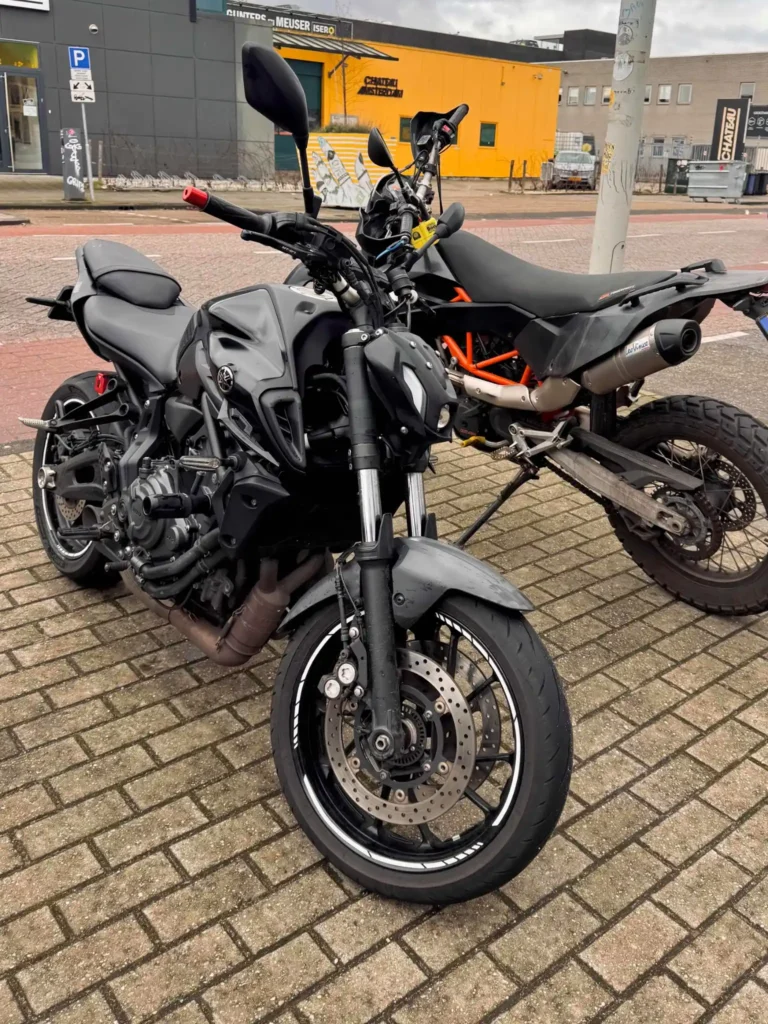
Cities require patience.
In Amsterdam-style traffic especially, a group ride should be calm and compact without becoming tight or pushy. Cyclists, pedestrians, scooters, trams and cars can all overlap in ways that demand constant awareness.
Do not treat the city like an open road.
The goal is flow, not force.
Group Riding on Country Roads
Country roads can be beautiful for group rides, but they also create temptation.
The road opens up. Corners feel inviting. The group pace rises. Riders may start following each other too closely.
Be careful.
Country roads can hide:
- Gravel
- Mud
- Blind corners
- Farm vehicles
- Cyclists
- Animals
- Narrow lanes
- Uneven surfaces
- Oncoming vehicles cutting corners
Ride with margin.
Do not assume the rider ahead has seen everything. Do not copy their line blindly. Keep your own vision active.
Learn : Motorcycle Vision Techniques
If the pace becomes uncomfortable, slow down.
A group ride should not become a chain reaction of risk.
What to Do at Stops
Good etiquette continues when the group stops.
At fuel stops or rest points:
- Park safely
- Do not block traffic
- Leave space for other riders
- Refuel if needed
- Check if everyone is okay
- Confirm the next section of the route
- Mention any problems early
- Be ready before the group leaves
Do not disappear without telling anyone. Do not delay the group without communicating. Do not assume everyone knows the next destination.
Small organization keeps the ride smooth.
And smooth rides are safer.
Beginner Group Riding Checklist
Before joining a group ride, ask:
- Do I know the route?
- Do I know the pace?
- Is this group beginner-friendly?
- Who is leading?
- Who is sweeping?
- What formation are we using?
- What happens if we get separated?
- Do I have enough fuel?
- Is my bike ready?
- Am I comfortable riding my own pace?
- Do I know the basic signals?
- Am I willing to speak up if needed?
During the ride, remember:
- Keep space
- Stay predictable
- Do not overtake inside the group
- Do not stare only at the rider ahead
- Ride your own ride
- Signal early
- Stay calm at junctions
- Let the group regroup safely
- Do not rush to catch up
- Respect your limits
Common Mistakes
| Mistake | Why It’s Risky | Better Habit |
|---|---|---|
| Riding too close | Reduces reaction time | Keep enough space |
| Trying to keep up | Pushes riders beyond skill | Ride your own ride |
| Overtaking within the group | Creates unpredictability | Follow agreed overtaking rules |
| Staring at the rider ahead | Reduces road awareness | Scan through the group and road |
| Forcing staggered formation everywhere | Reduces space in corners or hazards | Use single file when needed |
| Poor communication | Causes confusion | Signal early and agree rules |
| Leaving beginners at the back | Adds pressure and catch-up risk | Place beginners near the front |
| Rushing through junctions | Increases collision risk | Wait and regroup safely |
| Showing off | Raises risk for everyone | Ride smoothly and respectfully |
| No separation plan | Creates panic if split | Agree regroup points beforehand |
Final Thoughts: A Good Group Ride Feels Calm
Group riding can be one of the most enjoyable parts of motorcycling.
The shared route, the sound of bikes together, the stops, the conversations, the feeling of moving as one group — it can be beautiful.
But only when it is done with respect.
A good group ride should not feel like pressure.
It should feel organized, predictable and calm.
The best group riders are not the ones trying to dominate the road. They are the ones who make the ride safer for everyone around them.
They leave space.
They signal clearly.
They ride their own ride.
They protect beginners.
They do not show off.
They communicate early.
They arrive with the group, not at the expense of the group.
That is the kind of rider I want to be.
Because group riding is not just about sharing the road.
It is about sharing responsibility.
Ride smart. Stay calm. Bring everyone home safe.
FAQs
What is the safest formation for motorcycle group riding?
The safest formation depends on the road. Staggered formation is often used on straight open roads, while single file is safer for corners, narrow roads, poor surfaces, rain, heavy traffic and roadworks.
Should beginner riders join group rides?
Beginner riders can join group rides if the group is beginner-friendly, the pace is calm and the rider feels comfortable riding their own ride. Beginners should avoid aggressive or fast-paced groups.
Where should beginner riders ride in a motorcycle group?
Beginner riders are often better placed near the front, behind the lead rider. This helps the group set a pace that suits them and reduces the pressure of catching up from the back.
Can riders overtake inside a group ride?
Riders should not overtake inside a group unless the group has clearly agreed that it is allowed. Unexpected overtaking creates confusion and risk.
What should I do if I get separated from the group?
Stay calm and do not ride aggressively to catch up. Follow the agreed route, use GPS if needed and regroup at the next safe planned stop.
Is side-by-side riding safe in a motorcycle group?
Riding directly side by side in the same lane is usually not ideal because it reduces escape space. Staggered formation is safer because it gives each rider more room.
What should a group agree on before the ride?
Before the ride, the group should agree on the route, pace, lead rider, sweep rider, formation, stops, overtaking rules, communication signals and what to do if separated.
Related Reads
If you are building your riding foundation, read these next:
Motorcycle Safety for Beginners: The Complete Guide to Riding Smart and Staying Alive
Beginner’s Guide to Defensive Motorcycle Riding
How to Brake Safely on a Motorcycle: Front vs Rear Explained
Motorcycle Vision Techniques: How to Look Through the Corner Correctly