I bought TITAN used.
My 2021 Yamaha MT-07 already had close to 20,000 km on the odometer when I bought him in the Netherlands.
The purchase price was:
€6,300
Almost a year and roughly 10,000 km of my own riding later, I am happy I bought the motorcycle.
But owning a used bike has also taught me something important:
The purchase price is only the beginning of the decision.
With a second-hand motorcycle, you’re buying:
the motorcycle,
its maintenance history,
its previous owner’s decisions,
its current wear,
and potentially some work that hasn’t become obvious yet.
That doesn’t make buying used a bad idea.
Quite the opposite.
Used motorcycles can offer excellent value.
But I think the smartest approach is to separate the purchase into two questions:
Is this particular motorcycle worth buying?
and:
Can the ownership be transferred correctly and safely into my name?
In the Netherlands, the second part is largely handled through RDW.
This guide covers both.
Note: Dutch administrative rules and fees can change. The RDW information in this guide was checked in October 2026. Always verify the current process with RDW before completing a purchase.
If you’re new to Dutch motorcycle ownership generally, start with my broader Motorcycling in the Netherlands: A Practical Guide for New & Expat Riders.
Before You Even View the Motorcycle: Run the RDW Kentekencheck
If the motorcycle already has a Dutch registration, one of the first things I would do is get the kenteken — registration number — from the seller.
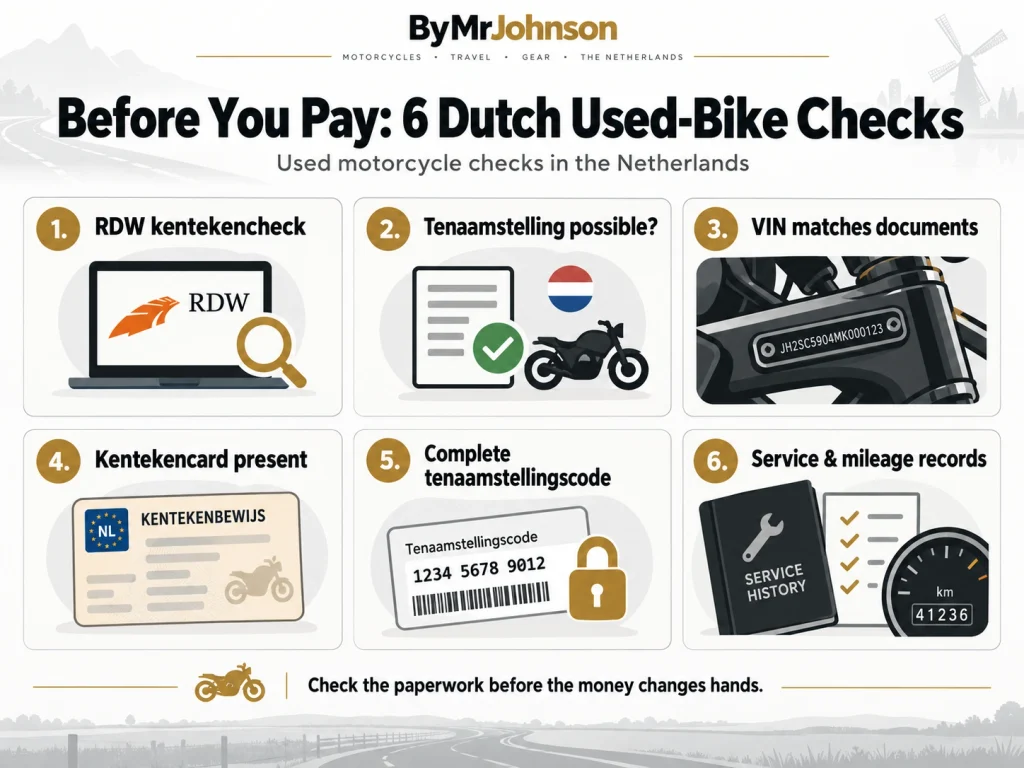
Then use the free RDW kentekencheck.
You don’t need to own the motorcycle to do this.
RDW says the check gives you access to registered vehicle information and parts of the vehicle’s history. It can also tell you whether the vehicle can currently be transferred to a new owner.
That last part is particularly useful.
Look for:
Tenaamstelling mogelijk?
If the answer is nee, the motorcycle cannot currently be transferred.
RDW gives examples including vehicles registered as stolen or exported.
That is something I would rather discover at home than after travelling across the country with money ready to buy the bike.
What Can the RDW Check Tell You?
The registration check can help you confirm basic information such as:
- vehicle identity
- technical specifications
- registration history
- whether ownership transfer is possible
- known recalls registered with RDW
- other recorded vehicle information.
I would compare those records with the actual motorcycle when viewing it.
Does the model match?
Does the year make sense?
Do the specifications line up?
Is anything obviously inconsistent?
One mismatch doesn’t automatically prove something is wrong.
But it is a reason to stop and understand the difference before paying.
Check the VIN, Not Just the Number Plate
A number plate is easy to see.
The VIN — vehicle identification number or chassis number — is much more important.
RDW specifically recommends checking that the VIN stamped into the vehicle matches the registration documentation.
On a motorcycle, locate the chassis number and compare it carefully with the documents.
Don’t just look at the last four digits.
Check the complete number.
I would be cautious if:
the VIN appears damaged,
characters look altered,
the area around it appears suspiciously modified,
or the documentation doesn’t match.
This is one of those checks that only takes a minute and can prevent a very large problem.
Check the Mileage — But Understand What RDW Can and Can’t Tell You
Mileage matters when buying a used motorcycle.
But motorcycle mileage records in the Netherlands work slightly differently from car records.
RDW records odometer readings for:
- cars
- light commercial vehicles
- motorcycles.
A motorcycle owner can obtain an RDW Vehicle Report, which can contain registered mileage information.
However, there is an important limitation.
RDW currently does not give motorcycles the same public logical / illogical mileage judgement that it can give many cars and vans, because it says there is not enough mileage data available for motorcycles.
So I wouldn’t think:
“The RDW check didn’t show a problem, therefore the mileage must definitely be genuine.”
Instead, compare several things.
The odometer.
Service invoices.
Workshop records.
Maintenance history.
Tyre and chain history where available.
General wear.
And what the seller tells you.
You are looking for a story that makes sense.
Imported Motorcycles Need More Context
If the motorcycle was imported into the Netherlands, the history may be less complete.
That doesn’t make an imported motorcycle bad.
It simply means the Dutch registration record may not tell the entire story.
There has been some improvement here.
RDW has incorporated Belgian mileage records for certain imports since January 2025 and started taking German mileage information into its register from 3 February 2026.
For motorcycles imported from elsewhere, maintenance invoices, previous registration documents and service records can become particularly useful.
Read : Buying a motorcycle abroad
Ask to See the Registration Documents
For a modern Dutch vehicle with a credit-card-sized registration document, the seller should normally have:
the kentekencard
and:
the complete tenaamstellingscode.
The tenaamstellingscode contains nine digits and is needed when the motorcycle is transferred, sold, suspended, scrapped or exported.
If the seller cannot produce the required documentation:
don’t improvise.
RDW says missing documents or codes should be replaced before the transfer takes place.
That is much cleaner than paying first and hoping the paperwork gets solved later.
Older vehicles may still have paper registration documents, in which case the required transfer paperwork is different and the transfer cannot be completed online.
Verify That the Seller Makes Sense
For a private sale, I also want the person selling the motorcycle to make sense in the context of the motorcycle.
RDW recommends several precautions for private purchases, including:
- meeting the seller at their home
- verifying their identity
- checking the registration data
- looking at the vehicle’s history
- checking keys and documentation
- comparing the VIN
- paying by bank rather than cash.
I particularly like the idea of meeting at the seller’s home.
Not because every genuine seller has to invite you inside.
But because a motorcycle, seller, address and paperwork that all connect logically give me more confidence than:
“Meet me in this random car park with €7,000.”
Don’t Let the RDW Check Replace the Motorcycle Inspection
Administrative history can tell you a lot.
It cannot tell you whether the chain is worn out.
It cannot tell you whether the fork seal has started leaking.
It cannot tell you whether the tyres need replacing next month.
And it cannot tell you how the engine sounds when it starts cold.
So once the paperwork makes sense, move to the motorcycle itself.
Try to See the Motorcycle Cold
If possible, I prefer the idea of inspecting a used motorcycle before the seller has warmed it up.
A cold start can reveal things that disappear once an engine reaches operating temperature.
You can listen for:
unusual mechanical noises,
difficulty starting,
unstable idle,
excessive smoke,
or anything that doesn’t feel consistent with the motorcycle you’re considering.
That does not mean every sound is a fault.
Motorcycle engines are mechanically noisy machines.
If you’re unsure, this is exactly where bringing somebody more experienced or paying for a professional inspection can be worth the money.
Start With the Obvious Wear Items
You don’t need to be a professional mechanic to notice some expensive items.
Tyres
Check:
- remaining tread
- uneven wear
- cracking
- damage
- tyre age
- whether the front and rear tyres make sense as a pair.
A motorcycle with legal tyres can still be close to needing a replacement set.
And motorcycle tyres aren’t free.
Chain and sprockets
Look for:
- excessive rust
- neglected lubrication
- tight spots
- damaged teeth
- obviously poor adjustment.
A worn drivetrain is not necessarily a reason to walk away.
It is a reason to understand what you may need to spend.
Brake pads and discs
Look at remaining brake-pad material where visible.
Check the discs for obvious damage or severe wear.
Again:
wear isn’t automatically a problem.
Unexpected wear is a budgeting problem.
Look for Leaks and Crash Evidence
Walk around the bike slowly.
I would look at:
- fork seals
- engine cases
- coolant areas
- brake components
- hoses
- around the radiator
- underneath the motorcycle.
Then look for signs the bike may have been dropped or crashed.
Bar ends.
Levers.
Mirrors.
Foot pegs.
Engine covers.
Exhaust.
Swingarm.
Bodywork.
One scratched lever does not mean the motorcycle has been destroyed.
Motorcycles get dropped.
The useful question is:
Does the damage match the explanation?
And does it appear cosmetic or structural?
If you aren’t confident distinguishing between the two, get professional help.
Modifications Deserve More Questions, Not Automatically More Money
Used motorcycles are frequently modified.
TITAN himself isn’t completely standard.
He currently has equipment including an aftermarket exhaust, BMC air filter, short levers, wind protection and a tail tidy.
Modifications aren’t automatically bad.
But I wouldn’t automatically value a motorcycle higher simply because the previous owner spent money on accessories.
Ask:
Who installed it?
Is the original part included?
Has the modification changed maintenance requirements?
Is it road legal?
Has wiring been modified?
Is the ECU or fuelling affected?
Does the part actually add value to you?
A €1,000 accessory the seller loves may be worth €0 to the person who wants the motorcycle completely standard.
Service History Matters More to Me Than a Perfectly Clean Motorcycle
A freshly polished motorcycle photographs beautifully.
A folder of credible maintenance records interests me more.
Ask:
When was the last service?
What was actually done?
When were the tyres fitted?
How old is the brake fluid?
Has coolant been replaced?
When were the spark plugs done?
What condition is the chain in?
Are there receipts?
Is there digital service history?
This is particularly important once mileage starts moving beyond the early part of the motorcycle’s life.
I explain the maintenance side in more detail in my Yamaha MT-07 Maintenance Schedule.
My Used-Motorcycle Lesson From TITAN
This is where my own motorcycle taught me something useful.
I bought TITAN at roughly:
20,000 km
for:
€6,300.
The motorcycle has been good to me.
But buying used meant I did not begin with a brand-new machine whose entire maintenance history happened under my ownership.
At 25,270 km, TITAN had a major service.
My cost:
€650
Then, at approximately 28,200 km, I needed tyres and rear brake pads.
That cost:
€584.
None of that means I bought a bad motorcycle.
The motorcycle already had mileage.
Tyres wear out.
Brake pads wear out.
Services become due.
But those bills changed the way I think about buying used.
If I were budgeting for another used motorcycle today, I would not spend my entire budget on the purchase price.
I would deliberately leave a maintenance buffer.
My MT-07 running-cost article shows exactly how those costs affected my first year.
A €6,300 Motorcycle Didn’t Mean I Only Needed €6,300
This is probably the most useful financial lesson I can offer.
When I bought TITAN, the obvious number was:
€6,300.
But ownership then brought:
insurance,
road tax,
servicing,
tyres,
brake pads,
security,
gear,
fuel,
and other smaller purchases.
That doesn’t mean you should expect exactly the same costs I had.
It means the bike’s advertised price shouldn’t consume every euro available to you.
If your entire motorcycle budget is €6,500, buying a €6,500 used motorcycle leaves very little room for discovering it needs:
two tyres,
a service,
a chain and sprockets,
or proper security.
I would rather buy slightly below my maximum budget and have breathing room.
Consider a Professional Inspection
If you don’t know what you’re looking at mechanically, paying a workshop or experienced professional to inspect the motorcycle can be money well spent.
Especially when:
the purchase price is substantial,
the service history is incomplete,
the bike is heavily modified,
the seller cannot answer basic questions,
or something simply doesn’t feel right.
You don’t need to become a mechanic before you’re allowed to buy a motorcycle.
You need enough information to make a sensible decision.
Sometimes the sensible decision is paying somebody who knows more than you do.
Test Ride Only If Everything Is Properly Arranged
A test ride can reveal:
clutch behaviour,
gear changes,
braking,
steering,
alignment,
suspension behaviour,
engine response,
and whether something simply feels wrong.
But this needs to be done legally and with the seller’s permission.
Make sure the motorcycle is insured appropriately for the ride and that your licence covers it.
If those conditions are unclear, don’t improvise.
A used-motorcycle purchase isn’t worth creating an insurance or legal problem before you even own it.
Agree on the Sale Before Transferring Ownership
Once you’re satisfied with the motorcycle, agree clearly on:
- price
- what accessories are included
- keys
- documents
- any spare parts
- known defects
- when the motorcycle is handed over.
I also like the idea of having a simple written purchase record.
Include information such as:
- date
- registration
- VIN
- mileage
- price
- buyer
- seller
- major agreed conditions.
That document does not replace the RDW transfer.
It simply creates a record of what both parties agreed to.
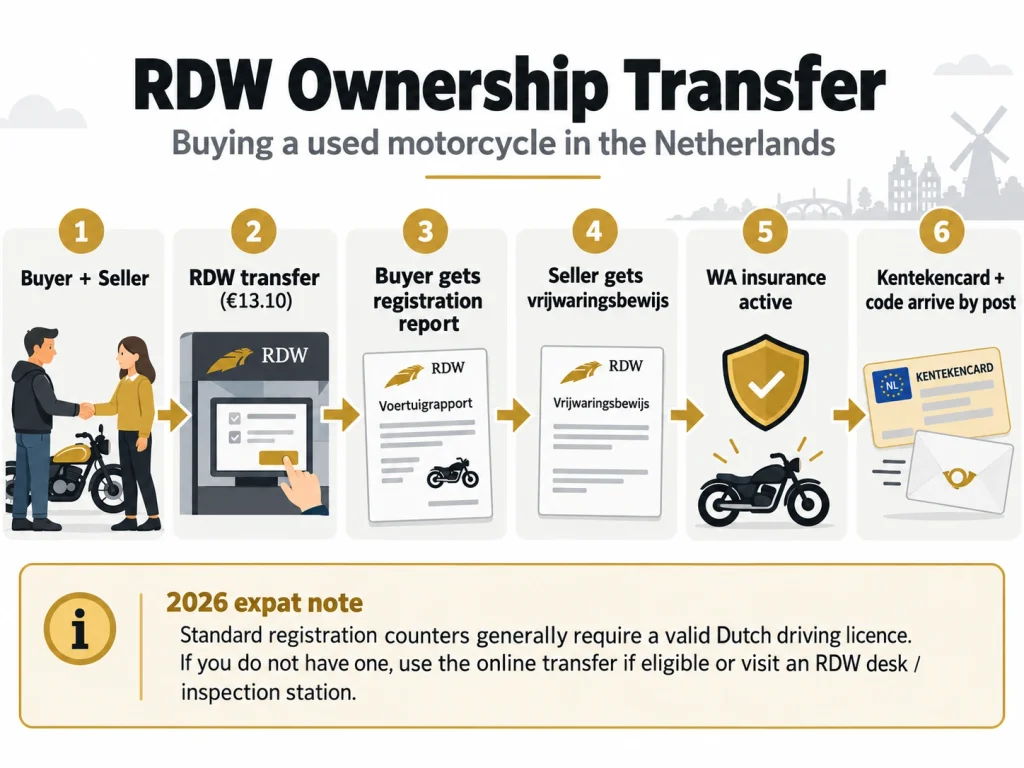
How Do You Transfer a Used Motorcycle in the Netherlands?
Once the deal is agreed, the motorcycle’s kenteken must be transferred into the buyer’s name.
RDW currently allows this:
- online
- at a kentekenloket
- at an RDW desk
- at an RDW inspection station
- through an RDW-recognised vehicle business.
If you buy from an RDW-recognised dealer, the dealer may arrange the transfer for you.
The 2026 transfer fee is:
€13.10
RDW says the transfer fee is the same regardless of whether you arrange it through RDW or a standard registration counter.
Transferring the Motorcycle Online
For an online transfer, the buyer needs:
- the valid kentekencard
- the complete tenaamstellingscode
- DigiD app with identity verification
- eligibility to register the vehicle personally.
The buyer logs into RDW and completes the transfer.
After successful registration, RDW sends several confirmations.
Most importantly:
the motorcycle is now immediately registered in the buyer’s name.
That moment matters.
Because that is also when your responsibilities begin.
Read : After buying a motorcycle in the Netherlands
Important for Expats: The 2026 ID Change
This deserves its own section because it can catch international residents out.
From January 2026, a standard kentekenloket or RDW-recognised business generally requires a valid Dutch driving licence when registering a vehicle in person.
A passport or national identity card is no longer accepted there for this particular process.
If you don’t have a Dutch driving licence, RDW says you can instead:
- use the online transfer service if you meet its requirements
- go to an RDW desk
- go to an RDW inspection station.
At those RDW locations, other valid identity documents such as a passport or identity card can still be used.
This is exactly the sort of administrative detail I wish expat guides made clearer.
You Also Need to Be Registered in the BRP
For a vehicle to be transferred into your personal name, RDW requires you to be registered in the Dutch Basisregistratie Personen — BRP with a residential address or correspondence address in the Netherlands.
So if you have only just moved to the country, make sure that side of your administration is in order before travelling to buy the motorcycle.
What Happens Immediately After the Transfer?
Once the transfer is complete, several things happen.
The buyer receives a tenaamstellingsverslag — registration report.
That contains part 1 of the new tenaamstellingscode.
RDW then sends:
- the new kentekencard
- part 2 of the tenaamstellingscode
by post.
Keep the two parts of that code safely together when they arrive.
You’ll need the complete nine-digit code later if you:
sell,
trade,
suspend,
scrap,
or export the motorcycle.
The Seller Must Receive the Vrijwaringsbewijs
This is extremely important for the seller.
After the transfer, the vrijwaringsbewijs confirms that the motorcycle is no longer registered in their name.
RDW tells sellers not to hand over the vehicle until they have received that proof.
From the seller’s perspective, this is what ends their responsibility for the vehicle.
So if you’re the buyer:
make sure the seller gets it.
A clean transaction protects both people.
Insurance Must Be Ready Immediately
Once the motorcycle is registered in your name, you are responsible for the insurance requirement.
A motorcycle in the Netherlands must have at least WA — statutory liability — insurance unless the registration is formally suspended.
The government makes this compulsory for motorcycles and other registration-required motor vehicles.
So I would arrange the insurance before completing the purchase.
Have the quotation ready.
Know what the insurer needs.
Then activate the cover at the appropriate moment when ownership transfers.
Do not transfer the motorcycle and then think:
“I’ll sort insurance next week.”
The Meldcode Is Not the Same as the Tenaamstellingscode
Dutch vehicle terminology becomes confusing quickly.
These two codes are different.
Meldcode
The meldcode consists of the final four digits of the VIN and is commonly needed by your insurer.
You can also find it on the registration documentation.
Tenaamstellingscode
The tenaamstellingscode is the nine-digit code used for administration such as selling, transferring, suspending or exporting the vehicle.
Don’t mix them up.
Insurance asks for one.
Vehicle ownership administration uses the other.
Road Tax Starts Automatically
Once the motorcycle is registered in your name, you do not need to file a separate motorrijtuigenbelasting declaration.
The Belastingdienst receives the registration information automatically from RDW.
Putting the vehicle into your name effectively starts the tax process.
The tax obligation starts from the day the vehicle is registered to you.
The Belastingdienst will then handle the payment schedule.
For reference, TITAN’s current motorcycle road tax has been around €37 per quarter for me.
That is my motorcycle and my current situation — not a universal Dutch motorcycle-tax figure.
Use the official calculator for the motorcycle you’re considering.
Motorcycles Don’t Need APK
One administrative difference from buying a used car is that motorcycles currently have no Dutch APK periodic-inspection requirement.
RDW explicitly lists motorcycles among vehicles exempt from APK.
That sounds convenient.
But there is another side to it.
You cannot use a recent APK result as a shortcut for deciding whether a motorcycle is mechanically healthy.
The responsibility for assessing condition falls more heavily on:
you,
the seller’s records,
and any professional inspection you arrange.
No APK does not mean:
no maintenance problem.
Can You Ride Home Before the New Kentekencard Arrives?
Yes.
RDW says that after a successful transfer you may drive the vehicle even though the physical kentekencard has not yet arrived.
You are required to have the card with you after 14 days.
If you drive abroad, however, you need to carry the registration document.
So buying the bike on Saturday does not mean you necessarily need to wait for the post before riding it home.
The important things are that:
the transfer is complete,
your licence is valid,
the motorcycle is insured,
and the motorcycle itself is roadworthy.
Don’t Pay Before You Know the Transfer Can Be Completed
If I had to choose one administrative rule to remember, it would be this:
Don’t separate the money from the ownership transfer unnecessarily.
Confirm beforehand that RDW says the motorcycle can be transferred.
Make sure the required documents and code are present.
Complete the agreed transaction together.
Get confirmation.
Then hand over the motorcycle.
RDW itself warns private buyers not to let themselves be pressured into paying quickly or paying before they have enough certainty about the vehicle.
A good used motorcycle will still be a good used motorcycle after you’ve taken ten minutes to check the paperwork.
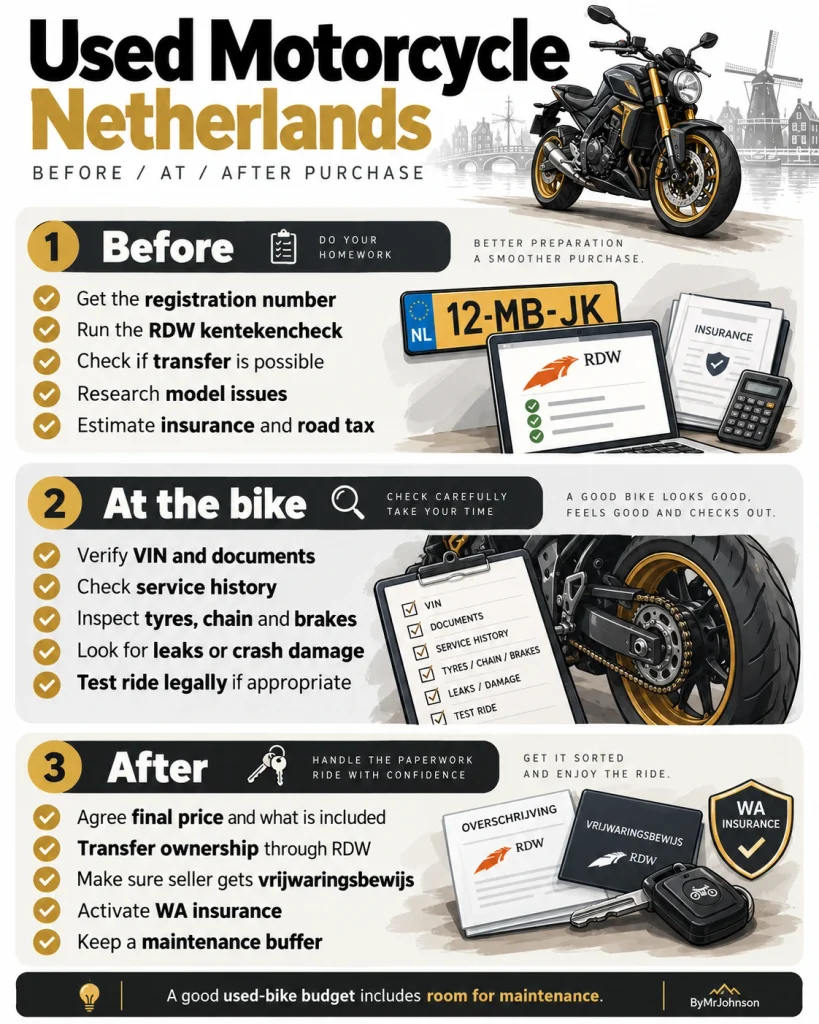
My Used-Motorcycle Buying Checklist
If I were buying another used motorcycle in the Netherlands today, I would divide the process into three stages.
Before the viewing
- Get the registration number.
- Run the RDW kentekencheck.
- Check whether transfer is possible.
- Research known model issues.
- Check approximate insurance cost.
- Estimate road tax.
- Look up normal market prices.
- Ask for service-history details.
At the motorcycle
- Verify the VIN against the documents.
- Check the kentekencard and transfer documentation.
- Look at mileage and service records together.
- Inspect tyres.
- Inspect chain and sprockets.
- Check brakes.
- Look for leaks.
- Look for crash/drop evidence.
- Ask about modifications.
- Check keys.
- Listen to the motorcycle from cold where possible.
- Test ride legally if appropriate.
- Don’t be pressured.
Before riding away
- Agree the final price.
- Record what is included.
- Transfer ownership through RDW.
- Make sure the seller receives the vrijwaringsbewijs.
- Activate WA insurance.
- Keep the tenaamstellingsverslag.
- Budget for baseline maintenance.
- Ride home only once the legal and insurance side is sorted.
That sounds like a long list.
In reality, most of it takes very little time.
And the few minutes spent checking properly are insignificant compared with the time and money involved in fixing a bad purchase.
Buying From a Dealer vs a Private Seller
Both can work.
RDW itself notes that buying through an RDW-recognised vehicle business can reduce some risks associated with stolen, cloned or illegally altered vehicles and can provide stronger buyer protection if serious identity problems emerge later.
A private purchase may offer:
a better price,
direct contact with the previous owner,
and useful information about how the motorcycle was actually used.
But you need to do more of the verification yourself.
I would not automatically assume:
dealer = good motorcycle
or:
private seller = risky motorcycle.
The individual bike and the quality of the information still matter.
The Cheapest Motorcycle Isn’t Always the Cheapest Purchase
Imagine two otherwise similar motorcycles.
Bike A: €5,800
But it immediately needs:
€400 tyres
€250 chain and sprockets
€350 service
Real starting point:
€6,800
Bike B: €6,300
Good tyres.
Fresh service.
Documented history.
Healthy chain.
The €5,800 bike wasn’t necessarily cheaper.
It simply moved part of the purchase price into the first few months of ownership.
That is exactly why TITAN changed the way I think about used-bike budgeting.
My larger maintenance costs weren’t evidence that the bike was a mistake.
They were evidence that:
condition and upcoming maintenance matter alongside purchase price.
What I’d Do Differently With My Next Used Motorcycle
I wouldn’t necessarily avoid a motorcycle with mileage.
TITAN has convinced me that a properly maintained motorcycle doesn’t suddenly become useless because the odometer has five digits on it.
What I would pay even more attention to next time is the maintenance baseline.
I would want to answer:
What was done recently?
What is due soon?
How old are the tyres?
What condition are the brakes?
What does the manufacturer schedule say happens next?
And how much money do I want available after buying it?
Those questions matter more to me now than:
“Can I negotiate another €200 off?”
Saving €200 at purchase is nice.
Knowing that €1,000 of maintenance is approaching is more useful.
Final Thoughts
Buying a used motorcycle in the Netherlands is not particularly complicated once you separate the process into two jobs.
First:
Decide whether the motorcycle itself is worth buying.
Check:
condition,
history,
mileage,
VIN,
maintenance,
documents,
and what may need attention soon.
Then:
Transfer it properly.
Use RDW.
Make sure ownership transfer is possible.
Have the correct kentekencard and tenaamstellingscode.
Complete the registration.
Give the seller their vrijwaringsbewijs.
Get your insurance active.
Then let RDW and the Belastingdienst handle the registration and tax side from there.
I bought TITAN used at around 20,000 km.
After another 10,000 km together, I don’t regret buying a used motorcycle.
Quite the opposite.
But ownership has taught me to think beyond the number written in the advertisement.
A good used-bike budget isn’t:
“How much motorcycle can I afford?”
It is:
“How much motorcycle can I afford while still having enough money to look after it?”
That is the number I would buy around.
Ride safe and enjoy the journey.
FAQs
How do I check a used motorcycle in the Netherlands before buying it?
Start with the free RDW kentekencheck using the motorcycle’s registration number. Check that ownership transfer is possible, compare registered information with the actual motorcycle, verify the VIN and inspect the documentation and maintenance history.
How much does it cost to transfer a motorcycle in the Netherlands?
The RDW ownership-transfer fee is €13.10 in 2026. RDW says the normal transfer fee is the same whether you arrange it directly or through a registration counter.
Can I transfer a motorcycle online?
Yes, provided the required conditions are met. For a normal online personal transfer you need the valid kentekencard, complete tenaamstellingscode and DigiD app with identity verification.
Can an expat buy and register a motorcycle in the Netherlands?
Yes, but to register a vehicle personally you generally need to be registered in the BRP with a Dutch residential or correspondence address. Since 2026, ordinary registration counters generally require a valid Dutch driving licence for in-person registration; other identity documents can still be used at RDW desks or inspection stations, and eligible buyers can use the online process.
Does RDW check motorcycle mileage?
RDW registers mileage readings for motorcycles and a vehicle report can include registered readings. However, RDW does not currently give motorcycles the same public “logical” or “illogical” mileage judgement used for many cars and vans.
Do used motorcycles need an APK in the Netherlands?
No. Motorcycles are currently exempt from the Dutch APK periodic inspection requirement. That makes a proper pre-purchase inspection and maintenance history even more useful.
When do I need motorcycle insurance after buying?
WA liability insurance is compulsory once the motorcycle is registered in your name unless the registration is formally suspended. I would therefore arrange insurance before completing the ownership transfer.
Related Reads
Motorcycling in the Netherlands: A Practical Guide for New & Expat Riders
Yamaha MT-07 Maintenance: Service Intervals and Checks Owners Should Know
What Does a Yamaha MT-07 Cost to Own in the Netherlands? My First-Year Numbers