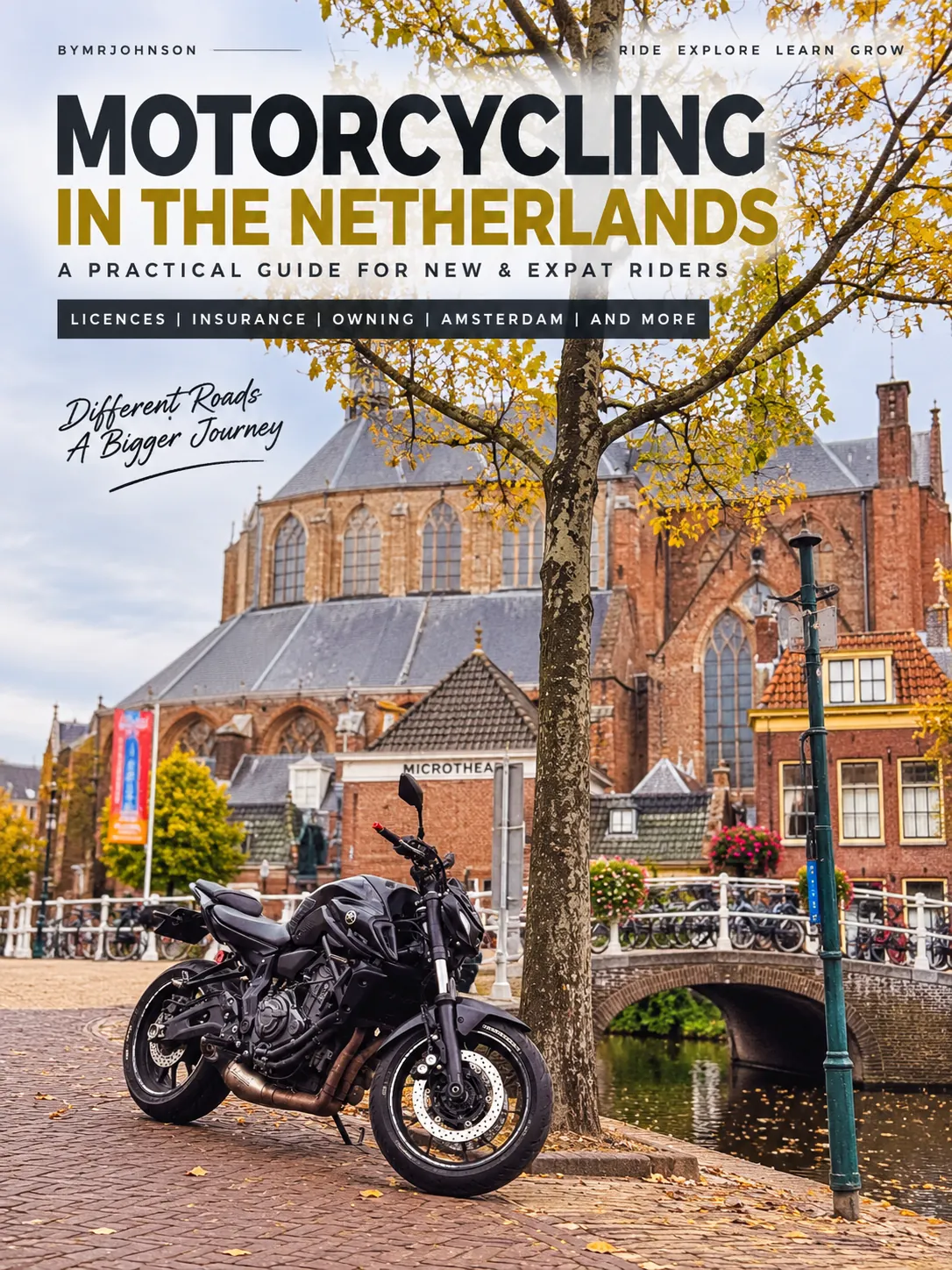
Motorcycling in the Netherlands can look deceptively straightforward.
The roads are generally well organised. Distances are manageable. There is good infrastructure, plenty of motorcycle dealers and workshops, and you are never particularly far from another country if you want to turn a weekend ride into something bigger.
But if you are new to the Netherlands — especially if you learned to ride somewhere else — there are details that can take some adjustment.
Licensing works differently depending on where your existing licence came from. Motorcycles have to be insured and registered. Lane filtering has its own accepted guidelines. Cyclists need far more attention than many international riders are used to. Parking rules can vary locally. Weather can change quickly.
And Amsterdam adds another layer entirely.
I had already ridden motorcycles before moving to the Netherlands, but I still had to approach riding here with a beginner’s mindset.
One of the biggest adjustments was very basic: I had previously ridden on the left side of the road.
But adapting was about much more than simply moving to the other side.
Observation, positioning, priorities, interaction with cyclists and the expectations built into Dutch riding instruction all forced me to rethink habits I had previously taken for granted.
That experience eventually led me to obtain my Dutch motorcycle licence and, later, to owning and riding TITAN — my Yamaha MT-07 — around Amsterdam and on weekend rides farther afield.
This guide is not meant to replace the RDW, CBR, Dutch government or your instructor.
Think of it as a starting point.
If you are planning to ride a motorcycle in the Netherlands, these are the things worth understanding first.
Note: Rules and administrative requirements can change. The regulatory information in this guide was checked in September 2026. Always confirm important legal or licensing questions with the relevant Dutch authority before acting on them.
What Do You Legally Need to Ride a Motorcycle in the Netherlands?
At the most basic level, riding legally in the Netherlands requires more than simply owning a motorcycle.
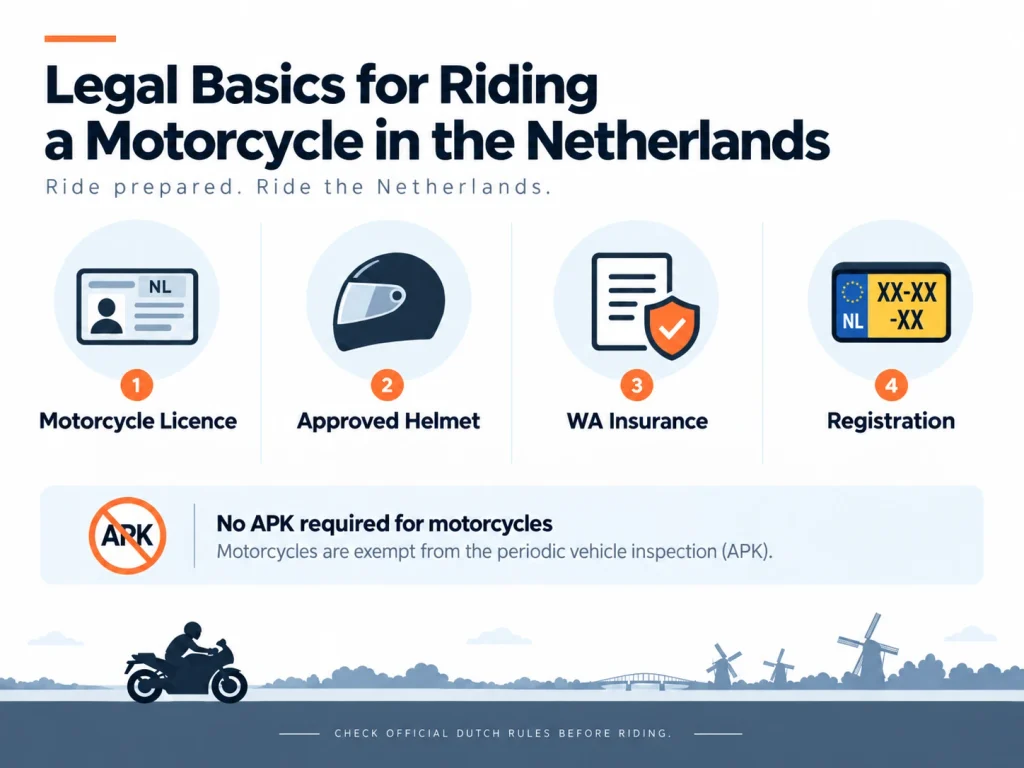
The Dutch government states that a motorcycle rider must have the appropriate motorcycle licence, wear an approved helmet, have statutory liability insurance and meet the relevant registration requirements.
For most road riders, that means thinking about four basic things:
- The correct motorcycle licence
- A road-legal and registered motorcycle
- WA liability insurance
- An approved motorcycle helmet
Protective motorcycle clothing is strongly recommended but is not generally a legal requirement for ordinary road riding in the Netherlands. The helmet is the mandatory part.
Personally, I would never use that distinction as an argument for riding without proper gear.
Legal minimums and sensible riding choices are not always the same thing.
If you are still putting together your riding setup, my Motorcycle Safety Gear Explained: What Each Piece Actually Does might be helpful.
Understanding the Dutch Motorcycle Licence System
The Netherlands uses the familiar European A1, A2 and A motorcycle-licence structure.
At a basic level:
| Licence | Motorcycle |
|---|---|
| A1 | Up to 125 cc and maximum 11 kW |
| A2 | Up to 35 kW |
| A | Unrestricted motorcycle power |
The important point for someone moving here is that having motorcycle experience elsewhere does not automatically mean your existing licence remains usable indefinitely in the Netherlands.
Read : Using a Dutch motorcycle licence abroad
What If You Already Have a Foreign Motorcycle Licence?
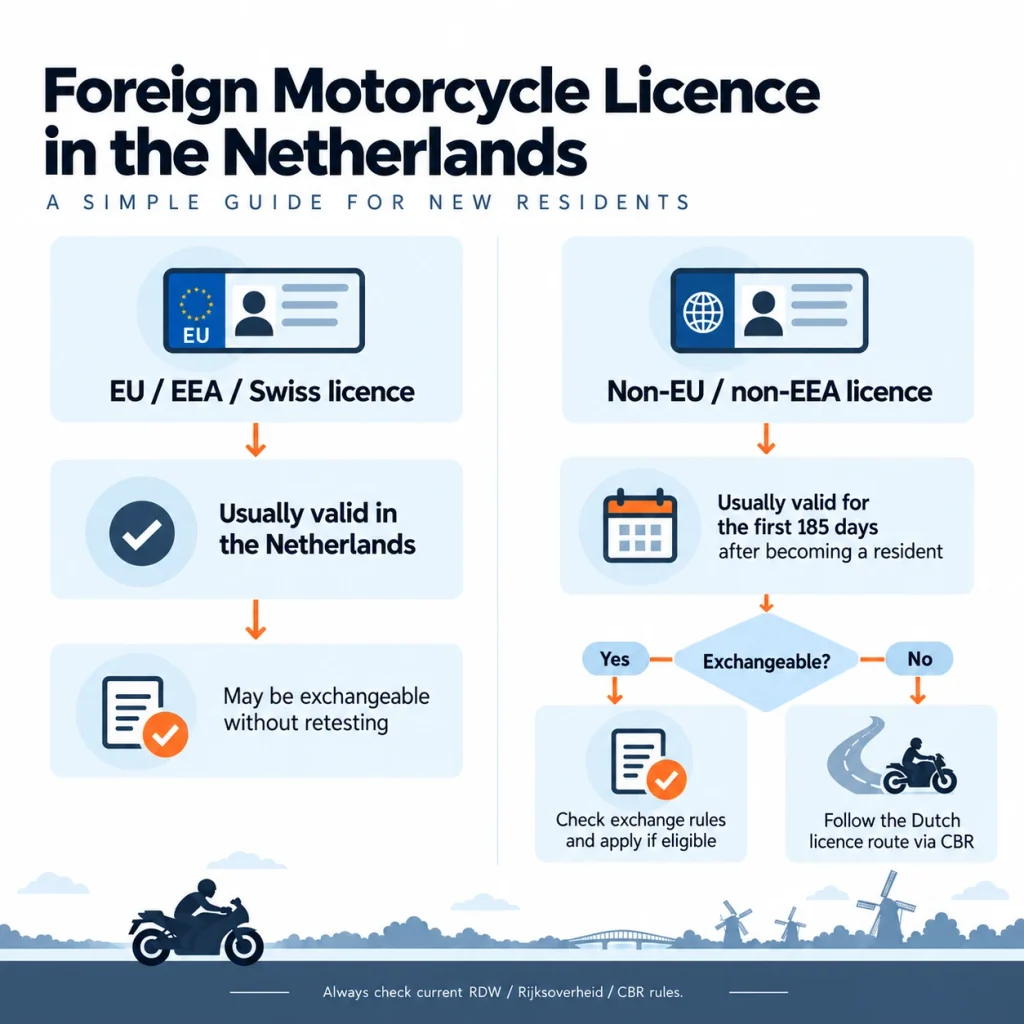
This depends heavily on where the licence was issued.
If your licence comes from an EU, EEA country or Switzerland, the rules are generally much simpler and it may be possible to continue using or exchange it without repeating your riding tests.
If your licence was issued outside the EU, EEA or Switzerland and you become resident in the Netherlands, the government generally allows you to drive using it for the first 185 days after becoming resident. What happens after that depends on whether the licence qualifies for exchange.
If your licence cannot be exchanged, you may need to complete the Dutch licensing process.
That was the route my own journey eventually took.
I had riding experience already, but obtaining my Dutch motorcycle licence forced me to reset some of my assumptions and learn how riding was expected to be done here.
I will cover that separately in:
How I Got My Dutch Motorcycle Licence as an Expat: Tests, Costs & Lessons Learned
That article will include the actual lessons, tests and roughly €2,202 I spent getting through the process in the first try.
Buying and Registering a Motorcycle in the Netherlands
Once you have the licence side sorted, motorcycle ownership itself is relatively structured.
When you buy a vehicle, the registration — kenteken — needs to be transferred into your name.
RDW says this can be completed online or through an RDW desk, inspection station or authorised registration counter. If you purchase from an RDW-approved business, the company may handle the transfer for you.
For a private buyer, RDW currently requires you to be registered in the Dutch BRP and have the necessary identification and vehicle-registration documentation. Online transfer requires DigiD with identity verification.
There is one important 2026 change worth knowing if you are an expat.
At many physical registration counters and RDW-approved businesses, a valid Dutch driving licence is now required as identification when registering or suspending a vehicle. Riders without one can instead use RDW’s online service where eligible, or visit an RDW desk or inspection station where other valid identification can still be accepted.
This is exactly the type of small administrative detail that can make buying your first motorcycle here feel more complicated than expected.
These articles might be useful:
Buying a Used Motorcycle in the Netherlands: RDW Checks & Ownership Transfer
Importing a Motorcycle to the Netherlands: RDW, BPM & Registration Explained
Motorcycle Insurance Is Mandatory
If the motorcycle is registered in your name and being used normally on the road, you need WA insurance — wettelijke aansprakelijkheid, or statutory liability insurance.
This is the minimum compulsory insurance that covers liability for damage you cause to others.
You can then choose broader cover depending on the motorcycle, its value and your own risk tolerance.
You will commonly see:
WA
Basic statutory liability.
WA+ / limited casco
Liability plus certain additional risks depending on the policy.
All-risk / full casco
Broader cover that may also include damage to your own motorcycle, subject to the policy terms.
The important thing is not to assume somebody else’s premium tells you what yours will cost.
Insurance pricing can depend on the rider, age, address, licence history, motorcycle, coverage, security requirements and insurer.
For example, I currently pay €23 per month to insure TITAN.
That is useful as a real ownership example, but it is not a Dutch MT-07 insurance price.
Your quotation could be very different.
I have broken down my first-year MT-07 spending separately in What Does a Yamaha MT-07 Cost to Own in the Netherlands?, including insurance, tax, fuel and maintenance.
A dedicated Dutch motorcycle-insurance guide is also coming later in this cluster:
Motorcycle Insurance in the Netherlands: WA, WA+ & All-Risk Explained
What About Motorcycle Road Tax?
Motorcycles registered in the Netherlands are also part of the Dutch motorrijtuigenbelasting — MRB — system.
Rather than publishing one universal figure, I would always use the official Belastingdienst calculator for the motorcycle you are considering because taxes and rates can change.
For context, my current MT-07 tax has been around €37 per quarter.
Again, that is my number, not a rate everyone should expect.
The useful budgeting lesson is simpler:
When you buy a motorcycle here, think beyond the purchase price.
Insurance, tax, fuel, servicing, tyres, security equipment and protective gear all become part of the ownership cost.
I learned that very quickly during my first year with TITAN.
Do Motorcycles Need an APK Inspection?
This one is refreshingly simple.
Motorcycles currently do not have a Dutch APK periodic inspection requirement. RDW explicitly lists motorcycles among the vehicle categories exempt from APK.
That does not mean maintenance becomes optional.
Tyres, brakes, lights, steering, suspension and general mechanical condition still matter — arguably even more when you only have two tyres connecting you to the road.
I prefer to think of the lack of APK as responsibility being placed more directly on the owner rather than as permission to ignore the motorcycle.
Lane Filtering in the Netherlands
One of the first questions riders often ask is whether motorcycles are allowed to move between lanes during traffic jams.
The Dutch situation is slightly more nuanced than a simple “yes, lane splitting is legal.”
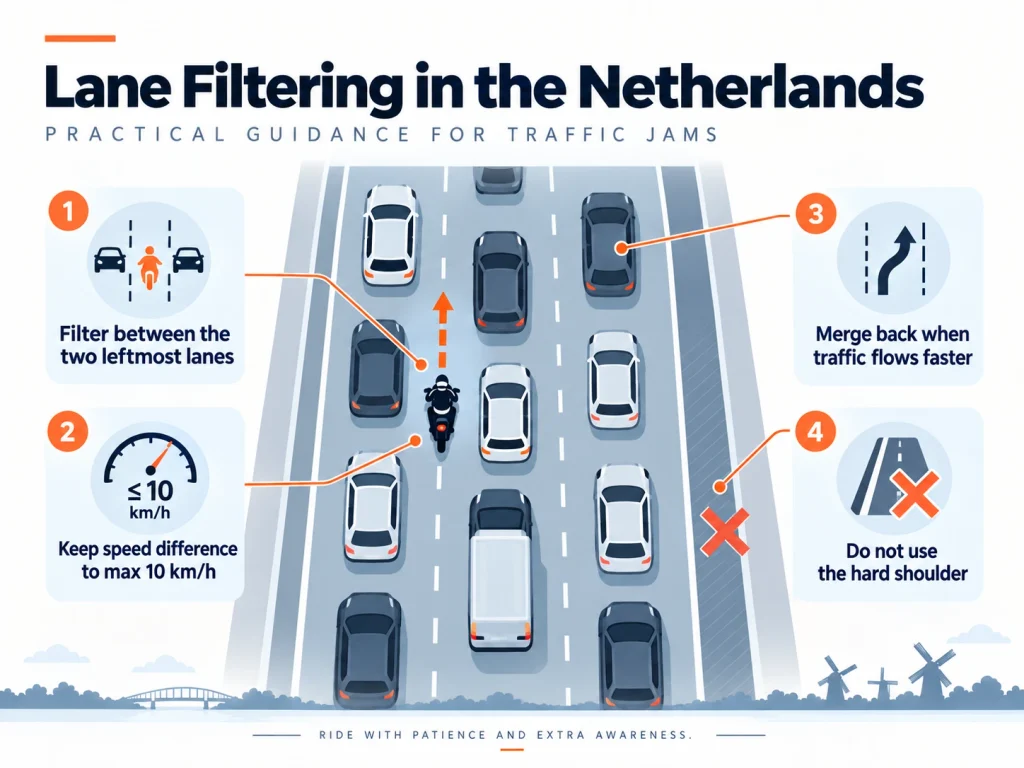
There is no single law specifically creating a right to filter through traffic. Instead, filtering is accepted in practice and supported by the Dutch filegedragscode, or traffic-jam code of conduct.
Current KNMV guidance includes several useful principles:
- keep the speed difference to roughly 10 km/h or less
- return to the normal lane when traffic begins moving faster than approximately 50 km/h
- use the space between the two leftmost lanes where possible
- do not use the hard shoulder
- leave space between motorcycles while filtering.
The most important mindset, though, is that filtering should never become something you feel entitled to do regardless of conditions.
A gap can disappear quickly.
Drivers change lanes.
Mirrors stick out.
Large vehicles create blind spots.
Use patience.
Read : Lane Filtering in the Netherlands: Rules and the 10 km/h Guideline
These articles on riding in heavy traffic and motorcycle lane positioning are also useful foundations.
Riding in Amsterdam Is Its Own Skill Set
Amsterdam is where much of my regular riding happens, and it has changed the way I think about observation.
The obvious difference is bicycles.
There are cyclists beside you, ahead of you, crossing junctions and sometimes appearing from places that are easy to miss if you are only watching cars.
Then there are tram tracks, narrow streets, pedestrians, delivery vehicles, scooters, roadworks and frequent changes in road layout.
The motorcycle can actually be a very practical way to move around the city.
But riding comfortably here comes from being mentally ahead of the bike.
I try to constantly ask:
Where could someone appear from?
Where is my escape space?
Can that driver actually see me?
Is a cyclist about to cross my path?
What happens if the surface changes halfway through this turn?
Those are essentially the same defensive-riding habits I use everywhere, but Amsterdam makes them feel much more immediate.
If urban riding is something you are still building confidence with, start with my Beginner’s Guide to Defensive Motorcycle Riding and Riding in Heavy Traffic before worrying about being fast or assertive.
What About Amsterdam’s Emission Zones?
This is an area where motorcycles and scooters are easy to confuse.
Amsterdam currently has emissions restrictions affecting several vehicle categories, including mopeds and scooters.
However, as of September 2026, the City of Amsterdam specifically states that motorcycles currently do not have a low-emission or zero-emission zone in the city.
That could change in the future.
Motorcycle Parking in Amsterdam
Parking is another subject where I would avoid relying on assumptions from another country.
Amsterdam’s rules distinguish motorcycles from bicycles and mopeds.
The explanatory notes to the city’s APV state that motorcycles fall under the normal rules for motor vehicles rather than the special bicycle and moped parking rules. In particular, motorcycles are not treated as vehicles that can simply be parked on the pavement.
There are also specific situations such as blue zones and P+R facilities, so the exact answer depends on where you are parking. The city, for example, explicitly allows two-wheeled motorcycles in blue zones without requiring a blue parking disc and lists motorcycles as eligible vehicles at P+R locations.
I am deliberately not trying to squeeze all the payment, permit and parking-location rules into this pillar.
That deserves its own properly researched article:
Motorcycle Parking in Amsterdam: Rules, Paid Parking & Practical Tips
Dutch Weather Changes How You Ride
If you ride regularly in the Netherlands, weather becomes part of the decision-making process.
Rain is obvious.
Wind is the one that surprised me more.
Open roads, exposed areas and motorway sections can make wind much more noticeable than it looks from indoors.
Then there are cold mornings, wet leaves, painted road markings, metal surfaces and the general reduction in grip and visibility that comes with poor conditions.
I have separate guides for:
Gravel, sand and slippery road surfaces
That keeps this article focused while giving you somewhere useful to go when the weather becomes the actual question.
Is the Netherlands a Good Place to Own a Motorcycle?
I think that depends on what you want from motorcycling.
If your dream is endless mountain passes outside your front door, the Netherlands will probably test your creativity.
It is famously flat.
But I’ve learned not to judge riding only by the number of corners on a map.
A motorcycle here can be useful during the week and still give you an excuse to explore farther when you have time.
There are dikes, coastal areas, small towns, rural roads and routes through landscapes that look completely different depending on the season.
And the country’s size makes neighbouring Belgium and Germany very accessible for longer trips.
For me, that versatility is a big part of why TITAN works.
He can deal with an ordinary ride around Amsterdam one day and then leave the city behind on the weekend.
My 10,000 km MT-07 Ownership Guide explains what that mix of riding has actually been like.
Later in this cluster I’ll also put together some motorcycle day trips from Amsterdam rather than pretending good riding begins only after crossing a border.
What I Would Tell a Rider Moving to the Netherlands
If you already know how to ride, bring that experience with you.
Just don’t let it stop you from learning again.
That is probably the biggest thing the Dutch licensing process taught me.
I didn’t arrive knowing nothing about motorcycles.
But some previous habits had been built in a different traffic environment.
Different side of the road.
Different traffic culture.
Different expectations.
Different hazards.
There was value in temporarily putting my experience aside and asking:
How is riding supposed to work here?
That mindset helped me much more than trying to prove I already knew what I was doing.
The same idea applies even if you do not need to take a Dutch test.
Spend time observing.
Understand the cycling infrastructure.
Learn the road signs.
Study local parking rules.
Watch how traffic behaves before deciding how you think it should behave.
And if something feels unfamiliar, getting a few lessons from a qualified local instructor is not a step backwards.
It can save you months of figuring things out the hard way.
A Simple Netherlands Motorcycle Checklist
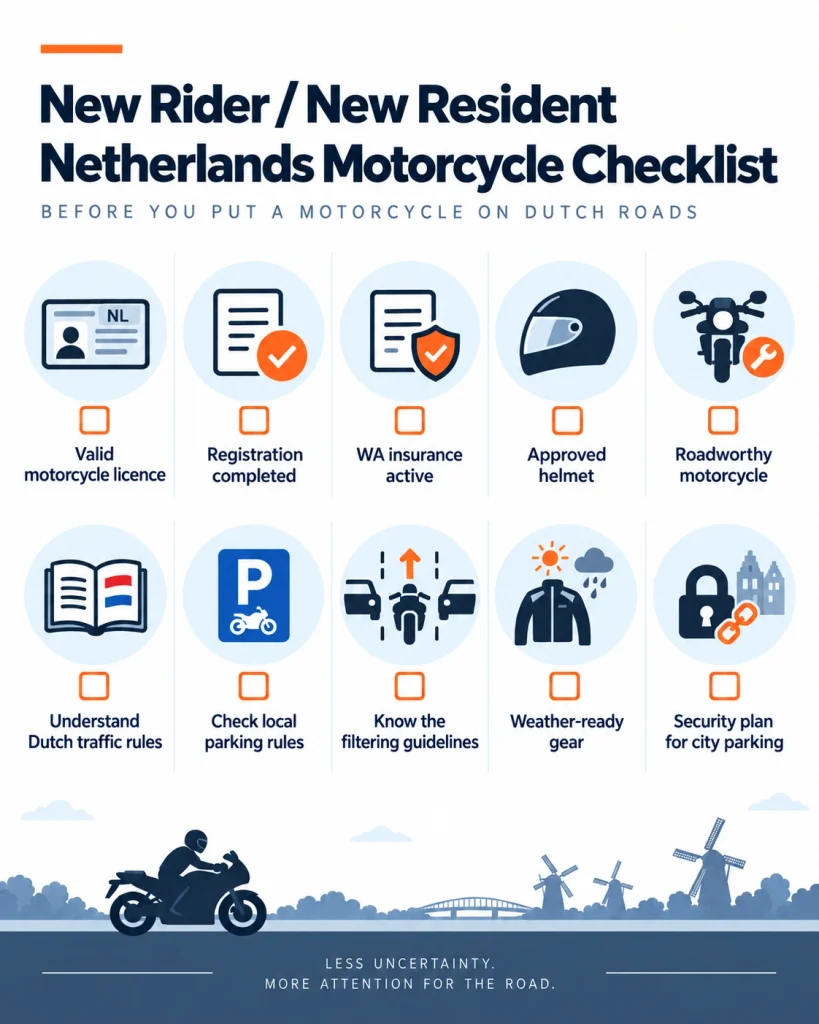
Before putting a newly purchased motorcycle onto Dutch roads, I would want to know that:
- my licence is valid for the motorcycle I am riding
- the motorcycle is correctly registered
- WA insurance is active
- the motorcycle is roadworthy
- I have a properly approved helmet
- I understand the basic Dutch traffic rules
- I have checked the relevant local parking rules
- I understand how filtering is normally handled
- I have realistic protective gear for Dutch weather
- I have a sensible security plan, particularly when parking in a city.
None of those things individually makes somebody a good rider.
Together, though, they remove a lot of unnecessary uncertainty.
Then you can focus on the thing that actually matters:
Learning to ride smoothly, predictably and safely in the environment around you.
Where This Netherlands Motorcycle Series Goes Next
This guide is deliberately the starting point rather than the final word.
Over the coming articles, I’ll go deeper into the subjects that deserve more than a paragraph:
How I Got My Dutch Motorcycle Licence as an Expat: Tests, Costs & Lessons Learned
Riding a Motorcycle in Amsterdam: What City Riding Is Really Like
Lane Filtering in the Netherlands: Rules and the 10 km/h Guideline
Motorcycle Parking in Amsterdam: Rules, Paid Parking & Practical Tips
Buying a Used Motorcycle in the Netherlands: RDW Checks & Ownership Transfer
Motorcycle Insurance in the Netherlands: WA, WA+ & All-Risk Explained
Importing a Motorcycle to the Netherlands
And later, the Amsterdam side of the series will move further into motorcycle security, commuting, cyclists and tram tracks, and weekend rides out of the city.
The goal isn’t to make riding here sound more complicated than it is.
It’s the opposite.
Once you understand the system, you have fewer things to guess about.
And that leaves more attention for the road.
FAQs
Can I ride in the Netherlands with a foreign motorcycle licence?
Possibly. It depends on where the licence was issued and whether you are visiting or becoming resident. EU/EEA and Swiss licences generally receive broader recognition. Residents with many non-EU licences can usually continue driving for 185 days before needing a Dutch licence, subject to the specific exchange rules that apply to their licence.
Is motorcycle insurance compulsory in the Netherlands?
Yes. WA statutory liability insurance is compulsory for motorcycles that are registered and being used normally on the road.
Do motorcycles need an APK in the Netherlands?
No. Motorcycles are currently exempt from the Dutch APK periodic inspection requirement. Owners are still responsible for keeping the motorcycle safe and roadworthy.
Is lane filtering allowed in the Netherlands?
There is no specific Dutch law creating an explicit right to filter, but it is accepted in practice when done responsibly under the established filegedragscode. Current guidance recommends keeping the speed difference to roughly 10 km/h.
Are petrol motorcycles banned from Amsterdam’s zero-emission zone?
No. As of September 2026, Amsterdam states that motorcycles currently do not have a low-emission or zero-emission zone. Different rules apply to mopeds and scooters.
Do I need full motorcycle clothing by law?
An approved motorcycle helmet is legally required. Protective motorcycle clothing is strongly recommended, but normal road riders are not generally legally required to wear a full protective motorcycle outfit.
Related Reads
Riding in Heavy Traffic: Safety Tips for Urban Motorcyclists
Lane Positioning for Motorcyclists: How to Choose the Safest Road Position
Wet Weather Motorcycle Riding Tips: How to Ride Safely in the Rain
Living With a Yamaha MT-07: My 10,000 km Ownership Guide
How I Got My Dutch Motorcycle Licence as an Expat: Tests, Costs & Lessons Learned