
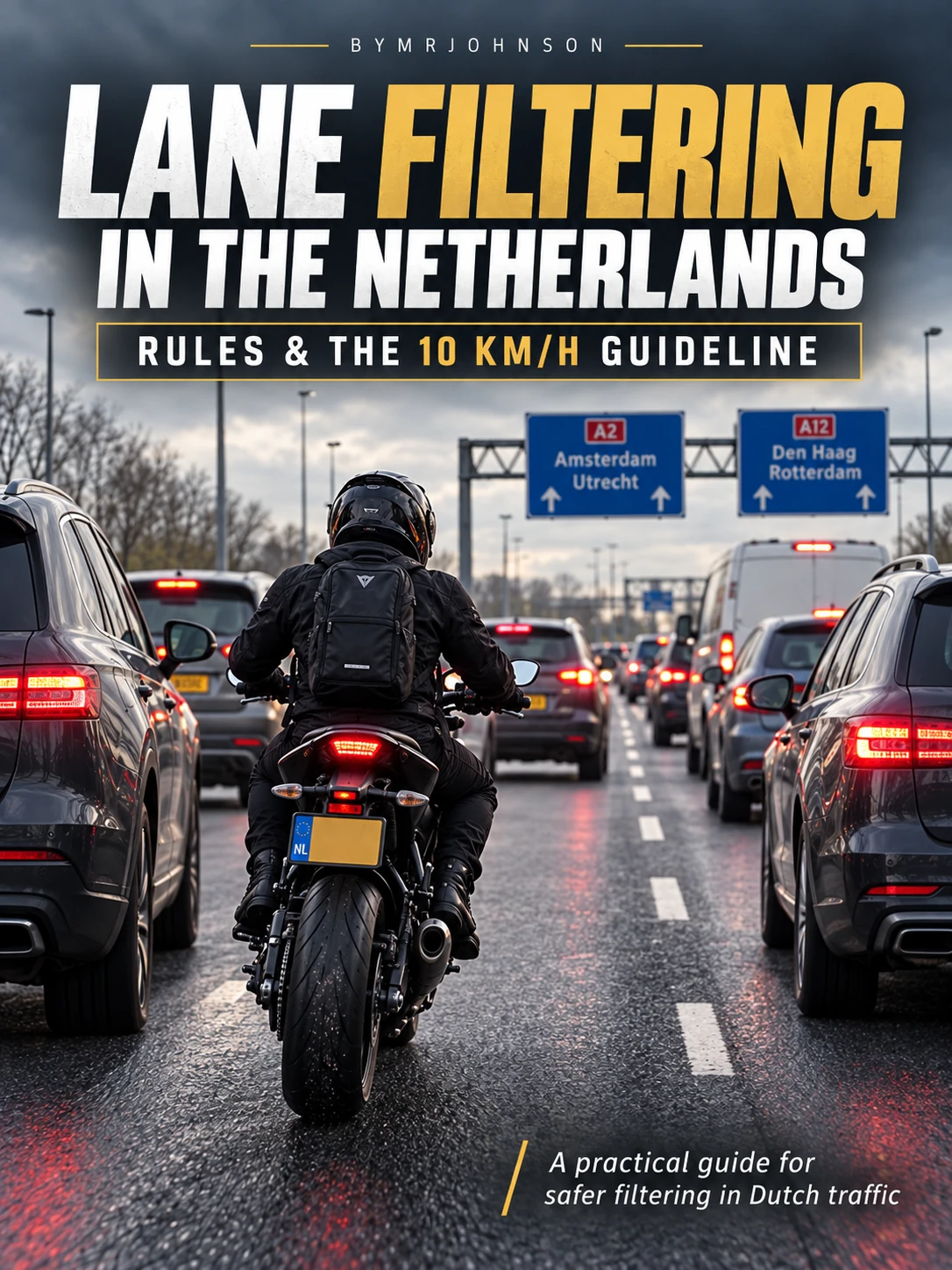
One of the practical advantages of riding a motorcycle becomes obvious the first time you reach a long Dutch traffic jam.
Cars stop.
The queue grows.
And there is often space between the lanes.
So the obvious question is:
Can you legally ride your motorcycle through it?
In the Netherlands, motorcycle filtering is accepted in stationary or slow-moving traffic, but the answer needs some context.
There isn’t a separate Dutch law that simply says:
Motorcycles may lane split whenever they want.
Instead, Dutch motorcycle and road-safety organisations use the filegedragscode — literally a traffic-jam code of conduct — to explain how riders and drivers should behave when motorcycles move through a queue.
The Dutch government itself points riders towards this guidance.
The most famous part is simple:
Keep the speed difference to a maximum of about 10 km/h
But that number is only one part of filtering safely.
Where you ride matters.
When you stop filtering matters.
The spaces between cars matter.
And perhaps most importantly:
The fact that there is enough physical room for a motorcycle does not necessarily mean there is enough safety margin.
Note: This guide was checked against current Dutch guidance in October 2026. The filegedragscode is guidance rather than a separate statutory filtering law. Always follow current road signs, police directions and applicable Dutch traffic law.
Is Lane Filtering Legal in the Netherlands?
Motorcyclists can move slowly between stationary or slow traffic in the Netherlands.
The Dutch government points riders towards the established filegedragscode, while Dutch motorcycle organisations use the same guidance to explain how filtering should be done.
There is an important distinction, though.
The code is an urgent recommendation rather than a separate law.
That means I wouldn’t interpret it as:
“Stay inside these numbers and anything you do is automatically legal and safe.”
I think a better way to read it is:
“This is the behaviour Dutch road-safety organisations expect when motorcycles pass through a traffic jam.”
That is a much better mindset to take onto the road.
If you’re new to riding here generally, my Motorcycling in the Netherlands: A Practical Guide for New & Expat Riders covers the broader rules and ownership basics.
What Is the Dutch Filegedragscode?
The filegedragscode was developed through Motorplatform, which brings together organisations involved in Dutch motorcycling and road safety.
Its purpose isn’t only to tell riders what to do.
It also helps drivers know what to expect when motorcycles pass through a queue.
That shared expectation matters.
If riders generally use the same part of the road and keep their speed difference small, motorists have a better idea of where to look.
The basic guidance includes:
- keep the speed difference small
- expect cars to move into gaps
- leave space behind another filtering motorcycle
- use the space between the two leftmost lanes on wider motorways
- don’t use hazard lights continuously while filtering
- rejoin normal traffic as the queue begins moving again
- stay away from areas such as the hard shoulder and other restricted road space.
Let’s unpack the parts that matter most.
The 10 km/h Guideline
This is the part most riders remember.
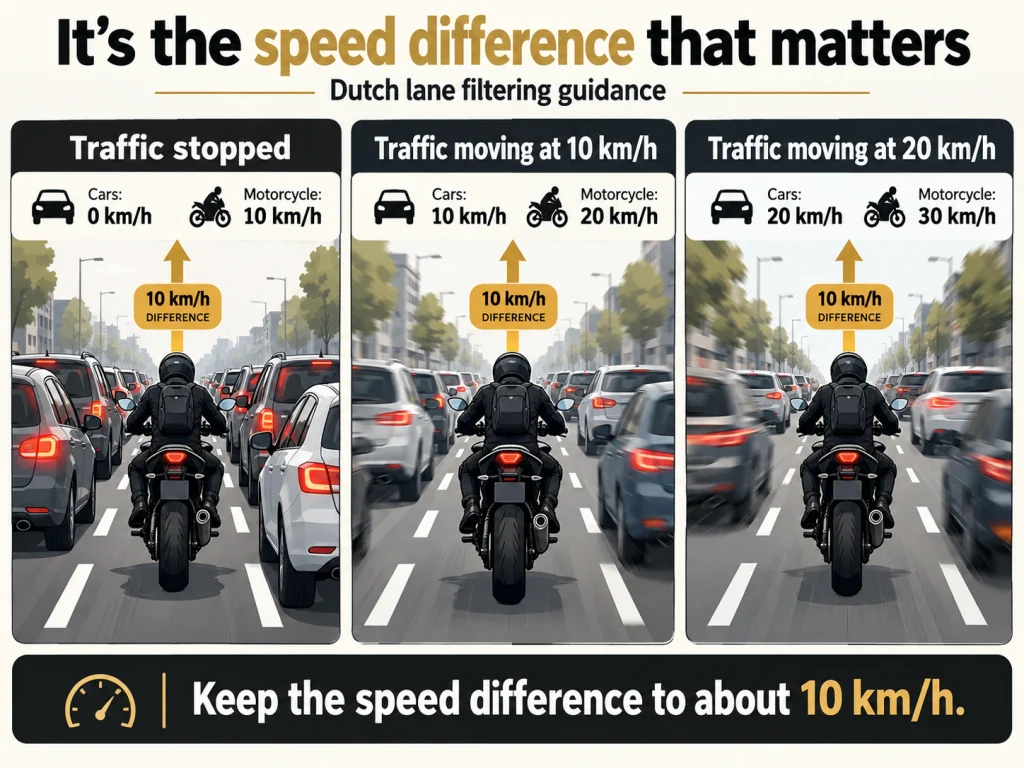
The guidance recommends keeping the speed difference between the motorcycle and the vehicle being passed to around 10 km/h or less.
Notice that this is a speed difference, not simply a motorcycle speed limit.
If the cars are stopped:
Cars: 0 km/h
Motorcycle: roughly 10 km/h
If traffic is moving at 10 km/h:
Cars: 10 km/h
Motorcycle: roughly 20 km/h
If traffic is moving at 20 km/h:
Cars: 20 km/h
Motorcycle: roughly 30 km/h
The point isn’t that 10 km/h is magically safe.
The point is keeping the closing speed small enough that you still have time to react.
Imagine passing a row of almost stationary cars.
At a small speed difference, a driver beginning to change lanes gives you some time to:
see the movement,
reduce speed,
change position,
or stop.
Add another 20 or 30 km/h of closing speed and the same lane change becomes a very different problem.
That is why I think the useful part of the 10 km/h guideline is the principle behind it:
Your filtering speed should leave enough time to respond when a stationary-looking vehicle suddenly becomes a moving obstacle.
When Should You Stop Filtering?
You will also sometimes hear 50 km/h mentioned when Dutch riders discuss filtering.
I would not treat that as a target you need to reach.
The filegedragscode is intended for stationary or slow-moving motorway traffic.
Current Dutch motorcycle guidance generally recommends returning to normal traffic once the queue starts flowing at around 50 km/h.
But judgement still matters.
You do not need to continue filtering until the exact moment traffic reaches 50.
If the available space becomes uncomfortable at 30 km/h, merge earlier.
If vehicles begin changing lanes frequently, merge earlier.
If the queue begins flowing smoothly again, merge earlier.
The useful question isn’t:
“How long am I allowed to keep doing this?”
It is:
“Is filtering still giving me more margin than simply joining the traffic?”
If the answer changes, so should your position.
Filter Between the Two Leftmost Lanes
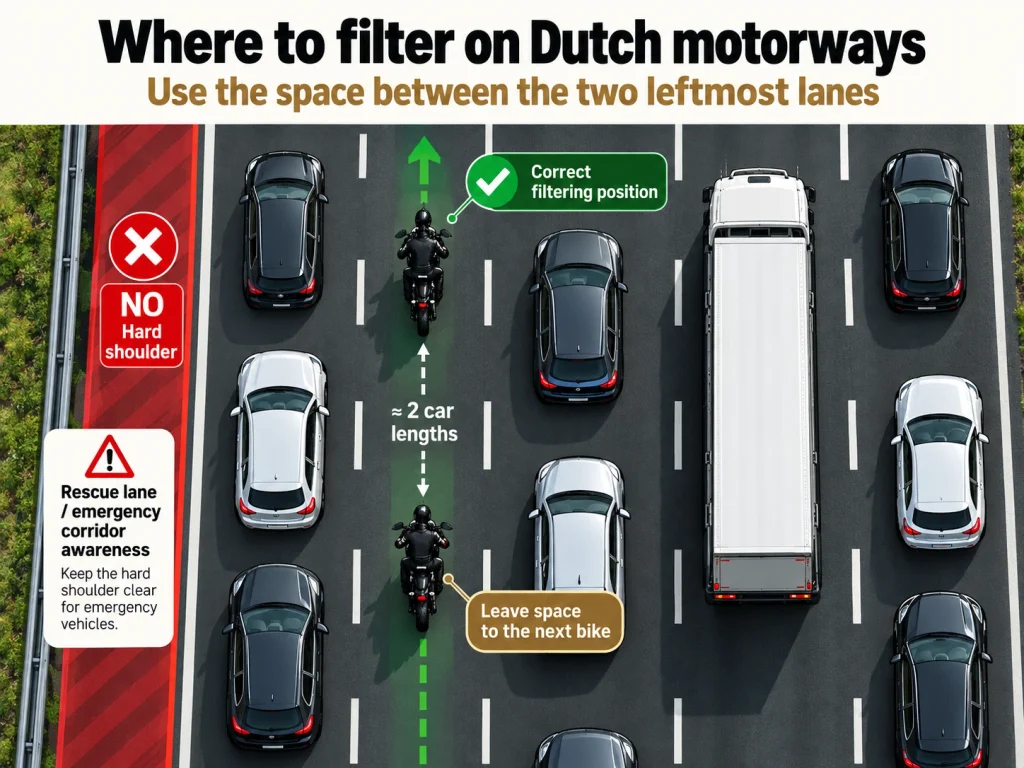
On motorways with more than two lanes, Dutch guidance recommends filtering between the two leftmost traffic lanes.
There is a practical reason for that.
Consistency makes motorcycles more predictable.
If drivers who know motorcycles may be filtering expect them in one particular place, they have a clearer idea of where to check.
If one motorcycle filters between lanes one and two, another between two and three and another uses the shoulder, riders become much harder for drivers to anticipate.
Predictability is a form of visibility.
That is also why I would resist constantly hunting for whichever gap looks widest.
A motorcycle’s small size gives us options.
That doesn’t mean every option is equally useful.
If you’re still developing how you choose road position in normal traffic, my Lane Positioning for Motorcyclists goes much deeper into that subject.
Filtering is simply a more compressed version of the same question:
Where can I see, be seen and still have somewhere to go?
Don’t Use the Hard Shoulder
The hard shoulder is not an alternative filtering lane.
Dutch guidance also warns riders against using spaces such as:
- the vluchtstrook — hard shoulder
- the narrow strip beside the left barrier
- lanes reserved for specific traffic
- hatched exclusion areas
- painted gore areas.
That matters even if the space looks completely empty.
Empty road space is not automatically available road space.
It may need to remain available for:
emergency vehicles,
broken-down vehicles,
road workers,
or something else you cannot yet see.
Use the recognised filtering space instead.
What About a Rescue Lane?
Traffic may sometimes form a temporary reddingsstrook, or rescue corridor, for emergency vehicles.
On wider roads that space is usually created between the two leftmost lanes — which happens to be the same general area motorcycles normally use when filtering.
That does not give the motorcycle priority.
If emergency services need the corridor, move out of the way.
This is another reason I keep checking my mirrors even when filtering.
The traffic ahead is only half the picture.
Don’t Ride Through the Queue With Your Hazards Flashing
This one can surprise riders.
Dutch guidance advises against leaving your hazard lights or indicators flashing continuously while filtering because drivers may misunderstand what the signal means.
There is a useful distinction here.
Approaching the queue
Making yourself noticeable to traffic approaching from behind can be useful.
Filtering between traffic
Stay predictable without leaving ambiguous signals flashing.
Rejoining a lane
Use the indicator normally to communicate the lane movement you’re actually making.
Clear signals are more useful than constant signals.
If Another Motorcycle Is Ahead, Give Them Space
Dutch filtering guidance recommends leaving approximately two car lengths behind another motorcycle.
That sounds like a minor detail until the rider ahead suddenly stops.
Maybe a car moves.
Maybe the gap closes.
Maybe they decide not to continue through a narrow space.
If you are directly behind them, their problem instantly becomes your emergency.
Leaving room lets you react independently.
It also removes another temptation:
Don’t let another rider determine your pace.
Their comfort level may be different.
Their motorcycle may be narrower.
They may have seen something you haven’t.
Or they may simply be taking more risk than you want to.
Ride your own gap.
The Most Dangerous Part of Filtering Can Be the Open Gap
A continuous row of stationary cars can actually be fairly readable.
The interesting moment is often when a large gap appears.
Imagine the lane beside you is almost stationary.
Suddenly there is an empty car-length in front of one vehicle.
To you, that looks like open filtering space.
To the driver beside you, it may look like the perfect opportunity to change lanes.
That is where I want extra attention.
I watch:
Front wheels
A wheel starting to turn can reveal movement before the entire car changes direction.
Mirrors
Is the driver actively checking?
Indicators
Useful when they’re used — but I don’t depend on them.
Gaps
A large gap attracts vehicles.
Driver movement
Sometimes head or body movement gives you a clue that somebody is preparing to move.
And even after checking all of those things, I still assume the car might change lanes without warning.
My Motorcycle Visibility Tips for Urban Riders covers the wider problem of being seen in traffic.
The filtering lesson is simple:
A gap in traffic is not only a gap for you.
Vans and Trucks Need More Margin
Large vehicles change the filtering picture.
A truck or van can:
block your view,
hide another vehicle,
leave less physical space,
have larger blind spots,
and change the available gap as it moves.
The right-hand side of a truck in particular can contain a significant blind spot.
A trailer also does not always follow exactly the same path as the cab during a turn.
So if the available space stops feeling comfortable:
wait.
The traffic jam isn’t going anywhere quickly.
There is no prize for getting through one vehicle sooner.
Mirrors Are Not Enough
It is easy to assume every driver will see a motorcycle coming between the lanes.
Some will.
Some won’t.
A driver can check the mirror and still fail to consciously register you.
Motorcycles are narrow.
We can briefly disappear behind:
a mirror,
a door pillar,
another car,
a van,
or a driver’s blind spot.
That is another reason the speed difference matters so much.
Your speed should compensate for the possibility that someone simply hasn’t seen you.
Visibility helps. Margin protects you when visibility doesn’t work.
Filtering Requires More Than Looking Straight Ahead
When the space becomes narrow, riders can develop tunnel vision.
The eyes fix on the open path between the cars.
The motorcycle follows it.
Everything else disappears.
But good filtering needs a wider scan.
Look farther ahead for:
- narrowing gaps
- brake lights
- cars changing lane
- trucks
- merging traffic
- roadworks
- lane endings
- emergency vehicles.
Look nearby for:
- front wheels turning
- mirrors
- doors
- pedestrians
- cyclists
- sudden movement.
And keep checking behind you.
That is essentially the same observation habit I use throughout my Riding in Heavy Traffic guide.
The gap directly in front of your tyre is only the next metre.
The problem you need to solve may be five cars ahead.
Don’t Let Filtering Become an Entitlement
This might be the most useful mindset around the entire subject.
Dutch drivers are generally accustomed to motorcycles moving through motorway queues.
That does not mean every driver will see you.
It does not mean every driver will move aside.
And it definitely doesn’t mean I think a motorcyclist should become angry when somebody doesn’t.
If the gap isn’t there:
wait.
If the driver hasn’t noticed you:
wait.
If two vehicles move closer together:
wait.
The motorcycle advantage will still be there ten seconds later.
Filtering works best when it feels calm.
Once it starts feeling like you’re fighting your way through traffic, the safety margin has probably already become too small.
The Code Is for Motorway Traffic — Not a Free Pass Everywhere
This distinction is important.
The Dutch filegedragscode is specifically intended for stationary or slow-moving traffic on motorways.
So I would not take:
“10 km/h faster between the left lanes”
and blindly apply it to every traffic queue in Amsterdam.
Urban riding can involve:
cycle lanes,
tram tracks,
pedestrians,
junctions,
narrow lanes,
traffic islands,
buses,
and turning traffic.
The environment is different.
Normal traffic rules still apply, and road markings or street design may remove the space you thought was available.
This is one reason my Riding a Motorcycle in Amsterdam: What City Riding Is Really Like article treats Amsterdam as an observation problem rather than simply a filtering problem.
Motorway filtering and squeezing through a complicated urban junction are not the same task.
A Simple Filtering Routine
If I had to reduce all of this into one simple routine, it would look like this.
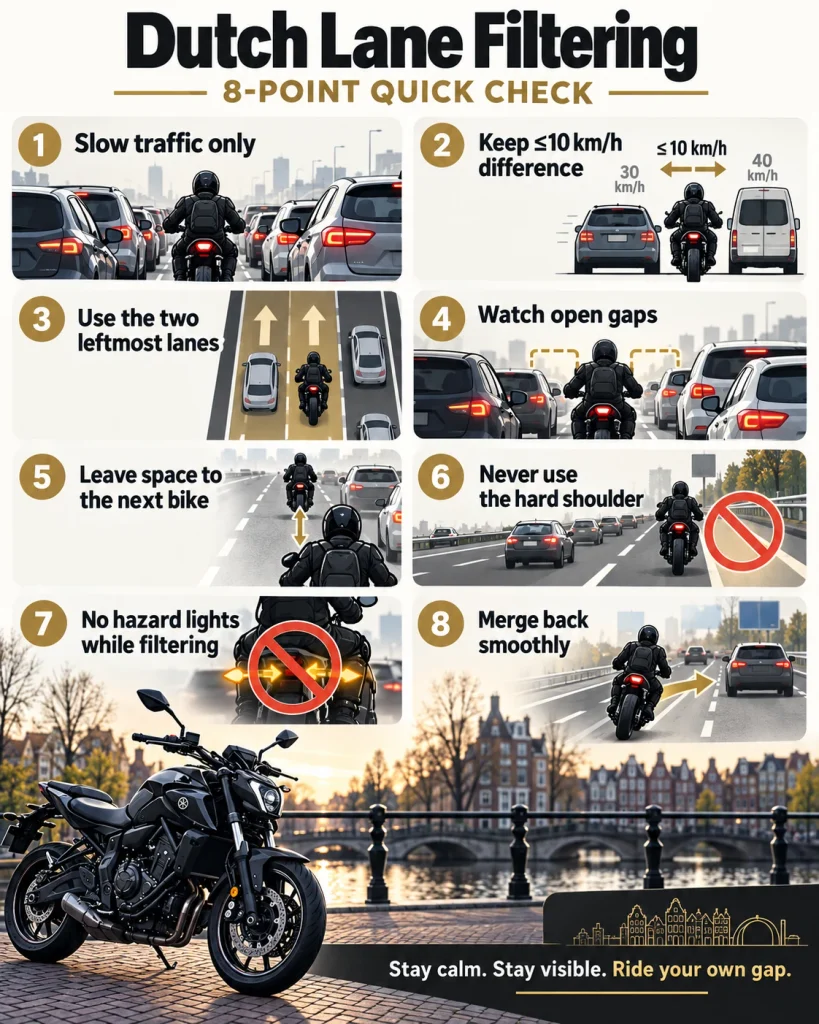
1. Recognise the queue early
Reduce speed gradually.
Check your mirrors.
Don’t arrive at the back of stopped traffic carrying too much speed.
2. Decide whether filtering actually makes sense
Is the traffic genuinely stationary or moving slowly?
Is there enough space?
Can you see far enough ahead?
3. Move into the expected filtering position
On a motorway with multiple lanes, use the space between the two leftmost lanes.
4. Keep the speed difference small
Think of 10 km/h as a maximum guideline rather than a target you need to reach.
5. Treat every open gap as a possible lane change
The more attractive the gap looks to you, the more attractive it may look to the car beside you.
6. Give other motorcycles room
Don’t follow another rider wheel-to-wheel.
7. Keep checking behind
Especially for another motorcycle or an emergency vehicle.
8. Merge back before filtering stops feeling comfortable
Signal clearly.
Rejoin smoothly.
Continue with normal traffic.
The routine isn’t complicated.
The challenge is staying patient enough to follow it.
Low-Speed Control Helps More Than You Might Think
Filtering isn’t a slalom competition.
But good low-speed control helps because it leaves more attention available for traffic.
If all your concentration is being used to:
balance,
manage the clutch,
avoid stalling,
and keep the handlebars steady,
there is less mental capacity left for the driver beside you.
When controlling the motorcycle becomes more automatic, you can spend more attention on what is happening around it.
That is why skills such as clutch control, balance and smooth braking have so much real-world value.
My 20 Motorcycle Low-Speed Control Tips covers that side of riding separately.
Don’t Copy Dutch Filtering Rules Across the Border
This matters in the Netherlands because international borders are never particularly far away.
Filtering rules vary between European countries.
Belgium, Germany, France and other nearby countries do not necessarily treat filtering exactly the same way as the Netherlands.
So if your ride turns into a weekend trip abroad:
check the rules again.
A habit that is accepted at home can become an offence after crossing a border.
That will also become an interesting subject later as I build out more content around international riding, motorcycle rentals and documentation.
My Main Takeaway
Lane filtering is one of the practical advantages of riding a motorcycle in the Netherlands.
But the advantage does not come from being able to move faster than everyone else.
It comes from being able to use road space differently.
That only works when you preserve enough margin to react.
The 10 km/h difference helps.
Using the two leftmost lanes makes your position more predictable.
Leaving space behind another motorcycle helps.
Staying off the hard shoulder helps.
Watching gaps, mirrors and front wheels helps.
But none of those guidelines replaces judgement.
Some days the gap is comfortable.
Some moments it isn’t.
You don’t lose anything by waiting.
The whole queue is moving slowly anyway.
Filter when it makes sense.
Merge back when it doesn’t.
And keep enough speed, space and attention in reserve for the driver who never realised you were there.
Ride safe and enjoy the journey.
FAQs
Is lane filtering legal for motorcycles in the Netherlands?
Motorcyclists can move slowly between stationary or slow traffic in the Netherlands. There isn’t a separate statutory filtering law; instead, the recognised Dutch filegedragscode provides guidance for how riders and drivers should behave in motorway traffic jams.
How much faster can a motorcycle ride than traffic while filtering?
Dutch guidance recommends keeping the speed difference between the motorcycle and the vehicle being passed to approximately 10 km/h or less.
That means if traffic is moving at 10 km/h, the motorcycle would generally remain around 20 km/h rather than treating 10 km/h as the motorcycle’s absolute speed.
At what traffic speed should I stop filtering?
The filegedragscode applies to stationary or slow-moving traffic. Current Dutch motorcycle guidance generally recommends rejoining normal traffic once the queue begins moving around 50 km/h, or earlier whenever the available space or conditions make filtering unsuitable.
Which lanes should motorcycles filter between?
On Dutch motorways with more than two lanes, the guidance is to use the space between the two leftmost traffic lanes.
Can motorcycles filter on the hard shoulder?
The hard shoulder should not be used as a filtering lane. The same applies to other restricted spaces such as hatched areas and traffic-specific lanes unless signs explicitly allow your vehicle to use them.
Should I use hazard lights while filtering?
Dutch guidance advises against leaving hazard lights or indicators flashing continuously while riding between the queue because other drivers may misunderstand the signal. Use your indicator normally when you actually merge back into a lane.
Related Reads
Motorcycling in the Netherlands: A Practical Guide for New & Expat Riders
Riding in Heavy Traffic: Safety Tips for Urban Motorcyclists
Lane Positioning for Motorcyclists: How to Choose the Safest Road Position
Motorcycle Visibility Tips for Urban Riders
20 Motorcycle Low-Speed Control Tips
Riding a Motorcycle in Amsterdam: What City Riding Is Really Like