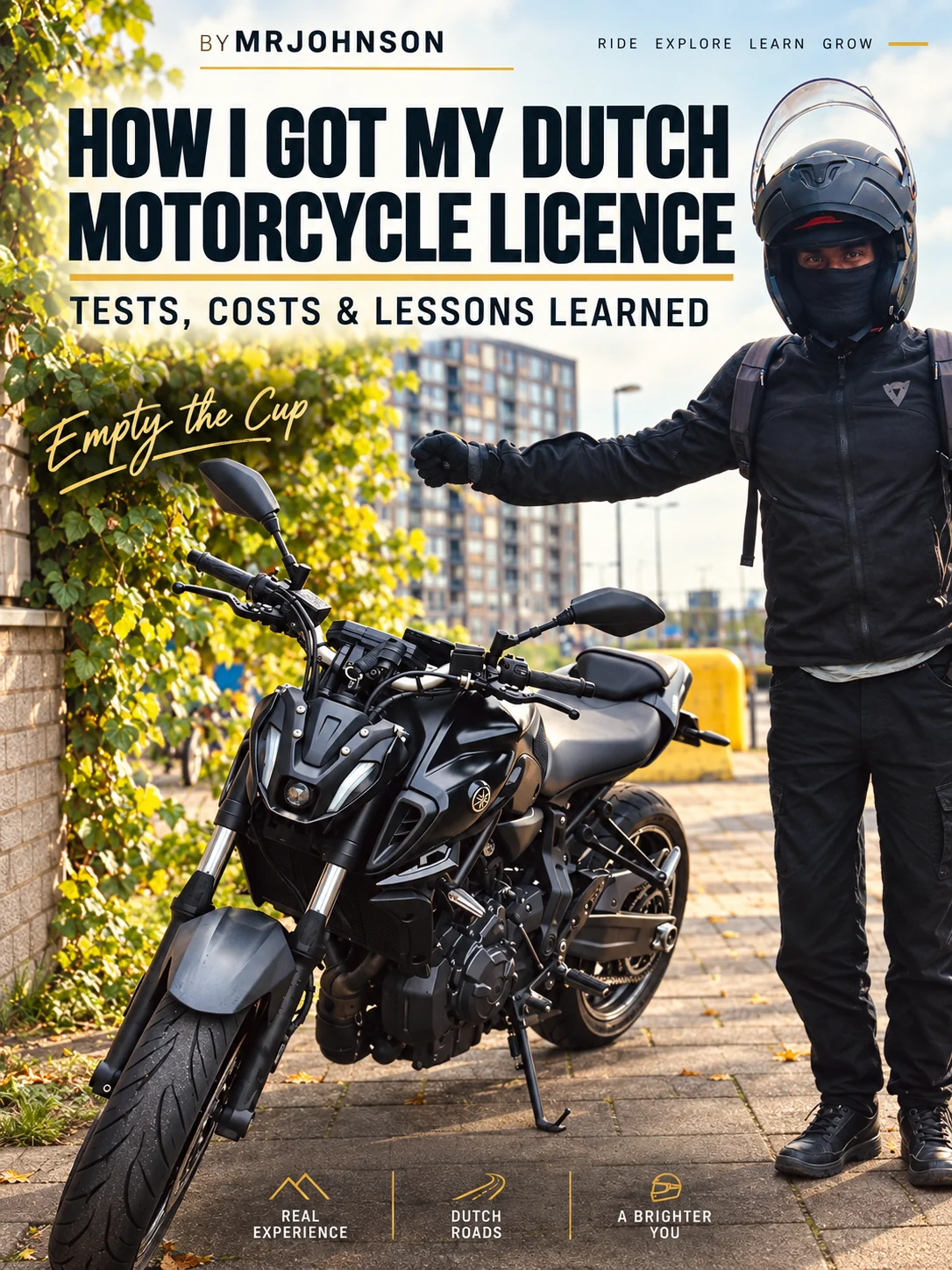
I wasn’t completely new to motorcycles when I moved to the Netherlands.
But when it came to getting my Dutch motorcycle licence, I eventually realised that acting like an experienced rider wasn’t necessarily going to help me.
I needed to become a student again.
Before moving here, I was used to riding on the left side of the road. I already understood how to operate a motorcycle and had habits built from previous riding experience.
Then I arrived in a completely different traffic environment.
Different side of the road.
Different road positioning.
Different priorities.
A huge number of cyclists.
And a different standard of what instructors and examiners expected from a rider.
The phrase that eventually made the most sense to me was:
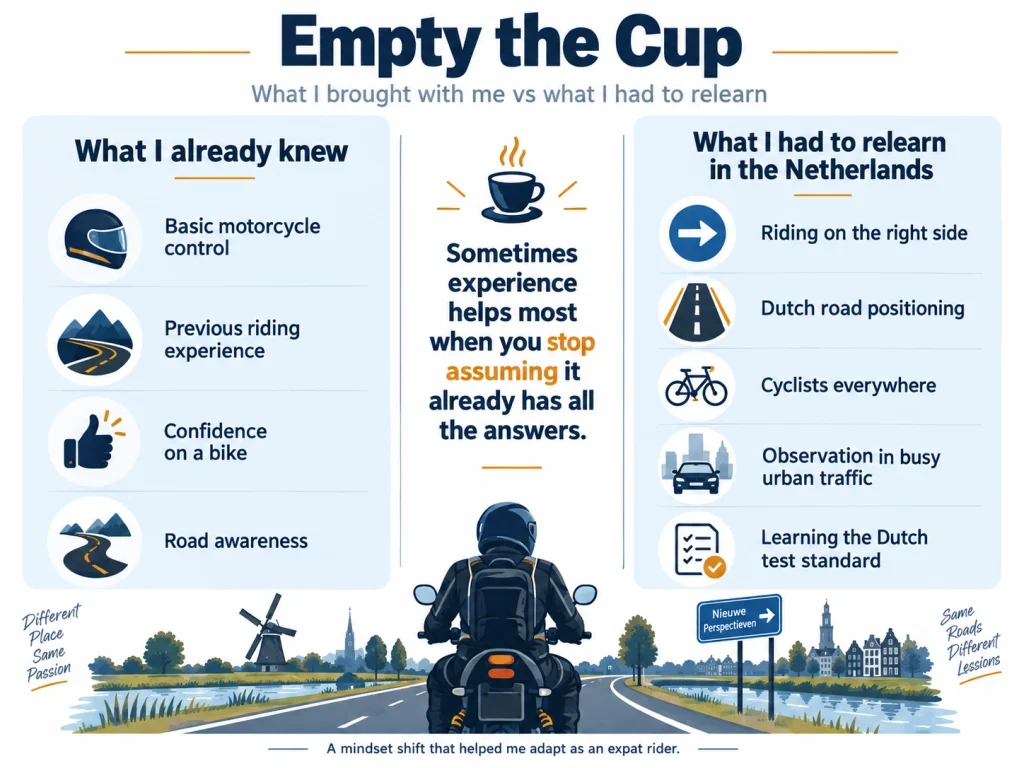
Empty the cup.
Instead of trying to fit Dutch motorcycle training around everything I already thought I knew, I tried to put those assumptions aside and learn the system in front of me.
That approach eventually got me through all three parts of the Dutch motorcycle licence process on my first attempt.
My total cost came to approximately €2,202.
This is how the process worked for me, what I spent, and what getting my licence taught me about adapting as an experienced rider in a new country.
Important: The costs in this article are my actual historical expenses, not a quote for getting a motorcycle licence in 2026. CBR, municipality, riding-school and interpreter prices change. I have included current official 2026 fees later in the article for context.
If you’re completely new to the Dutch motorcycle system, you may want to start with my broader guide to motorcycling in the Netherlands first.
Why I Needed a Dutch Motorcycle Licence
Moving countries does not necessarily mean your existing driving licence automatically transfers with you forever.
The rules depend on the country that issued it.
Drivers moving to the Netherlands with licences issued in the EU, EEA or Switzerland generally have much simpler recognition and exchange arrangements. For many licences issued outside those areas, a new Dutch resident can continue driving for up to 185 days, after which a Dutch licence is required. Some foreign licences can be exchanged; others cannot.
In my situation, I had to go through the process of obtaining a Dutch motorcycle licence.
And although I already had motorcycle experience, that did not mean I could simply turn up and treat the Dutch exams as a formality.
That quickly became obvious during the training.
The Biggest Adjustment Wasn’t Controlling the Motorcycle
Physically operating a motorcycle wasn’t the unfamiliar part for me.
The environment was.
I had previously ridden on the left side of the road.
Now I had to ride on the right.
That sounds like one simple change, but road positioning influences almost everything else.
Where you instinctively place yourself.
Where you look when approaching a junction.
How you enter and leave a turn.
Where you expect other vehicles to appear.
What feels like the “normal” side of a lane.
And then there was the Dutch cycling infrastructure.
Motorcycles, cars, bicycles, scooters, pedestrians and public transport can all interact within a relatively small amount of road space, particularly around cities.
Previous experience still helped me with basic motorcycle control.
But I didn’t want that experience to turn into:
“This is how I’ve always done it.”
That was where the empty-cup mentality became useful.
I wasn’t trying to prove that I could already ride.
I was trying to learn how I needed to ride here.
That distinction mattered.
The Dutch Motorcycle Licence Has Three Main Tests
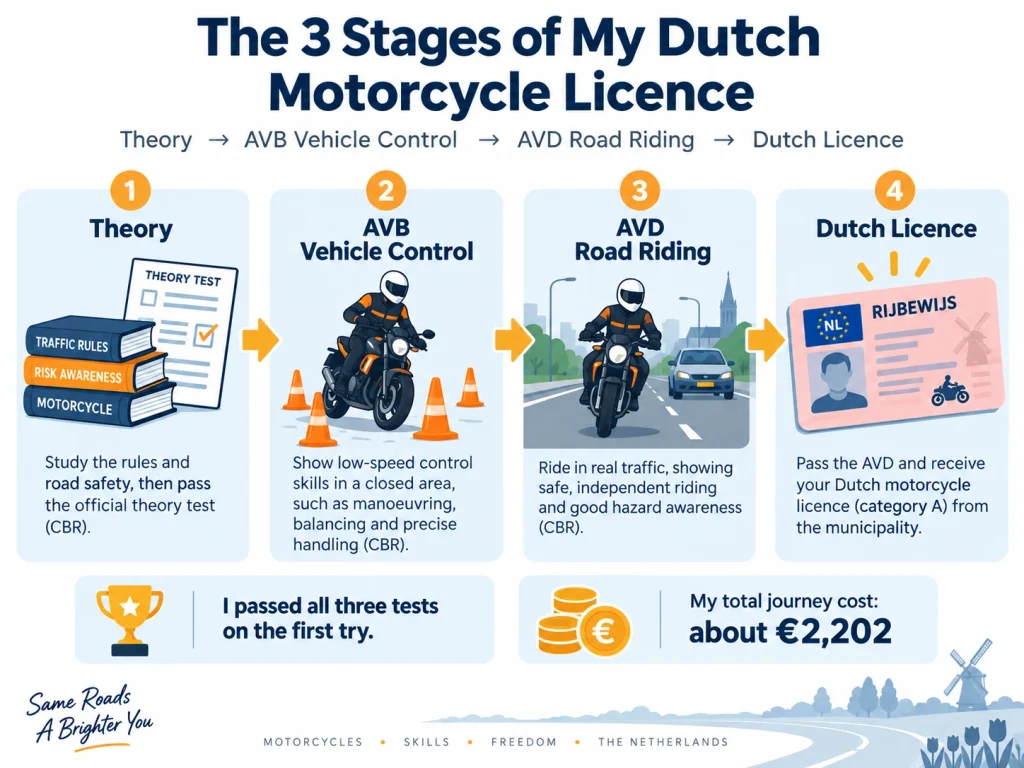
For someone going through the full motorcycle-licence route, it helps to think of the process in three stages:
Theory → Vehicle Control → Road Riding
The two practical parts are officially known as AVB and AVD.
The Dutch government describes motorcycle licensing as a theory component followed by two practical components: vehicle control and participation in traffic.
My journey therefore looked like this:
1. Motorcycle Theory Exam
The theory stage covers the knowledge you need before the practical road test.
For me, however, there was an additional complication.
Language.
When I took my motorcycle theory exam, I used an interpreter.
I paid:
€114 for the theory exam
plus
€226 for the interpreter through Global Talk.
So before lessons or practical exams even entered the equation, the language requirement added a substantial extra cost.
I also spent money preparing for the theory exam.
I used the online course from theorieleren.nl, which cost me €34.50, and later bought another €30 question-bank top-up.
Those are simply the resources I personally used. I’m not presenting them as the best or only way to prepare. But if you ask me, I’d tell you to double down on the question bank.
What matters more is that you understand the format you’re booking and the language options available to you.
CBR pricing and theory-exam options change over time. In 2026, the official tariff is €50.50 for a standard motorcycle theory exam and €118.50 for an individually guided theory exam. Interpreter costs can be separate, so don’t use my €226 translator bill as today’s quotation.
Check the current CBR information when you book.
2. AVB — Vehicle Control
The first practical test is the praktijkexamen voertuigbeheersing, generally shortened to AVB.
This is the part where you demonstrate control of the motorcycle away from normal road traffic.
Slow-speed manoeuvres.
Braking.
Changing direction.
Controlling the motorcycle accurately rather than simply keeping it upright and moving.
For a rider with previous experience, this is an interesting stage.
Road experience does not automatically mean you have practised every technical manoeuvre in exactly the way an examination expects.
That is another reason I found formal lessons useful.
Instead of thinking:
“I can already ride a motorcycle.”
The better question was:
“Can I demonstrate the required control consistently and correctly?”
Those are not quite the same thing.
If slow-speed riding is something you’re currently working on, my 20 Motorcycle Low-Speed Control Tips goes much deeper into balance, clutch control, U-turns and slow riding.
3. AVD — Riding in Real Traffic
The final stage is the praktijkexamen verkeersdeelneming, or AVD.
This is the road test.
By this point the question isn’t simply whether you can control the motorcycle.
It is whether you can use that control while reading traffic and making safe decisions.
The Dutch government requires the AVB component to be completed before the AVD road examination, along with the required theory qualification.
This was also where the difference between knowing how to operate a motorcycle and adapting to Dutch roadcraft became especially relevant for me.
Observation mattered.
Positioning mattered.
Planning ahead mattered.
And the interaction with other road users mattered.
Those are the same ideas I now keep coming back to in articles such as my Beginner’s Guide to Defensive Motorcycle Riding.
Passing a test doesn’t mean you have finished learning them.
It gives you a foundation to continue from.
The Health Declaration Was Another Step
Before the practical process, I also had to complete the CBR Gezondheidsverklaring, or Health Declaration.
I paid €45 at the time.
The official CBR charge in 2026 is now €46.90.
It is a relatively small line item compared with lessons, but it is easy to forget when people estimate the cost of getting a motorcycle licence.
And that became one of the recurring lessons from the entire process:
The exam itself is only part of what you pay for.
How Much My Dutch Motorcycle Licence Actually Cost Me
I kept the expenses from the time I went through the process.
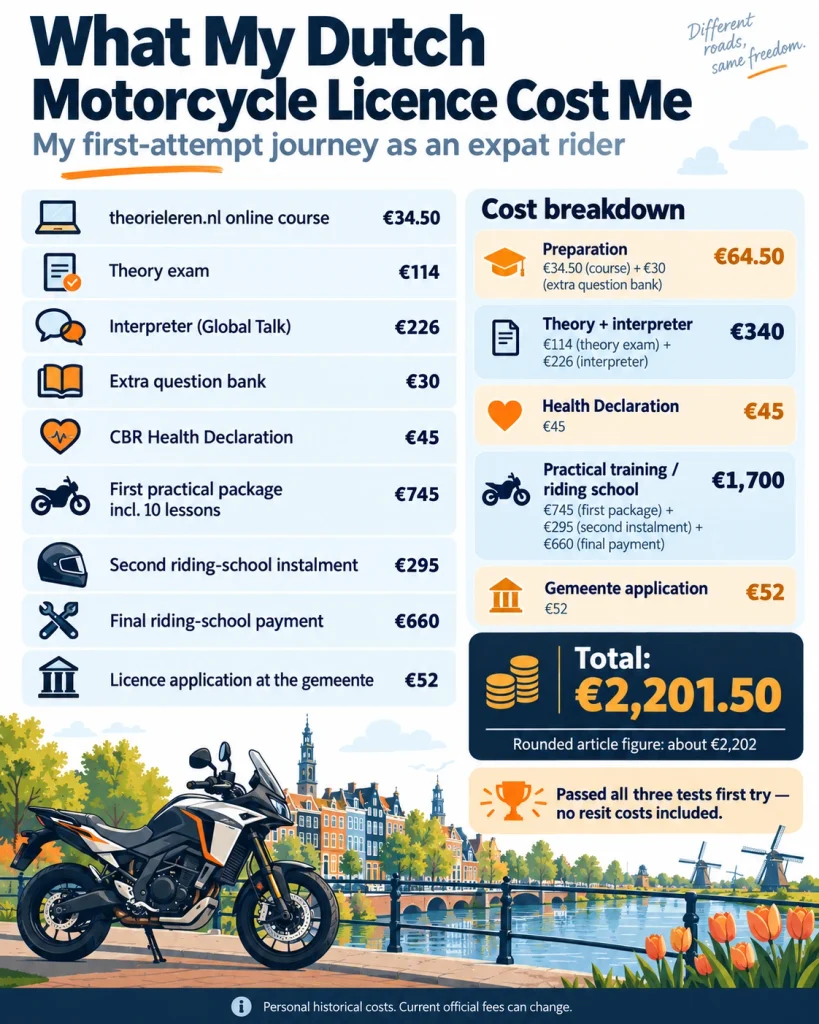
Here is what I paid.
| Expense | My cost |
|---|---|
| theorieleren.nl online course | €34.50 |
| Theory exam | €114 |
| Interpreter — Global Talk | €226 |
| Extra question bank | €30 |
| CBR Health Declaration | €45 |
| First practical package including 10 lessons | €745 |
| Second riding-school instalment | €295 |
| Final riding-school payment | €660 |
| Licence application at the gemeente | €52 |
| Total | €2,201.50 |
Rounded up:
My Dutch motorcycle licence cost me about €2,202.
There is an important piece of context attached to that number.
I passed everything on my first attempt.
There were no theory resits.
No AVB resit.
No AVD resit.
So €2,202 was effectively my first-attempt journey, not a guaranteed cost that another rider should expect.
If I had needed additional lessons or another examination, the total would obviously have increased.
Why Most of My €2,202 Wasn’t the CBR Exam Fee
This is something worth understanding if you’re trying to budget.
When riders search for the cost of a Dutch motorcycle licence, they may find the official CBR exam prices and assume that adding those numbers together gives them the answer.
It doesn’t.
In my own spending, €1,700 went through the riding-school/practical-training side:
- €745
- €295
- €660
That included lessons and the practical side of getting me through the process.
Driving schools also have to account for things such as training time, use of the motorcycle, instructor time and arranging practical examinations.
So the official CBR examination fee and the amount appearing on your riding-school invoice are not necessarily the same thing.
This is why I would budget for the complete training journey, rather than only searching “how much is the motorcycle exam?”
What Are the Official Motorcycle Licence Fees in 2026?
For some current context, the official 2026 CBR fees include:
| Official 2026 charge | Fee |
|---|---|
| Standard motorcycle theory exam | €50.50 |
| Individually guided theory exam | €118.50 |
| Health Declaration | €46.90 |
| AVB vehicle-control exam | €83 |
| AVD road exam | €147 |
These are official underlying CBR charges, not a complete estimate of what you will spend with a riding school.
If you are applying for your first licence in Amsterdam, the municipality currently charges €53.65 for the licence itself.
So even today’s official charges are only the base of the calculation.
You still need to consider lessons, riding-school packages, any additional preparation, and — where relevant — interpreter costs.
That’s why I think my €2,202 real-world total is more useful as a planning reference than simply listing exam fees.
Just don’t treat it as a guaranteed 2026 price.
Passing First Time Helped Keep the Cost Down
I am happy that I passed all three stages first time.
But I don’t think the useful takeaway is:
“You should pass everything first time too.”
Exams do not work that way.
Different riders arrive with different experience levels, learning speeds and circumstances.
The more useful takeaway from my experience is that previous riding experience should not become an excuse to resist instruction.
I had already ridden.
But instead of constantly comparing Dutch training with whatever I had done before, I tried to understand what the instructor wanted me to learn.
That was the value of emptying the cup.
Not pretending my previous experience didn’t exist.
Just being willing to add something new to it.
The Right Side of the Road Became Normal Faster Than I Expected
Coming from left-side traffic, riding on the right was obviously one of the most visible changes.
But adaptation isn’t only about remembering:
“Stay right.”
It’s about rebuilding instinct.
Where do I naturally look?
Which side will a vehicle approach from?
Where should I position myself before a turn?
Which part of the road feels like my default?
You can consciously remember a rule very quickly.
Changing the automatic habit underneath it takes longer.
That’s why I think local instruction has particular value for riders moving between very different traffic environments.
You have somebody watching the things you may not even realise you are doing.
If you’re considering extra rider training even after getting licensed, I discussed that broader question in Motorcycle Safety Courses: Are They Worth It?
I Also Had to Adjust to Dutch Observation
The other major difference for me was how much information could be happening around the motorcycle.
Especially in urban areas.
Cars are only part of the picture.
Cyclists matter enormously.
Cycle paths can intersect roads.
Scooters and pedestrians can enter your decision-making space.
And eventually you stop treating those things as unusual.
They simply become part of what you scan for.
That is one reason my riding today is strongly built around observation and anticipation.
It also explains why so many of the lessons I learned during licensing eventually found their way into ByMrJohnson articles about defensive riding, lane positioning and heavy traffic.
The licence process ended.
The learning didn’t.
What I Would Tell Another Expat Who Already Knows How to Ride
The first thing I would do is check whether you actually need to repeat the Dutch licensing process.
Some foreign licences can be used or exchanged without repeating all the exams. Others cannot. The rules depend on where the licence was issued and your residency situation.
If you do have to start again, though, I would not think of it as:
“I already know this.”
Think of it as:
“I know how to ride. Now I need to learn how riding works here.”
That small shift in attitude helped me.
I would also budget beyond the headline CBR fees.
Think about:
- theory preparation,
- language or interpreter costs if applicable,
- the Health Declaration,
- lessons,
- AVB preparation,
- AVD preparation,
- exam bookings,
- and the final gemeente application.
And leave some financial room for additional lessons or a resit even if you hope not to need them.
If you come in under budget, great.
Was Getting the Dutch Motorcycle Licence Worth It?
For me, absolutely.
Not only because it allowed me to ride legally in the country I now live in.
The process changed how I approached riding.
I had to question habits.
I had to adapt.
I had to stop using experience as proof that there was nothing left to learn.
And once I had the licence, it opened more possibilities than just riding around Amsterdam.
A valid Dutch licence is recognised throughout the EU. Outside the EU, requirements depend on the country and you may also need an International Driving Permit.
I discovered that personally later.
I eventually went on a motorcycle trip in Japan, using my Dutch motorcycle licence together with the required International Driving Permit.
Read : Using my Dutch motorcycle licence for a motorcycle trip in Japan
Japan currently requires Dutch residents to carry their Dutch licence together with a 1949-model International Driving Permit when driving or riding there.
That story deserves its own article.
There is an entire future subject around:
riding internationally,
renting motorcycles abroad,
International Driving Permits,
insurance,
documents,
and the practical lessons from riding in a completely different country.
We’ll get there as the blog grows.
For now, getting my Dutch licence was where that next chapter started.
Final Thoughts
Getting a Dutch motorcycle licence as an expat was more than an administrative hurdle for me.
It became an exercise in relearning.
I came into the process with previous riding experience.
But I also came from a different traffic environment and from riding on the opposite side of the road.
The most useful thing I did was stop treating those two facts as contradictions.
I could be an experienced rider and still be a beginner in the Dutch system.
Both could be true.
The theory exam tested my knowledge.
AVB tested my control.
AVD tested whether I could put everything together on the road.
I passed all three first time and finished the journey at approximately €2,202.
But the number I remember more than the cost is the lesson behind it:
Sometimes becoming a better rider starts with being willing to learn like a beginner again.
Ride safe and enjoy the journey.
FAQs
How many tests are there for a Dutch motorcycle licence?
For someone following the full Dutch motorcycle-licence route, there is a motorcycle theory exam plus two practical components: AVB vehicle control and AVD participation in traffic.
How much did my Dutch motorcycle licence cost?
My total was €2,201.50, which I round to approximately €2,202. That included theory preparation, my theory exam, interpreter, Health Declaration, riding lessons/practical payments and the final municipality application.
Can I exchange a foreign motorcycle licence instead?
Possibly. EU/EEA and Swiss licences generally have straightforward recognition/exchange rules. Some non-EU licences can also be exchanged, depending on the country and circumstances. If your licence cannot be exchanged, you may need to take the Dutch examinations.
Does an expat need an interpreter for the motorcycle theory exam?
I used an interpreter when I took mine and paid €226 separately for that service. However, CBR booking formats and language options can change, so check the current CBR options rather than assuming my exact setup still applies.
Is a Dutch motorcycle licence valid abroad?
A valid Dutch licence is recognised in EU countries. Outside the EU, requirements vary. Some countries require an International Driving Permit in addition to the Dutch licence. Japan, for example, currently requires the Dutch licence plus a 1949-model IDP for Dutch residents.
Related Reads
Motorcycling in the Netherlands: A Practical Guide for New & Expat Riders
Yamaha MT-07 on an A2 Licence: What European Riders Should Know
Motorcycle Safety Courses: Are They Worth It?
20 Motorcycle Low-Speed Control Tips: Balance, U-Turns & Slow Riding