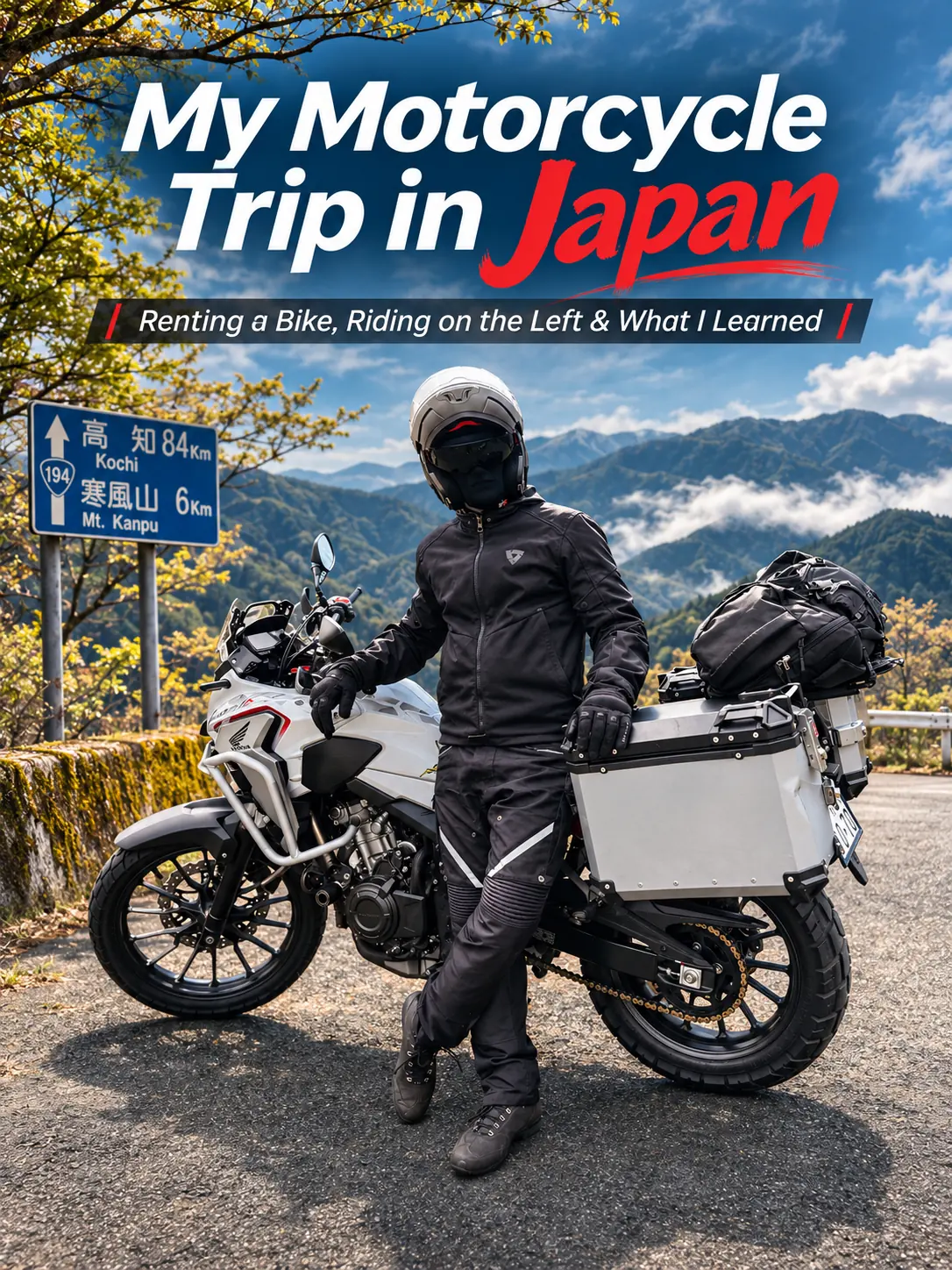
There’s a photograph from my motorcycle trip in Japan that captures why I wanted to make the journey.
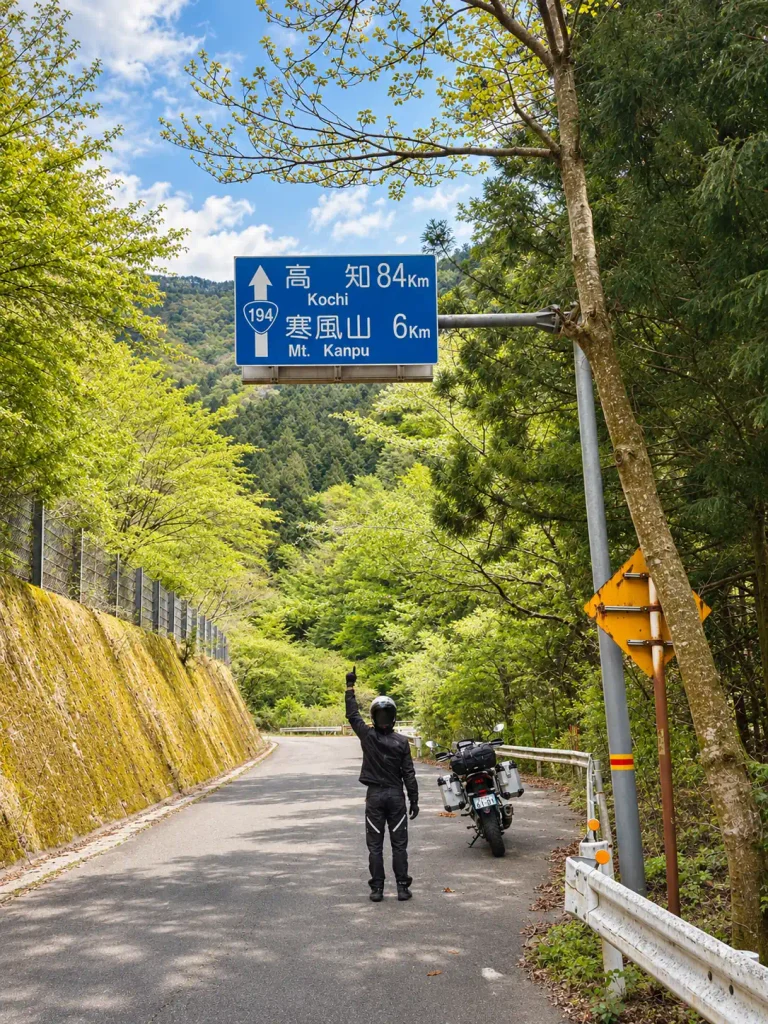
A quiet mountain road surrounded by forest. A blue Japanese road sign pointing towards Kochi and Mt. Kanpu. A motorcycle parked nearby.
No famous city skyline. No crowded tourist attraction. Just a road running through the mountains.
That was the Japan I wanted to experience.
Japan is famous for its cities, efficient trains, food and culture. And for good reason.
But I was interested in something different.
What would Japan feel like from the saddle of a motorcycle?
Not simply travelling between destinations, but experiencing the roads, the changing landscapes and the places in between.
The idea was to rent a motorcycle in Osaka and use it to explore the countryside, with the mountainous island of Shikoku and the remote Iya Valley providing the inspiration for the route.
Of course, taking a motorcycle trip in another country isn’t as simple as booking a train ticket.
You need the correct licence and documentation. You have to understand the rental arrangements. There are unfamiliar roads, local rules and the responsibility of riding a motorcycle you don’t know particularly well.
And in Japan, there is another important consideration for riders accustomed to continental Europe:
Traffic drives on the left.
This is the story behind my motorcycle trip in Japan, what went into preparing for it, and the lessons I would take into another international riding adventure.
Why I Wanted to Explore Japan on a Motorcycle
Japan has one of the most impressive public transportation systems in the world.
If your priority is travelling efficiently between major cities, the train is difficult to beat.
So why choose a motorcycle?
For me, the appeal was never about covering distance as quickly as possible.
It was about having the freedom to stop.
To see a road disappearing into the mountains and be able to explore it when appropriate.
To experience rural areas beyond the usual city-to-city itinerary.
And to have the journey itself become part of the experience.
There is something different about travelling by motorcycle.
You notice changes in the temperature.
You feel the wind.
You’re more aware of the landscape around you.
And when you stop somewhere, you have actually ridden through the countryside rather than simply watched it pass outside a window.
That was the attraction.
I wasn’t interested in ticking off every famous destination.
I wanted to experience a different side of Japan.
The Plan: Osaka, Shikoku and the Mountains
The original idea was to begin in Osaka and explore Shikoku.
For anyone unfamiliar with it, Shikoku is one of Japan’s four main islands, located south of Honshu.
It has coastal roads, mountainous interiors, small towns and some spectacular countryside.
What particularly caught my attention during planning was Iya Valley.
Located in Tokushima Prefecture, Iya Valley is known for its steep mountains, deep river gorges, traditional settlements and narrow winding roads.
It feels very different from the image of Japan most visitors first imagine.
The Japan National Tourism Organization describes Iya as one of the country’s more secluded mountain areas, where narrow roads naturally encourage slower travel.
That sounded ideal for the kind of motorcycle journey I wanted to plan.
Choosing a Manageable Route
An early planning framework was a journey of roughly four to five days, starting and finishing in Osaka.
The aim wasn’t to attempt a huge cross-country tour.
It was to allow enough time for the experience itself.
One of the mistakes I think motorcycle travellers can make is planning an itinerary that looks manageable on a map but leaves very little room for the realities of riding.
A 200 km day on a motorway is very different from 200 km on narrow mountain roads.
And when you’re in another country, everything can require a little more attention.
Navigation.
Fuel stops.
Traffic signs.
Parking.
Finding accommodation.
Even ordering food or asking for directions can take longer than expected.
A useful touring plan needs room for all of those things.
The route should support the experience, not become a schedule you spend the entire trip trying to catch up with.
Renting a Motorcycle in Japan
Before any riding could happen, there was the practical matter of arranging a motorcycle.
This was one of the important differences between riding TITAN at home and travelling internationally.
At home, I know my motorcycle.
I know the controls, how it responds, where everything is and what to expect from it.
With a rental motorcycle, you need to become comfortable with an unfamiliar machine while also adapting to a different country.
That is a lot of new information at once.
Choosing the Right Motorcycle
It’s tempting to choose a rental motorcycle because it looks exciting.
A large touring bike.
An adventure motorcycle.
Something very different from what you normally ride.
But for an unfamiliar country, I think the better approach is choosing something appropriate for the journey.
I would consider:
- Comfortable riding position
- Manageable weight and seat height
- Luggage capacity
- Wind protection
- Fuel range
- Ease of low-speed handling
- Suitability for the planned roads.
A motorcycle with luggage capacity and a relaxed riding position can make sense for a multi-day trip.
But bigger is not always better.
Especially on narrow mountain roads or in unfamiliar city traffic.
The goal is to enjoy the riding rather than spend the journey wrestling with an unnecessarily demanding motorcycle.
The Rental Handover
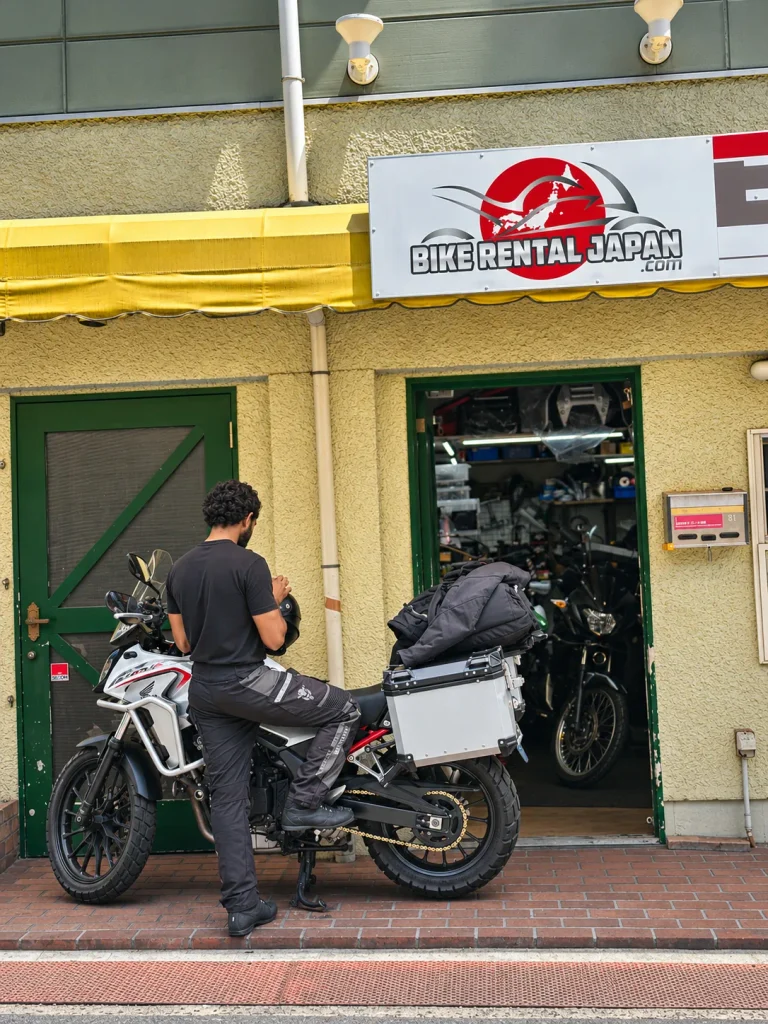
My photographs from Japan include the motorcycle outside the rental location, with touring luggage fitted.
It’s a useful reminder of how much preparation sits behind the moment you finally ride away.
There are the obvious things:
Documents.
Keys.
Helmet.
Luggage.
And then the less exciting but equally important things:
Insurance.
Existing motorcycle damage.
Fuel policy.
Emergency contact details.
And understanding how everything on the rental motorcycle works.
I would never treat the collection process as something to rush simply because the roads ahead look inviting.
You are accepting responsibility for somebody else’s motorcycle.
It makes sense to know exactly what you’re accepting.
For a detailed practical breakdown, see my guide to renting a motorcycle abroad, including insurance, deposits, rental conditions and pre-ride inspections.
The Paperwork: My Dutch Licence and International Driving Permit
Having a motorcycle licence is not automatically enough to ride in every country.
For Japan, a Dutch motorcycle licence needs to be accompanied by the correct International Driving Permit (IDP).
I arranged an IDP in the Netherlands before travelling.
The important detail is that Japan recognises the 1949 Geneva Convention IDP, not the Dutch 1968 Vienna Convention version.
And it must be the original paper document.
A photograph or digital copy on your phone is not a legal replacement.
The IDP also needs to show the correct motorcycle category.
That matters because the permit is not a licence giving you additional driving privileges.
It supports the entitlement you already hold on your Dutch licence.
You need both documents.
This is a good example of why international motorcycle travel rewards proper preparation.
It’s easy to assume that getting an IDP is simply another item on a packing list.
But getting the wrong type of permit can potentially stop the trip before it begins.
My separate article on riding abroad with a Dutch motorcycle licence covers the documentation requirements in more detail.
For current official information, check the Japanese National Police Agency’s IDP guidance and ANWB’s international permit information.
Riding on the Left: Familiar Roads, Different Rules
One of the interesting things about this trip was the left-side road system.
Before moving to the Netherlands, I was accustomed to riding on the left.
Getting my Dutch motorcycle licence meant adapting to riding on the right and learning a different approach to European traffic.
Japan presented another left-side riding environment.
That sounds like it should be straightforward.
After all, if you’ve ridden on the left before, why should it be difficult?
But I don’t think road familiarity works quite like that.
Knowing how to ride a motorcycle and knowing how to read a particular road environment are different skills.
The Side of the Road Is Only the Beginning
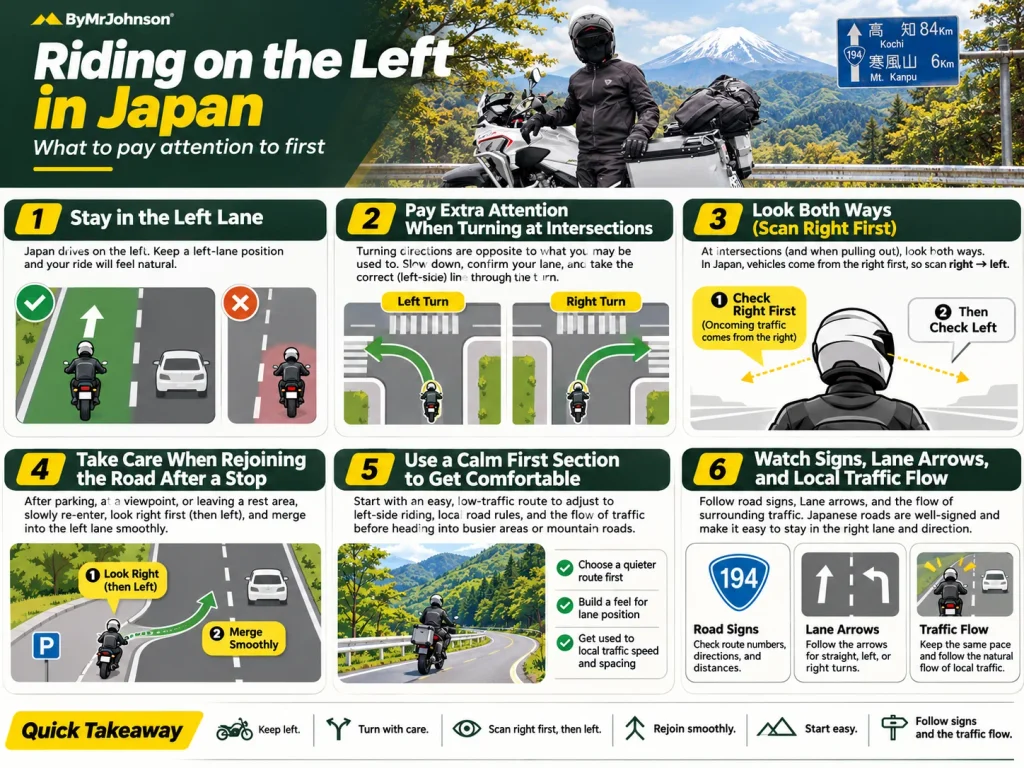
Riding on the left affects more than which lane you use.
You need to pay particular attention to:
- Which direction you look first at intersections
- How you position yourself before turning
- Where oncoming traffic approaches from
- How you enter and leave parking areas
- Lane selection at junctions
- Road signs and local traffic behaviour.
A rider accustomed to driving on the right may instinctively look or position themselves in a familiar way during a turn.
That’s one reason Japanese authorities specifically warn foreign drivers to pay attention when turning at intersections.
The risk isn’t necessarily on a long, straight road.
It can appear during a routine manoeuvre when you’re relying on habit rather than consciously observing the road.
Avoid Rushing the Adjustment
My advice to anyone renting a motorcycle abroad would be to keep the first section of the journey straightforward whenever possible.
Get comfortable with:
the clutch,
the throttle,
the brakes,
the mirrors,
the motorcycle’s weight,
and the local traffic pattern.
Then gradually settle into the journey.
There is no benefit in choosing the most demanding roads before you’ve even become familiar with the motorcycle.
I also wouldn’t assume that previously riding on the same side of the road eliminates the need to concentrate.
Different countries still have different signs, junction layouts, lane markings and driving cultures.
The useful mindset is to stay curious rather than assuming you already know everything.
That’s a lesson that began for me during the Dutch licensing process and remains relevant whenever I ride somewhere new.
Getting Beyond the City
Osaka was the starting point around which I planned the journey.
But the real motivation was to get beyond the urban environment.
Japan’s cities can be dense, busy and full of information demanding your attention.
Mountain roads offer a very different setting.
That change is part of what makes motorcycle touring appealing.
You go from thinking about junctions, traffic lights and navigation to becoming more aware of road width, elevation, bends and the surrounding landscape.
But there is a balance.
Beautiful roads can also be technically demanding roads.
The fact that a road looks peaceful doesn’t mean it should be ridden casually.
Progress Isn’t Just About Speed
For a journey involving Shikoku, it is useful to think about two types of riding.
Transit riding helps you cover the distance between major areas.
Scenic riding is where you deliberately slow down and enjoy the route.
Motorways and toll roads can be useful when you need to make progress.
Smaller mountain roads may be far more memorable, but they can also take considerably longer.
I think the mistake would be judging both using the same kilometre-per-hour expectations.
A well-planned trip uses the faster roads when necessary and preserves enough time for the slower ones.
That is usually a better approach than trying to make every kilometre scenic while still maintaining an ambitious daily schedule.
A Mountain Road That Captures the Trip
One of my favourite visual reminders from Japan is the photograph beneath the blue road sign pointing towards Kochi, 84 km, and Mt. Kanpu, 6 km.
The sign also carries the Route 194 marker.
What I like about that image is its simplicity.
A road.
Mountains.
Trees.
A motorcycle.
And a sign showing that there is still more road ahead.
There’s nothing particularly glamorous about the setting.
And that’s exactly why it represents the type of motorcycle travel I was looking for.
You don’t always need a famous landmark to remember a place.
Sometimes a quiet stretch of road can become the image that stays with you.
Why Mountain Roads Need a Different Mindset
One of the most useful principles for riding in mountainous areas is to avoid confusing beautiful scenery with an easy riding environment.
Mountain roads may include:
Tight bends.
Blind corners.
Steep gradients.
Changing road surfaces.
Areas of shade.
Narrow sections.
And limited space to pass oncoming traffic.
A road that looks open in a photograph may require much more care in practice.
That’s particularly true when you’re riding a motorcycle you don’t own and don’t know as well as your usual machine.
I would much rather leave a little margin through every corner than treat a scenic route like a test of how quickly I can ride.
The road will still be beautiful at a sensible pace.
Iya Valley: The Place That Shaped the Plan
The Iya Valley was one of the main reasons Shikoku interested me during planning.
Even before considering individual attractions, the geography makes it appealing.
Deep valleys.
Steep forested mountains.
Small settlements.
Winding roads running through the interior.
It’s the sort of region where the journey between two points can be just as interesting as the destination itself.
Popular places in the area include the Kazurabashi Vine Bridge, Oboke Gorge and the traditional villages of the Iya Valley.
These are useful locations to research when developing a route, although I wouldn’t build an itinerary purely around fitting every attraction into a single day.
The Japan National Tourism Organization’s Iya Valley guide specifically notes that the region’s narrow mountain roads make travel slower.
That is worth taking seriously on a motorcycle.
Distances Can Be Misleading
Imagine two possible rides.
One is 150 km, mostly on open roads.
The other is 100 km through narrow mountain roads with frequent bends and limited visibility.
The shorter ride may easily require more time and concentration.
And if you stop regularly to take photographs, eat, or enjoy the scenery, the difference becomes larger.
For a journey like the one I had in mind, I would plan around:
realistic riding hours rather than maximum daily distance.
That means allowing time for:
unexpected delays,
weather changes,
navigational mistakes,
rest breaks,
and simply stopping somewhere because the view is worth it.
Those aren’t interruptions to the trip.
They are part of the experience.
Navigation in a Country Where You Don’t Speak the Language
Navigation is one of the practical challenges of travelling by motorcycle abroad.
A modern navigation app can make the route look simple.
But the world outside the screen is still unfamiliar.
Street names may appear in Japanese.
Some road signs will be easier to understand than others.
And when you miss a turn, finding somewhere safe to stop and reconsider can be harder than it looks.
For me, the important principle is to avoid letting navigation become a distraction.
Prepare the Route Before Riding
For an international trip, I would:
Download offline maps.
Save the destination and important stops.
Review the broad route.
Identify likely fuel stops.
Check whether toll roads are involved.
And leave room for alternatives.
If the navigation becomes confusing, find somewhere safe to stop before working it out.
Trying to solve a navigation problem while negotiating a tight mountain bend is not worth the risk.
Don’t Follow the Navigation Blindly
A navigation app doesn’t always understand what makes a particular road suitable for your motorcycle and experience.
It may suggest a narrow mountain shortcut because it saves a few kilometres.
That doesn’t automatically make it the better choice.
Check the road.
Check the conditions.
And remember that turning around is a perfectly reasonable decision if the road becomes unsuitable.
Weather, Fuel and the Importance of Flexibility
Weather can change the character of a motorcycle trip very quickly.
This is especially true when the itinerary moves between lower elevations and mountainous areas.
A road that looks inviting in sunshine can feel very different in heavy rain or reduced visibility.
And in remote areas, you have fewer immediate alternatives.
That’s why I think planning a motorcycle trip is partly about creating options.
Where can I stop?
Where can I refuel?
Is there another route?
What happens if the weather changes?
Where is the next accommodation?
Can the day’s distance be shortened?
Those questions may sound overly cautious when planning an adventure.
But having answers makes it easier to enjoy the journey without feeling pressured into riding through conditions you’re not comfortable with.
Fuel Stops Deserve More Attention
On a familiar motorcycle near home, you know roughly how far a tank will take you.
With a rental motorcycle, that range may be unfamiliar.
And once you head into quieter mountain areas, you shouldn’t assume fuel will always be available at the next village.
I would rather refuel a little earlier than discover I have very limited options later.
That’s a small decision that can remove a lot of unnecessary uncertainty.
What This Trip Taught Me About Riding Abroad
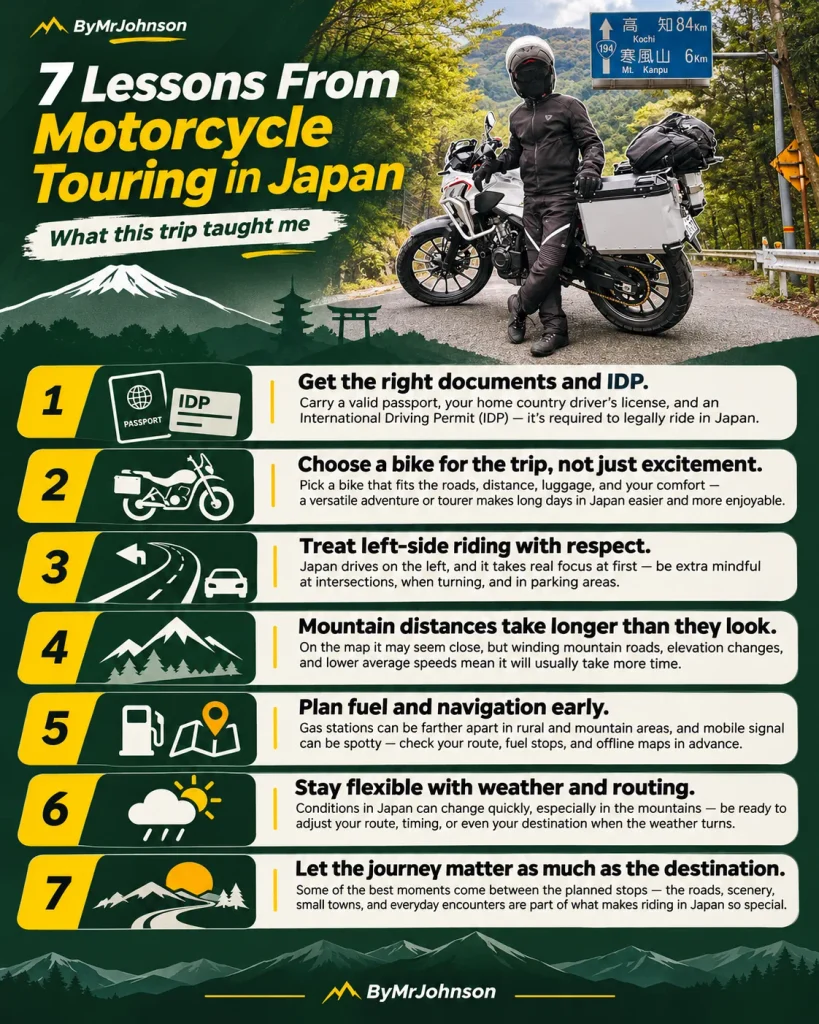
Looking back at the experience and the planning that went into it, several lessons stand out.
1. Preparation Creates Freedom
The documentation, rental arrangements and insurance might not be the exciting parts of the trip.
But dealing with those things properly lets you concentrate on riding.
The correct International Driving Permit is a good example.
It isn’t something you think about during a beautiful mountain ride.
But without the right documents, you might never get to enjoy that ride legally.
2. Familiar Riding Skills Don’t Replace Local Knowledge
Motorcycle control is transferable.
Road expectations aren’t always.
Even if you’re comfortable on a motorcycle and have experience riding on the same side of the road, unfamiliar traffic patterns deserve respect.
I think the safest approach is to treat the first part of any international motorcycle journey as a period of adjustment.
3. Choosing the Right Motorcycle Matters More Than Choosing the Most Exciting One
A motorcycle that looks incredible in the rental catalogue may not be ideal for narrow roads, luggage and repeated low-speed manoeuvres.
Comfort and manageability become more important over several days than they might appear during a short test ride.
4. Mountain Roads Reward Patience
A beautiful route doesn’t need to be ridden quickly to be memorable.
In fact, giving yourself enough time to stop and take in the landscape can be the reason for choosing the motorcycle in the first place.
5. A Flexible Itinerary Is More Valuable Than a Perfect One
I would rather finish a day’s riding with energy left to appreciate where I am than arrive exhausted simply because I wanted to stick to the original plan.
A good touring itinerary gives you options.
It doesn’t trap you into a particular distance.
6. The Journey Can Matter More Than the Destination
That photograph of the road sign near Mt. Kanpu captures this for me.
It’s not a photograph of a famous attraction.
It’s a moment along a road.
Yet it represents something I find valuable about motorcycle travel: the freedom to explore beyond the places everybody already knows.
Would I Ride a Motorcycle in Japan Again?
Yes.
Japan offers the kind of riding environment that makes international motorcycle travel interesting to me.
There are the practical challenges of an unfamiliar country, of course.
Different road rules.
Rental arrangements.
Documentation.
Navigation.
Mountain roads.
But those considerations are also part of what encourages you to prepare properly and approach the journey with an open mind.
If I were planning another motorcycle trip in Japan, I would again put more emphasis on the quality of the route than the number of kilometres.
I would choose a motorcycle appropriate for the roads.
Allow more than enough time for the interesting sections.
And keep the daily itinerary flexible.
Most importantly, I would remember that there is no need to transform every road into a challenge.
Sometimes the best thing to do is simply ride, stop somewhere interesting, take in the view, and carry on when you’re ready.
Final Thoughts
When I first got my Dutch motorcycle licence, my immediate goal was to ride in the Netherlands.
I hadn’t viewed the licensing process only as preparation for travelling internationally.
But later, being able to use that licence together with the correct International Driving Permit for a motorcycle journey in Japan gave it another dimension.
Motorcycling had become a way to experience somewhere completely different.
And that is one of the things I appreciate most about riding.
It can take something familiar — controlling a motorcycle, watching the road, choosing a line through a corner — and place it in a completely unfamiliar setting.
The skills travel with you.
But you still have to learn the environment.
That requires preparation, patience and a willingness to adapt.
The scenery is part of the reward.
So is the feeling of exploring somewhere new.
But for me, the most memorable part isn’t necessarily reaching a famous destination.
Sometimes it’s finding yourself on a quiet mountain road, with the motorcycle parked nearby and a sign pointing towards places you haven’t explored yet.
The road itself becomes the experience.
And that’s what I was looking for in Japan.
Ride safe and enjoy the journey.
FAQs
Can you rent a motorcycle in Japan with a Dutch motorcycle licence?
Yes, provided you have the required valid documents and satisfy the rental company’s conditions. Dutch visitors generally need their Dutch licence and the 1949 Geneva Convention International Driving Permit, with the correct motorcycle entitlement.
Is riding a motorcycle in Japan difficult?
It depends on your experience, the motorcycle and the route. Japan drives on the left, so riders accustomed to right-side traffic need to pay particular attention at junctions and turns. Narrow mountain roads can also demand extra concentration.
Is Shikoku good for motorcycle touring?
Shikoku offers coastal routes, mountainous countryside and quieter rural areas that can appeal to touring riders. Some mountain roads are narrow and slow, so realistic planning matters more than simply measuring distance.
Can you explore Iya Valley by motorcycle?
Yes, but plan carefully. The area has steep mountain roads, narrow sections and slower travel times. Check local road conditions and seasonal closures before setting out.
What should I check when renting a motorcycle in Japan?
Confirm your licence and IDP, insurance, excess, deposit, mileage policy, equipment and emergency support. Inspect the motorcycle and document existing damage before riding away.
How many days should I plan for a motorcycle trip from Osaka to Shikoku?
A four- or five-day itinerary can provide a starting framework, but the right duration depends on the route and how much time you want in the mountains. Additional days make it easier to enjoy slower roads and accommodate weather changes.
Which International Driving Permit is accepted in Japan?
Japan recognises the 1949 Geneva Convention International Driving Permit. The Dutch 1968 Vienna Convention permit is not accepted for this purpose. You must carry the original physical document.
Related Reads
Riding a Motorcycle Abroad With a Dutch Licence: IDP, Documents & What to Check
Renting a Motorcycle Abroad: Licence, Insurance, Deposits & What to Check