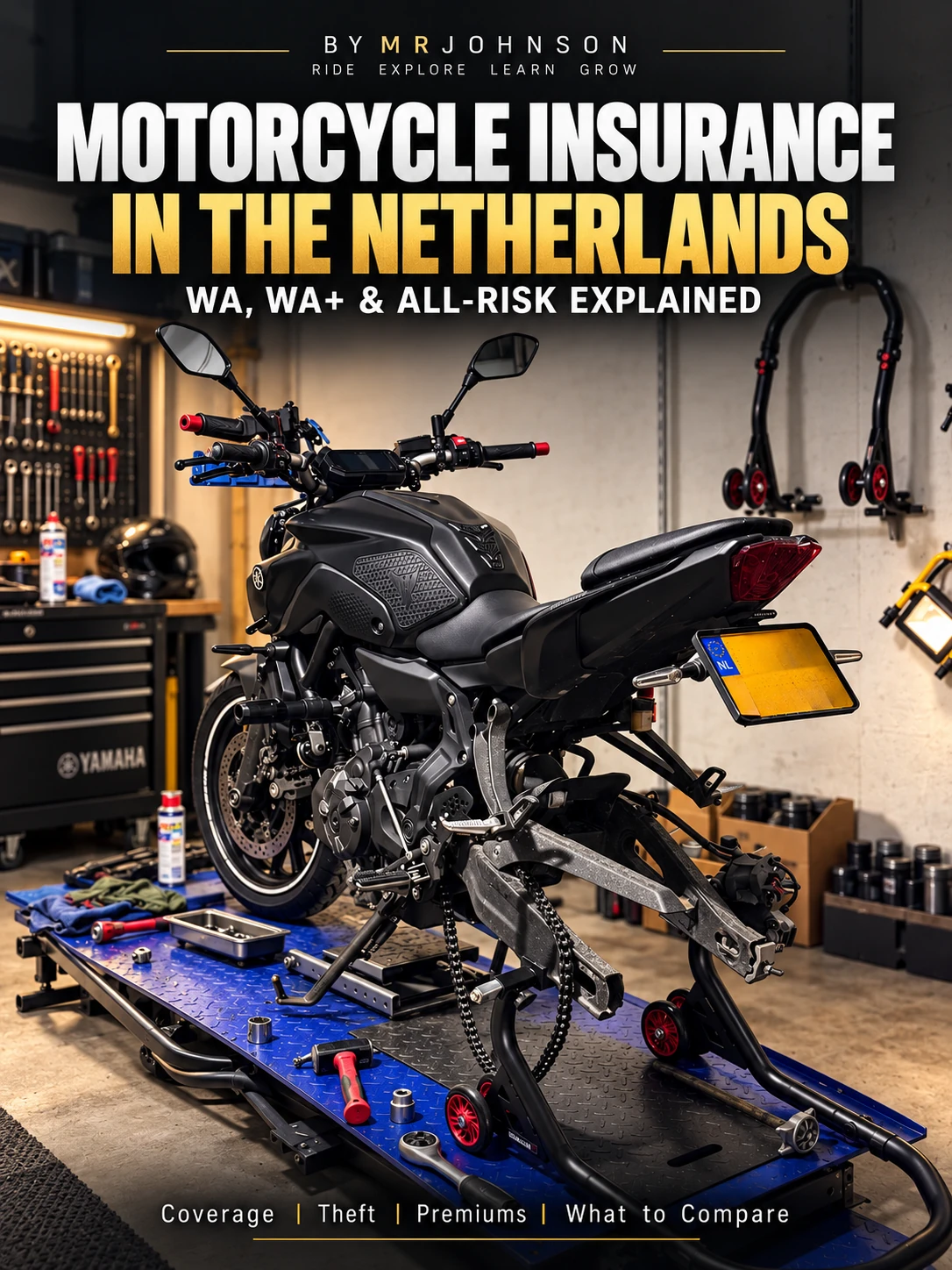
Buying the motorcycle is the exciting part.
Insurance feels more like administration.
But in the Netherlands, it is something I would understand before putting the motorcycle into my name rather than after.
Once a motorcycle is registered to you, you need at least WA insurance — wettelijke aansprakelijkheid.
That is the legal minimum.
But the legal minimum and the amount of financial protection you personally want are two different questions.
When comparing Dutch motorcycle insurance, you will normally come across three basic levels:
WA
WA + Beperkt Casco — often shortened to WA+
and:
WA + Volledig Casco — commonly called All-Risk.
They can look like three versions of essentially the same policy.
They are not.
The biggest difference is whose damage is covered and what caused it.
Understanding that distinction is much more useful than simply choosing the cheapest monthly number.
Important: Insurance conditions vary between providers and change over time. This article explains the general Dutch structure using current 2026 information, but the actual policy wording always takes priority.
If you’re still at the motorcycle-buying stage, start with my Buying a Used Motorcycle in the Netherlands guide first.
Also check : Importing a motorcycle to the Netherlands if you are considering to buy from abroad.
Is Motorcycle Insurance Mandatory in the Netherlands?
Yes.
If a motorcycle registration is in your name, Dutch law requires at least WA — third-party liability — insurance.
The Dutch government explicitly includes motorcycles under the compulsory motor-vehicle liability insurance rules.
The basic idea is straightforward.
If you cause a crash and damage:
another vehicle,
somebody else’s property,
or another person,
WA insurance provides liability cover according to the policy and applicable law.
What WA does not normally do is pay for damage to your own motorcycle when you caused the crash.
That is where the broader coverage levels begin.
Don’t Leave Insurance Until After Buying the Motorcycle
This becomes particularly important when buying used.
When the RDW ownership transfer succeeds, the motorcycle becomes registered in your name.
From that point, the insurance responsibility is yours.
RDW runs daily checks comparing the vehicle-registration register against insurance records and can identify registered vehicles that appear not to meet their compulsory insurance obligation.
So my preferred order would be:
Get insurance quotes before buying.
Then:
Have the insurer and policy details ready before the RDW transfer.
Then:
Make sure cover becomes active when ownership changes.
I wouldn’t buy the motorcycle on Friday and think:
I’ll sort the insurance next week.
The administrative part of the purchase should happen as one process.
WA Motorcycle Insurance: The Legal Minimum
WA stands for:
Wettelijke Aansprakelijkheid
or statutory liability.
It is the minimum cover you need.
A WA motorcycle policy primarily covers damage you cause to other people and their property.
ANWB describes its current WA motorcycle cover the same way: damage caused to others is insured, while WA is the compulsory baseline.
Imagine you misjudge a junction and collide with somebody else’s car.
The damage to the other road user is the liability problem.
That’s what WA is designed around.
But your motorcycle may also be badly damaged.
With basic WA alone, you should generally be prepared to deal with your own collision damage yourself.
That distinction is crucial.
Cheap insurance doesn’t necessarily mean cheap consequences.
When Might WA Make Sense?
I don’t think there is one correct coverage level for every rider.
WA can make sense when the motorcycle’s value is low enough that you would realistically be willing and financially able to replace or repair it yourself after an at-fault accident.
For example, imagine a motorcycle worth €2,000.
If the difference in annual premium between WA and broader cover becomes large relative to the motorcycle’s value, somebody may reasonably decide to retain that risk themselves.
But there is another question:
Could I comfortably absorb the loss?
A motorcycle might only be worth €3,000 on paper.
If losing that €3,000 tomorrow would leave you unable to replace it, broader coverage may still matter to you.
Insurance isn’t only about the bike’s market value.
It is also about how much risk you personally want to carry.
WA+ / Beperkt Casco: The Middle Ground
The next level is usually called:
WA + Beperkt Casco
or simply:
WA+.
This keeps the WA liability cover and adds protection against certain types of damage to your own motorcycle.
Typical examples include:
- theft or attempted theft
- fire
- storm damage
- some natural events
- collision with animals.
Current KNMV WA+ coverage, for example, includes liability, theft and joyriding, fire and storm, and collision with animals. It does not include your own collision damage, falling over or vandalism under that policy.
Exact cover differs by insurer.
That’s why I wouldn’t treat:
WA+ = this exact universal list
as a permanent rule.
Think of it instead as:
WA liability plus selected risks affecting your own motorcycle, but normally not every type of self-caused crash damage.
Then read the actual policy.
Insurance becomes a different consideration when you’re riding someone else’s motorcycle.
My guide to renting a motorcycle abroad explains rental insurance, security deposits and the excess you may be responsible for.
Why Theft Cover Changes the Decision for Motorcyclists
For motorcycles, theft is a particularly important difference between basic WA and broader casco cover.
Basic WA is about your liability to others.
It is not generally a motorcycle-theft policy.
If theft is something you want insured, you usually need a coverage level that specifically includes it.
That becomes especially relevant for riders who regularly leave motorcycles outside or away from secure private storage.
But theft cover also brings another issue:
security conditions.
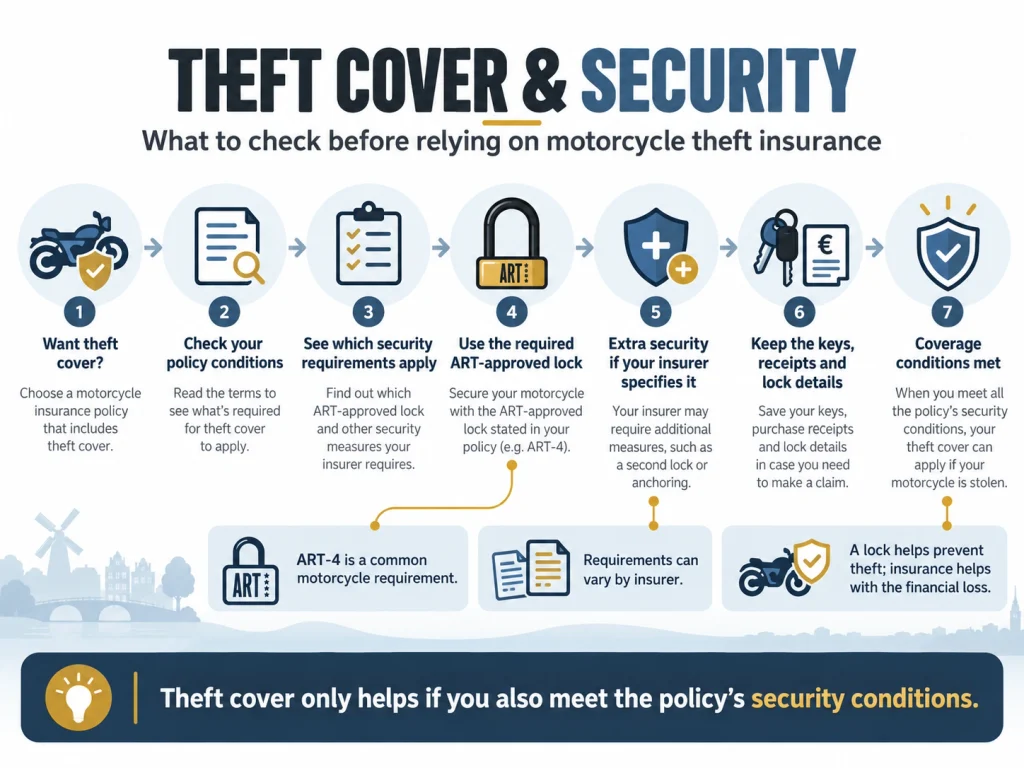
Having Theft Insurance Doesn’t Mean You Can Use Any Lock
Insurance policies can require specific motorcycle security.
For example, ANWB currently states that when motorcycle theft is covered, an ART-4 approved lock is required. Some motorcycles can also receive additional security requirements shown during quotation or on the policy schedule.
ART itself uses security classes.
For motorcycles, ART-4 and ART-5 are the relevant higher categories; ART-4 is commonly used for motorcycle security requirements.
The practical lesson is:
Read your theft conditions before buying your lock.
Not afterwards.
A €150 chain that isn’t accepted under your policy could be less useful financially than an approved lock that actually meets the insurer’s conditions.
And keep:
the purchase receipt,
keys,
approval information,
and any other evidence the insurer’s conditions ask for.
That documentation can matter if the motorcycle is stolen.
What Does All-Risk Motorcycle Insurance Cover?
The broadest standard category is usually:
WA + Volledig Casco
or:
All-Risk.
The key addition is cover for damage to your own motorcycle in more situations, including crashes that you caused yourself, subject to the policy conditions.
Current KNMV All-Risk coverage, for example, adds areas such as collision damage, falling and vandalism to the WA+ risks.
ANWB similarly describes full casco as covering damage to others and damage to your own motorcycle, including damage you caused yourself.
That sounds simple.
But All-Risk doesn’t mean:
every imaginable thing that happens to the motorcycle is always paid in full.
Policies still contain:
deductibles,
exclusions,
security requirements,
valuation rules,
claim conditions,
and limits.
“All-Risk” is a convenient name.
The policy wording is what you’re actually buying.
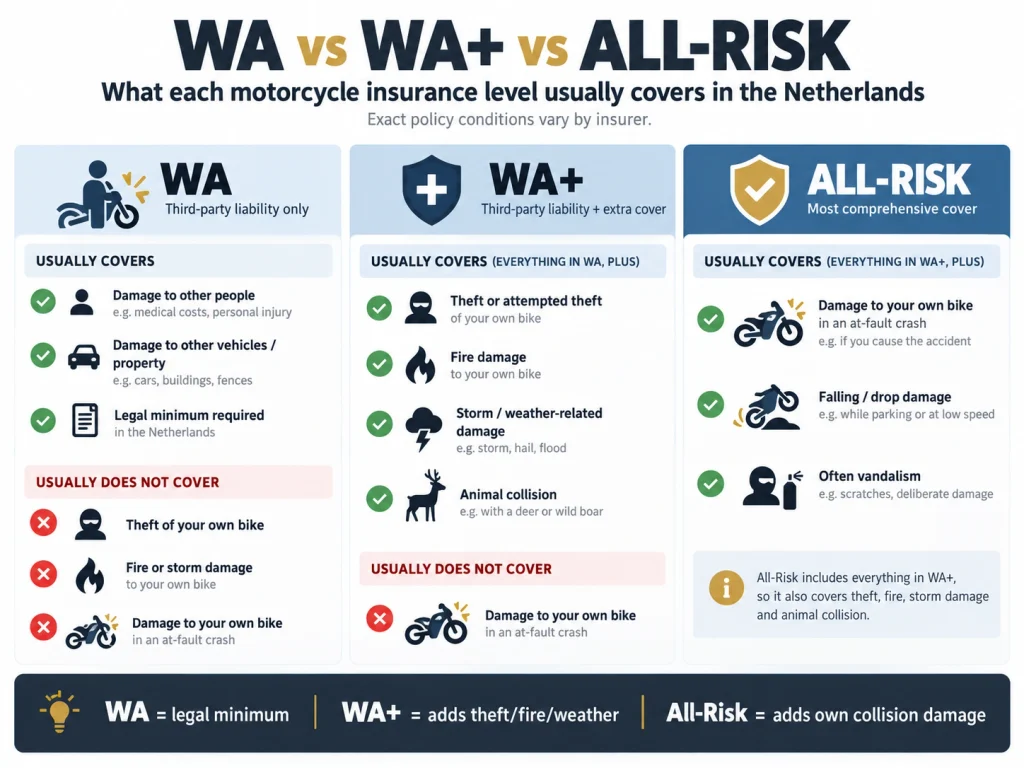
WA vs WA+ vs All-Risk at a Glance
A simplified comparison looks like this:
| Situation | WA | WA+ / Beperkt Casco | All-Risk |
|---|---|---|---|
| Damage you cause to another person | ✓ | ✓ | ✓ |
| Damage you cause to another vehicle/property | ✓ | ✓ | ✓ |
| Theft of your motorcycle | Usually no | Usually yes | Usually yes |
| Fire/storm damage | Usually no | Usually yes | Usually yes |
| Animal collision | Usually no | Often yes | Often yes |
| Damage to your own bike in an at-fault crash | No | Usually no | Usually yes |
| Dropping/falling with your bike | No | Usually no | Often yes |
| Vandalism | No | Policy-dependent | Often yes |
The words usually and often are deliberate.
Insurers don’t all package these things identically.
Always compare the actual coverage rather than just the label.
Which Coverage Level Should You Choose?
I don’t think the useful answer is:
Buy All-Risk if your motorcycle is X years old.
Age is relevant.
It isn’t the entire decision.
I would look at at least four things.
1. What is the motorcycle actually worth?
The greater the value, the larger the financial loss you are asking yourself to absorb.
2. Could you replace it tomorrow?
Not theoretically.
Financially.
If the motorcycle disappeared tonight, what happens?
3. Where and how is it used?
A bike stored privately and ridden occasionally creates a different personal decision from one used every day and parked frequently in public places.
That doesn’t automatically dictate coverage.
It simply changes the risks you may care about.
4. How big is the premium difference?
Get actual quotes for:
WA,
WA+,
and All-Risk.
Then compare the extra annual cost with what the additional protection gives you.
Sometimes the difference may feel worthwhile.
Sometimes it won’t.
The quote decides much more than a generic internet rule.
What Do I Pay to Insure TITAN?
My current MT-07 insurance costs me:
€23 per month
Over twelve months:
€276 per year
That’s one of the fixed costs I included in my MT-07 running-cost breakdown.
But I want to be very clear about what that number means.
It means:
My insurance currently costs €23 per month.
It does not mean:
A Yamaha MT-07 costs €23 per month to insure in the Netherlands.
Another rider could get a quote that is much higher or lower.
The useful part of my number is simply showing that insurance needs to be included in a real ownership budget.
Why Can Two Riders Get Completely Different Insurance Quotes?
Motorcycle premiums aren’t based only on the motorcycle.
Insurers use combinations of factors when calculating risk.
These can include things such as:
- the motorcycle
- its value
- chosen coverage
- rider age
- address or location
- annual mileage
- claims history
- number of claim-free years.
ANWB, for example, says motorcycle coverage choices can depend on motorcycle age/value and accumulated claim-free years, while the Dutch Roy-data system explains that insurers also use factors such as residence, vehicle type and annual kilometres in pricing.
That explains why comparing your premium directly with another rider’s can be misleading.
Even two people with identical motorcycles may not be comparable customers.
Claim-Free Years Matter
In Dutch insurance discussions you will often hear:
schadevrije jaren
— claim-free years.
Broadly, the longer you build an insurance history without claims that affect those years, the more favourable your no-claim position can become.
Dutch insurers use the central Roy-data system to record claim-free years for motor insurance and other eligible motor-vehicle policies. Consumers can also check their own data.
This becomes particularly relevant when changing insurer.
You normally do not need to carry a paper history between Dutch insurers because the information can be accessed through the system.
But don’t confuse:
claim-free years
with:
the discount percentage on your policy.
Each insurer can apply its own bonus/malus table and commercial discount structure.
So:
10 claim-free years
doesn’t necessarily mean:
the exact same discount at every company.
What If You’re an Expat With Insurance History Abroad?
This is worth asking about rather than assuming your overseas riding history disappears.
If you have previous claim-free insurance history outside the Netherlands, ask potential insurers what evidence they will accept.
EPS notes that an overseas insurer can provide documentation of claim-free years or claims history and that some Dutch insurers may use that information to offer a commercial discount. Acceptance can vary by company.
So if you’ve already insured motorcycles elsewhere:
get the documentation before you lose access to the old insurer or move country.
You may not receive exactly the same Dutch claim-free status automatically.
But the history can still be worth having.
Read : Motorcycle insurance before riding abroad
Check the Excess — Eigen Risico
A cheap monthly premium can look less attractive once you discover a large eigen risico, or deductible.
The deductible is the amount you may need to pay yourself before or as part of an insured claim.
Example:
Repair cost:
€1,000
Policy deductible:
€250
Depending on the claim and policy:
the insurer may pay the covered amount above that €250 rather than simply paying the complete bill.
Different claim types may also have different deductibles.
So whenever I compare policies, I would look at:
monthly premium
and:
what would I actually pay if I needed the insurance tomorrow?
The second number matters just as much.
Check How the Motorcycle Is Valued
This becomes important for theft or total-loss claims.
Terms you may encounter include:
nieuwwaarde — new value
aanschafwaarde — purchase value
dagwaarde — current market/day value.
These are not interchangeable.
For example, ANWB’s current motorcycle product says its limited casco generally uses day value for theft/total loss, while full casco can include a period of purchase-value or new-value protection depending on whether the motorcycle was bought new or used and on the policy conditions.
That is exactly why I would ask:
If my bike is stolen tomorrow, what number is the payout actually based on?
Not just:
Does this policy cover theft?
Those are different questions.
What About Accessories?
Motorcycle owners can gradually add a surprising amount of value to the bike.
Exhaust.
Luggage.
Navigation.
Windscreen.
Heated grips.
Crash protection.
Phone mounts.
Other accessories.
Don’t automatically assume every aftermarket part is insured for its full replacement value.
Some policies provide accessory cover up to a limit.
Others may require additional cover or documentation.
If you have invested significantly in the motorcycle, check:
Are accessories covered?
Up to what amount?
Do I need receipts?
This becomes particularly important if the replacement cost of the setup is much higher than the motorcycle’s completely standard specification.
And What About Your Riding Gear?
A jacket, trousers, boots, gloves and helmet can represent a meaningful amount of money.
Some motorcycle policies include certain gear under casco coverage.
Others treat it as an optional addition or set specific limits.
ANWB and KNMV, for example, currently mention helmet/clothing coverage within portions of their broader motorcycle products.
Again, don’t assume.
Ask what is covered and under which type of incident.
A stolen helmet.
A damaged jacket after a crash.
Luggage.
Accessories.
Those can all be treated differently.
Passenger / Rider Cover Is Another Separate Question
WA protects your liability to others.
That doesn’t automatically answer every question about injury to you or somebody riding as your passenger.
Dutch insurers commonly offer additional accident or occupant/passenger-related products.
The terminology and cover can vary, so I would ask:
What happens financially to me after an accident?
What happens to my passenger?
What medical or disability-related benefits are included?
What is already handled elsewhere through health insurance or liability law?
And what am I paying extra for?
That conversation is more useful than simply ticking every optional box because the website offers it.
Legal Assistance Can Be Separate Too
Another common optional add-on is:
verkeersrechtsbijstand
— legal assistance for traffic disputes.
That can help with legal support after certain incidents or disputes, depending on the policy.
Whether you need it may also depend on whether you already have broader legal-expenses insurance that covers traffic.
The useful check is:
Am I buying coverage I already have somewhere else?
Insurance overlap isn’t necessarily harmful.
It can simply mean paying twice for something similar.
What If You Stop Riding for Winter?
There are two different approaches here.
Some motorcycle insurers offer seasonal arrangements or premium discounts while the motorcycle remains insured.
Alternatively, if you genuinely stop using the motorcycle for a longer period, RDW allows you to suspend the registration — schorsen.
During an official suspension:
- the motorcycle may not be used on public roads
- it may not be parked on the public road
- motorrijtuigenbelasting stops
- compulsory WA insurance is no longer required.
RDW also warns that it can still be sensible to keep some insurance depending on your situation, for example because the motorcycle could still be damaged or stolen while stored.
That distinction matters.
No legal WA requirement does not mean:
nothing bad can happen to the motorcycle while it is stored.
Don’t Cancel Insurance Before RDW Suspension Is Active
If you’re going to use the suspension route, the order matters.
First:
suspend the registration properly through RDW.
Then deal with the insurance according to the insurer’s process.
When suspension ends, the legal obligations begin again immediately. RDW specifically warns that applicable insurance requirements resume as soon as the suspension stops.
So I wouldn’t cancel a policy today because I plan to suspend the motorcycle tomorrow.
Complete the administrative step first.
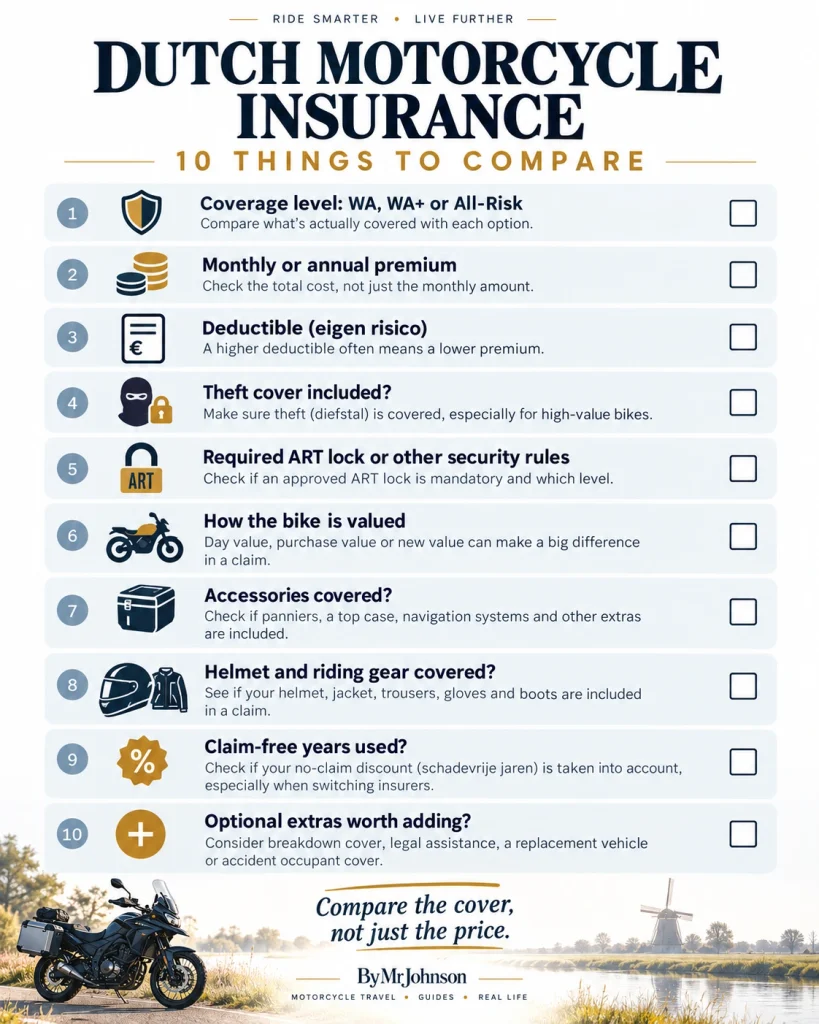
My Motorcycle Insurance Checklist
Before choosing a policy, these are the questions I would want answered.
Legal baseline
Is WA cover active from the moment the motorcycle becomes mine?
Coverage
Am I choosing:
WA,
WA+,
or All-Risk?
Theft
Is theft actually covered?
Security
Which ART lock or additional security system does the insurer require?
Own damage
What happens if I drop the motorcycle or cause the collision myself?
Value
Would theft or total loss be paid at:
purchase value,
new value,
or current market value?
Deductible
What is my eigen risico?
Accessories
How much aftermarket equipment is covered?
Gear
Are helmet and motorcycle clothing included?
Claim-free years
How many schadevrije jaren is the insurer using?
Optional extras
Do I genuinely need:
passenger cover,
legal assistance,
or other additions?
That is enough to make a much more informed comparison than simply sorting quotes from cheapest to most expensive.
Cheapest Is Not Always Cheapest
Imagine two policies.
Policy A
€18 per month.
Policy B
€26 per month.
Policy B costs:
€96 more per year.
If all you look at is the premium, Policy A wins.
But imagine Policy B also gives you a level of theft or own-damage protection you actually value, while Policy A doesn’t.
The real question becomes:
Is that additional protection worth €96 per year to me?
Sometimes yes.
Sometimes no.
There isn’t one answer.
That’s why insurance comparisons become much clearer when you convert the monthly difference into an annual number.
Five euros per month sounds small.
That’s €60 per year.
Twenty euros per month is €240.
Once I see the yearly difference, I find it easier to decide whether the extra coverage is solving a problem I actually care about.
Insurance and Security Are Two Different Layers
This is another distinction I think is worth making.
Insurance does not stop someone stealing the motorcycle.
A good lock doesn’t reimburse you after a total loss.
The two solve different problems.
Security tries to prevent or delay the incident.
Insurance reduces the financial consequences if the incident still happens.
For my own motorcycle, I prefer thinking in layers rather than expecting one product to solve everything.
Where I park.
How visible the motorcycle is.
Which locks I use.
How I attach it.
What the insurer requires.
And what happens financially if all of that still isn’t enough?
Check Out : Motorcycle Security in Amsterdam
What I Would Tell a New Motorcycle Owner in the Netherlands
Don’t wait until after buying the bike to start looking at insurance.
Before you hand over the money:
get several quotes.
Compare the same level of coverage.
Check the deductible.
Check theft requirements.
Check the valuation method.
Check your claim-free years.
Ask about previous overseas insurance history if you’re an expat.
And understand what is not covered.
That last point matters.
Insurance documents aren’t exciting.
But finding the exclusion after something has happened is much worse than reading it beforehand.
Final Thoughts
Motorcycle insurance in the Netherlands is simple at the legal minimum:
You need WA.
The decision becomes more personal after that.
WA asks you to carry most risks to your own motorcycle yourself.
WA+ can add protection against things such as theft, fire and weather-related damage.
All-Risk can extend that further to your own collision damage and other risks, depending on the policy.
None is automatically the “correct” choice.
The right level depends on:
your motorcycle,
its value,
your financial situation,
how it is used,
where it is kept,
and how much uncertainty you’re comfortable carrying yourself.
TITAN currently costs me €23 per month to insure.
That’s useful for understanding my ownership costs.
It isn’t useful as a universal Dutch MT-07 insurance price.
If you’re budgeting for your own motorcycle, get the actual quote before buying it.
Then read what that quote actually covers.
The cheapest policy is only good value if it covers the risks you intended to insure.
Ride safe and enjoy the journey.
FAQs
Is motorcycle insurance compulsory in the Netherlands?
Yes. A motorcycle registered in your name must normally have at least WA statutory liability insurance. A formally suspended vehicle is exempt from the normal WA obligation while the suspension remains active and the vehicle is kept off public roads.
What does WA motorcycle insurance cover?
WA primarily covers your legal liability for damage you cause to other people or their property. It does not generally cover damage to your own motorcycle when you caused the accident.
What is WA+ motorcycle insurance?
WA+ — usually called WA + Beperkt Casco — adds selected cover for your own motorcycle to the compulsory WA liability cover. Common examples include theft, fire, storm and animal collisions. Exact coverage varies by insurer.
What is All-Risk motorcycle insurance?
WA + Volledig Casco, generally called All-Risk, includes WA liability plus broader protection for your own motorcycle. Depending on the policy, this can include damage from an at-fault collision, falling and vandalism.
Do I need an ART lock for motorcycle insurance?
Not for basic WA simply because Dutch law requires the policy. However, insurers can impose lock requirements when theft is covered. For example, ANWB currently requires an ART-4 approved lock for its motorcycle theft coverage and can impose additional security conditions on certain motorcycles. Check your own policy.
How much does motorcycle insurance cost in the Netherlands?
There is no universal figure. Premiums can depend on the motorcycle, coverage, age, address, mileage and claim-free history. I personally currently pay €23 per month for TITAN, my 2021 Yamaha MT-07, but another rider’s quote may be completely different.
What are schadevrije jaren?
Schadevrije jaren are claim-free years used by Dutch motor insurers as part of their bonus/malus and pricing systems. They are recorded through Roy-data for motorcycle insurance and can follow you when changing insurer.
Do I need insurance if my motorcycle is suspended?
During an official RDW suspension, compulsory WA insurance is not required, but the motorcycle cannot be used or parked on public roads. You may still choose to keep certain insurance because theft or storage damage can still occur.
Related Reads
Buying a Used Motorcycle in the Netherlands: RDW Checks & Ownership Transfer
Motorcycling in the Netherlands: A Practical Guide for New & Expat Riders
What Does a Yamaha MT-07 Cost to Own in the Netherlands? My First-Year Numbers
Motorcycle Parking in Amsterdam: Rules, Paid Parking & Practical Tips