Amsterdam isn’t really where a Yamaha MT-07 gets to demonstrate how fast it can go.
Most of the time, that would be missing the point anyway.
This is a city of cyclists, trams, pedestrians, junctions, narrow streets, changing surfaces, unpredictable weather and moments where patience is far more useful than horsepower.
And that’s exactly why riding TITAN here has taught me so much.
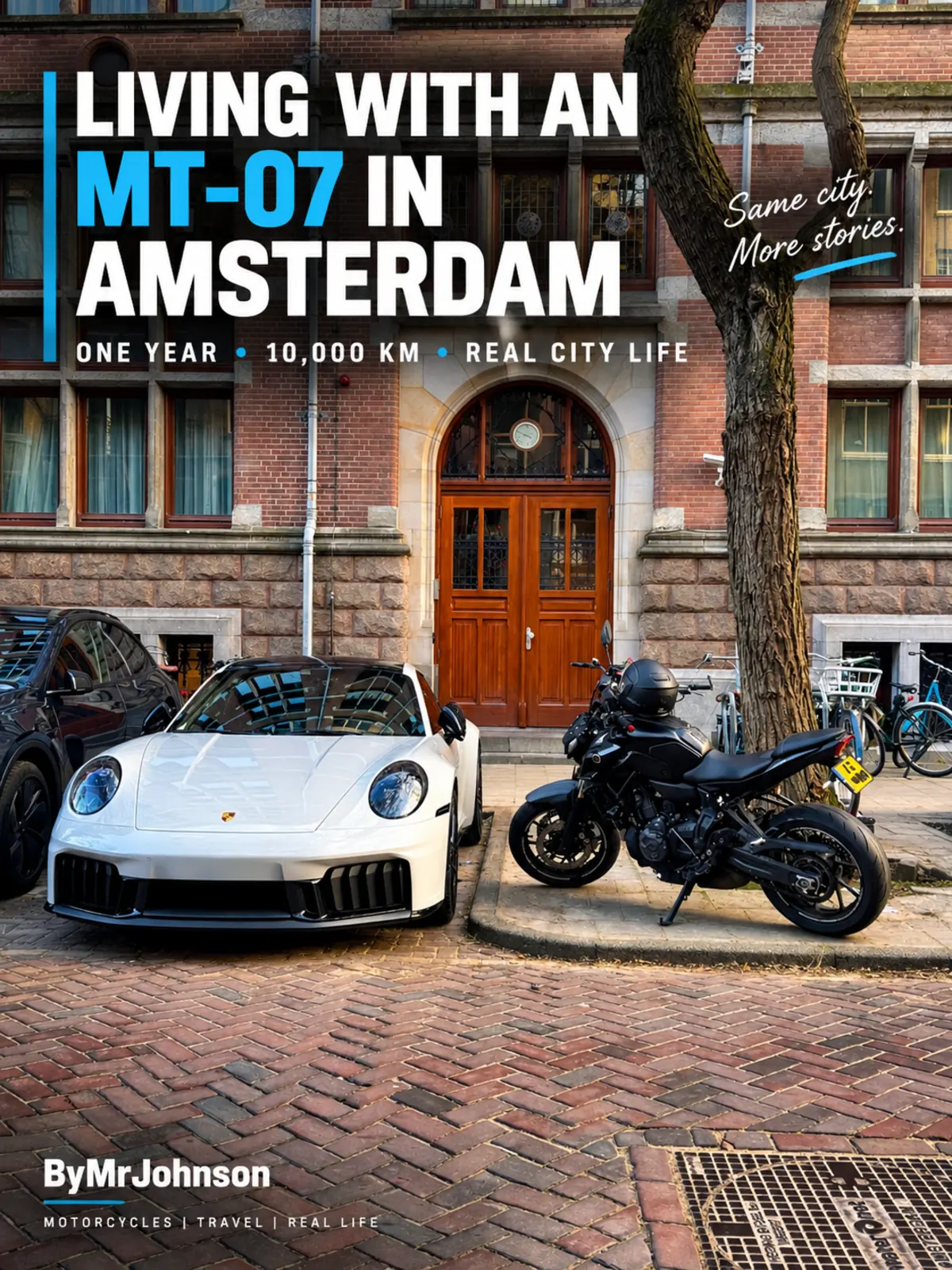
My 2021 Yamaha MT-07 now has around 30,500 km on the odometer. I bought it used at close to 20,000 km, which means I’ve ridden roughly 10,000 km during my first year of ownership.
Some of those kilometres have been weekend rides away from Amsterdam.
But a lot of motorcycle ownership happens in much less glamorous circumstances.
Going somewhere.
Coming home.
Traffic.
Rain.
Parking.
Short weekday rides.
Moving slowly through a city where something always seems to be happening around you.
And strangely, those ordinary rides are where I’ve learned to appreciate the MT-07 most.
Amsterdam changes what I value in a motorcycle
Before owning a motorcycle, it’s easy to focus on specifications.
Horsepower.
Torque.
Acceleration.
Top speed.
After riding regularly in Amsterdam, my questions have become different.
How easily can I manoeuvre the bike?
Can I see what traffic is doing?
Does the motorcycle feel awkward when everything slows down?
Can I place it precisely?
How tiring is it in stop-start conditions?
Can I comfortably use it for a normal weekday and still want to ride it somewhere interesting at the weekend?
Those aren’t exciting specification-sheet questions.
But they’re real ownership questions.
And for the way I live with TITAN, they’re more important.
The MT-07 feels like the right size for Amsterdam
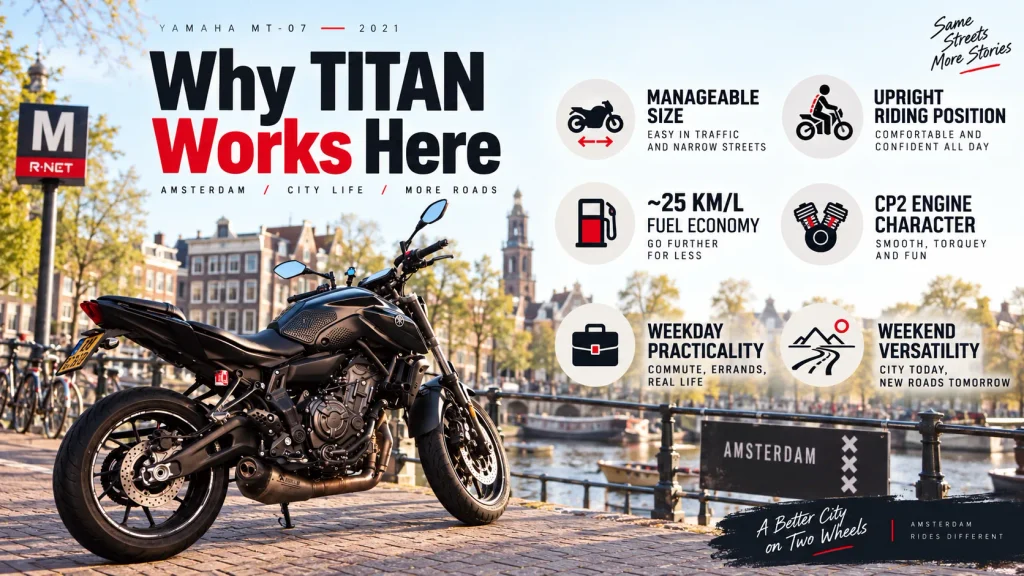
One of the main reasons TITAN works here is that the bike doesn’t feel unnecessarily large.
Yamaha lists the 2021 MT-07 at 184 kg wet, with an 805 mm seat height and overall width of 780 mm.
There are obviously smaller motorcycles.
There are much lighter ones.
But I find the MT-07 sits in a useful middle ground.
It feels like a full-size motorcycle without making every slow manoeuvre feel like work.
That’s important in Amsterdam.
You spend a lot of time below the speeds that motorcycle advertising usually talks about.
Moving out of a parking spot.
Turning tightly.
Stopping.
Starting again.
Waiting.
Navigating around other road users.
Finding somewhere sensible to leave the bike.
A motorcycle that feels manageable during those moments becomes a motorcycle you’re more likely to actually use.
That’s one of TITAN’s strongest qualities for me.
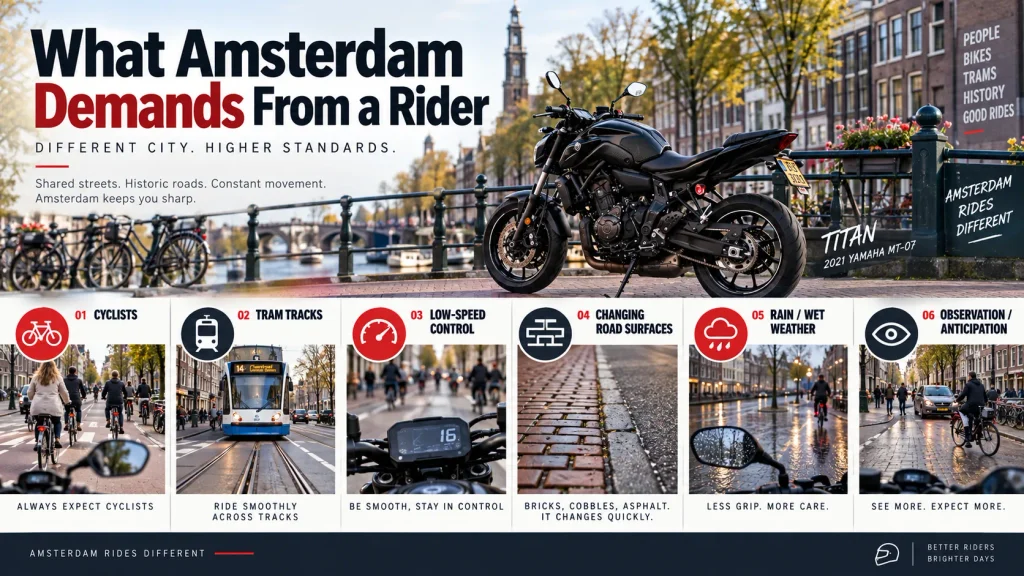
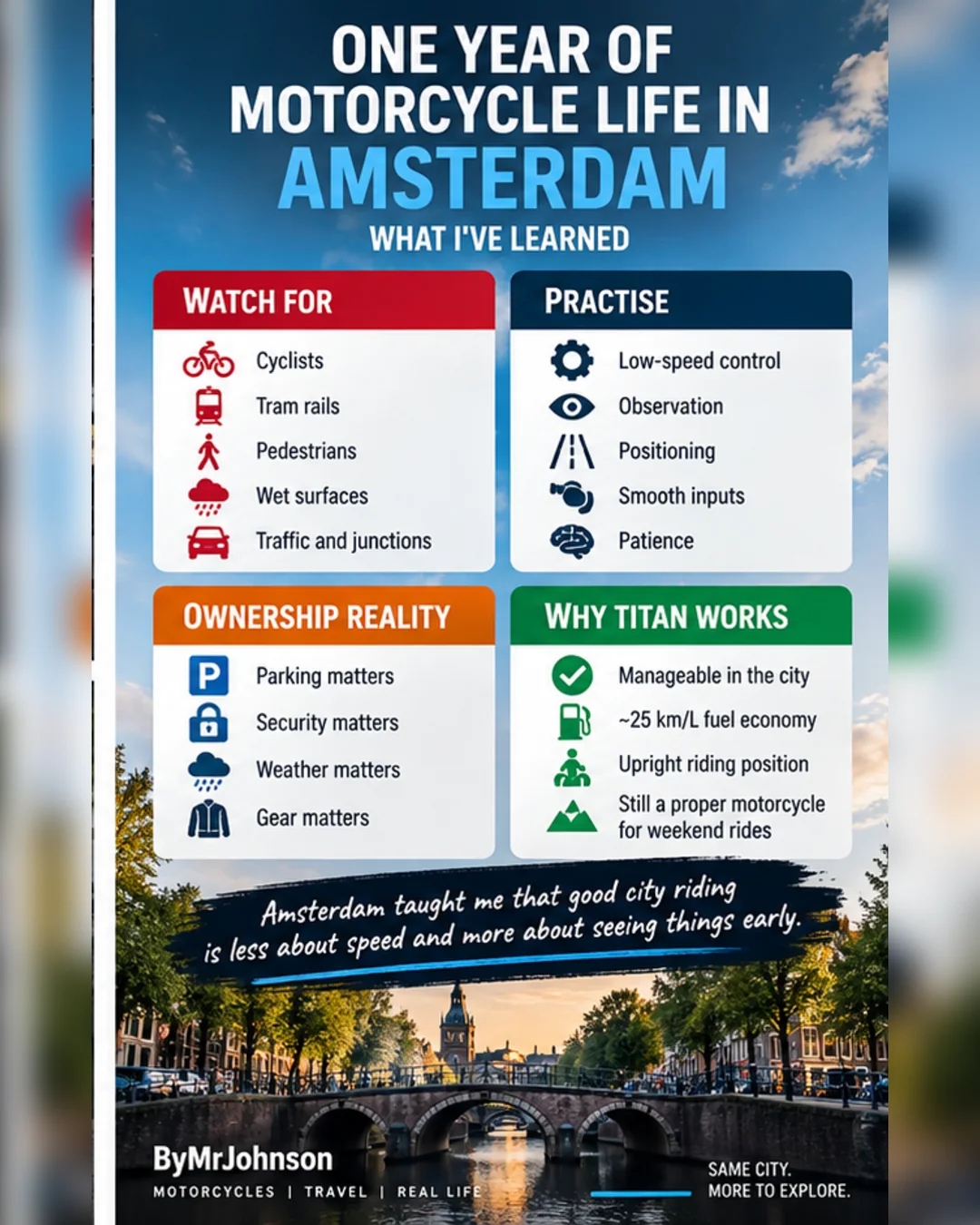
Cyclists change the way I ride
You cannot talk honestly about riding in Amsterdam without talking about bicycles.
They’re everywhere.
And that’s not a complaint.
Cycling is part of what makes the city what it is.
In-fact, I cover a lot of the city cycling through it as well.
But from a motorcycle, it means I need to think differently about what could happen next.
A cyclist may be beside me.
Approaching from behind.
Crossing ahead.
Moving around stopped traffic.
Turning.
Changing position.
Or simply occupying a part of my peripheral vision while I’m also watching cars, pedestrians and junctions.
The lesson for me has been simple:
Don’t expect everybody around you to behave like a car.
That sounds obvious.
In practice, it changes how I scan the road.
I try to look farther ahead.
I try to avoid putting myself where somebody has to notice me at the last second.
And I try not to treat having priority as a guarantee that somebody else has seen me.
City riding has made me much more interested in anticipation than reaction.
That’s something I’ve explored more deeply in my guide to motorcycle visibility in urban traffic and my article on riding safely in heavy traffic.
The motorcycle helps—but observation does more
The MT-07 gives me a useful platform.
The upright riding position makes it easy to keep my head up.
The bike feels compact enough to place accurately.
The engine responds without requiring constant gear changes.
But none of those things make Amsterdam simple.
A rider can still put a very manageable motorcycle in a bad position.
So I think less in terms of:
“Can TITAN fit through there?”
and more in terms of:
“If I go there, what options will I still have?”
That’s a more useful city-riding question.
Physical space isn’t necessarily safe space.
Tram tracks deserve respect
Amsterdam adds another surface that motorcyclists have to think about:
tram rails.
Dry metal and wet metal are not the same thing.
Neither are rails and normal asphalt.
The main thing I try to avoid is casually treating a rail as though it has the same grip as the road around it.
When I need to cross tracks, I want the motorcycle settled.
I want to cross at a sensible angle where possible.
And I don’t want to make unnecessary braking, throttle or steering inputs directly on a slippery metal surface.
This is especially important in wet weather.
The same basic principle applies to:
- road markings;
- manhole covers;
- metal plates;
- cobbles;
- leaves;
- gravel;
- other changes in surface grip.
The motorcycle doesn’t suddenly become dangerous because one of those surfaces appears.
But I need to recognise that the available grip may have changed.
My broader guide to riding on gravel, sand and slippery surfaces covers that mindset in more detail.
Rain changes Amsterdam quickly
Living here also means accepting that a dry ride can become a wet one.
That’s part of motorcycle life in the Netherlands.
And wet-weather riding changes more than grip.
Visibility changes.
Stopping distances change.
Painted markings become more interesting.
Tram tracks become more interesting.
Other road users may behave differently.
My visor becomes part of the problem.
And I become more conscious of whether my inputs are smooth.
One thing I’ve gradually learned is that riding in the rain becomes much less stressful when I stop treating rain itself as the emergency.
Slow things down.
Create space.
Be smooth.
Look farther ahead.
Give yourself time.
TITAN currently runs Michelin Road 6 tyres, and I’ve been happy using the bike through the mixture of conditions that comes with normal riding here.
But good tyres don’t cancel poor judgement.
I’ve written separately about wet-weather motorcycle riding because it deserves much more attention than a few paragraphs here.
Low-speed control matters constantly
Amsterdam has made me appreciate slow riding more than fast riding.
That probably isn’t the sentence I expected to write when I first became interested in motorcycles.
But city life contains a lot of:
clutch control
rear brake
balance
vision
tight turns
walking-speed movement
controlled stops
A rider who feels calm at 10 km/h is going to have a very different experience in a city from someone who only feels comfortable once the bike is moving quickly.
The MT-07 is a good motorcycle for practising those skills because it doesn’t feel overwhelmingly heavy.
But again, it doesn’t perform the technique for me.
I’ve spent time deliberately working on low-speed control because it makes ordinary riding easier.
If that’s something you’re building too, my low-speed motorcycle control guide contains the drills and techniques I focus on.
Sometimes the most satisfying ride isn’t fast
This is one of the things Amsterdam has changed in my riding mindset.
There are days when the satisfying part of a ride is not speed.
It’s reading a situation early.
Getting through busy traffic without feeling rushed.
Making a slow turn cleanly.
Stopping exactly where I intended.
Moving away smoothly.
Spotting a cyclist before their movement becomes a surprise.
Finding a calm rhythm when everything around me feels busy.
That might not produce the most dramatic motovlog footage.
But it’s riding.
And I increasingly enjoy getting those small things right.
Lane position becomes a moving decision
City riding also makes me think differently about lane position.
There isn’t one perfect position that works everywhere.
Sometimes I want more visibility.
Sometimes I want more space from a vehicle.
Sometimes I want to stay away from a door zone.
Sometimes the road surface determines where I want the tyres.
Sometimes another road user changes the situation completely.
So I try to think about position as something active.
Not:
“Motorcycles belong here.”
But:
“Where gives me the best combination of visibility, space and options right now?”
That’s the approach behind my full guide to motorcycle lane positioning.
Parking is part of Amsterdam motorcycle life
This is one of the parts of owning a motorcycle in a city that doesn’t appear in road tests.
Eventually you have to stop riding.
And then you need somewhere sensible to put the motorcycle.
There is an important current legal distinction in Amsterdam.
The city’s APV explanation specifically notes that motorcycles do not fall under the pavement-parking rules that apply to bicycles and mopeds. Motorcycles are treated as motor vehicles, and the pavement is not simply a legal motorcycle parking space.
That’s worth understanding because looking around Amsterdam can sometimes give a different impression.
You’ll see motorcycles parked in all sorts of places.
But:
“I’ve seen somebody else do it” is not the same thing as “this is definitely permitted.”
I prefer to look at the actual location, signs and current rules rather than assume every convenient piece of pavement is motorcycle parking.
I’ll make Amsterdam motorcycle parking its own article because this subject deserves more precise treatment than I can give it here.
Blue zones have a useful motorcycle exception
One Amsterdam-specific detail worth knowing is that the city currently allows two-wheeled motorcycles to park in a blue zone without using a blue parking disc.
That’s one of those small practical rules that’s useful to know but easy to miss.
The bigger lesson remains the same:
Parking rules can depend on the exact location.
Check rather than assume.
P+R is also available to motorcycles
Amsterdam’s city information specifically states that you can park a car or motorcycle at its P+R locations and continue into the centre by public transport under the P+R system and its conditions.
That’s probably more relevant to someone visiting Amsterdam by motorcycle than it is to my normal weekday riding, but it’s a useful option to know exists.
Especially if someone doesn’t want to bring their motorcycle deep into the city centre.
Security becomes part of the routine
City ownership also means I don’t think about parking without thinking about security.
I’ve bought both a chain lock and a disc lock during my first year.
That’s money I might not have thought about before owning a motorcycle.
Now it simply feels like part of the system.
Where am I leaving TITAN?
For how long?
What can I lock it to?
How visible is the location?
Do I want the motorcycle covered?
None of that is unique to an MT-07.
It’s city motorcycle ownership.
And it’s one reason a motorcycle that seems inexpensive to buy can create several hundred euros of extra setup costs fairly quickly.
My first-year MT-07 running-cost breakdown includes those kinds of expenses alongside fuel, maintenance, tax and insurance.
Amsterdam’s zero-emission zone currently doesn’t apply to motorcycles
This is another distinction worth making because “scooter”, “moped” and “motorcycle” often get mixed together in casual conversation.
Amsterdam currently has a zero-emission zone covering mopeds and motor scooters, with transition rules for older vehicles.
But the City of Amsterdam explicitly states:
there is currently no low-emission or zero-emission zone for motorcycles.
So TITAN, as a petrol Yamaha MT-07, isn’t currently restricted by that motorcycle-specific emission rule.
That may change in future policy, which is why I would always verify the current Amsterdam rules rather than treating this paragraph as permanent.
Local-rule information checked September 2026.
The city makes me appreciate TITAN’s simplicity
There are motorcycles with much more technology than my 2021 MT-07.
More riding modes.
More screens.
More electronic adjustment.
For city riding, I rarely find myself wishing TITAN had more menus.
The controls are simple.
The riding position is straightforward.
The engine is flexible.
I get on and ride.
That simplicity works especially well when the road around me is already supplying enough information.
Cyclists.
Traffic lights.
Cars.
Pedestrians.
Tram rails.
Road signs.
Surfaces.
Navigation.
I don’t particularly want the motorcycle itself demanding much mental attention on top of that.
Fuel economy suits city ownership
TITAN has been averaging approximately:
25 km/L
or around:
4.0 L/100 km
Across my first roughly 10,000 km, I’ve spent about €998 on fuel.
That works out to roughly:
€10 per 100 km
For me, that makes fuel relatively easy to budget.
Short city rides accumulate kilometres slowly.
Weekend rides accumulate them much faster.
The same motorcycle handles both without fuel consumption becoming something I resent.
I’ve broken the full numbers down in my MT-07 fuel economy and range guide.
But Amsterdam isn’t where the MT-07 is most fun
This is an important distinction.
The MT-07 works extremely well here.
That’s not quite the same as saying the city is where I enjoy the motorcycle most.
The CP2 engine has more character than urban speeds usually allow me to explore.
The bike becomes a different experience when traffic thins.
When there is more space.
When I can concentrate less on congestion and more on the road itself.
That’s where weekday practicality becomes weekend fun.
And that’s probably the strongest reason TITAN makes sense to me.
The city bike and the weekend bike are the same motorcycle
This is where the MT-07 wins for my use.
I don’t need one motorcycle for getting around Amsterdam and another one for enjoying motorcycling.
TITAN can deal with:
weekday city life
and then:
weekend getaways
without either role feeling ridiculous.
A scooter would probably beat the MT-07 on pure city practicality.
A larger touring motorcycle would beat it on long-distance comfort.
A sportier bike might offer more performance.
But motorcycle ownership doesn’t happen in isolated comparison categories.
I have one motorcycle.
And it needs to fit my actual life.
The MT-07 does that remarkably well.
Leaving Amsterdam is part of Amsterdam motorcycle life
One of my favourite things about owning a motorcycle in the city is actually being able to leave it.
Amsterdam is home.
But the bike changes my relationship with the area around it.
A free afternoon becomes:
Where could I go?
A weekend becomes an excuse to get farther away.
And suddenly the city isn’t only somewhere I ride inside.
It’s my starting point.
That feels like an important part of this new Amsterdam Rider Life section of ByMrJohnson.
I don’t want it to become:
“Here are 17 tourist things to do in Amsterdam.”
I’m much more interested in:
What does this city feel like when motorcycle ownership becomes part of your normal life?
TITAN gives me a way to explore that.
The bike has also changed how I see Amsterdam
You notice different things from a motorcycle.
Road surfaces become interesting.
Parking becomes interesting.
Weather forecasts become interesting.
Wind becomes interesting.
The way traffic moves becomes interesting.
A street you have travelled many times becomes a completely different experience when you’re thinking about visibility, grip and escape space.
Motorcycling hasn’t made Amsterdam simpler.
It has made me pay more attention to it.
And I think that’s a good thing.
What I would tell someone planning to ride in Amsterdam
Don’t arrive expecting the city to behave like an open road.
Give yourself time.
Expect cyclists.
Expect pedestrians.
Expect surface changes.
Respect tram tracks.
Don’t let somebody behind you rush your decision.
Think about parking before you arrive rather than after.
And don’t confuse being on a small, manoeuvrable motorcycle with being entitled to every available gap.
The goal isn’t to conquer the city.
It’s to move through it smoothly.
That’s a very different mindset.
Is the MT-07 a good motorcycle for Amsterdam?
For me:
Yes.
Not because Amsterdam requires 73 horsepower.
It doesn’t.
The reasons are much less dramatic.
The MT-07 is:
- manageable;
- relatively compact;
- upright;
- easy to use slowly;
- economical;
- responsive without needing high revs;
- simple enough for everyday use;
- interesting enough that I still want to ride it once the city ends.
That’s the combination that matters.
What are the compromises?
Amsterdam also exposes the things the MT-07 doesn’t do particularly well.
There is little built-in storage.
Weather protection is minimal.
A city security setup costs money.
The suspension isn’t especially luxurious over poor surfaces.
And a motorcycle will never have the pure urban convenience of a bicycle, scooter or public transport in every situation.
That’s fine.
I don’t need TITAN to be the objectively most efficient way to cross Amsterdam.
I need it to be a motorcycle I enjoy owning that can still function here.
It does.
One year later, Amsterdam and TITAN make more sense together
When I bought my MT-07, I was thinking about the motorcycle.
A year later, I think much more about the relationship between the motorcycle and the place where I ride it.
Amsterdam has probably taught me more about patience, observation and low-speed control than outright performance.
TITAN has taught me that a motorcycle doesn’t need a perfect road to be enjoyable.
Sometimes ownership is the ride away from the city.
Sometimes it’s the ride through it.
Sometimes it’s just seeing your motorcycle parked somewhere familiar and thinking:
I’m glad I rode today.
That’s the version of Amsterdam motorcycle life I want to keep exploring.
FAQs
Is Amsterdam good for motorcycle riding?
Amsterdam can work well for motorcycles, but the riding environment is busy. Cyclists, pedestrians, trams, junctions, changing road surfaces and dense traffic mean observation and low-speed control matter more than performance.
Is the Yamaha MT-07 good for Amsterdam?
For my use, yes. Its manageable size, upright position, usable engine and roughly 25 km/L fuel economy make it well suited to city riding while still being enjoyable on weekend rides outside Amsterdam.
Can motorcycles park on the pavement in Amsterdam?
Amsterdam’s current APV explanation distinguishes motorcycles from bicycles and mopeds. Motorcycles are treated as motor vehicles and are not simply permitted to park on the pavement. Always check the rules and signs for the exact location.
Do motorcycles need a blue parking disc in Amsterdam blue zones?
Amsterdam currently states that two-wheeled motorcycles may park in a blue zone without using a blue parking disc.
Does Amsterdam’s zero-emission zone apply to motorcycles?
Not currently. The City of Amsterdam states that there is presently no low-emission or zero-emission zone for motorcycles. The existing rules discussed by the city apply to mopeds and motor scooters.
Can motorcycles use Amsterdam P+R?
Yes. Amsterdam’s P+R information explicitly states that cars and motorcycles can use its P+R locations, subject to the applicable conditions.
What should motorcycle riders watch for in Amsterdam?
My main concerns are cyclists, pedestrians, dense traffic, tram rails, slippery surfaces, wet weather, positioning and parking. Smooth low-speed control and good observation are much more useful than trying to ride quickly.
Related Reads
Continue with:
Is the Yamaha MT-07 Good for Commuting and City Riding?
Riding in Heavy Traffic: Safety Tips for Urban Motorcyclists
Motorcycle Visibility Tips for Urban Riders
Wet Weather Motorcycle Riding Tips
This article is also the beginning of something new on ByMrJohnson.
Amsterdam Motorcycle Life.
I’ll move deeper into the practical side of owning and riding a motorcycle here – parking, security, city habits and the small things you only really notice once a motorcycle becomes part of everyday Amsterdam life.
Amsterdam rules referenced in this article were checked in September 2026. Local traffic, parking and emission-zone rules can change, so verify current information with the City of Amsterdam when it affects a specific journey or parking decision.