Being visible on a motorcycle involves more than wearing a fluorescent vest.
A bright jacket may help you stand out. A working headlight may make the motorcycle easier to notice. A good lane position may place you directly inside a driver’s field of view.
None of these measures guarantees that another road user has seen you.
That is especially important in urban traffic, where drivers are also processing traffic lights, cyclists, pedestrians, parked vehicles, delivery vans, road signs and navigation instructions.
A driver may look in your direction without fully recognising the motorcycle or correctly judging how quickly you are approaching.
The safest strategy is therefore not to rely on one visibility trick.
Use several layers together: make the motorcycle easy to notice, position yourself where drivers are more likely to see you and keep enough space to react when they do not.
This guide explains practical motorcycle visibility tips for junctions, blind spots, traffic queues, filtering and low-light urban riding.
Quick Answer
How Can Motorcyclists Be More Visible?
To make yourself easier to notice in urban traffic:
- Check that all motorcycle lights and reflectors work correctly.
- Use clothing or helmet colours that contrast with the surroundings.
- Add reflective details for darkness and poor weather.
- Choose lane positions that place you inside drivers’ mirrors and sight lines.
- Avoid remaining beside another vehicle.
- Reduce your speed near junctions and side roads.
- Create enough following distance to see and be seen.
- Signal early and cancel your indicators after turning.
- Keep your speed low and predictable while filtering.
- Never depend on eye contact as proof that a driver has seen you.
Visibility helps other people notice you. Defensive riding protects you when they still do not.
Why Motorcycles Are Easy to Miss in Traffic
Motorcycles have a much smaller visual profile than cars, vans and buses.
From the front, another road user may see only the headlight, front wheel, handlebars and rider. This smaller shape can be difficult to separate from a visually busy background.
Drivers may also find it harder to judge a motorcycle’s:
- Distance
- Closing speed
- Position within the lane
- Intended direction
- Available stopping distance
Urban surroundings add more distractions.
A motorcycle may temporarily blend into parked vehicles, street furniture, shadows, shopfronts or headlights behind it. The rider may also disappear behind a car’s mirror, windscreen pillar or passenger.
This is why visibility must include more than brightness.
You need to consider contrast, movement, road position, timing and the possibility that you have not been recognised at all.
1. Treat Visibility as a Complete System
There is no single accessory that makes a motorcyclist completely visible.
A fluorescent vest cannot prevent you from entering a blind spot.
A powerful headlight cannot force a distracted driver to check properly.
A good lane position cannot help when you approach too quickly for another road user to judge your speed.
Build visibility through several connected habits:
- Motorcycle lighting
- Contrasting riding gear
- Reflective materials
- Lane position
- Speed management
- Following distance
- Clear signals
- Defensive observation
Each layer supports the others.
The objective is not to assume that everyone will see you. It is to increase the chance of being noticed while preserving an escape option when you are not.
2. Check Your Lights Before Riding
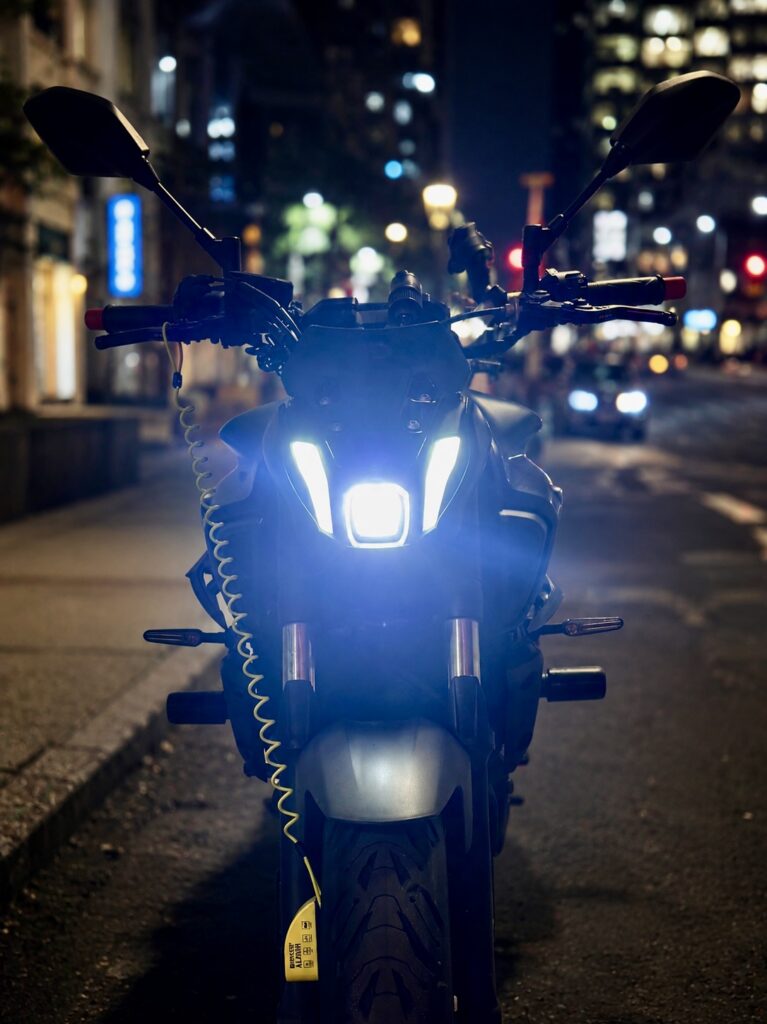
Your motorcycle’s lighting is one of its most visible features.
Before leaving, check:
- Headlight or daytime running light
- Rear light
- Brake light
- Front indicators
- Rear indicators
- Number-plate light
- Reflectors
- Auxiliary lights, when legally fitted
Do not assume that a light works simply because it worked during the previous ride.
Stand behind the motorcycle and operate both brake controls separately. Confirm that the brake light responds to the front brake lever and rear brake pedal.
Check that indicators flash clearly and cancel them after the test.
Clean dirty lenses. Road spray, dust and insects can reduce the amount of light reaching other road users.
A headlight that works but is badly adjusted may also be less useful. It can point too low, reducing its visible range, or too high, creating glare.
Include these checks in your regular routine using the Free Motorcycle Pre-Ride Safety Checklist.
3. Use Contrast Rather Than Relying on One Colour
High-visibility equipment can make a rider easier to separate from the background, but the most effective colour depends partly on the surroundings.
A bright yellow jacket may stand out against dark buildings and vehicles.
A white or brightly coloured helmet may create contrast above the roofline of nearby cars.
Reflective panels become more useful when headlights shine towards them in darkness or poor visibility.
However, no colour works equally well against every background.
Bright yellow can blend into sunlit vegetation. White can disappear against a bright sky. Dark clothing can merge into shadows, wet roads or dark vehicles.
You do not need to replace all your gear with fluorescent equipment.
Practical upgrades can include:
- A light-coloured helmet
- Reflective panels on a jacket
- Reflective details on a backpack
- A high-visibility waterproof layer
- Contrasting gloves or sleeves
- Reflective sections on boots or trousers
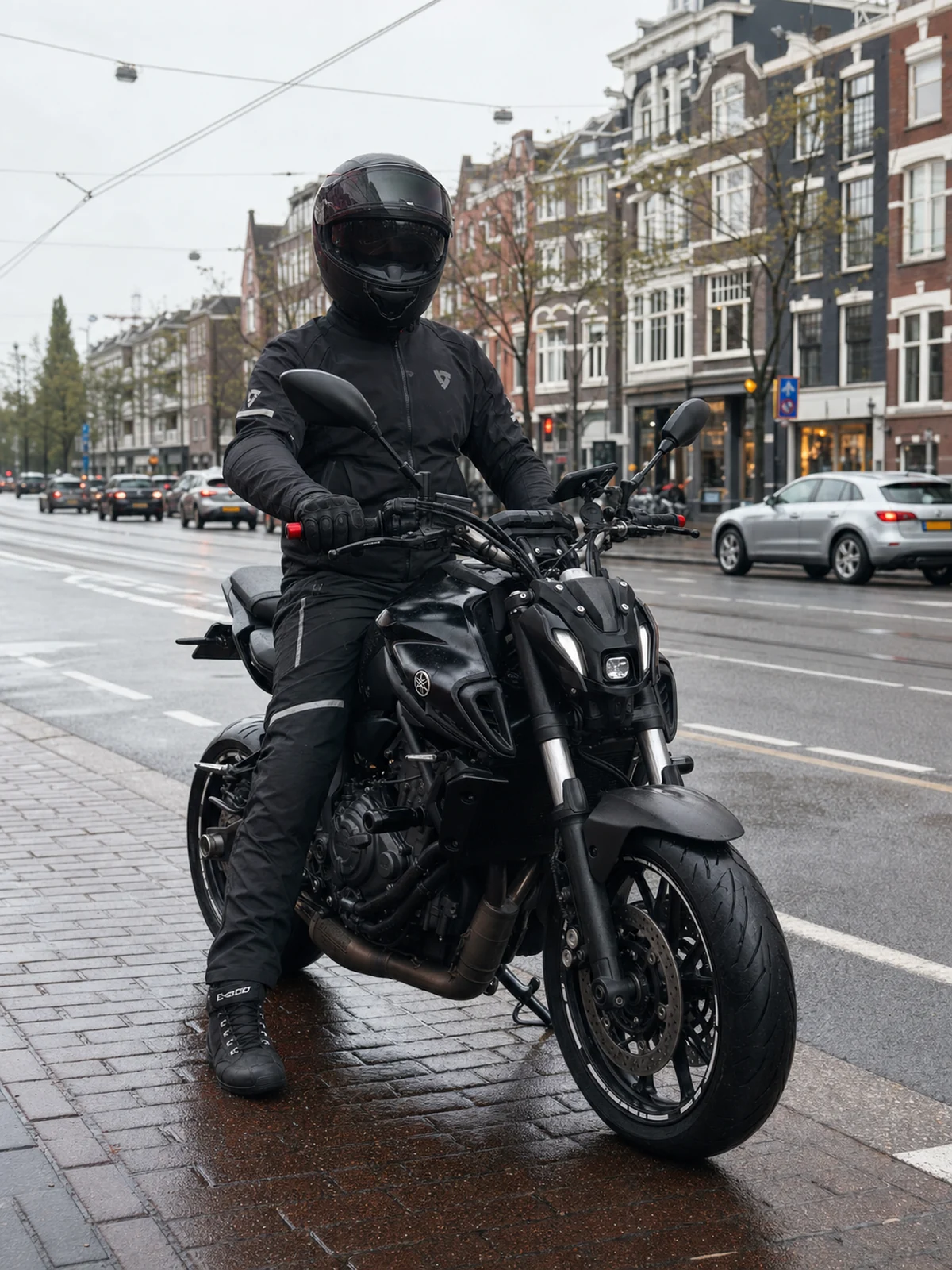
Protection still comes first. Choose properly fitting, protective motorcycle equipment rather than wearing an unsuitable bright garment only for its colour.
Read Motorcycle Safety Gear Explained: What Each Piece Actually Does for more guidance on balancing protection, comfort and visibility.
4. Choose a Lane Position That Helps Drivers See You
Your position within the lane can determine whether you appear clearly in a mirror or disappear behind another vehicle.
Avoid automatically riding in the centre, left or right part of every lane.
Instead, ask:
- Can the driver ahead see me in a mirror?
- Am I hidden behind the vehicle in front?
- Can a driver waiting at a side road see me?
- Am I beside a windscreen pillar or door mirror?
- Do I have space to move if someone changes lane?
- Can I see far enough ahead to identify developing hazards?
When following a car, position yourself where you can see the driver’s side mirror when conditions allow. This does not prove that the driver has noticed you, but it creates a clearer possible line of sight.
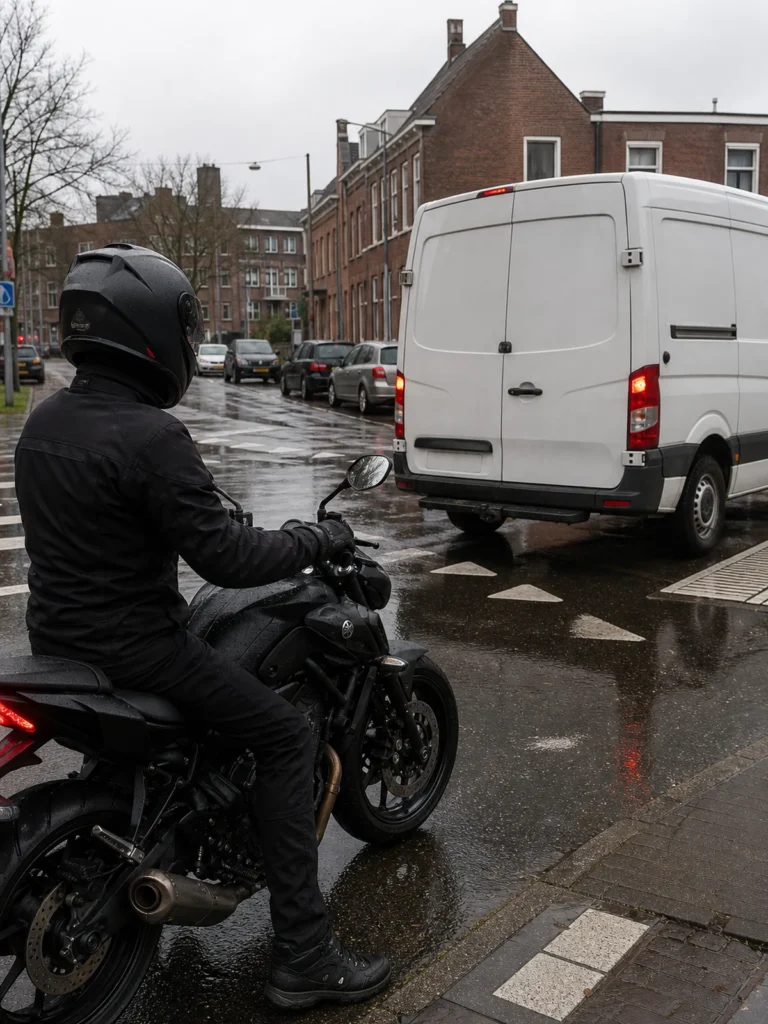
Avoid following directly behind a large van, bus or truck. The vehicle blocks your view, and other road users may not realise that a motorcycle is travelling behind it.
Move only when the new position improves both visibility and safety.
Do not ride over slippery markings, debris or poor road surfaces merely to become more visible.
For a complete explanation of flexible road positioning, read Lane Positioning for Motorcyclists.
5. Create a Clearer View at Junctions
Junctions are one of the most important places to think about motorcycle visibility.
Watch for:
- Cars waiting to turn across your path
- Vehicles emerging from side roads
- Drivers turning through gaps in traffic
- Cyclists crossing from both directions
- Pedestrians stepping between parked vehicles
- Vehicles making sudden U-turns
- Drivers leaving parking spaces
Approach with a speed that gives both you and the other road user time.
Where the road layout allows, adjust your lane position slightly to create a clearer angle between you and the waiting driver. This may help separate the motorcycle from vehicles or objects behind you.
The movement should be controlled and purposeful.
Do not make dramatic weaving movements, cross lane boundaries or sacrifice your escape space simply to attract attention.
Cover the brakes, identify where the vehicle may move and prepare to slow down.
Look at the vehicle’s wheels as well as the driver. A wheel beginning to rotate may reveal movement before the entire vehicle appears to move.
Most importantly, do not continue at full speed because you believe you have made eye contact.
The driver may be looking through you, past you or towards another hazard.
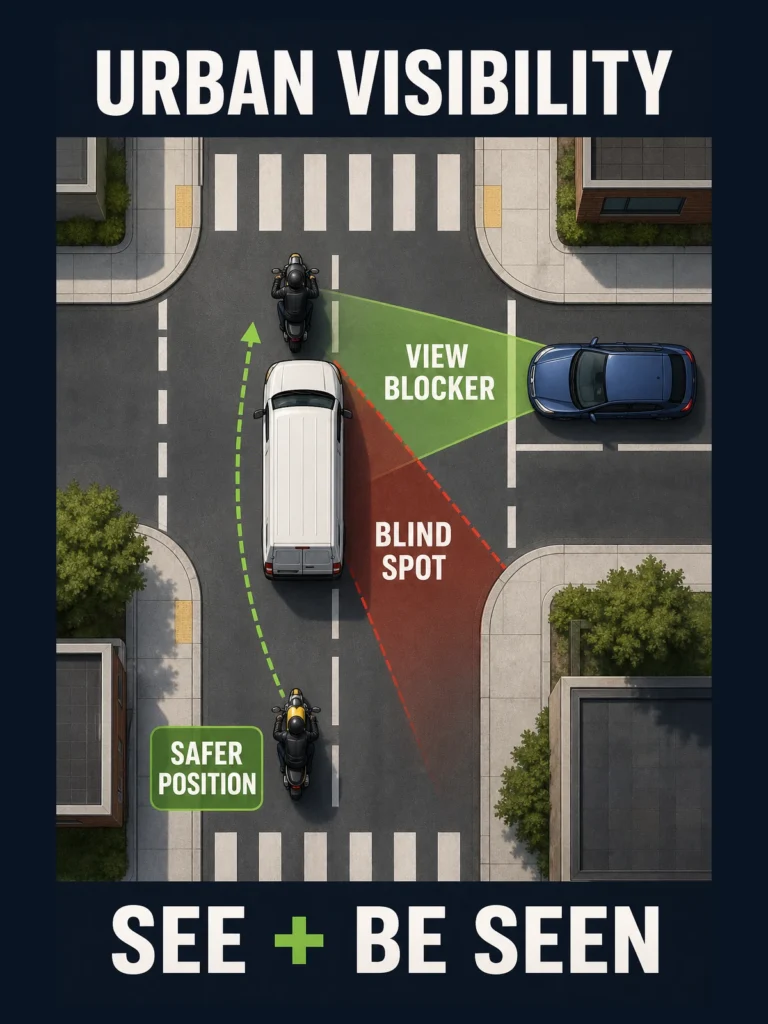
6. Avoid Riding in Blind Spots
A motorcycle can disappear beside a car even when the rider feels physically close to the driver.
Common blind zones include:
- Beside the rear doors
- Near the rear corner of a vehicle
- Alongside vans without rear side windows
- Close beside trucks and buses
- Directly behind large vehicles
- Beside a vehicle while it approaches a junction
Do not remain beside another vehicle longer than necessary.
Either stay far enough behind to maintain space or pass smoothly when the lane, speed limit and traffic conditions allow it.
Be especially cautious when a vehicle could:
- Change lane
- Turn into a side road
- Enter a parking space
- Move around an obstruction
- Avoid a cyclist
- Follow a navigation instruction
- React to a closing lane
A vehicle does not need to show an indicator before it begins moving.
Watch its position within the lane, front-wheel direction and the available gaps ahead.
7. Use Speed to Give People Time to See You
Visibility is partly about time.
A driver may see a motorcycle but still misjudge how quickly it is approaching.
Higher speed reduces the time available for the driver to recognise you, understand the situation and make a safe decision. It also reduces your time to respond when they make the wrong one.
Slow down before:
- Junctions
- Pedestrian crossings
- Roundabouts
- Queues
- Side roads
- Parked vehicles
- Tram stops
- Bus stops
- School areas
- Narrow urban streets
Do not wait until a vehicle begins moving before reducing your speed.
A small, early speed reduction can preserve far more reaction time than a hard braking response later.
Choose a pace that allows you to stop within the distance you can see and keep a larger safety margin where another road user may enter your path.
8. Create Following Distance to See and Be Seen
Following distance supports visibility in two directions.
It helps you see beyond the vehicle ahead, and it gives other road users a better chance of seeing you as a separate vehicle.
When you follow too closely:
- The vehicle ahead blocks your view
- Oncoming drivers may not see you
- Drivers at side roads may assume there is nothing behind the car
- You have less time to react to sudden braking
- You may be hidden from mirrors
- Escape routes become smaller
Increase the gap in rain, darkness, heavy traffic or poor visibility.
A larger gap also allows you to choose a more useful lane position without constantly reacting to the vehicle directly in front.
Avoid filling every space that opens in traffic. A clear gap is not wasted road. It is time, vision and manoeuvring space.
This is one of the central habits covered in the Beginner’s Guide to Defensive Motorcycle Riding.
9. Signal Clearly and Predictably
Other road users should not have to guess what you are about to do.
Signal early enough to communicate your intention, but not so early that the signal could be mistaken for a different turn.
Before changing position:
- Check your mirrors.
- Check the relevant blind spot.
- Signal clearly.
- Confirm that the space remains available.
- Move smoothly.
- Cancel the indicator.
Motorcycle indicators do not always cancel automatically.
An indicator left flashing after a turn can invite another driver to pull out, turn across your path or assume that you are leaving the road.
Include a quick indicator check after every junction until cancellation becomes an automatic habit.
Avoid sudden lane changes that place you in front of a vehicle before the driver has had time to register your presence.
10. Be Especially Careful While Filtering
Filtering can place a motorcycle where drivers do not normally expect another vehicle.
Keep your speed low enough to respond to:
- A car changing lanes
- A passenger opening a door
- A pedestrian crossing between vehicles
- A cyclist moving through the queue
- A delivery rider changing position
- A gap opening near a side road
- A bus moving away from a stop
Avoid filtering beside a vehicle when there is a gap ahead that it could enter.
The open space may look useful to you, but it may also attract a driver who has not checked for a motorcycle.
Watch mirrors and front wheels. Leave extra space beside vans, trucks and buses because their drivers may have more limited visibility.
Do not assume that a loud exhaust, headlight or high-visibility jacket makes fast filtering safe.
Your speed difference is one of the most important factors you can control.
Read Riding a Motorcycle in Heavy Traffic for a wider strategy covering queues, filtering, escape space and urban observation.
11. Use Your Brake Light Deliberately
Your brake light helps tell following traffic that your speed is changing.
Begin slowing early and progressively where possible. This gives the driver behind more time to notice the brake light and respond.
Check your mirrors before slowing sharply.
When traffic ahead becomes uncertain, create space before you need it rather than repeatedly making last-second stops.
At a red light or stationary queue:
- Keep the motorcycle in a stable position
- Watch approaching traffic in your mirrors
- Leave space in front when possible
- Keep an escape direction available
- Avoid stopping directly behind the centre of a large vehicle
Once following traffic has clearly stopped behind you, you can reduce some of your attention on the mirrors and refocus on the junction.
Do not depend on the brake light alone. A distracted driver may still fail to react.
12. Avoid Visual Camouflage
A motorcycle can become difficult to notice when it lines up with objects of a similar colour or brightness.
Examples include:
- A dark motorcycle against a dark van
- A black jacket in the shadow of a building
- A headlight blending with headlights behind it
- A rider hidden against roadside signs
- A motorcycle aligned with parked vehicles
- A rider disappearing in road spray
You cannot control every background, but you can often adjust your position slightly.
Moving within your lane may separate your outline from the object behind you. A small change in position can create clearer contrast without requiring a sudden manoeuvre.
Think about what the other road user sees, not only what you can see.
A clear view of the driver does not always mean the driver has a clear view of you.
13. Adapt for Darkness, Rain and Low Sun
Visibility changes quickly when light and weather change.
In darkness, reflective material becomes more useful because it returns light towards its source.
During rain, road spray can hide the motorcycle and reduce the contrast between vehicles.
Low sun can place you directly inside another road user’s glare.
When visibility deteriorates:
- Reduce your speed
- Increase following distance
- Use the correct motorcycle lighting
- Keep your visor clean
- Avoid riding beside vehicles
- Wear an outer layer with visible or reflective details
- Move away from heavy road spray
- Expect drivers to react later
- Avoid unnecessary overtaking
Check that waterproof clothing does not cover the reflective sections of your normal riding gear.
A bright summer jacket provides little benefit when it is hidden under a completely dark rain layer.
For more detailed low-light guidance, read Night Riding Safety: How to Ride a Motorcycle Safely After Dark.
14. Be Visible From the Side
Motorcycle visibility discussions often focus only on the headlight.
However, urban traffic can approach from several directions.
At junctions, roundabouts and crossings, another road user may see the motorcycle mainly from the side.
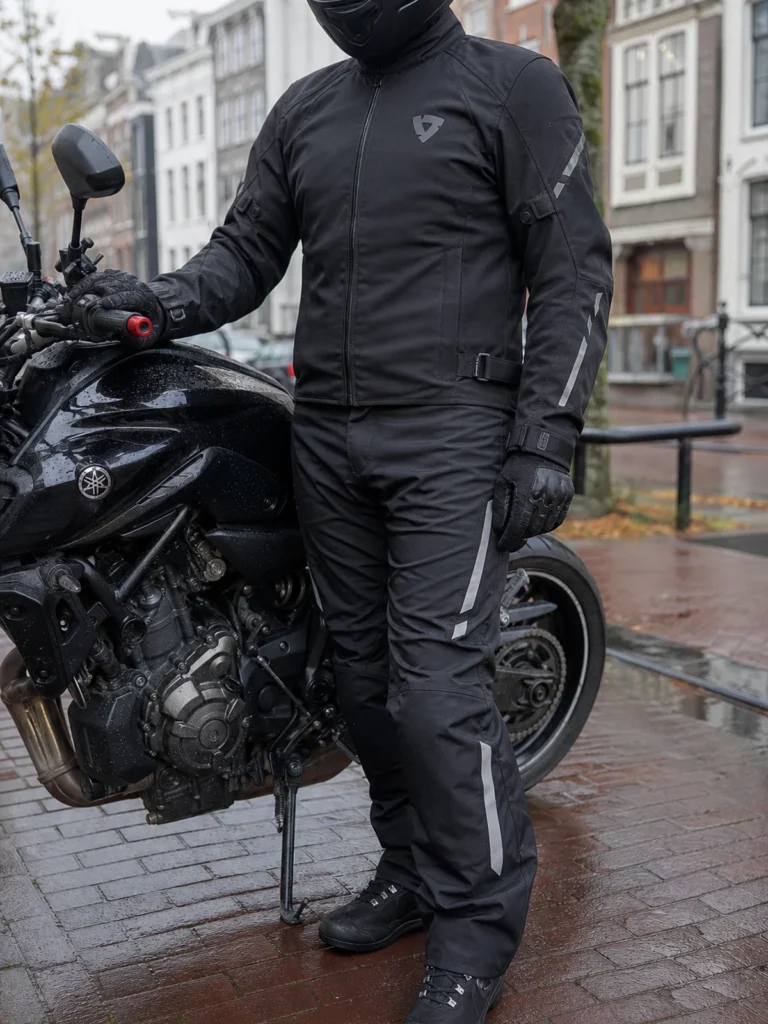
Side visibility can be improved through:
- Reflective jacket panels
- Contrasting sleeves
- Reflective wheel or motorcycle details where legally permitted
- Visible side indicators
- A clear position at junctions
- Avoiding obstruction by vans and parked vehicles
Do not stop so far forward that you enter another traffic stream, but avoid hiding completely behind a larger vehicle when a safer visible position is available.
Side visibility is especially important near cycle lanes, tram stops and multilane junctions where different road users may cross your route.
15. Do Not Assume Eye Contact Means You Are Safe
Eye contact can be useful information, but it is not a guarantee.
You may not be able to tell whether the driver is looking:
- At you
- Past you
- At a traffic signal
- At another vehicle
- Into a mirror
- Towards a pedestrian
- At a navigation screen
Treat eye contact as one small part of the situation.
Look for additional evidence:
- Has the vehicle fully stopped?
- Are the wheels still moving?
- Is the driver’s path clear?
- Is there a gap they may try to enter?
- Is the vehicle angled towards your lane?
- Has the driver begun releasing the brake?
- Do you have space to stop or move away?
Continue only when the situation gives you a reasonable safety margin.
Being seen is helpful.
Being prepared for someone who has not seen you is safer.
Common Mistakes
| Mistake | Why It Creates Risk | Better Habit |
|---|---|---|
| Relying only on a high-visibility vest | Bright clothing cannot prevent blind spots or poor observation | Combine visible gear with position, speed and space |
| Assuming the headlight guarantees visibility | Drivers may still fail to notice or judge the motorcycle correctly | Ride defensively even with the light on |
| Staying beside another vehicle | Places the motorcycle in a blind zone with little escape space | Pass smoothly or remain farther behind |
| Following too closely | Hides the motorcycle and reduces forward vision | Create a larger following gap |
| Riding directly behind a van or bus | Blocks your view and hides you from other traffic | Move to a safer visible position |
| Approaching junctions too quickly | Gives drivers less time to recognise your speed | Reduce speed before reaching the conflict point |
| Trusting eye contact | The driver may be looking elsewhere or through you | Confirm the vehicle’s movement and keep an escape option |
| Leaving an indicator flashing | May cause another driver to misread your intentions | Check indicator cancellation after every turn |
| Filtering too quickly | Reduces the time available to react to doors, gaps and lane changes | Keep the speed difference low and predictable |
| Wearing reflective material only underneath another layer | The useful material is no longer visible | Make the outermost layer conspicuous |
| Sitting in one lane position automatically | The position may hide you in traffic | Adjust according to mirrors, sight lines and hazards |
| Using aggressive weaving to attract attention | Creates unpredictable movement and may reduce control | Use small, purposeful positioning changes |
| Assuming a loud exhaust makes you visible | Sound direction and driver attention are unreliable | Depend on positioning, lighting and defensive space |
| Riding in road spray | Reduces contrast and hides you from following traffic | Increase distance or change position safely |
| Treating visibility as another driver’s responsibility | Leaves you without a plan when they make a mistake | Expect errors and protect your own safety margin |
Urban Motorcycle Visibility Checklist
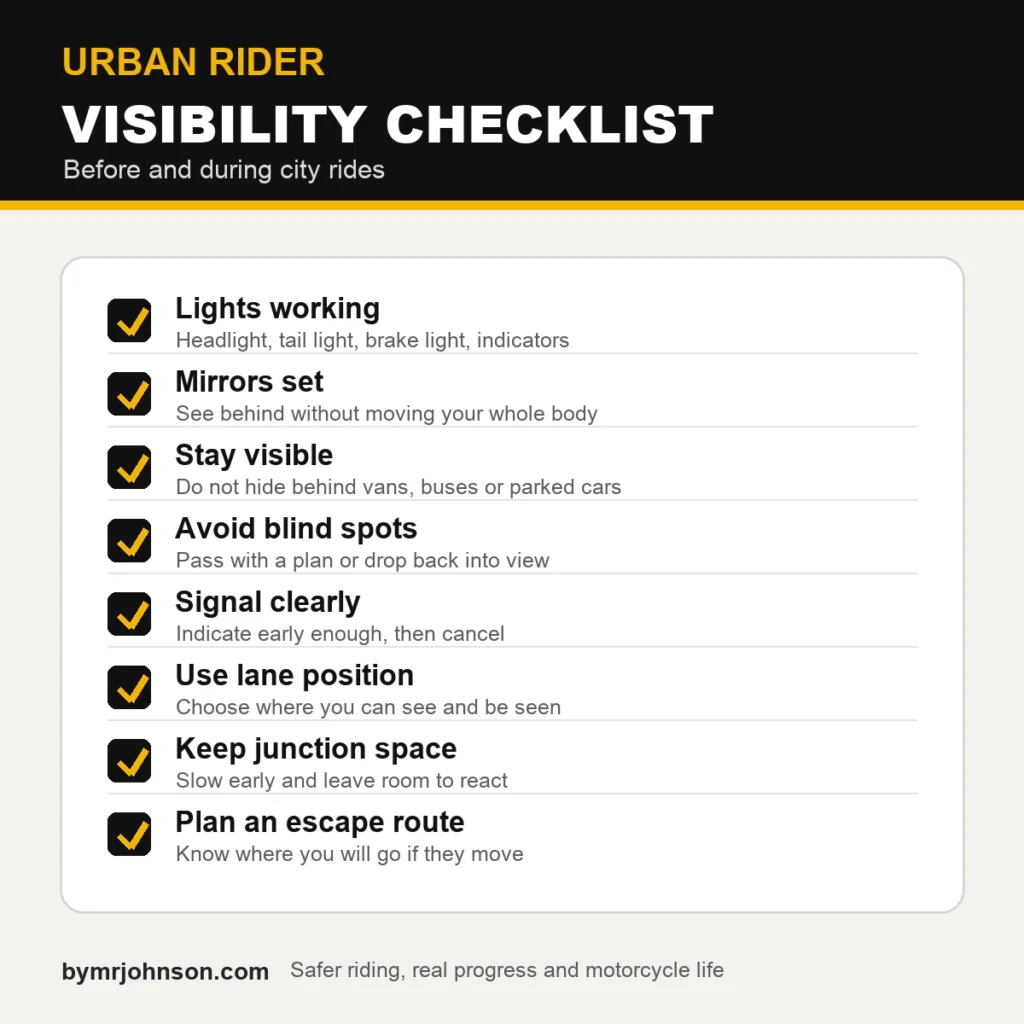
Before the ride:
- Check the headlight or daytime running light
- Test both brake controls and the brake light
- Check all indicators
- Clean light lenses and reflectors
- Clean the visor
- Check mirrors
- Make sure luggage does not cover the lights
- Choose an outer layer suitable for the conditions
- Confirm that reflective details remain visible
During the ride:
- Stay out of blind spots
- Create a clear following distance
- Position yourself where mirrors and sight lines are useful
- Reduce speed before junctions
- Watch vehicle wheels and lane position
- Signal early and cancel indicators
- Keep filtering speed low
- Avoid riding beside large vehicles
- Move away from heavy road spray
- Assume that eye contact may be misleading
- Keep an escape route available
After the ride:
- Clean dirty lights
- Check for damaged lenses
- Inspect reflective material
- Note locations where vehicles repeatedly failed to notice you
- Review whether your lane position and speed gave you enough space
Final Thoughts: Be Noticeable, but Ride as Though You Were Missed
Improving motorcycle visibility is worthwhile.
Working lights, contrasting gear and a strong road position can all make it easier for another person to recognise you.
But visibility should never become a reason to relax your defensive riding.
A driver may still miss the motorcycle. They may notice you but misjudge your speed. They may see you clearly and make a poor decision anyway.
Your protection comes from combining visibility with time and space.
Approach junctions at a manageable speed. Avoid blind spots. Leave enough distance to see beyond the vehicle ahead. Position yourself deliberately and keep watching for the first signs of movement.
Make yourself easy to notice.
Then ride with enough margin for the person who does not notice you at all.
Ride smart. Stay visible. Come home safe.
FAQs
What is the best way to make a motorcycle more visible?
Use several measures together. Maintain your lights, wear contrasting or reflective gear, choose a visible lane position, avoid blind spots and reduce your speed around junctions and traffic conflicts.
Does high-visibility motorcycle clothing prevent crashes?
High-visibility clothing may make a rider easier to notice, but it cannot prevent every visibility-related situation. It should support defensive positioning, observation and speed management rather than replace them.
Should motorcyclists use headlights during the day?
A daytime running light or dipped headlight can make a motorcycle easier to notice. Use the lighting fitted to your motorcycle correctly and follow the requirements that apply in your country.
What colour motorcycle helmet is most visible?
Light or bright colours often create better contrast than a completely dark helmet, but visibility also depends on the background, weather and lighting. Reflective details become especially useful in darkness.
Where should I ride so drivers can see me?
Choose a position that places you inside useful mirror and sight lines while preserving space from oncoming traffic, road edges and surface hazards. There is no single lane position that works everywhere.
What should I do when a driver starts pulling out in front of me?
Look towards your safe path, stabilise the motorcycle and use progressive braking. Avoid steering directly towards the vehicle you are trying to avoid. Your response will depend on the available space, surface and surrounding traffic.
How do I know whether I am in a car’s blind spot?
A useful warning sign is being unable to see the driver or a useful part of the vehicle’s mirror. However, mirror visibility does not guarantee that the driver has seen you, so avoid remaining alongside the vehicle.
Is eye contact enough to know that a driver has seen me?
No. The driver may be looking past you or towards another hazard. Confirm that the vehicle has stopped or is yielding, monitor its wheels and keep enough space to respond.
How can I stay visible while filtering?
Keep your speed low, avoid gaps that vehicles may enter, watch mirrors and front wheels, stay away from large vehicles and expect pedestrians or cyclists to appear between traffic.
Does a loud motorcycle exhaust make the rider safer?
Do not depend on exhaust noise as a visibility strategy. Other road users may not hear it clearly, recognise its direction or react in time. Road position, lighting, speed and escape space are more dependable controls.
Are reflective and fluorescent materials the same?
No. Fluorescent colours are designed to stand out strongly in daylight, while retroreflective material returns light towards its source and becomes particularly useful when illuminated in darkness.
Related Reads
Beginner’s Guide to Defensive Motorcycle Riding
Riding a Motorcycle in Heavy Traffic
Lane Positioning for Motorcyclists
Night Riding Safety: How to Ride a Motorcycle Safely After Dark
Motorcycle Safety Gear Explained: What Each Piece Actually Does