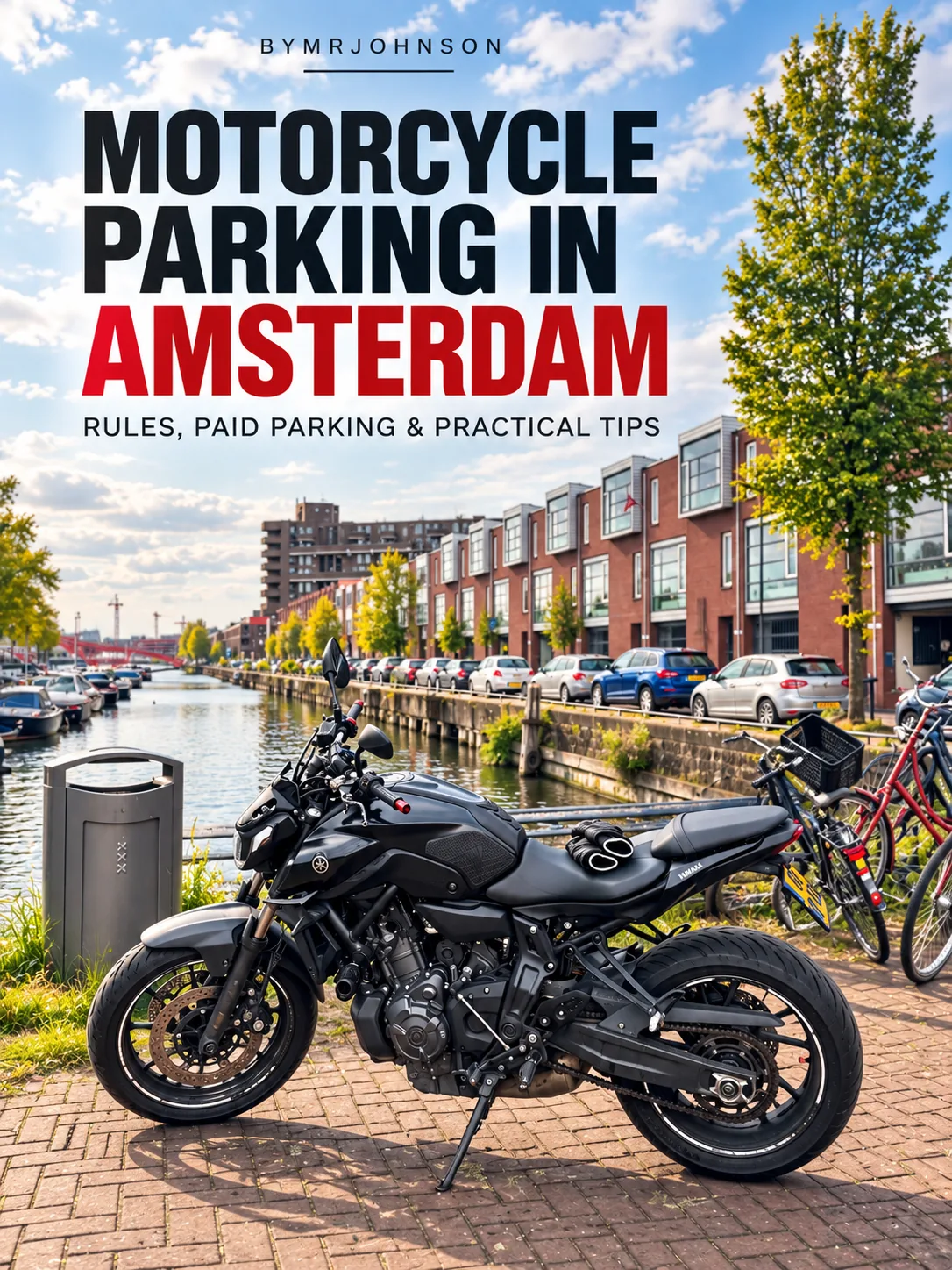
Motorcycle Parking in Amsterdam: Rules, Paid Parking & Practical Tips
Motorcycle parking in Amsterdam is more complicated than “just leave it on the pavement.” Here is what the current rules say about paid spaces, pavement parking, blue zones, permits and P+R.
On This Page
15–23 minutes
Parking a motorcycle in Amsterdam looks simple until you try to find a clear answer to one question:
Where am I actually allowed to leave it?
Spend enough time walking around Amsterdam and you will see motorcycles parked in all kinds of places.
In normal parking spaces.
Beside bicycles.
Against buildings.
Near canal railings.
And quite often on the pavement.
That can make it tempting to assume:
If other motorcycles are parked there, it must be allowed.
Unfortunately, that isn’t always a reliable way to understand the rules.
Motorcycle parking in Amsterdam sits at the intersection of national traffic rules, local parking regulations and a long-standing Amsterdam enforcement practice that has sometimes tolerated motorcycles on pavements when they aren’t causing an obstruction.
Then there is another question entirely:
Do motorcycles have to pay for street parking?
This guide separates those issues so you can make a clearer decision when you arrive somewhere on a motorcycle.
Important: Amsterdam parking policy and enforcement can change. The information in this article was checked in October 2026. Always follow current signs and use the City of Amsterdam’s parking information for the exact street where you plan to leave your motorcycle.
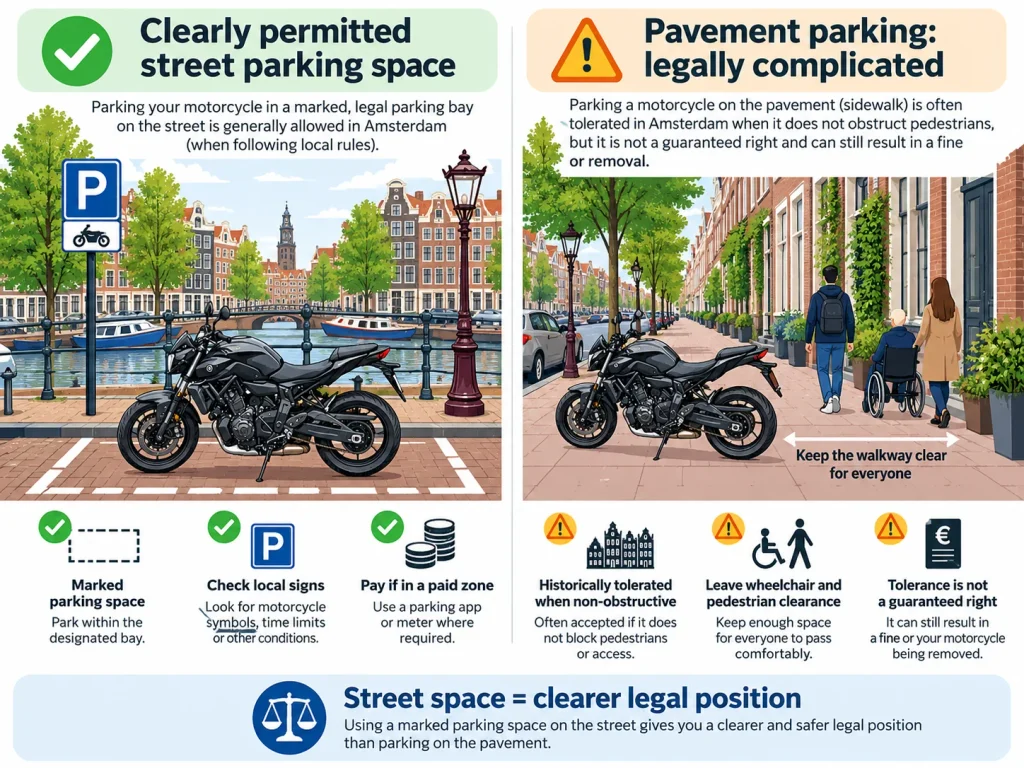
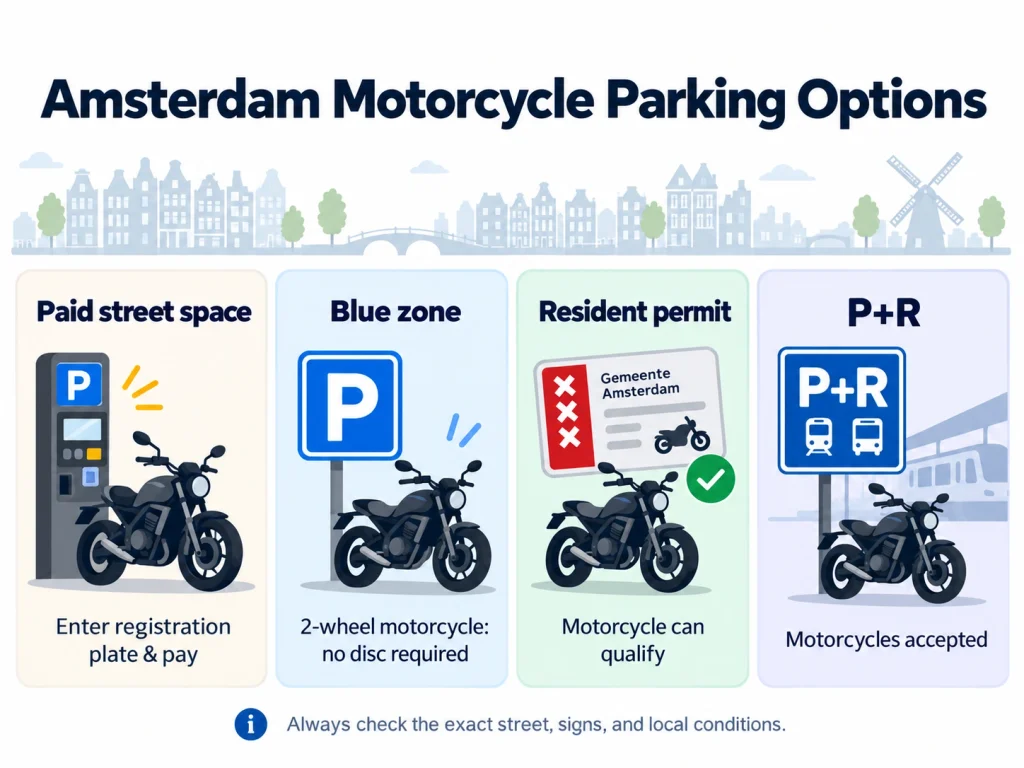
In a normal legal street parking space: You can park a motorcycle there. If that location is inside a paid-parking zone, assume the motorcycle needs a valid paid parking session or parking permit unless a specific exception applies.
In an Amsterdam blue zone: A two-wheeled motorcycle may park there without using a blue parking disc.
At Amsterdam P+R: The municipality explicitly allows both cars and motorcycles at its P+R locations, subject to the relevant P+R conditions.
On the pavement: This is where things become more complicated.
Dutch traffic law normally says motor vehicles may not use the pavement or footpath for parking. Amsterdam has historically tolerated motorcycles parked on the pavement where they do not create danger or obstruction, and an Amsterdam court recognised that policy in a 2025 case. But the city’s current public parking pages do not clearly give riders a universal pavement-parking exemption.
So I would not describe pavement parking as an automatic right.
Let’s go through each situation properly.
Can You Park a Motorcycle on the Pavement in Amsterdam?
This is the question that creates most of the confusion.
At national level, the Dutch RVV 1990 traffic rules are reasonably clear.
Article 10 says that drivers other than the road users specifically listed in the preceding articles use the carriageway and may use other road sections for parking except areas including:
the pavement
footpath
cycle path
combined cycle/moped path
bridleway.
A motorcycle is a motor vehicle for this purpose.
So if you only read the national traffic rule, the conclusion is:
A motorcycle should not be parked on the pavement.
But Amsterdam has another layer.
Amsterdam Has Historically Tolerated Some Pavement Parking
For years, Amsterdam riders have commonly parked motorcycles on pavements where the motorcycle does not block pedestrians or create a dangerous situation.
That wasn’t simply an internet rumour.
A useful piece of evidence appeared in an Amsterdam District Court case decided on 10 March 2025.
The case concerned two fines issued to a motorcycle parked on the pavement.
During the hearing, the municipality acknowledged that Amsterdam had operated a gedoogbeleid — a tolerance policy — for motorcycles parked on pavements as long as they were not creating an obstruction.
The court noted that the motorcycles shown in the evidence were not parked obstructively and cancelled the fines.
That explains why Amsterdam riders may have very different experiences from somebody simply reading the national rule.
But there is an important detail.
The judgment also records that this tolerance wording had disappeared from the Dutch-language version of the municipality’s website, while at that time it was still present on the English version.
That is why I would be careful about writing:
“Motorcycles are allowed to park on Amsterdam pavements.”
Allowed is too strong.
A more accurate description is:
Amsterdam has historically tolerated non-obstructive motorcycle pavement parking, but national traffic rules still make the legal position more complicated.
What Would I Do With That Information?
I think there are three different questions here.
Is pavement parking explicitly protected by national traffic law?
No.
Has Amsterdam historically tolerated it?
Yes, and that tolerance was explicitly discussed in a 2025 Amsterdam court case.
Does that guarantee you will never receive a fine?
I would not assume so.
Amsterdam itself has a current information page explaining what to do if you receive a fine for incorrectly parking on the pavement.
So if I were choosing between:
a clearly legal motorcycle position in a normal parking space
and
a questionable piece of pavement where I’m relying on enforcement tolerance,
the proper parking space gives me the clearer position.
That doesn’t mean every motorcycle you see on a wide Amsterdam pavement is immediately going to be fined.
It means I wouldn’t build my parking strategy around the idea that a tolerance policy is the same thing as an unconditional legal right.
If You Do Park Near Pedestrian Space, Obstruction Is the Key Issue
The 2025 court case is particularly useful because the judge specifically noted that the motorcycle did not cause an obstruction and that enough pavement remained available for people to pass.
So even if a rider is relying on Amsterdam’s historical tolerance, blocking pedestrian movement is clearly a bad idea.
Think about:
wheelchairs
mobility scooters
pushchairs
people with visual impairments
busy building entrances
shop doors
emergency access.
A motorcycle may look narrow to us.
That doesn’t mean the remaining walkway is actually usable for everyone.
And Amsterdam already has enough competition for public space without motorcycles making pedestrian movement harder.
Do Motorcycles Have to Pay for Parking in Amsterdam?
If you put your motorcycle into a normal paid street parking space, I would work on the basis that paid-parking rules apply to it as a motor vehicle.
Amsterdam’s parking system is based heavily around the vehicle’s registration number.
When paying at a municipal parking machine, you enter your number plate. There is no ticket that has to be displayed in the vehicle; enforcement checks the registration digitally.
That actually makes payment much easier for motorcycles than older paper-ticket systems did.
You don’t have to work out where to attach a ticket to the bike.
Enter the motorcycle’s registration.
Pay.
The parking session is associated with the plate.
Amsterdam’s parking-tax rules apply to motor vehicles parked in the areas designated for paid parking, and motorcycles can also qualify as vehicles for resident parking permits.
The practical rule I would use is:
If TITAN is occupying a normal street parking space in an area where signs say parking is paid, I would not assume the motorcycle is exempt simply because it has two wheels.
How Much Does Motorcycle Parking Cost?
There isn’t one motorcycle parking price for Amsterdam.
Street parking rates vary by location and time.
The municipality’s parking map is the right place to check the exact street because the rate and paid-parking hours can change substantially across the city. Amsterdam says paid parking applies on most streets and directs drivers to that map for current prices and hours.
That also means I don’t want to hard-code a single Amsterdam hourly price into this article.
It would become outdated very quickly.
For a real example of how much rates vary, Amsterdam’s 2026 information lists some areas at €1.72 per hour, while other tariff areas are substantially more expensive.
The useful habit is:
Check the street, not just the city.
How Do You Pay for Motorcycle Parking?
Amsterdam’s machines use registration-based parking.
The process is straightforward:
Find the nearest parking machine or use a compatible parking service.
Enter the motorcycle’s registration number.
Select the parking duration.
Pay.
You do not need to display anything on the motorcycle.
Municipal parking machines accept card or mobile payment, and the city warns users not to scan unofficial QR codes stuck to machines.
QR-code scams around parking machines are simple because visitors expect to use their phones.
Use the official payment methods rather than a random sticker.
Can Two Motorcycles Share One Parking Space?
Physically, often yes.
Financially, do not assume one parking payment covers both motorcycles.
Amsterdam’s street-parking system works through the vehicle registration.
Each motorcycle has its own plate.
So if two motorcycles require paid parking, each vehicle needs the appropriate parking entitlement associated with its own registration.
The fact that both motorcycles fit into one car-sized bay does not turn them into one vehicle.
From a space-use perspective, sharing a bay can make a lot of sense.
Just don’t confuse efficient use of space with a parking-fee exemption.
Can Amsterdam Residents Get a Motorcycle Parking Permit?
Yes.
The City of Amsterdam explicitly includes a motor among the vehicles that can qualify for a resident parking permit, provided the normal eligibility conditions are met.
That does not mean every Amsterdam address automatically qualifies for a permit.
Eligibility can depend on factors such as:
your home address
the permit area
whether parking is available on private property
waiting lists
number of permits allowed at the address.
The city provides an address checker showing the relevant permit zone, waiting list and cost for the address.
This is particularly relevant if the motorcycle is your primary vehicle.
Don’t assume resident parking permits are only for cars.
What About Visitor Parking Permits?
Amsterdam also has visitor parking arrangements in eligible permit areas.
These can allow a resident’s visitor to park on the street at a reduced rate, although the availability and discount depend on the permit area.
Visitor parking works digitally by registering the visitor’s number plate and starting a parking session.
Whether that makes sense for a visiting motorcycle depends on the situation, but again the important idea is:
Amsterdam parking enforcement is increasingly registration-based.
That works just as well with a motorcycle plate as it does with a car.
Motorcycle Parking in Amsterdam Blue Zones
Blue zones are much simpler for two-wheeled motorcycles.
Amsterdam specifically states that you may park a two-wheeled motorcycle in a blue zone without using a blue parking disc.
That’s worth remembering because a motorcycle obviously doesn’t have a convenient dashboard for displaying a cardboard parking disc anyway.
Still pay attention to the normal parking restrictions around the location.
The exemption from displaying the blue disc doesn’t mean every piece of road inside the blue-zone boundary becomes a motorcycle parking space.
Can You Use Amsterdam P+R With a Motorcycle?
Yes.
This is one of the clearest motorcycle-specific statements on the city’s current parking website.
Amsterdam says you can park your car or motorcycle at one of its P+R facilities and receive the reduced P+R price when you meet the relevant travel conditions.
For 2026, the normal reduced P+R structure at many city locations is:
€13 for the first 24 hours if you enter before 10:00 Monday to Friday
€6 per 24 hours if you arrive after 10:00 on weekdays, or at weekends/public holidays
subsequent discounted days are generally €6, subject to the maximum P+R stay and individual location rules.
Conditions matter.
The reduced price normally depends on completing the required public-transport journey and payment process correctly.
So P+R is not simply:
park the motorcycle for €6 and walk away.
Read the instructions for the particular site.
But if you are visiting Amsterdam and do not actually need the motorcycle inside the centre, P+R is worth knowing about.
What About Parking Garages?
This is where I would check the individual garage before arriving.
Some parking facilities are designed primarily around cars.
There can be:
barriers
number-plate recognition
narrow entry systems
specific tariffs
restrictions on where motorcycles may stand.
Amsterdam’s general municipal parking conditions require motor vehicles using its parking facilities to use designated parking spaces and follow the site’s payment conditions.
So I wouldn’t assume that because a garage appears on Google Maps it will necessarily be the best motorcycle option.
Check the particular facility first.
For me, that is preferable to discovering the barrier system doesn’t recognise the motorcycle while another vehicle is waiting behind.
Don’t Park in Bicycle Spaces Just Because Two Wheels Only
A motorcycle is not a bicycle.
That sounds obvious, but Amsterdam has enormous amounts of street furniture and infrastructure designed specifically for bicycles.
Bike racks and bicycle parking areas may look like convenient spaces beside the road.
That does not automatically make them motorcycle parking.
Amsterdam’s APV has separate rules for parking bicycles and mopeds in designated facilities and areas. A motorcycle remains a motor vehicle rather than becoming part of that bicycle-parking system simply because it also has two wheels.
That distinction becomes particularly important around:
stations
busy squares
shopping areas
high-capacity bicycle parking zones.
If an area has specific signs telling particular vehicles where they need to park, follow those signs rather than copying the motorcycles already standing nearby.
Loading Bays, Disabled Spaces and Reserved Parking Still Matter
A small motorcycle doesn’t get an exemption from a parking restriction simply because it occupies less space.
I would avoid:
loading and unloading bays
individually reserved disabled spaces
taxi spaces
car-sharing spaces
EV charging bays unless the motorcycle genuinely qualifies and is charging
permit-only locations without the correct permit
hatched or restricted areas.
The physical question—
“Can the bike fit here?”
—isn’t the same as the legal question:
“Is this space intended for motorcycle?”
Amsterdam specifically notes that some parking products are not valid in loading zones or spaces reserved for specific user groups.
Think About Security Before You Think About Convenience
A legal parking place can still be a poor place to leave a motorcycle.
And this is where motorcycle parking becomes very different from parking a car.
When I’m evaluating a location, the useful questions go beyond:
Am I allowed to park here?
They also include:
Is the motorcycle visible?
How isolated is it?
Will people be walking very close to it?
Could another vehicle easily hit it while parking?
Is there somewhere suitable to use the security equipment I carry?
Am I leaving it for twenty minutes or overnight?
Those questions deserve an article of their own.
Later in this cluster we’ll cover:
How I Secure My Motorcycle in Amsterdam: My Everyday Theft-Prevention Setup
That article will focus on actual security rather than parking law.
Keeping the two topics separate matters.
A legal parking spot is not automatically secure.
A secure-looking location isn’t automatically legal.
Canal-Side Parking Needs Some Common Sense
A motorcycle beside an Amsterdam canal can make a great photograph.
It can also be an unforgiving place to manoeuvre a heavy machine.
Cobblestones.
Slopes.
Narrow spaces.
Bicycles.
Pedestrians.
Wet surfaces.
And occasionally not much separating the motorcycle from the water.
This is where low-speed control becomes useful even after the ride has technically finished.
Before committing to a space, I would rather think about how the motorcycle is going to leave it.
Can I roll out forwards?
Will I need to paddle the motorcycle backwards uphill?
And a street where a motorcycle was fine last month may look completely different today.
This is another reason I don’t like relying on:
“I always park here.”
Look at the signs each time.
Particularly in central Amsterdam.
The city isn’t static.
Your parking habits shouldn’t be either.
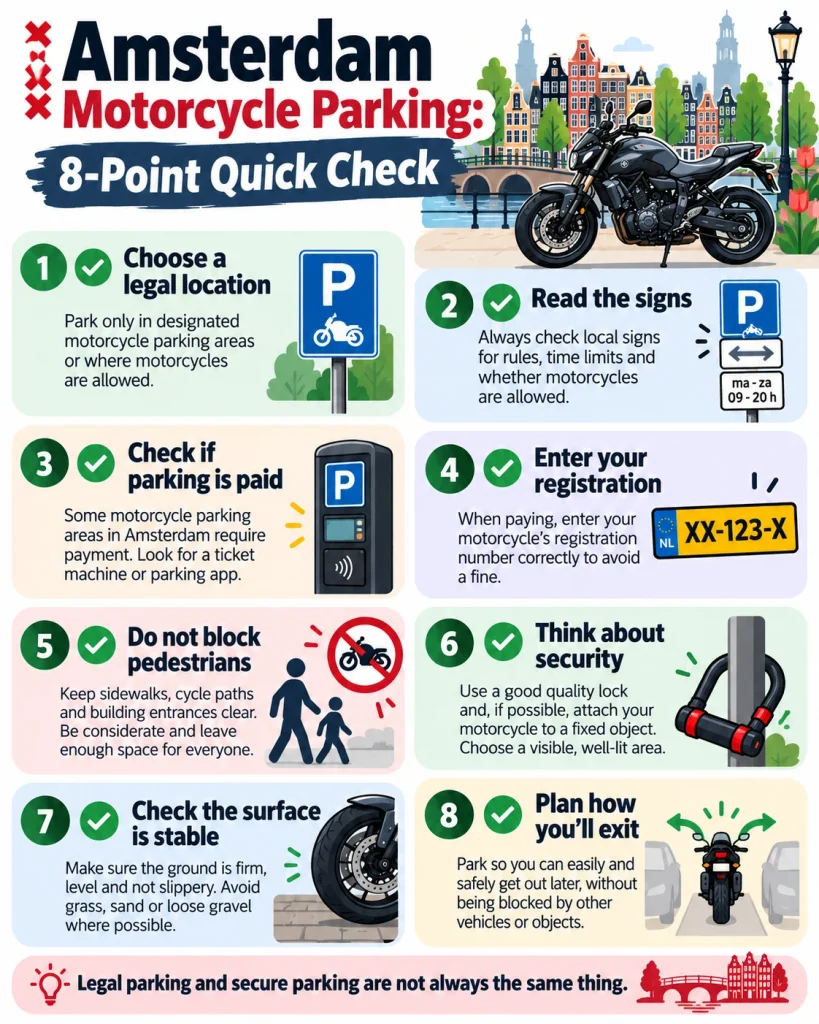
A Simple Amsterdam Motorcycle Parking Routine
I don’t think riders need a complicated system.
A quick decision process is enough.
1. Look for a clearly legal parking location first
A proper parking space gives you the least ambiguity.
2. Check whether paid parking applies
Use the signs or Amsterdam’s parking map.
3. If payment is required, use the motorcycle’s registration
The system is digital, so you don’t need to display a paper ticket.
4. Check local restrictions
Permit-only areas, loading bays and reserved spaces still apply.
5. If considering the pavement, understand the distinction
Amsterdam has historically tolerated some non-obstructive motorcycle pavement parking, but national rules do not give motorcycles a general right to park there.
6. Never block pedestrian movement
Leave genuinely usable space, not just enough room for one able-bodied person to squeeze past.
7. Think about motorcycle security
Legal parking and secure parking are two separate decisions.
8. Think about getting out again
Especially on slopes, cobbles and tight canal-side streets.
The Problem With Copying What Other Motorcyclists Do
This may be the biggest practical lesson in the whole article.
Amsterdam riders develop local habits.
Some of those habits reflect rules.
Some reflect tolerance.
Some reflect years of enforcement practice.
And some may simply be people taking a chance.
From the outside, those situations all look identical:
a motorcycle parked somewhere.
You don’t know which one you’re looking at.
So I wouldn’t use the presence of five motorcycles as proof that the sixth one is definitely legal.
Use signs.
Use the municipality’s current information.
And understand the difference between something that is explicitly permitted and something that has historically been tolerated.
That distinction matters particularly with pavement parking.
Is Motorcycle Parking in Amsterdam Easy?
In some ways, yes.
A motorcycle requires much less physical space than a car.
It is easier to manoeuvre into many locations.
Blue zones are straightforward for two-wheeled motorcycles.
Residents can apply for motorcycle parking permits where eligible.
P+R explicitly accepts motorcycles.
And the digital number-plate payment system avoids the old problem of trying to display a parking ticket on a bike.
But I wouldn’t describe Amsterdam as:
“You can park a motorcycle anywhere.”
That advice is too casual for a city where pavement space, cycling infrastructure, paid parking and public-space rules all overlap.
The real advantage of a motorcycle isn’t ignoring the parking system.
It’s needing less space within it.
My Main Takeaway
Motorcycle parking in Amsterdam becomes much clearer when you separate three questions.
Is the location legal?
Check the signs, road layout and parking restrictions.
Do I need to pay?
If you’re using a normal paid street parking space, assume the motorcycle needs the appropriate paid session or permit.
Is it sensible to leave the motorcycle there?
Think about pedestrians, other vehicles, security and how you’re going to manoeuvre out again.
The pavement question is the one I would approach most carefully.
Amsterdam has a documented history of tolerating motorcycles on pavements when they don’t cause obstruction.
But tolerance and legal entitlement are not the same thing.
So don’t rely on a ten-year-old forum comment saying:
“Motorcycles park free everywhere in Amsterdam.”
The city is more complicated than that.
Find a sensible place.
Read the signs.
Pay when the parking system requires it.
Don’t make life harder for pedestrians.
Secure the motorcycle.
Then go and enjoy Amsterdam without spending the whole time wondering whether TITAN will still be where you left him.
Ride safe and enjoy the journey.
FAQs
Can motorcycles park on the pavement in Amsterdam?
Dutch traffic rules normally exclude pavements and footpaths from places where motor vehicles may park. Amsterdam has historically operated a tolerance policy for non-obstructive motorcycle pavement parking, which was acknowledged in an Amsterdam District Court case in 2025. Because this is tolerance rather than a clear national parking entitlement, I would not assume every pavement location is permitted.
Do motorcycles have to pay for parking in Amsterdam?
If you park a motorcycle in a normal paid street parking location, work on the basis that the paid-parking rules apply. Amsterdam’s parking system is linked to the vehicle registration number, so you can register and pay for the motorcycle without displaying a paper ticket.
How do I pay for motorcycle parking in Amsterdam?
Enter the motorcycle’s registration number at the parking machine and pay for the required time, or use an accepted digital parking method. Amsterdam does not require a paper ticket to be displayed because enforcement is registration-based.
Can motorcycles park in an Amsterdam blue zone?
Yes. Amsterdam specifically states that two-wheeled motorcycles may park in a blue zone without displaying a blue parking disc.
Can I get an Amsterdam resident parking permit for a motorcycle?
Potentially, yes. Amsterdam includes motorcycles among the vehicles eligible for resident parking permits, subject to the normal address, ownership, permit-zone and eligibility conditions.
Can motorcycles use Amsterdam P+R?
Yes. The municipality explicitly states that cars and motorcycles can use Amsterdam P+R locations. To receive the reduced P+R tariff, you still need to meet the conditions for the particular P+R facility.
Is motorcycle parking free everywhere in Amsterdam?
No. Don’t treat the common claim that motorcycles park free everywhere as a general rule. A motorcycle using a paid street parking location can be subject to paid-parking requirements. Pavement parking is a separate and more nuanced issue involving national rules and Amsterdam’s historical enforcement tolerance.