A motorcycle can be properly parked, fully insured and still be vulnerable to theft.
Those are three different problems.
Parking rules determine whether I am allowed to leave the motorcycle there.
Insurance determines how much of the financial loss may be covered if something happens.
Security is what I can do before that point to make stealing the motorcycle harder.
And I think that distinction matters.
There is no lock I would describe as:
“Buy this and your motorcycle cannot be stolen.”
Given enough time, tools and determination, physical security can be defeated.
So the more useful question is:
How can I make my motorcycle more difficult, noisy, time-consuming and risky to steal?
The answer is usually not one product.
It is layers.
Dutch police advice follows the same general approach. Their motorcycle-theft prevention recommendations include good storage, quality locks, attaching the motorcycle to the ground or a fixed motorcycle post, an alarm system, an immobiliser and GPS vehicle tracking.
In this guide, I’ll break those layers down and explain how I would think about motorcycle security in Amsterdam and elsewhere in the Netherlands.
Important: Security and insurance conditions change, and insurers do not all require the same equipment. This guide was checked against current Dutch information in October 2026. Always check your own policy before relying on a specific lock or security system.
If you’re still working out where you can legally leave your motorcycle, start with my Motorcycle Parking in Amsterdam guide first.
Motorcycle Security Starts With One Uncomfortable Reality
A motorcycle is easier to physically move than a car.
Even a fairly heavy motorcycle can potentially be:
pushed,
rolled,
lifted,
or loaded into another vehicle.
That is why I don’t think simply locking the steering is enough to call a motorcycle secure.
The steering lock is still worth using.
It adds another obstacle.
But it should be treated as the first layer, not the complete security system.
The stronger question is:
What stops somebody physically taking the motorcycle away?
That leads to the most important security principle in this article.
Layer 1: Attach the Motorcycle to Something Solid
A motorcycle that cannot easily be moved creates a different problem for a thief.
Dutch police specifically recommend securing a motorcycle to the ground or to dedicated motorcycle posts, and ANWB similarly advises riders to attach motorcycles outside to a sturdy anchored object so the bike cannot simply be lifted and taken somewhere else to attack the lock privately.
At home, that could mean a proper:
ground anchor
or:
wall anchor.
ANWB also notes that approved wall and ground anchors exist within the ART system.
The concept matters more than the exact product.
A heavy chain around the motorcycle that isn’t attached to anything still leaves open the possibility of moving the entire motorcycle.
A chain connected to a properly installed anchor changes that.
Outside the Home
Public parking is harder.
You may not have a dedicated anchor available.
And I would not automatically chain a motorcycle to:
a random railing,
street furniture,
pedestrian infrastructure,
or anything else simply because it happens to be solid.
It needs to be appropriate and permitted, and the motorcycle and chain must not obstruct pedestrians or other road users.
This is where parking location and security start overlapping.
The ideal space isn’t only legal.
It also gives you a sensible way to secure the motorcycle.
Layer 2: Use a Proper Motorcycle Lock
Dutch riders frequently encounter the ART security rating.
This isn’t simply a manufacturer’s marketing score.
Stichting ART certifies locks after security testing, and the system uses star categories to indicate the intended security level.
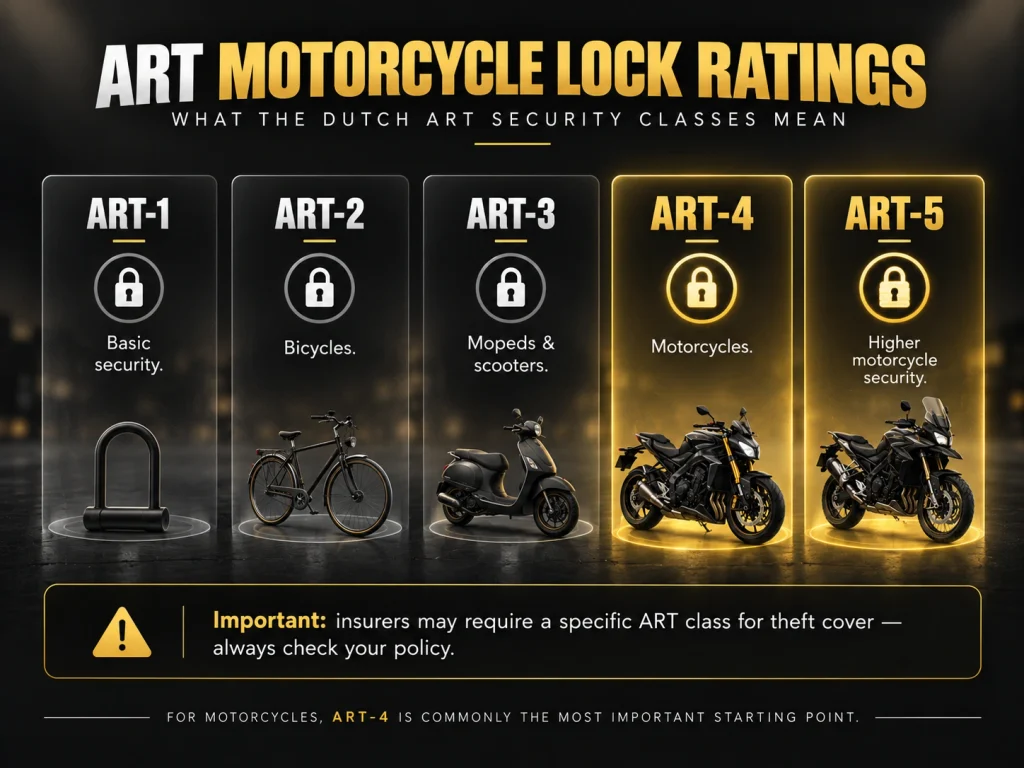
The current categories are broadly:
ART-1: basic security
ART-2: bicycles
ART-3: mopeds and scooters
ART-4: motorcycles
ART-5: motorcycles requiring an even higher security category.
ANWB specifically identifies ART-4 and ART-5 as motorcycle lock categories.
For motorcycle owners, ART-4 is particularly important because many Dutch insurance policies use it as a minimum theft-security requirement.
ANWB currently requires an ART-4 approved lock if theft is included in its motorcycle insurance. Some motorcycles can also receive additional security requirements.
That gives us two separate reasons to care about the rating.
Security
A certified motorcycle lock has been tested to a recognised standard.
Insurance
Your insurer may require that certification before theft coverage applies.
Those are not exactly the same thing.
A lock could feel extremely strong but still fail to satisfy the wording in your insurance contract.
Don’t Assume “Heavy” Means “Insurance Approved”
A huge chain can look impressive.
That doesn’t automatically mean your insurer accepts it.
Look for the actual:
ART logo
number of stars
and:
approval number.
Stichting ART maintains a searchable list of certified locks, so you can check whether a specific product actually holds the certification being claimed.
This is especially useful when buying online.
Product descriptions can say:
“motorcycle security”
“heavy duty”
“maximum security”
or:
“insurance lock.”
Those aren’t the same thing as confirming the exact product appears in the ART register.
Keep the Lock Receipt and Keys
Buying the right lock isn’t the end of the insurance side.
ANWB advises owners to retain the purchase receipt and says that, following a theft claim involving an ART lock, the original keys may need to be provided — including both the spare and the key that shows evidence of use.
That creates a simple habit:
When I buy security equipment, I would keep together:
- purchase receipt
- lock model
- ART approval number
- spare key
- key-registration information if supplied.
Do that when you buy the lock.
Trying to reconstruct it all after a theft is much harder.
Layer 3: Add a Second Lock
One reason layered security works is that different devices create different problems.
A chain prevents movement.
A disc lock prevents a wheel from rotating normally.
An alarm can create noise.
A tracker doesn’t necessarily stop theft at all — but can help after the motorcycle moves.
The goal isn’t necessarily to carry the largest possible version of every security device.
It is to avoid creating one single point of failure.
Stichting ART itself advises using a second ART lock to attach a two-wheeler to a fixed object.
A practical setup might therefore combine:
steering lock
plus:
ART-rated chain
plus:
a second lock.
The exact combination depends on where the motorcycle is parked.
Disc Locks Are Useful — But Have a Different Job
A disc lock attaches directly to a brake disc and prevents the wheel rotating normally.
That makes them attractive because they are usually much easier to carry than a large chain.
Some also include an alarm.
For a short stop, that portability can be useful.
But I wouldn’t automatically treat a small disc lock as equivalent to anchoring the entire motorcycle.
A motorcycle with a locked wheel can still potentially be physically lifted.
That’s why I think about the devices differently.
Chain + fixed object: reduce the ability to move the motorcycle.
Disc lock: adds another mechanical obstacle.
Alarmed disc lock: also adds noise.
Different layer.
Different problem.
Use Reminder Cables If You Need Them
There is one very avoidable downside to disc locks:
forgetting they are fitted.
Trying to ride away with a disc lock still attached can cause:
a fall,
damage to the brake,
damage to the wheel,
or at minimum a very embarrassing stop.
A bright reminder cable from the disc lock to the handlebar is cheap compared with repairing the result.
If your lock has one, use it.
Security shouldn’t create its own accident.
Layer 4: Noise
A silent theft attempt gives somebody one advantage:
time.
An alarm tries to reduce that advantage.
This could come from:
an alarm-equipped disc lock,
a dedicated motorcycle alarm,
or an electronic security system integrated into the bike.
Dutch police explicitly recommend considering an alarm system as part of motorcycle theft prevention.
I don’t see an alarm as a replacement for physical security.
Someone can ignore noise.
Nobody may respond.
False alarms can also make people stop paying attention.
But as another layer, noise can make an attempted theft much less discreet.
Layer 5: Immobilisation
A motorcycle’s factory security may include things such as:
a steering lock,
electronic immobiliser,
coded key,
or manufacturer-specific anti-start systems.
The Dutch police also recommend an immobiliser as part of motorcycle security.
Again, the role matters.
An immobiliser makes riding the motorcycle away more difficult.
It does not necessarily stop somebody loading the entire bike into a van.
That’s why it works better as part of a combination than as the only defence.
Layer 6: GPS Tracking
A tracker solves a different problem.
Locks are about:
preventing or delaying theft.
Tracking is about:
what happens after the motorcycle moves.
Dutch police specifically recommend installing a GPS vehicle-tracking system because it can help locate a motorcycle following theft.
That doesn’t mean a tracker guarantees recovery.
The device can be discovered.
Its signal may disappear.
The bike may be moved somewhere the tracker cannot communicate properly.
But it can potentially provide information that no physical lock can provide.
Tracker Placement Matters
A tracker that is immediately obvious is easier to find.
But putting it somewhere so deeply buried that:
battery replacement,
charging,
signal reception,
or maintenance
becomes difficult creates a different problem.
The right setup depends on the tracker.
Follow the manufacturer’s installation requirements rather than simply hiding it as deeply as possible.
Don’t Personally Chase a Stolen Motorcycle
This deserves saying clearly.
If a tracker says the motorcycle has moved somewhere:
that does not mean I would go there and confront whoever has it.
Send the information to the police.
A motorcycle can be replaced.
A dangerous confrontation is not worth creating over it.
For theft of a registered motorcycle in the Netherlands, Dutch police instruct owners to contact the Aangifteloket Gestolen Voertuigen as quickly as possible. The current number is 088-66 28 288, available daily from 07:00 to 23:00; outside those hours the police can still arrange for the vehicle to be flagged as stolen.
Keep that information somewhere you can access even if the motorcycle disappears.
Layer 7: Where You Park
The best lock still benefits from a better parking location.
I would think about things such as:
Visibility
Is the motorcycle somewhere somebody can work on it unnoticed?
Lighting
Would an attempted theft happen in complete darkness?
Foot traffic
Does the location have people naturally passing nearby?
Vehicle access
Could a van easily stop next to the motorcycle?
Time
Twenty minutes during the afternoon is a different exposure from leaving the motorcycle outside all night.
Anchoring
Is there an appropriate fixed object or anchor?
This doesn’t mean:
always park in the busiest possible place.
Busy areas can create other problems.
The point is simply that motorcycle security begins before the lock comes out of the bag.
I covered the legal side of choosing the location in Motorcycle Parking in Amsterdam.
Overnight Security Deserves More Effort
The longer I leave a motorcycle somewhere, the more security I would want around it.
A short café stop and an overnight parking location are not the same risk decision.
For long-term parking, the Dutch police preference is clear:
use a proper garage or secure storage where possible.
At home, a strong setup could combine:
garage or private storage,
ground or wall anchor,
ART-rated chain,
steering lock,
secondary lock,
alarm,
and tracking.
You don’t necessarily need every layer.
But home is where carrying a very heavy chain stops being a problem.
You aren’t transporting it.
That makes stronger stationary security much more practical.
A Motorcycle Cover Can Have a Role
A cover isn’t a lock.
It doesn’t physically secure anything.
But it can reduce casual visibility of:
the motorcycle model,
accessories,
modifications,
controls,
and some of the security equipment underneath.
I would still regard it as a minor supporting layer.
Not serious theft protection.
And I would make sure the motorcycle is cool enough before covering it and that the cover itself doesn’t create a stability problem in strong wind.
Different Locks Force Different Attacks
There is another advantage to using more than one type of device.
Two identical locks may be vulnerable to the same technique.
A chain and a disc lock potentially require:
different positioning,
different tools,
or at least additional time.
The basic philosophy is:
Don’t make the whole security system depend on defeating one object once.
This doesn’t make the motorcycle theft-proof.
It increases friction.
And friction is the point.
How Much Should You Spend on Motorcycle Security?
I wouldn’t use a fixed percentage.
The decision depends on:
motorcycle value,
where you store it,
how often it is parked outside,
insurance requirements,
and how much equipment you are realistically willing to use every time.
A €250 lock that stays in the garage because it is too inconvenient to carry may protect less than a lighter setup that is actually used consistently.
At the same time, buying a valuable motorcycle and protecting it with the cheapest lock available feels like false economy.
The goal should be:
security strong enough for your situation that you will actually use every time.
Check Your Insurance Before Building the Setup
This is one of the strongest lessons from the previous article.
Don’t buy the security equipment first and read the insurance policy second.
Do it the other way around.
Ask:
Is theft actually covered?
Basic WA insurance generally does not cover theft of your motorcycle.
What ART class is required?
ANWB currently requires an ART-4 approved lock when theft is included. Other insurers can have different conditions.
Is additional security required for my specific motorcycle?
Some insurers apply additional conditions depending on the bike.
Must the motorcycle be anchored?
Read the wording.
What evidence must I supply after theft?
Locks.
Keys.
Receipts.
Police report.
Potential tracker information.
Check now.
Not after the motorcycle disappears.
My full explanation of that side is in Motorcycle Insurance in the Netherlands: WA, WA+ & All-Risk Explained.
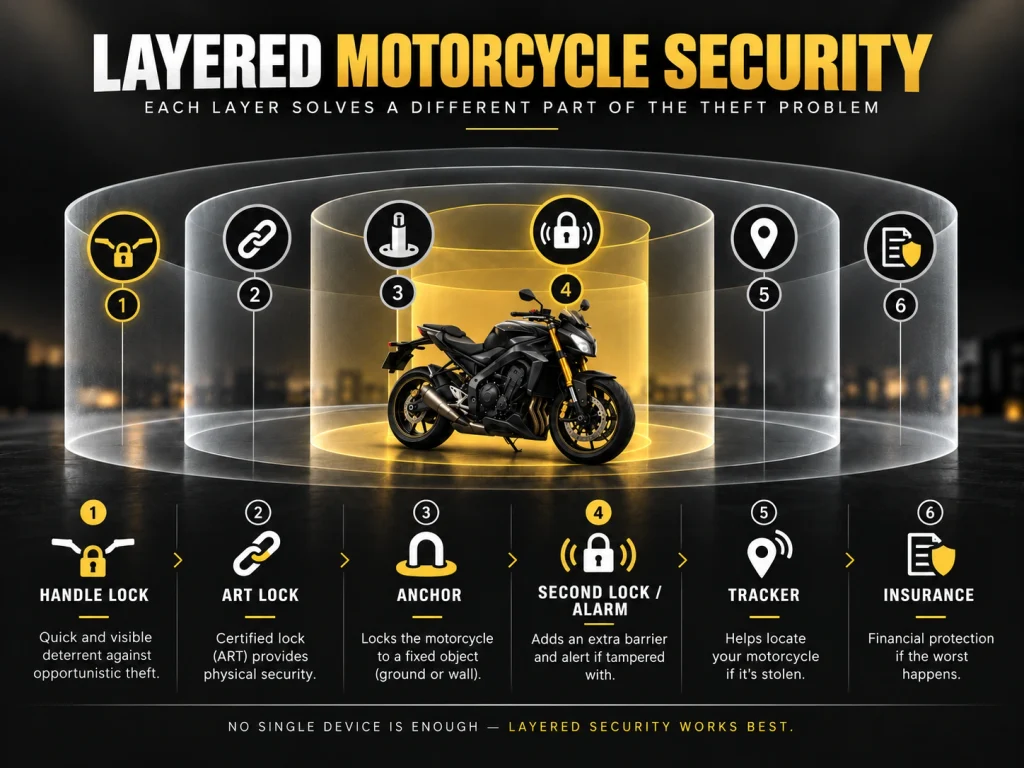
A Practical Layered Motorcycle Security Setup
If I were building security from scratch, I would think of it in this order.
Layer 1 — Factory security
Use the steering lock and built-in immobiliser every time.
They’re already on the motorcycle.
Layer 2 — Certified physical lock
Use an appropriate ART-rated motorcycle lock, meeting at least whatever your insurance requires.
Layer 3 — Anchor
When possible, connect the motorcycle to something genuinely fixed and appropriate.
At home, install a proper ground or wall anchor.
Layer 4 — Second device
Add another type of lock.
For example, a disc lock alongside the main chain.
Layer 5 — Noise
An alarm or alarmed lock adds attention to an attempted theft.
Layer 6 — Tracking
A GPS tracker gives you a recovery layer if the first five fail.
Layer 7 — Insurance
Make sure the financial layer actually matches the security conditions you’ve built.
That is much stronger than expecting one expensive chain to solve everything.
What I Would Carry vs What I Would Keep at Home
This is where practicality matters.
At home
Weight matters much less.
That is where a:
heavy chain,
large anchor,
alarm,
cover,
and other permanent security
can make sense.
On the motorcycle
Every kilogram of lock has to go somewhere.
So for riding around Amsterdam, I would prioritise equipment that balances:
security,
size,
weight,
and likelihood of actually using it.
The perfect lock sitting at home protects the bike very well while the bike is also at home.
It does nothing when you’re parked somewhere else.
Read : Motorcycle Commuting Amsterdam: Gear, Weather & Practicality
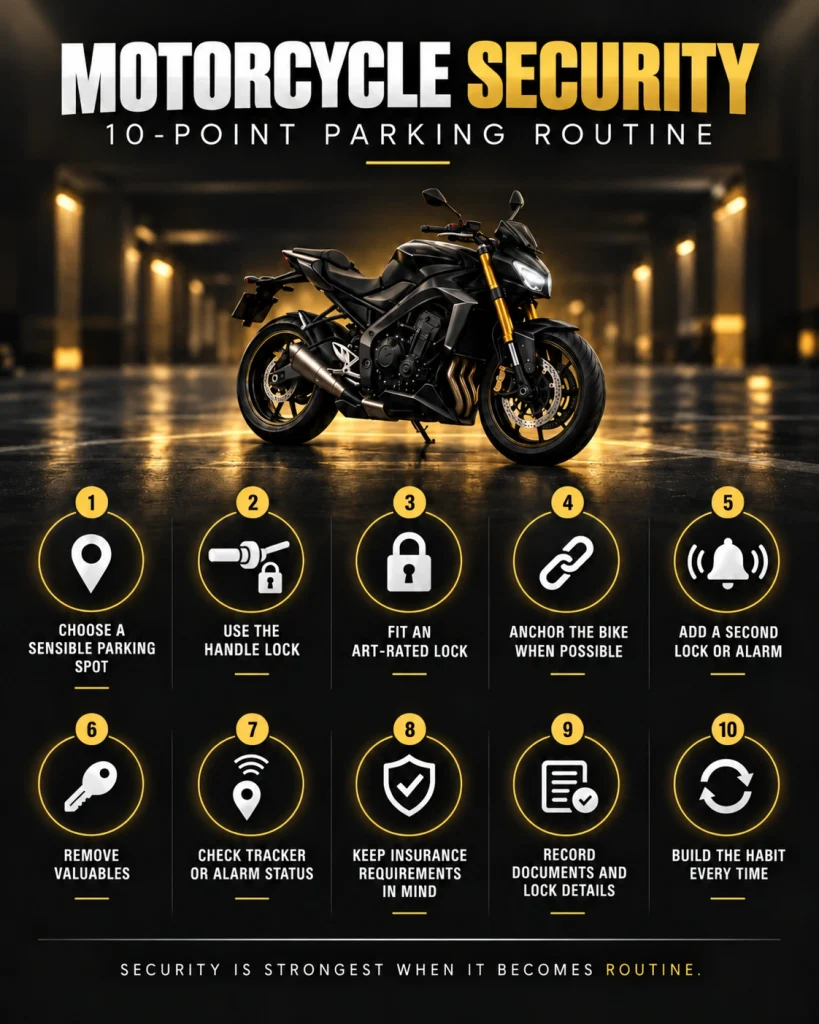
Security Is Also About Routine
The best equipment still relies on behaviour.
A routine helps.
Park.
Steering lock.
Main lock.
Anchor when available.
Second lock.
Check the motorcycle is stable.
Take valuables.
Walk away.
Doing the same sequence repeatedly reduces the chance of:
forgetting the lock,
leaving the key,
failing to attach the chain properly,
or assuming:
“I’m only going inside for five minutes.”
Five minutes is exactly when convenience tends to replace the routine.
Record Your Motorcycle Before You Need the Information
Security preparation should also include documentation.
Keep accessible copies of:
- registration details
- VIN/chassis number
- motorcycle photographs
- distinctive modifications
- purchase invoice
- insurance policy
- lock receipts
- lock certification details
- tracker information.
If the motorcycle disappears, you’re unlikely to be in the best mood for searching through drawers for the chassis number.
Prepare it once.
What to Do If Your Motorcycle Is Stolen in the Netherlands
If the motorcycle really has disappeared:
1. Check that it hasn’t been legitimately moved
Depending on where it was parked, rule out removal or another explanation where appropriate.
2. Contact the police quickly
For a stolen motorcycle with its own registration, the police direct owners to the Aangifteloket Gestolen Voertuigen: 088-66 28 288. Police specifically advise calling as soon as possible because this improves the chances of recovery.
3. Have the documents ready
The police advise having your driving licence and vehicle registration information available.
4. Contact your insurer
Follow the theft-claim procedure in your policy.
5. Provide tracker information if available
Give useful location information to the authorities.
Don’t create a confrontation yourself.
6. Keep your lock evidence
Your insurer may ask for keys, proof of the approved lock and related documentation.
This is why storing the paperwork beforehand matters.
Is Any Motorcycle Security Setup Theft-Proof?
No.
And I would be suspicious of anyone promising otherwise.
The purpose of security is to make theft:
harder,
slower,
louder,
less convenient,
and more traceable.
Good security tries to make another target look easier.
That may not sound as satisfying as:
“Buy this lock and never worry again.”
But I think it is much more realistic.
The Setup I Would Build Around TITAN
For a motorcycle such as TITAN, my approach would be based around:
a certified physical lock
plus:
anchoring whenever practical
plus:
a second security layer
plus:
insurance conditions
and, where useful:
tracking.
I am deliberately not listing specific products here as products I personally use, because I only want the Gear I Use side of ByMrJohnson to contain equipment that I genuinely own and use.
Final Thoughts
Motorcycle security in Amsterdam isn’t really a story about finding the strongest lock.
It’s about eliminating easy options.
Can the motorcycle roll away?
Lock it.
Can it be lifted?
Anchor it.
Can somebody work quietly?
Add an alarm.
Can it disappear despite everything?
Track it.
Would theft leave you financially exposed?
Insure it properly.
And does your insurer require a particular security setup?
Follow it.
Dutch police advice supports the same layered principle: good storage, quality locks, anchoring, alarms, immobilisation and GPS tracking all have roles to play.
No individual layer needs to be magical.
They simply need to make the motorcycle progressively harder to take.
For me, that is a much more useful goal than trying to make a motorcycle “unstealable.”
Make it inconvenient.
Make it time-consuming.
Make it noisy.
Make it traceable.
Then make sure your insurance is still there if those layers aren’t enough.
Ride safe and enjoy the journey.
FAQs
What ART lock do I need for a motorcycle in the Netherlands?
ART-4 and ART-5 are the main ART categories intended for motorcycles. The exact requirement depends on your insurer. ANWB currently requires an ART-4 approved lock where motorcycle theft is insured.
Is an ART-4 lock enough to prevent motorcycle theft?
No lock makes a motorcycle theft-proof. ART certification provides a recognised security standard, but a layered setup can also include anchoring, a second lock, alarms and tracking.
Should I chain my motorcycle to a fixed object?
Where appropriate and permitted, this is one of the strongest practical security improvements. Dutch police recommend physically securing motorcycles to the ground or dedicated motorcycle posts, while ANWB recommends attaching a bike outside to a sturdy anchored object.
Is a disc lock enough for a motorcycle?
A disc lock is useful as an additional mechanical layer and some models include alarms. However, it doesn’t necessarily prevent the entire motorcycle being physically lifted or transported, so I would not automatically treat it as a replacement for anchoring.
Are GPS trackers worth using on motorcycles?
Dutch police recommend GPS vehicle-tracking systems as one motorcycle theft-prevention measure because tracking can help locate a vehicle after it is stolen. They do not prevent theft by themselves, so they work best as another layer.
Does motorcycle insurance require an ART lock?
It depends on the insurer and coverage. Theft cover frequently includes security conditions. For example, ANWB currently requires an ART-4 approved lock and may apply extra requirements to certain motorcycles.
Should I keep my motorcycle-lock receipt?
Yes, particularly if the lock is part of your insurance requirements. ANWB advises retaining proof of purchase and notes that lock keys may also be required following a theft claim.
What should I do if my motorcycle is stolen in the Netherlands?
Contact the police’s Aangifteloket Gestolen Voertuigen as soon as possible on 088-66 28 288 and have your licence and registration details available. Then contact your insurer and provide tracker information if applicable.
Related Reads
Motorcycle Insurance in the Netherlands: WA, WA+ & All-Risk Explained
Motorcycle Parking in Amsterdam: Rules, Paid Parking & Practical Tips
Buying a Used Motorcycle in the Netherlands: RDW Checks & Ownership Transfer
Motorcycling in the Netherlands: A Practical Guide for New & Expat Riders