Every motorcyclist starts somewhere.
No one becomes a smooth, confident, safe rider on day one. We all make mistakes. We all have awkward moments. We all stall, brake too harshly, take a corner badly, forget to cancel an indicator or feel nervous in traffic.
That is normal.
But some beginner motorcycle mistakes are more serious than others. Some mistakes only make you feel embarrassed. Others can put you in real danger.
The goal of this article is not to scare you away from riding. It is the opposite. The goal is to help you enjoy motorcycling for longer by avoiding the habits that create unnecessary risk early.
Motorcycling is one of the most rewarding things I have ever experienced. But it has taught me something important: confidence is good only when it is built on awareness, skill and humility.
The best beginner rider is not the one who tries to look experienced.
The best beginner rider is the one who stays honest, learns quickly and respects the road before the road has to teach them the hard way.
Start with motorcycle safety guide for beginners
Quick Answer: What Are the Most Common Beginner Motorcycle Mistakes?
The most common beginner motorcycle mistakes include riding without proper gear, becoming overconfident too early, following vehicles too closely, relying too much on the rear brake, entering corners too fast, target fixation, sitting in blind spots, ignoring weather and road hazards, skipping pre-ride checks, not planning fuel stops or basic ride preparation and trying to keep up with faster riders.
Most of these mistakes come from the same problem: not leaving enough margin.
Margin means space, time, visibility, skill and calm thinking.
The more margin you create, the safer your ride becomes.
1. Thinking Short Rides Are Automatically Safe
One of the most common beginner mistakes is relaxing your standards because the ride is short.
You tell yourself:
“I am just going nearby.”
“It is only a few minutes.”
“I know this road.”
“I do not need all my gear.”
“I will ride carefully.”
I understand this mindset because familiar roads feel less dangerous. You know the corners. You know the traffic lights. You know the route. You feel comfortable.
But comfort can make you careless.
Many accidents happen close to home because that is where we relax.
A short ride is still a ride.
A familiar road is still a road.
A slow crash can still hurt.
Better habit:
Treat every ride with respect. You do not need to be tense or afraid, but you should be prepared. Wear your gear, check your bike and start the ride with a focused mind.
Check : When do you need a professional motorcycle training?
2. Riding Without Proper Protective Gear
This is one of the biggest mistakes new riders make.
Motorcycle gear is not just for long trips, highways or bad weather. It is for every ride.
At minimum, a beginner rider should wear:
- A properly fitted helmet
- Motorcycle gloves
- Protective jacket
- Motorcycle pants or riding jeans
- Motorcycle boots
- Ear protection for longer rides
Regular jeans, sneakers, thin gloves and casual jackets are not designed to protect you on asphalt.
A lot of beginners think gear is mostly about impact. But abrasion is also a major part of motorcycle protection. If you slide, normal clothing can wear through very quickly.
Good gear does not make you invincible, but it gives your body a much better chance.
Another mistake is buying gear only based on looks. Style matters, but fit and protection matter more.
A helmet that is too loose is not a good helmet. Gloves that make it hard to control the throttle are not good gloves. Boots that do not protect your ankle are not proper motorcycle boots.
Better habit:
Buy the best protective gear you can realistically afford, make sure it fits properly and wear it every time.
3. Becoming Overconfident Too Early
The first few weeks or months of riding can be dangerous because confidence often grows faster than skill.
At first, everything feels new. You ride carefully. You respect the bike. You take your time.
Then you start getting comfortable.
You shift smoother.
You lean a little more.
You accelerate harder.
You ride familiar roads.
You feel like you are improving fast.
That progress feels amazing.
But this is also when a beginner can start making risky decisions.
You may ride faster than your vision allows. You may follow experienced riders too closely. You may enter corners too quickly. You may underestimate traffic. You may stop practicing basics because you feel like you already know them.
Confidence is good.
False confidence is dangerous.
There is a big difference between being comfortable and being skilled.
Better habit:
Let confidence come from repeated practice, not adrenaline. Ride slightly below your limit, especially while you are still building experience. You do not need to prove anything.
Learn : Defensive motorcycle riding techniques
4. Following Vehicles Too Closely
Following too closely is one of the easiest mistakes to make.
In traffic, beginners often focus on keeping up with the flow. They may not notice that they are sitting too close to the car in front.
The problem is simple: if you are too close, you have no time.
No time to brake smoothly.
No time to avoid a pothole.
No time to react if the car stops suddenly.
No time to choose an escape path.
On a motorcycle, following distance is not only about stopping. It is also about visibility.
If you are too close to the vehicle in front, you cannot see the road surface ahead. You may miss gravel, oil, debris, potholes or sudden traffic changes.
A bigger gap gives you more information.
More information gives you better decisions.
Better habit:
Keep enough distance to see, think, brake and escape. If someone moves into your gap, do not get angry. Just rebuild the space.
Your safety gap is not wasted space.
It is your life buffer.
5. Relying Too Much on the Rear Brake
Many beginner riders feel more comfortable using the rear brake.
That makes sense. The rear brake feels less aggressive. It is controlled by your foot. It can make the bike feel stable at low speeds.
But relying too much on the rear brake is a mistake.
On most motorcycles, the front brake provides most of the stopping power. The rear brake is useful, but it is not enough by itself in many situations.
The danger is that a beginner may avoid the front brake because they are afraid of it. Then, during an emergency, they do not have the braking skill they need.
The front brake is powerful, but it is not the enemy.
The enemy is grabbing it suddenly.
Good braking is progressive. You apply pressure smoothly, let the weight transfer forward and then increase pressure if needed.
Better habit:
Learn to use both brakes. Respect the front brake, but do not fear it. Practice smooth braking in a safe area before you need it in traffic.
6. Grabbing the Front Brake in Panic
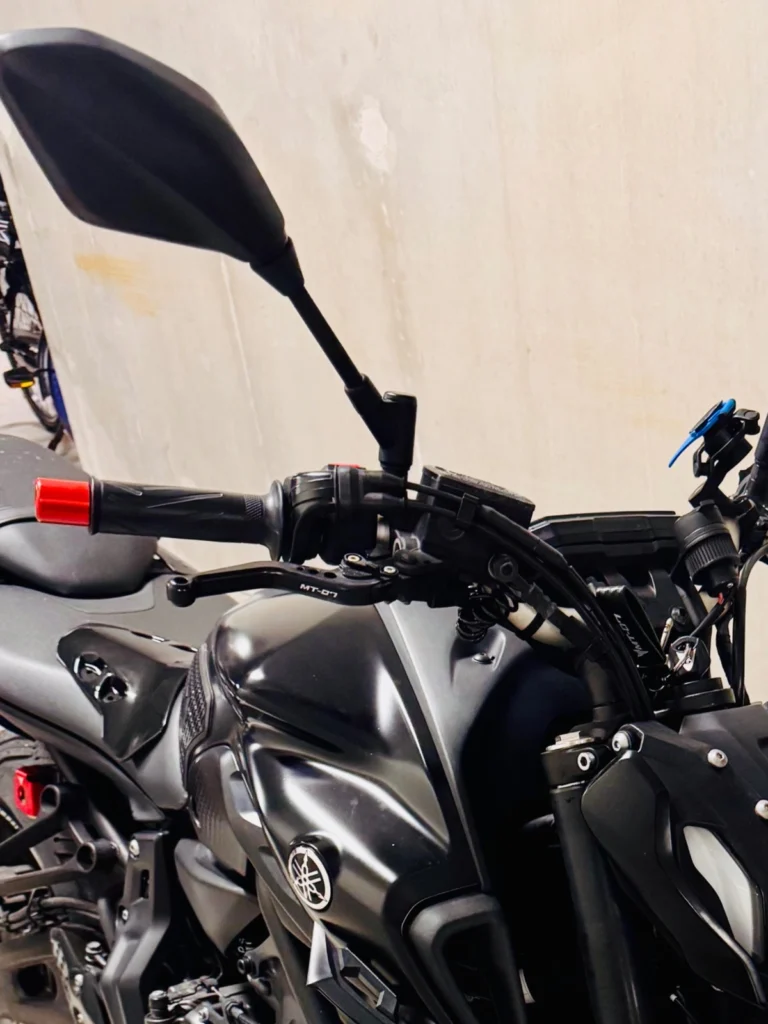
The opposite mistake is also common.
Some beginners know the front brake is powerful, but when something happens suddenly, they grab it too hard and too quickly.
A panic grab can unsettle the motorcycle, especially on slippery roads, gravel, painted lines or while leaned over.
Braking should not feel like an on/off switch.
It should feel like a controlled squeeze.
Think of it like this:
First, you ask the tire for grip.
Then, as the weight transfers forward, you ask for more.
That is progressive braking.
Better habit:
Practice braking before an emergency happens. Start slowly. Keep your eyes up. Squeeze the front brake smoothly. Add rear brake gently. Build the habit until braking feels familiar.
The first time you brake hard should not be when a car pulls out in front of you.
7. Entering Corners Too Fast
Cornering problems usually start before the corner.
A beginner rider may enter a corner too quickly, then realize halfway through that the turn is tighter than expected. That is when panic starts.
The rider may:
- Stare at the outside of the corner
- Grab the brakes
- Shut the throttle suddenly
- Become stiff
- Drift wide
- Freeze
- Stop trusting the motorcycle
The better solution is simple:
Slow down before the corner.
As a beginner, do most of your braking while the bike is upright. Enter the corner at a speed where you feel calm and in control. Look through the turn. Keep your arms relaxed. Use smooth throttle.
You do not need to attack corners.
You need to understand them.
Better habit:
Use the “slow in, smooth out” rule. Enter slower, look through the corner, stay relaxed and gently accelerate when the road opens.
Smooth cornering is safer than fast cornering.
8. Looking at the Danger Instead of the Safe Path
This mistake is called target fixation.
It happens when you stare at the thing you are afraid of hitting.
A pothole.
A curb.
A guardrail.
A car.
Gravel.
The outside of a corner.
A barrier.
The problem is that motorcycles tend to go where you look.
If you stare at the danger, your body may guide the bike toward it. If you look at the safe path, you give yourself a better chance to avoid it.
This is easy to understand but hard to practice under stress.
Your brain naturally wants to stare at the threat. You have to train yourself to look at the solution.
Better habit:
Look where you want to go. Turn your head. Point your eyes toward the safe path. If there is gravel, look at the clean line around it. If a corner feels tight, look through the exit.
Your eyes are part of your steering.
Use them properly.
9. Riding in Blind Spots
A motorcycle is small. It can disappear in traffic very easily.
One of the most dangerous beginner mistakes is sitting in another vehicle’s blind spot for too long.
This is especially risky around:
- Cars changing lanes
- Vans
- Trucks
- Buses
- Roundabouts
- Multi-lane roads
- Motorways
- City traffic
A simple rule:
If you cannot see the driver’s mirror, they may not be able to see you.
Do not stay beside vehicles longer than necessary. Either stay clearly behind or move through safely when it is legal and appropriate.
Be extra careful around large vehicles. Their blind spots are bigger and they may block your view of pedestrians, side roads, traffic lights and road hazards.
Better habit:
Position yourself where you are more visible and where you still have an escape path. Never rely completely on another driver seeing you.
Ride like you are invisible.
10. Fighting for Right of Way
This is a mistake that comes from ego.
Sometimes you have priority. Sometimes the other road user is clearly wrong. Sometimes a driver pulls out, cuts you off or moves into your space.
It is tempting to prove a point.
But on a motorcycle, being right is not the same as being safe.
If a car makes a mistake, do not turn it into a fight. Do not accelerate to defend your lane. Do not argue with a vehicle using your body. Do not let pride make your safety decision.
You can be right and still get hurt.
Better habit:
Choose the safest outcome, not the most satisfying reaction. Let the mistake go. Create space. Stay calm. Arrive safely.
Peace is a riding skill.
11. Trying to Keep Up With Faster Riders
Riding with others can be fun, but it can also create pressure.
A beginner may try to keep up with a faster rider, even when the pace feels uncomfortable.
That is dangerous.
The other rider may have more experience, better skill, better road knowledge, better tires, better braking control or simply a higher risk tolerance.
Their pace is not your pace.
If you try to ride someone else’s ride, you may enter corners too fast, brake too late or ignore your own discomfort.
A good rider respects their limits.
A good riding friend respects them too.
Better habit:
Ride your own ride. If someone is faster, let them go. If a group is too fast, drop back. If you feel pressured, slow down or stop.
Your goal is not to impress anyone.
Your goal is to ride again tomorrow.
Check : Whether the Yamaha MT-07 makes sense for a newer rider
12. Ignoring Road Surface Hazards
Beginner riders often focus mostly on traffic and forget that the road surface itself can become a hazard.
You need to watch for:
- Gravel
- Sand
- Oil
- Wet leaves
- Painted lines
- Metal covers
- Potholes
- Tram tracks
- Mud
- Loose debris
- Standing water
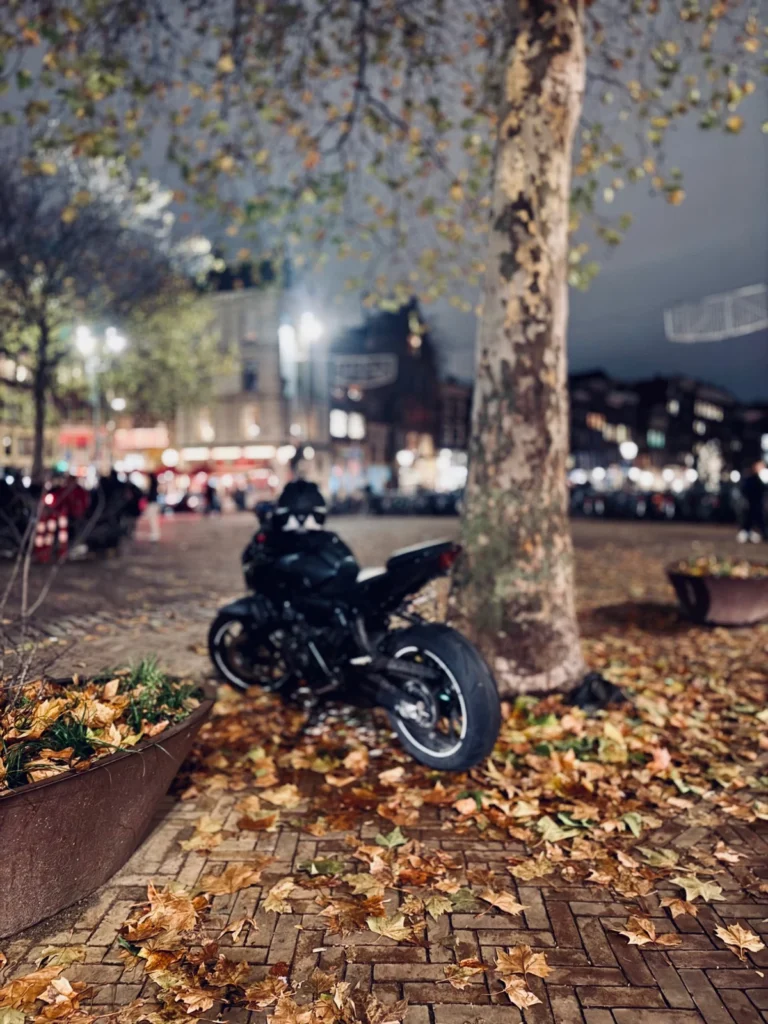
This matters even more in corners, junctions, parking areas, construction zones and city streets.
In Amsterdam and other urban areas, tram tracks, painted markings, wet surfaces and metal covers can be especially important to respect.
The earlier you spot a surface hazard, the smoother your reaction can be.
If you see gravel late, you may panic. If you see it early, you can slow down, reduce lean and choose a cleaner line.
Better habit:
Scan the road surface far ahead. Look for changes in colour, texture, shine, debris and markings. When grip is uncertain, stay smooth and keep the bike more upright.
13. Riding Too Fast for Visibility
Many riders think they are riding safely because they are not exceeding the speed limit.
But the speed limit is not always the safe speed.
The safe speed depends on what you can see, the road surface, the weather, traffic, your skill level and your ability to stop within the distance available.
If you cannot see around a corner, do not ride as if the road is clear.
If it is dark, wet, foggy or busy, slow down.
If there are parked cars, pedestrians, cyclists or side roads, create more margin.
A beginner mistake is riding at a speed that feels exciting but gives no time to react.
Better habit:
Ride at a speed where you can stop safely if something unexpected appears.
The question is not only, “Am I allowed to go this speed?”
The better question is, “Can I safely react at this speed?”
14. Skipping Pre-Ride Checks
A quick pre-ride check can prevent simple problems from becoming serious.
Many beginners skip this because they assume the bike is fine.
Most of the time, it probably is.
But “probably” is not a system.
Before riding, quickly check:
- Tires
- Brakes
- Lights
- Mirrors
- Chain
- Leaks
- Throttle
- Clutch
- Brake levers
- Fuel or battery range
- Riding gear
Also check yourself:
- Am I tired?
- Am I distracted?
- Am I angry?
- Am I rushing?
- Am I mentally ready?
- Am I properly dressed?
A motorcycle needs to be ready, but so do you.
Better habit:
Take one calm minute before the ride. Build the habit until it becomes automatic.
Check out : Top motorcycle safety tips for new riders
15. Riding Tired, Angry or Distracted
Your mental state matters more than you think.
Motorcycling requires focus. If your mind is somewhere else, you will miss important details.
Tired riders react slower.
Angry riders take more risks.
Distracted riders miss hazards.
Rushed riders make poor decisions.
Stressed riders become tense.
You do not need to be in a perfect mood to ride, but you do need enough mental clarity to make good decisions.
Some days, the safest ride is a short, calm ride.
Some days, the safest choice is not to ride at all.
That is not weakness.
That is maturity.
Better habit:
Before riding, check your mental state honestly. If you are tired or emotional, reduce the ride, simplify the route or wait until you are more focused.
A calm rider is a safer rider.
16. Not Practicing Low-Speed Control
Many beginners want to become better at fast riding, cornering or acceleration.
But low-speed control is where real confidence starts.
Low-speed skills help with:
- Parking lots
- U-turns
- Tight streets
- Traffic
- Slow filtering where legal
- Hill starts
- Stop-and-go riding
- Handling the bike calmly
If you cannot control the motorcycle smoothly at low speed, traffic will feel stressful.
Practice:
- Smooth starts
- Smooth stops
- U-turns
- Figure eights
- Slow riding
- Clutch control
- Rear brake control
- Looking where you want to go
Low-speed practice may not look exciting, but it builds confidence quickly.
Better habit:
Spend time practicing the boring basics. The boring basics are what make you look smooth later.
17. Forgetting to Cancel Indicators
This seems small, but it can become dangerous.
On many motorcycles, indicators do not cancel automatically. Beginner riders may forget to turn them off after a turn or lane change.
If your indicator stays on, other road users may think you are about to turn or move. That can create confusion.
Confusion in traffic is dangerous.
Better habit:
Build a habit of checking and cancelling your indicators after every turn or lane change.
You can make it part of your mental rhythm:
Turn. Straighten. Cancel. Check mirrors.
Small habits create safer riding.
18. Thinking Safety Makes Riding Boring
Some beginners worry that safe riding means boring riding.
I see it differently.
Safety is what allows you to enjoy riding more.
When you know how to brake, you feel calmer.
When you can corner smoothly, you feel more confident.
When you read traffic early, you feel less surprised.
When you wear proper gear, you ride with less anxiety.
When you ride within your limits, you enjoy the journey more.
Reckless riding may feel exciting for a moment.
Skilled riding feels good for a lifetime.
The goal is not to remove freedom.
The goal is to protect it.
Better habit:
See safety as part of the craft. The smoother, calmer and more aware you become, the more enjoyable riding gets.
19. Not Planning Fuel Stops or Basic Ride Preparation
This mistake sounds simple, but it can turn a normal ride into unnecessary stress.
Beginner riders often focus on the riding itself and forget the basic preparation around the ride.
Fuel.
Route.
Weather.
Phone battery.
Parking.
Road closures.
Breaks.
Gear for changing conditions.
When you ignore these things, small problems can become distractions. And distraction is not what you want on a motorcycle.
Running low on fuel in an unfamiliar area can make you rush.
Not checking the weather can leave you riding in rain with the wrong gear.
Starting a ride with low phone battery can become stressful if you need navigation.
Not planning breaks can make you tired and sloppy.
Not knowing the route can make you hesitate, brake late, or make sudden lane changes.
A safe ride is not only about what happens while moving.
It is also about how well you prepare before you leave.
This matters even more for beginner riders because your brain is already working hard. You are thinking about gears, braking, balance, traffic, lane position, mirrors, speed, road signs and other people’s mistakes.
The less unnecessary stress you add, the better.
Before a longer ride, ask yourself:
- Do I have enough fuel?
- Where can I refuel if needed?
- Is my phone charged?
- Do I know the route?
- Is the weather changing?
- Do I need rain gear?
- Do I have water?
- Do I need a break stop?
- Is my motorcycle ready?
- Am I mentally ready?
Better habit:
Plan the basics before the ride so you can focus fully while riding. You do not need to overthink every small trip, but you should avoid starting a ride unprepared.
Good preparation creates calm riding.
And calm riding is safer riding.
Quick Beginner Mistakes Checklist
Before your next ride, ask yourself:
- Am I wearing proper gear?
- Am I treating this short ride seriously?
- Am I mentally calm enough to ride?
- Am I keeping enough distance?
- Am I avoiding blind spots?
- Am I using both brakes smoothly?
- Am I slowing down before corners?
- Am I looking where I want to go?
- Am I scanning the road surface?
- Am I riding my own pace?
- Am I leaving an escape path?
- Am I willing to slow down when unsure?
If you can say yes to these, you are already riding with more maturity than many beginners.
Common Beginner Motorcycle Mistakes Table
| Mistake | Why It’s Risky | Better Habit |
|---|---|---|
| Skipping gear on short rides | Accidents can happen close to home | Gear up every ride |
| Overconfidence | Skill may not match confidence yet | Ride below your limit |
| Following too closely | Less time to react | Keep a safety bubble |
| Avoiding the front brake | Reduces stopping ability | Practice progressive braking |
| Grabbing the brake | Can unsettle the bike | Squeeze smoothly |
| Entering corners too fast | Creates panic mid-corner | Slow in, smooth out |
| Target fixation | You may ride toward the hazard | Look at the safe path |
| Sitting in blind spots | Drivers may not see you | Stay visible |
| Fighting for priority | Being right does not protect you | Choose safety over ego |
| Keeping up with faster riders | Pushes you beyond skill | Ride your own ride |
| Ignoring road surface | Grip can change suddenly | Scan far ahead |
| Riding tired or angry | Reduces judgement | Check yourself before riding |
Final Thoughts: Stay Humble and Keep Learning
Every rider makes mistakes.
The difference between a careless rider and a growing rider is reflection.
A growing rider notices the mistake, learns from it and adjusts before it becomes a habit.
You do not need to become perfect. You need to become aware.
Aware of your limits.
Aware of your surroundings.
Aware of your gear.
Aware of your emotions.
Aware of the road.
Aware of the bike underneath you.
Beginner riders often think confidence comes from doing more exciting things.
But real confidence comes from doing the basics well.
Wearing the gear.
Braking smoothly.
Looking far ahead.
Keeping space.
Slowing before corners.
Avoiding blind spots.
Staying calm.
Riding your own ride.
That is the foundation.
And the longer I ride, the more I respect the basics.
Motorcycling is freedom, but it is freedom with responsibility.
When you ride with humility, you give yourself the best chance to enjoy that freedom for years.
Ride smart. Stay calm. Come home safe.
FAQs : Common Beginner Motorcycle Mistakes
What is the biggest mistake beginner motorcycle riders make?
The biggest mistake beginner riders make is becoming overconfident before their skills are fully developed. This can lead to riding too fast, braking poorly, entering corners too quickly or taking unnecessary risks in traffic.
Should beginner riders use the front brake?
Yes. Beginner riders should learn to use the front brake properly because it provides most of the motorcycle’s stopping power. The key is to apply it smoothly and progressively, not grab it suddenly.
Is it dangerous to ride without full motorcycle gear?
Yes. Riding without proper gear increases the risk of injury if you crash or slide. A helmet, gloves, jacket, motorcycle pants and boots should be treated as basic riding equipment.
Why do beginners struggle with cornering?
Beginners often struggle with cornering because they enter too fast, look at the wrong place, tense their arms or make sudden inputs while leaned over. Slowing before the corner and looking through the turn helps a lot.
What is target fixation in motorcycling?
Target fixation is when a rider stares at a hazard and unintentionally moves toward it. To avoid it, look where you want to go instead of staring at the danger.
Should I ride with more experienced riders as a beginner?
Yes, but only if they respect your pace. Do not try to keep up with faster riders. Ride your own ride and let others wait or go ahead if needed.
Related Reads
Avoid Beginner Mistakes Before the Ride Starts
If you are building your safety foundation, start with the complete guide:
Motorcycle Safety for Beginners: The Complete Guide to Riding Smart