The first few minutes after a motorcycle crash can feel confused, loud and unreal.
You may not immediately know whether you are injured. Traffic may still be moving around you. The motorcycle may be lying in the road, and your first instinct may be to stand up, lift it or work out who caused the collision.
Those are not the first priorities.
Your immediate priorities are to avoid a second collision, contact emergency services when needed and protect anyone who is injured.
Questions about the motorcycle, insurance and responsibility come later.
This guide explains what to do after a motorcycle crash in a practical sequence. It includes general first-aid principles and specific notes for riders in the Netherlands.
It is not a replacement for emergency instructions or professional first-aid training. During a serious accident, follow the directions given by the emergency call handler and attending professionals.
Quick Answer
What Should You Do After a Motorcycle Crash?
After a motorcycle crash:
- Pause and check for immediate danger.
- Move yourself to safety when you can do so without worsening an injury.
- Call 112 when anyone is injured or there is immediate danger.
- Warn approaching traffic without placing yourself at further risk.
- Check whether injured people are responsive and breathing normally.
- Do not casually remove a motorcyclist’s helmet.
- Control severe bleeding with direct pressure when safe and possible.
- Photograph the scene and collect details only after urgent needs are handled.
- Arrange medical assessment for injuries or developing symptoms.
- Report the accident to your insurer and keep records of everything that follows.
Protect life first. Protect evidence only when the scene is already safe.
1. Do Not Rush to Stand Up
A crash can create a strong adrenaline response.
You may feel pressure to get out of the road, pick up the motorcycle or prove that you are unhurt.
Pause for a moment when the traffic situation allows it.
Check:
- Can you breathe normally?
- Can you move your hands and feet?
- Do you feel severe pain?
- Are you dizzy or confused?
- Is traffic still moving towards you?
- Is there fuel, smoke, fire or another immediate danger?
Do not remove your helmet simply because the ride has ended unexpectedly.
When you can move safely, get away from moving traffic. When you suspect a serious neck, back or limb injury and there is no immediate danger, remain still and wait for emergency assistance.
The situation may require movement when remaining in place creates a greater danger, such as being in an active traffic lane. Make the safest decision available rather than assuming that one rule works in every crash.
2. Get Yourself Out of Further Danger
A second collision may be a greater immediate threat than the original crash.
When you are physically able:
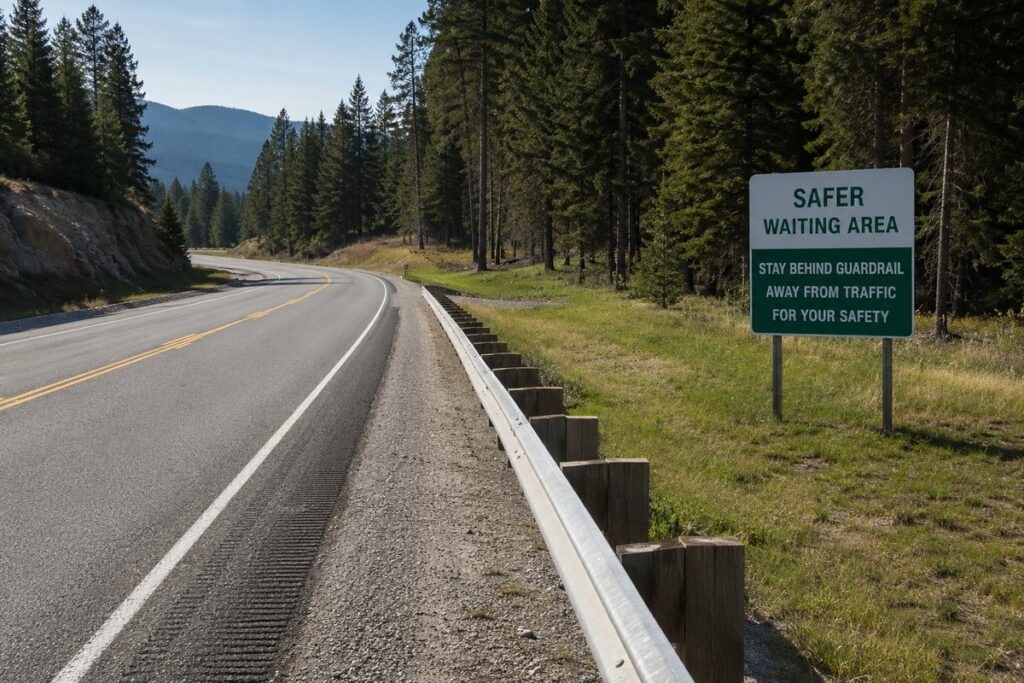
- Move behind a barrier or into a safe verge
- Stay away from leaking fuel
- Move away from smoke or fire
- Keep clear of live traffic lanes
- Make yourself visible
- Encourage uninjured people to move with you
On Dutch motorways, Rijkswaterstaat advises people who can leave the crash location themselves to wait behind the barrier or in the verge. Call 112 after a serious accident and remain in the safe area while help arrives.
Do not walk back into traffic to collect a camera, glove, pannier or broken piece of motorcycle.
Those items can be replaced.
You cannot protect the scene by becoming another casualty.
3. Call 112 When Anyone May Be Injured
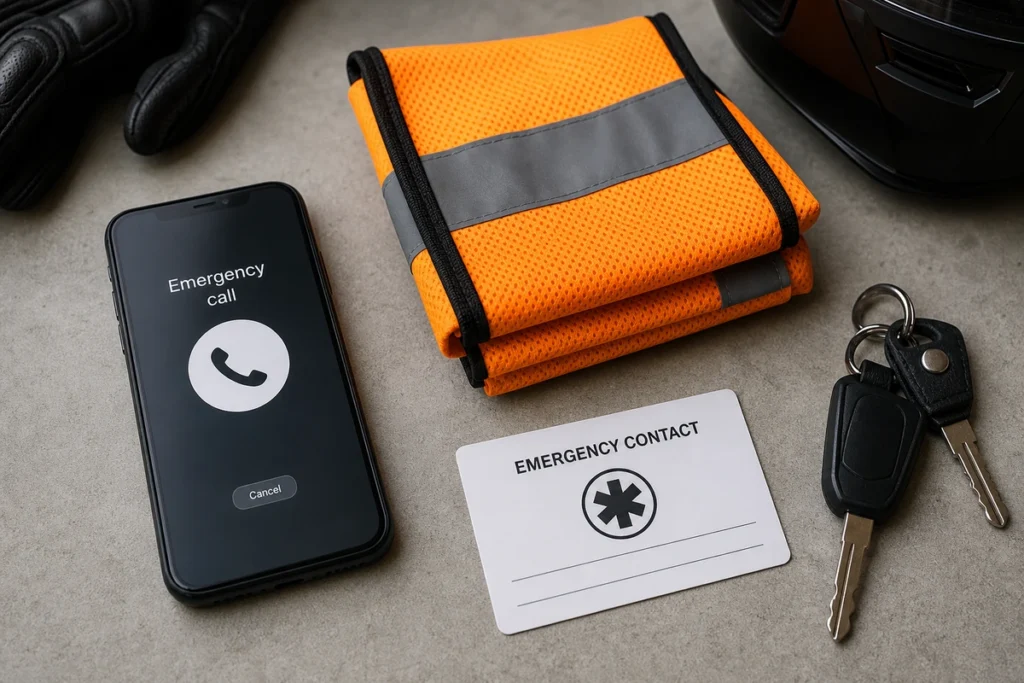
Call 112 when:
- Someone is injured
- Someone is unresponsive
- A person is not breathing normally
- There is severe bleeding
- Traffic creates an immediate danger
- The accident involves fire or leaking fuel
- Vehicles or debris are blocking a dangerous road
- You are unsure whether urgent help is required
The emergency number 112 connects callers with ambulance, police or fire services and can be used throughout the European Union.
Give the call handler:
- Your location
- The road name or number
- Your direction of travel
- A nearby junction, exit or kilometre marker
- The number of injured people
- Whether anyone is unconscious
- Whether anyone is trapped
- Any fire, fuel or traffic danger
Put the phone on speaker when practical so that you can follow instructions while keeping your hands available.
Do not end the call until the operator tells you to do so.
Netherlands Note
For a traffic accident involving injuries, the Dutch police advises calling 112 and beginning first aid. For a non-emergency police matter, the national police contact number is 0900-8844.
4. Warn Traffic Without Risking Your Own Safety
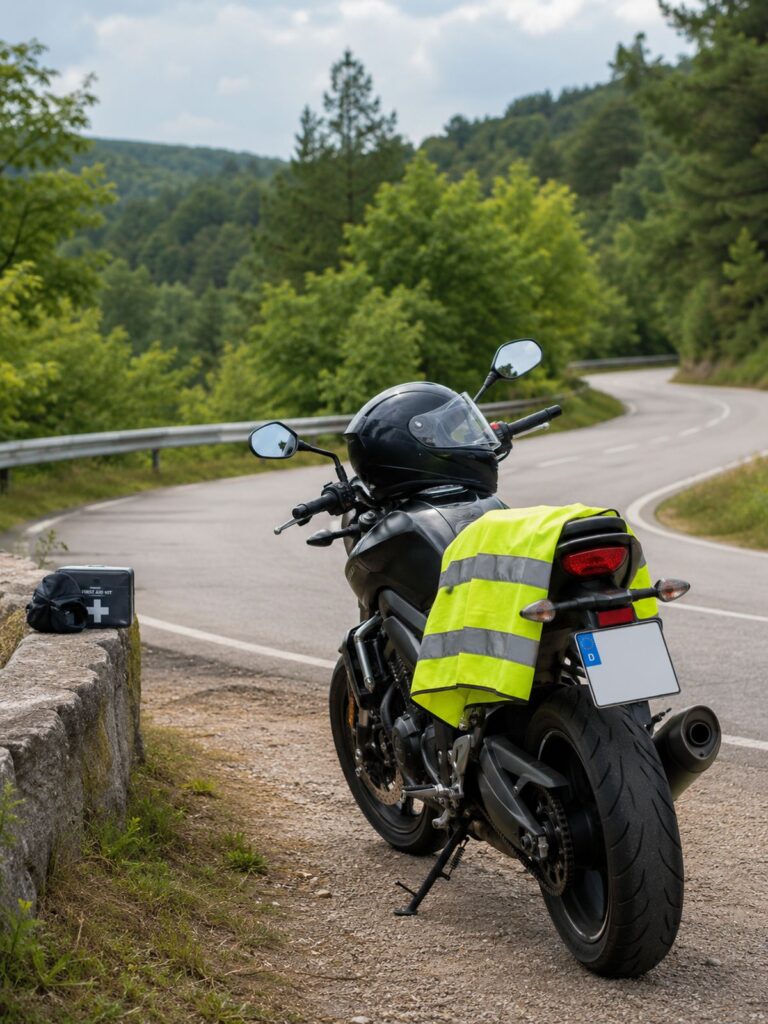
Other road users may not understand what has happened until they are close to the scene.
Use hazard lights when they are available and safe to activate. A reflective vest can help make you easier to notice.
A warning triangle may be useful in some situations, but do not walk along an active motorway lane to place one.
Your position behind a barrier is more important than preserving or marking the motorcycle.
Ask another uninjured person to warn traffic only when they can do so from a protected location.
Do not stand in the road waving at approaching vehicles.
5. Check the Injured Person
Approach only after confirming that it is safe enough to help.
Check whether the person:
- Responds when spoken to
- Can answer simple questions
- Is breathing normally
- Has severe visible bleeding
- Reports neck, back or severe limb pain
- Is becoming confused or unusually sleepy
The main first-aid priorities are airway, breathing and circulation. When someone is unresponsive and not breathing normally, contact emergency services and follow their CPR instructions. Airway and breathing take priority even when a spinal injury may be present.
When the person is conscious, encourage them to remain still and calm.
Keep checking their response and breathing while waiting for help.
Do not give an injured person food, drink or medication unless the emergency service specifically advises it.
6. Be Careful With the Helmet
Do not automatically remove a motorcyclist’s helmet after a crash.
When the rider is conscious and breathing normally:
- Leave the helmet in place
- Open the visor when needed
- Encourage the rider not to move their head
- Wait for emergency professionals
- Follow the 112 operator’s instructions
The Netherlands Red Cross advises leaving the helmet on when a neck or spinal injury is suspected and opening the visor instead.
The situation changes when the rider is unresponsive and not breathing normally.
The airway becomes the priority. Helmet removal may then be necessary to provide CPR or airway care, but it should be done according to the emergency operator’s instructions and preferably by people with appropriate training.
This article deliberately does not provide a written helmet-removal technique.
It is a practical skill that is safer to learn through recognised first-aid training.
7. Control Severe Bleeding
Severe bleeding can become life-threatening quickly.
When it is safe to help:
- Call 112 or confirm that someone else has called.
- Use gloves when they are immediately available.
- Apply firm, continuous pressure directly over the wound with a dressing or clean material.
- Keep the pressure in place until emergency help takes over.
- Follow any additional instructions given by the call handler.
Do not repeatedly lift the material to check whether the bleeding has stopped.
When an object is embedded in the wound, do not pull it out. Apply pressure around it rather than directly on top of it.
Direct pressure is the most important first action for serious external bleeding. Tourniquets require correct placement and should normally be used by someone who has been trained or under direct emergency guidance.
Keep the injured person warm with a jacket or blanket when possible, without unnecessarily moving them.
8. Do Not Move the Motorcycle Too Soon
Urgent safety comes before photographs or preserving the exact crash position.
When no one is injured and the motorcycle can be moved safely, clearing it from a dangerous traffic position may reduce the risk of another collision.
Before moving it, take a few photographs when this can be done without delaying safety.
Photograph:
- The overall road layout
- The position of each vehicle
- Lane markings and signs
- Traffic lights
- Road-surface conditions
- Debris or skid marks
- Damage to all vehicles
- Relevant obstructions
- Registration plates
When someone is injured, the scene is dangerous or the police have been called, wait for instructions before changing the situation unless movement is necessary to protect life.
Do not attempt to restart or ride the motorcycle merely to clear the road if controls, wheels, steering, brakes or fluid systems may be damaged.
Allow recovery professionals to move it when you are uncertain.
9. Exchange Details and Record What Happened
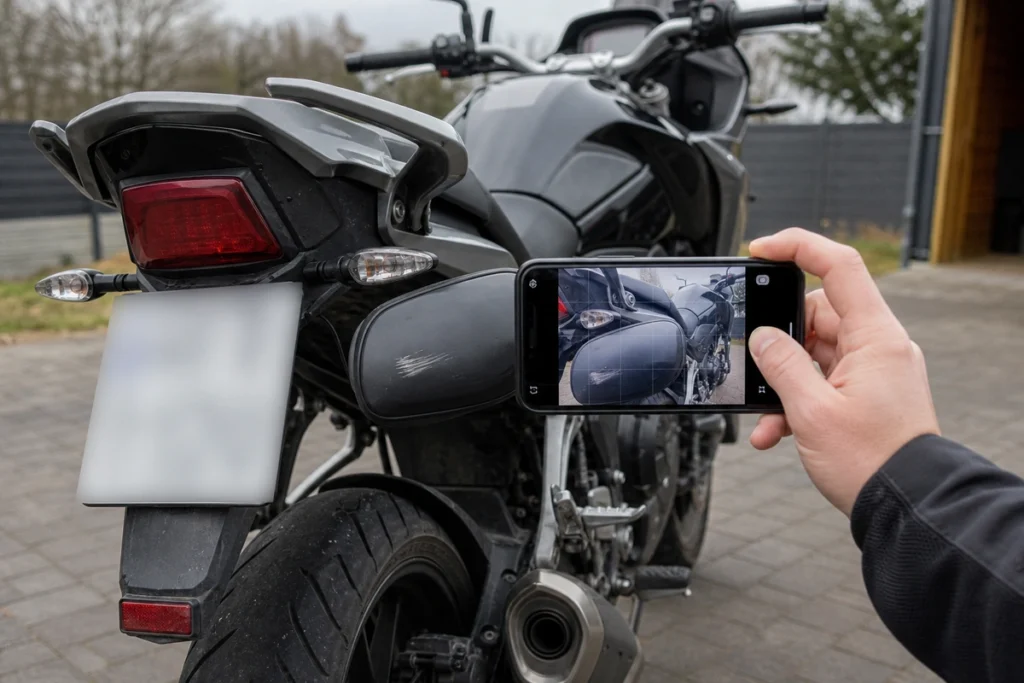
Once the urgent situation is under control, collect:
- Names and contact details
- Vehicle registration numbers
- Insurance information
- Contact details of witnesses
- Police or incident reference numbers
- Photographs and video
- The date, time and exact location
- Weather and road conditions
- A short factual description of events
Write your account while the details are still fresh.
Describe the direction of travel, lane position, signals, traffic conditions and sequence of events without exaggerating or guessing.
In the Netherlands, drivers involved in a collision must not leave without providing their details to the other party. Dutch police guidance also recommends completing the European Accident Statement or reporting the collision digitally.
Victim Support Netherlands recommends collecting the other party’s contact and insurance information, obtaining witness details and photographing the scene and damage.
Remain calm when speaking with the other party.
Do not argue beside the road or make promises about liability or payment. Record the facts and allow insurers or relevant authorities to assess responsibility later.
A permanently installed motorcycle dash cam can also preserve the sequence before and during an incident, but your immediate priority after a crash should still be safety, emergency help and medical care.
10. Get Medical Help Even When the Crash Felt Minor
Adrenaline can make pain less obvious immediately after a collision.
Seek urgent medical help for symptoms such as:
- Loss of consciousness
- Difficulty staying awake
- Repeated vomiting
- Confusion
- Severe or worsening headache
- Problems with speech, vision or balance
- Weakness or numbness
- Blood or clear fluid from the ears or nose
- Severe neck or back pain
- Difficulty breathing
- Uncontrolled bleeding
A road-traffic collision involving a head impact can require emergency assessment even when the rider initially appears awake. Some neck-injury symptoms may also take several hours to develop.
Do not ride yourself to a doctor or hospital after a head impact, significant fall or suspected injury.
Arrange an ambulance, taxi or lift from another person according to the urgency of the situation.
Dutch police guidance recommends contacting a doctor when you are injured or develop complaints after an accident, including complaints that initially appear minor.
Keep copies of:
- Medical reports
- Prescriptions
- Treatment invoices
- Travel costs
- Missed-work records
- Photographs of developing bruising or injury
- Notes about changing symptoms
These records may help both your recovery and any later insurance process.
11. Report the Crash Promptly
Contact your motorcycle insurer or assistance provider as soon as practical.
Provide:
- Your policy information
- The other party’s details
- The completed accident form
- Photographs
- Witness details
- Police or emergency references
- Medical information when requested
- The motorcycle’s recovery location
Follow the reporting deadline stated in your policy.
In the Netherlands, police guidance says that riders using a paper European Accident Statement should inform their insurer within 24 hours.
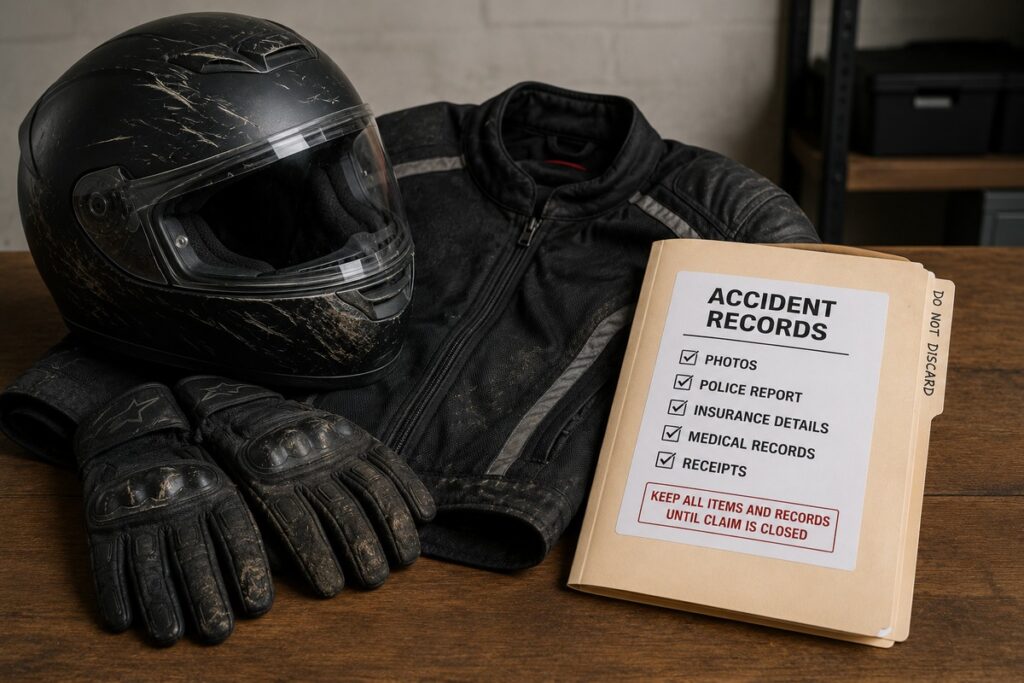
Do not approve repairs or dispose of damaged equipment before checking whether the insurer needs to inspect it.
Keep the helmet, protective clothing and damaged motorcycle parts until you have received appropriate advice.
Treat any helmet involved in an impact as potentially compromised. Follow its manufacturer’s instructions and the insurer’s assessment before deciding whether it can be used again.
When replacement becomes necessary, use How to Choose the Right Motorcycle Helmet Size to avoid replacing a damaged helmet with one that does not fit correctly.
12. Expect an Emotional Response
A motorcycle crash can affect more than the body and motorcycle.
You may experience:
- Replaying the crash repeatedly
- Difficulty sleeping
- Anger or guilt
- Nervousness around traffic
- Loss of confidence
- Irritability
- Avoidance of the crash location
- Pressure to ride again quickly
These responses do not automatically mean that something is seriously wrong.
Give yourself time and speak with people you trust.
Victim Support Netherlands offers free emotional, practical and compensation-related support to people affected by traffic accidents. It also advises seeking professional support when severe stress continues or does not begin reducing over time.
Do not use the first ride after a crash to prove that nothing has changed.
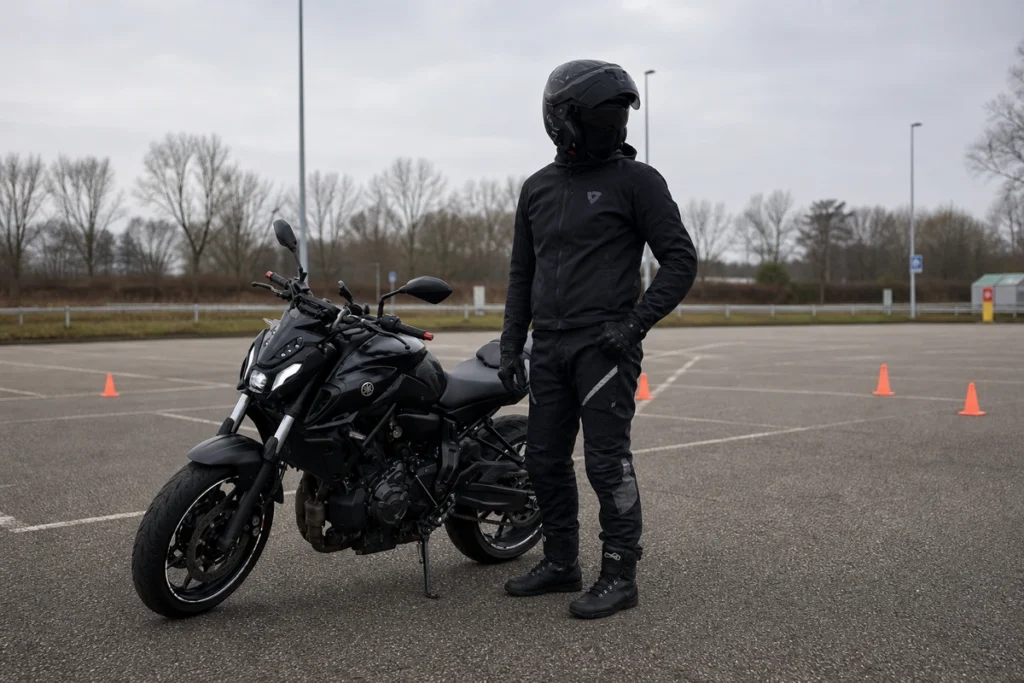
A professional refresher lesson may be more useful than forcing yourself back into the same road or traffic conditions. Read Motorcycle Safety Courses: Are They Worth It? when planning a controlled return.
Common Mistakes
| Mistake | Why It Creates Risk | Better Response |
|---|---|---|
| Standing up immediately | An injury may not yet be obvious | Pause and assess yourself |
| Lifting the motorcycle first | Traffic and injuries remain the priorities | Reach safety and call for help |
| Walking into traffic to collect equipment | Creates the risk of a second collision | Leave objects for professionals |
| Removing the rider’s helmet automatically | May cause unnecessary neck movement | Leave it on unless airway care requires action |
| Moving an injured person unnecessarily | May worsen a suspected spinal injury | Move only for immediate safety or on professional instruction |
| Arguing about blame | Distracts from safety and evidence | Exchange details and record facts |
| Forgetting witness information | Witnesses may be difficult to find later | Collect contact details early |
| Taking only close-up damage photos | Removes the wider road context | Photograph the full scene |
| Riding a damaged motorcycle home | Hidden damage may affect control | Arrange professional recovery |
| Ignoring mild physical symptoms | Some symptoms develop later | Seek appropriate medical advice |
| Discarding damaged gear | The insurer may need to inspect it | Store it until the claim is clear |
| Returning to riding immediately | Confidence and concentration may not have recovered | Return gradually and deliberately |
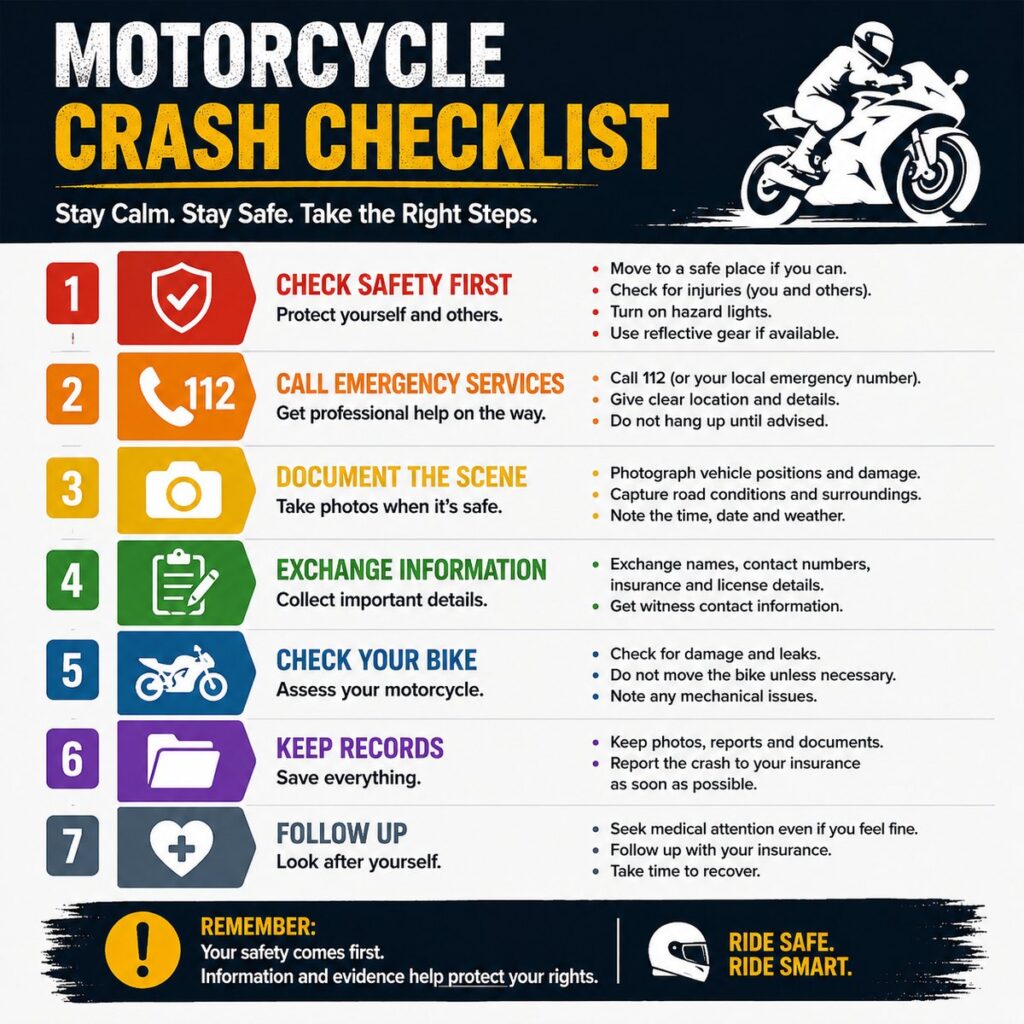
Motorcycle Crash Checklist
Immediate priorities:
- Pause and assess danger
- Move behind a barrier or away from traffic when able
- Call 112 for injuries or immediate danger
- Give the exact location
- Check responsiveness and breathing
- Control severe bleeding
- Leave the helmet on unless airway care requires action
- Keep injured people warm
- Follow emergency instructions
When the scene is safe:
- Photograph the road and vehicles
- Record registration numbers
- Exchange contact and insurance details
- Collect witness information
- Complete the accident form
- Arrange motorcycle recovery
- Keep damaged gear
After leaving the scene:
- Obtain medical assessment when needed
- Monitor for developing symptoms
- Report the crash to the insurer
- Save receipts, reports and photographs
- Write down what happened
- Ask for emotional or practical support
- Return to riding only when physically and mentally ready
Final Thoughts: Use the Right Order
A motorcycle crash creates many problems at once.
The motorcycle may be damaged. Traffic may be building. People may be angry, frightened or injured.
Trying to solve everything immediately creates confusion.
Use a clear order:
Safety. Emergency help. First aid. Evidence. Medical care. Insurance. Recovery.
Do not risk a second collision to protect the motorcycle.
Do not remove a helmet casually.
Do not allow embarrassment or pressure to prevent you from getting medical help.
Most importantly, do not judge the success of your response by whether you stayed calm every second.
Focus on the next useful action and accept help when it arrives.
Protect life first.
Everything else can be handled afterwards.
FAQs
What should you do immediately after a motorcycle crash?
Check for immediate danger, move away from traffic when physically able and call 112 when anyone may be injured. Do not begin by lifting the motorcycle or arguing about responsibility.
Should you remove a motorcyclist’s helmet after an accident?
Leave the helmet in place when the rider is conscious and breathing normally. When the rider is unresponsive and not breathing normally, airway care takes priority; call 112 and follow the operator’s instructions.
When should you call 112 after a motorcycle accident?
Call when someone is injured, unconscious, not breathing normally, bleeding severely or exposed to immediate danger. Also call for fire, leaking fuel or a dangerous road obstruction.
Should you move a motorcycle after a crash?
Move it only when the urgent medical situation is under control and doing so improves safety. Photograph the position first when possible, but never delay escape from immediate danger to collect evidence.
What information should you collect after an accident?
Collect names, contact details, registration numbers, insurance information, witness details, photographs, the location and any police or incident reference.
Should you see a doctor after a minor motorcycle crash?
Seek medical advice when you have pain, dizziness, confusion, a head impact or any developing symptoms. Some neck and concussion symptoms may not appear immediately.
Can you ride the motorcycle home after an accident?
Do not ride when you are injured or when the motorcycle’s steering, brakes, wheels, controls or fluids may have been affected. Arrange professional recovery when there is any doubt.
What should you do after a single-vehicle motorcycle crash?
Follow the same safety and medical priorities. Report damaged road furniture or property, contact the appropriate police or road authority and inform your insurer.
Related Reads
Motorcycle Safety for Beginners: The Complete Guide
Beginner’s Guide to Defensive Motorcycle Riding
Motorcycle Safety Gear Explained: What Each Piece Actually Does