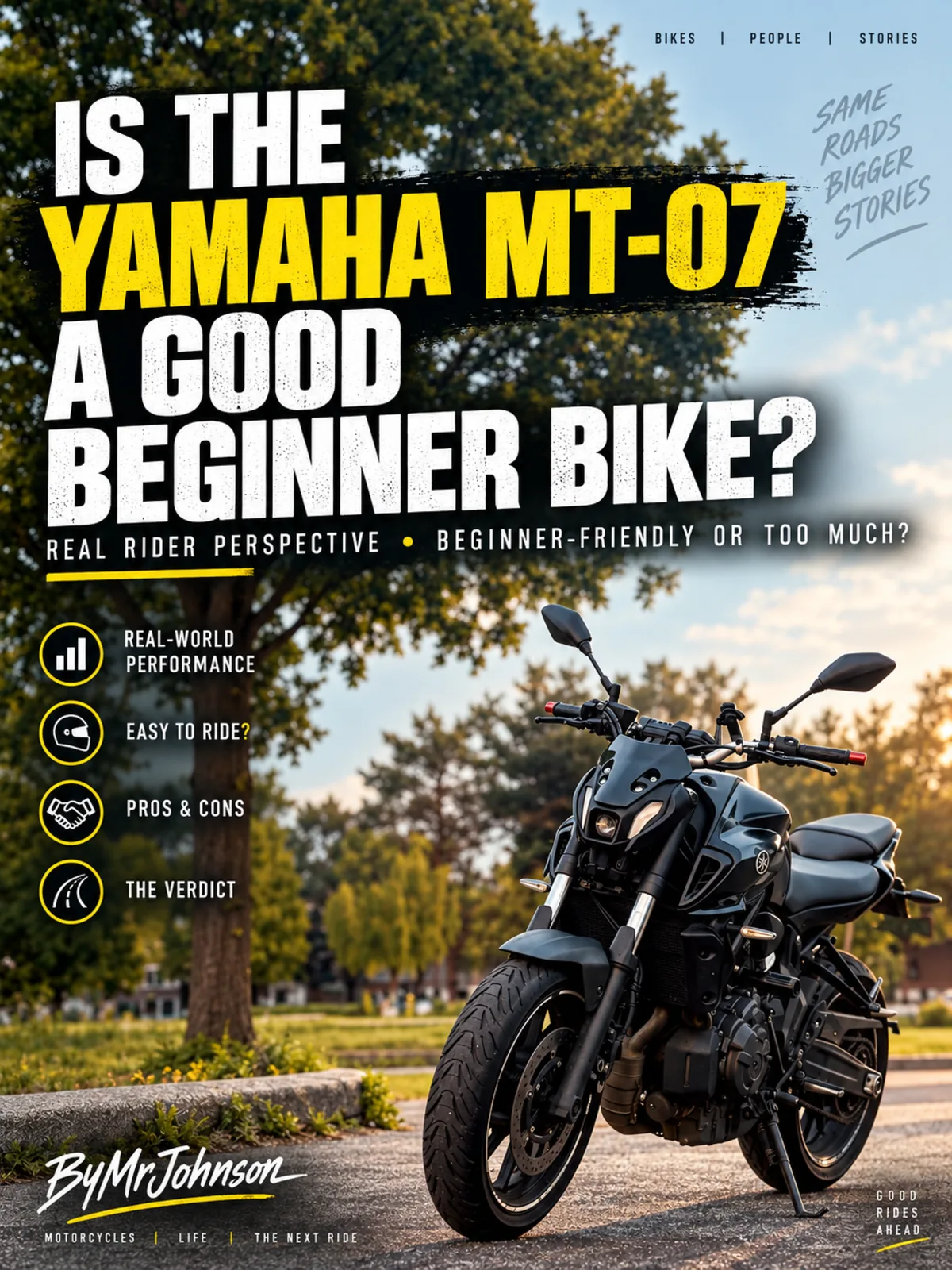
After spending around 10,000 kilometres with my 2021 Yamaha MT-07, I understand why it appears so often in conversations about beginner motorcycles.
It’s relatively compact. It doesn’t feel unnecessarily heavy. The riding position is straightforward. The engine works well at normal road speeds. And in Europe, Yamaha even offered the MT-07 in a 35 kW version suitable for A2 licence restrictions.
So, is the Yamaha MT-07 a good beginner motorcycle?
Yes—for the right beginner.
But I would add an important condition to that answer.
The MT-07 might be approachable, but it isn’t harmless.
My 2021 model produces 54 kW (73.4 PS) and 67 Nm of torque in unrestricted form. That’s enough performance to turn a rough throttle input, poor judgement or overconfidence into a problem surprisingly quickly.
What makes the MT-07 interesting as an early motorcycle isn’t that it is slow.
It’s that the bike combines useful performance with relatively manageable dimensions.
And whether that combination suits you depends just as much on the rider as it does on the motorcycle.
My perspective comes from living with one
My MT-07 is a 2021 model called TITAN.
I bought it used with close to 20,000 km on the odometer, and it now sits at roughly 30,500 km.
That means I’ve ridden around 10,000 km during my first year of ownership.
Most of that has been a mixture of weekday riding and weekend getaways, including plenty of time around Amsterdam.
I don’t claim that makes me the final authority on the MT-07.
But it has given me enough time with the motorcycle to move beyond the first impressions you get during a short test ride.
I’ve experienced it in slow manoeuvres, busy traffic, ordinary weekday riding and longer stretches away from the city.
And I think the answer to the beginner question becomes much clearer once you stop looking only at engine size.
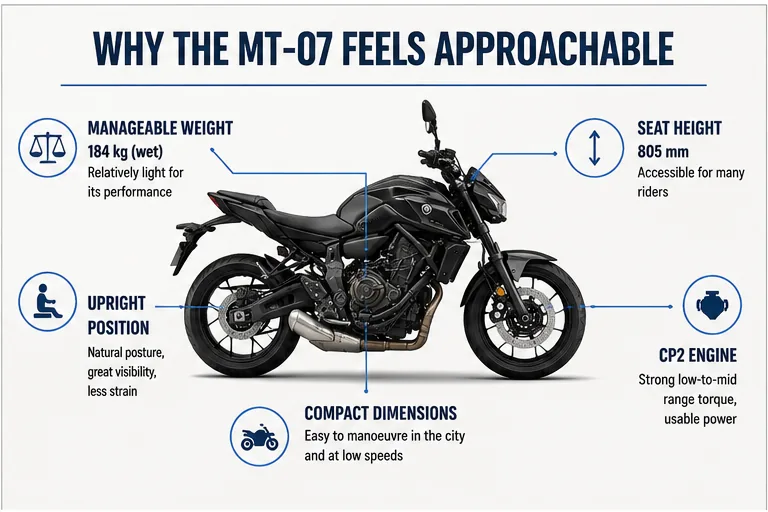
Why the MT-07 can work well for a newer rider
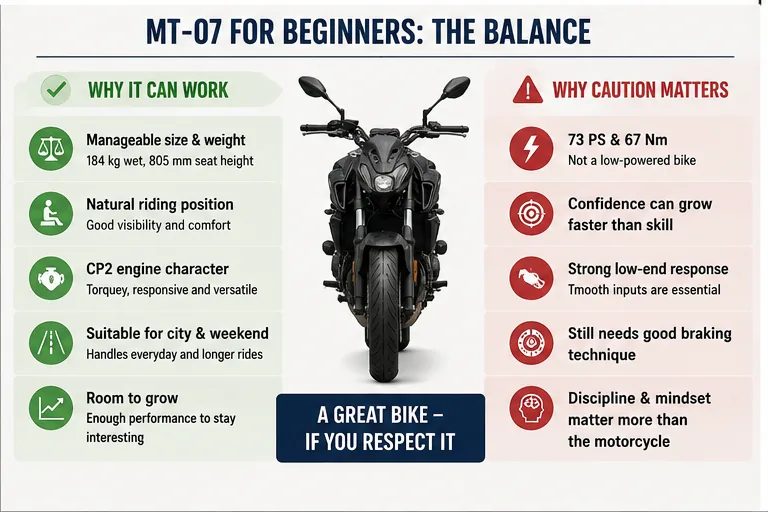
Several characteristics make the MT-07 easier to live with than its performance figures might suggest.
1. The physical size is relatively manageable
The 2021 MT-07 has an official wet weight of 184 kg and a seat height of 805 mm.
Those numbers don’t tell you whether you will find the bike comfortable, but they help explain why the MT-07 tends not to feel like an enormous motorcycle.
For me, that matters particularly at low speed.
Moving through a tight space, parking, making a U-turn or dealing with stop-start city riding often tells you more about how approachable a motorcycle feels than cruising along an open road.
A motorcycle becomes much easier to enjoy when you’re not constantly fighting its size.
That said, don’t confuse a manageable motorcycle with automatically having good motorcycle control.
Balance, clutch control, rear-brake use, vision and smooth throttle inputs still need to be learned.
If slow manoeuvres are something you’re working on, my guide to low-speed motorcycle control goes much deeper into those fundamentals.
2. The riding position feels natural
The MT-07’s relatively upright naked-bike layout is another reason I can understand its appeal to newer riders.
You’re not folded aggressively over the fuel tank like you would be on some sportier motorcycles.
For everyday road riding, I like being able to sit relatively upright and look farther ahead.
That becomes particularly useful in traffic.
Being comfortable on the motorcycle gives you more mental capacity to pay attention to what actually matters:
- traffic developing ahead;
- junctions;
- cyclists and pedestrians;
- blind spots;
- road surfaces;
- escape space;
- whether another driver has seen you.
A rider who is still learning already has a lot to process.
I would rather have a motorcycle that lets me concentrate on riding than one that adds unnecessary physical awkwardness to the equation.
3. The CP2 engine works well at normal road speeds
The 689 cc CP2 engine is probably the main reason people continue enjoying the MT-07 after the beginner stage.
You don’t have to chase the top of the rev range before the bike feels alive.
There is useful torque available during ordinary road riding, which makes the motorcycle responsive without needing constant gear changes.
That versatility is one of the things I’ve appreciated most about TITAN.
I can ride it calmly.
I don’t have to ride aggressively for the engine to feel satisfying.
And as my own riding develops, there is still enough motorcycle underneath me to remain interesting.
That last point is often used as an argument for buying the MT-07 as a first motorcycle:
“You won’t grow out of it.”
I understand the argument.
But I wouldn’t use it as the main reason to choose your first bike.
Your first priority should be finding something you can control confidently now, not worrying about whether you might become bored two years from now.
4. You can ride it calmly
This is an important distinction.
The MT-07 has enough performance to be exciting, but you don’t have to use all of it every time you leave home.
When I’m riding through the city, I’m not thinking about maximum horsepower.
I’m thinking about smoothness.
Throttle.
Braking.
Position.
Vision.
What the vehicle ahead might do.
The motorcycle is perfectly capable of being ridden that way.
And that makes a big difference.
A good road motorcycle should still make sense when you’re riding at seven-tenths—or much less.
The problem is that the motorcycle won’t force you to ride sensibly.
That part is still your responsibility.
Why I hesitate to call the MT-07 an easy beginner bike
This is where the discussion needs more nuance.
There are several characteristics that I think newer riders should take seriously.
1. Seventy-three horsepower is still seventy-three horsepower
The unrestricted 2021 MT-07 produces 54 kW, or 73.4 PS, with peak torque of 67 Nm.
That isn’t superbike territory.
But it is considerably more performance than anyone needs to learn the fundamentals of riding.
The danger with labels such as beginner-friendly is that they sometimes make a motorcycle sound almost incapable of getting a rider into trouble.
That’s not how I see the MT-07.
The CP2 engine responds strongly enough that poor throttle control matters.
If you’re tense, abrupt or trying to impress somebody, the motorcycle isn’t going to protect you from every bad decision.
A newer rider needs to understand that before treating the MT-07 as the automatic “safe choice.”
2. Confidence can grow faster than skill
This may be the bigger risk.
A motorcycle like the MT-07 can become comfortable surprisingly quickly.
Once the controls stop feeling unfamiliar and basic riding starts becoming more natural, it’s easy to interpret that comfort as:
“I’m getting really good at this.”
Maybe.
But basic comfort and actual riding competence aren’t the same thing.
You can learn to accelerate quickly long before you’ve developed strong:
- emergency braking;
- cornering judgement;
- hazard perception;
- vision;
- low-speed control;
- wet-weather skills;
- defensive riding habits.
That gap between confidence and competence is something I’d pay much more attention to than engine capacity alone.
I’ve written separately about common beginner motorcycle mistakes because many of the biggest problems newer riders face have little to do with the motorcycle itself.
3. The low-end response rewards smooth inputs
One reason the CP2 engine is so enjoyable is that you don’t have to wait for high revs before something happens.
For an experienced rider, that makes ordinary road riding entertaining.
For someone still developing throttle finesse, it means smoothness matters.
The lesson isn’t:
“The MT-07 throttle is dangerous.”
It’s:
Don’t treat throttle control as an on/off switch.
Roll it on progressively.
Keep your hands relaxed.
Separate intentional acceleration from nervous movements at the bars.
And remember that throttle control becomes particularly important while turning or when road grip isn’t perfect.
Those fundamentals matter on every motorcycle.
The MT-07 simply gives you enough response to notice when you’re getting them wrong.
4. It doesn’t eliminate the need for proper braking technique
Being able to accelerate is one thing.
Being able to stop the motorcycle properly is more important.
Before worrying about how quickly an MT-07 accelerates, I’d want a newer rider to become comfortable with progressive front-brake application, appropriate rear-brake use and keeping their vision up during harder braking.
Those skills should be practised deliberately rather than discovered for the first time during an emergency.
I’ve explained the basics separately in How to Brake Safely on a Motorcycle.
What about the A2 version?
For European riders, this changes the conversation significantly.
Yamaha’s official 2021 specifications list a 35 kW limited-power version of the MT-07 alongside the standard 54 kW version.
In the Netherlands, an A2 licence applies to motorcycles with a maximum power of 35 kW.
That makes the MT-07 particularly interesting because a rider can potentially experience the same basic motorcycle platform with restricted power while building experience.
I wouldn’t buy one blindly because of that, though.
Licence compatibility answers a legal question.
It doesn’t automatically answer whether the bike physically suits you or whether you’re ready for it.
We’ll go much deeper into the restricted version, Dutch licensing rules and what an A2 rider should check before buying in the next article:
Yamaha MT-07 on an A2 Licence: What European Riders Should Know.
MT-07 versus a smaller beginner motorcycle
This is probably the real decision many new riders are trying to make.
Do you buy something like an MT-07 immediately, or start on a smaller-capacity motorcycle?
There isn’t one correct answer.
A smaller motorcycle can make learning easier
A lighter, lower-powered motorcycle usually gives you more room to make imperfect inputs without immediately adding lots of acceleration.
That can make it easier to concentrate on:
- clutch control;
- braking;
- cornering;
- observation;
- slow-speed balance;
- positioning.
There’s also something useful about learning how to carry momentum and ride smoothly instead of using engine performance to cover poor technique.
Choosing a smaller bike isn’t failing to buy enough motorcycle.
Sometimes it’s choosing a better learning tool.
The MT-07 offers more room to grow
The other side of the argument is that the MT-07 can cover a broader range of riding.
City riding.
Faster roads.
Weekend trips.
Longer-term ownership.
After around 10,000 km with TITAN, I certainly haven’t reached a point where the engine suddenly feels irrelevant.
There’s still plenty for me to learn on the motorcycle.
But I’d rather frame that as:
The MT-07 has enough range to support a developing rider.
Not:
“Buy the biggest beginner bike possible so you don’t outgrow it.”
Those are two very different mindsets.
The beginner matters more than the motorcycle
Whenever someone asks me whether the MT-07 is a good beginner motorcycle, I think the better question is:
What kind of beginner are we talking about?
Two riders with exactly the same licence and number of months riding can be very different.
I would be more comfortable recommending an MT-07 to a beginner who:
- has completed proper motorcycle training;
- has reasonably smooth throttle and clutch control;
- doesn’t feel a need to prove themselves;
- practises slow-speed riding;
- takes braking seriously;
- is comfortable asking for more training;
- understands that confidence isn’t the same as skill;
- plans to ride progressively rather than immediately chase performance.
I would hesitate if the rider:
- is intimidated by the motorcycle’s weight or dimensions;
- struggles significantly with clutch or throttle control;
- buys mainly because friends say smaller bikes are boring;
- wants maximum acceleration as a first priority;
- assumes ABS or other technology can rescue every mistake;
- doesn’t intend to practise;
- feels pressure to “keep up” with faster riders.
That second list isn’t a judgement.
It simply suggests that another motorcycle may create a better learning environment.
Can you comfortably handle the MT-07 at a stop?
This is something I’d test before getting caught up in horsepower discussions.
The 805 mm seat height is reasonably accessible for many riders, but inseam, leg length, seat width and confidence all affect how a motorcycle actually feels.
You do not necessarily need to flat-foot both feet to ride a motorcycle safely.
Plenty of experienced riders can’t.
But a first motorcycle should not make every stop feel stressful.
Sit on one.
Move it around with the engine off.
Bring it upright from the side stand.
Put a foot down.
Try the controls.
If possible, experience one in a controlled training or dealership environment before making your decision.
Specifications can narrow down a shortlist.
They cannot tell you how secure you feel on a motorcycle.
City riding is where I appreciate the MT-07 most
One reason I can see the MT-07 working for developing riders is how usable it feels during normal riding rather than only when the road opens up.
Amsterdam is not a place where maximum horsepower matters very often.
What matters is being able to:
- ride slowly without becoming tense;
- see around traffic;
- anticipate cyclists and pedestrians;
- position the motorcycle intelligently;
- control the bike smoothly in stop-start conditions;
- stay patient.
The MT-07 gives me a platform that works well for that.
But city riding also reinforces why skill matters more than motorcycle specifications.
A compact bike doesn’t solve poor observation.
An upright riding position doesn’t guarantee somebody has seen you.
And a responsive engine doesn’t create an escape route if you’ve positioned yourself badly.
If urban riding is part of why you’re considering an MT-07, read my guide to riding safely in heavy traffic alongside this one.
Don’t underestimate training
If you’re deciding between spending money on another accessory or more training early in your riding life, I would take the training seriously.
A course can give you structured practice in an environment where somebody can actually watch what you’re doing.
That’s very different from repeatedly practising the same mistake by yourself.
Training also helps expose weaknesses that normal riding can hide.
Maybe your braking needs work.
Maybe you’re looking too close to the motorcycle during slow manoeuvres.
Maybe you’re tense through corners.
Maybe your road positioning could be more deliberate.
None of those problems are solved by buying a “better beginner bike.”
If you’re considering additional instruction, I’ve looked at the value of post-licence training in Motorcycle Safety Courses: Are They Worth It?.
Would I recommend the MT-07 as a first motorcycle?
For some riders, yes.
I would be comfortable considering an MT-07 if the rider has received proper training, feels physically comfortable with the bike and has the temperament to approach its performance progressively.
For European A2 riders, the official 35 kW version makes the proposition even more interesting.
But I wouldn’t recommend it because someone wants the most powerful motorcycle they can justify as “beginner friendly.”
And I wouldn’t tell somebody who’s happier on a 300, 400 or 500 cc motorcycle that they’re making the wrong choice.
Your first motorcycle doesn’t need to impress anyone.
It needs to help you ride.
That’s a very different job.
Check : My actual MT-07 running costs
My perspective after 10,000 km
After roughly 10,000 km with TITAN, what makes me appreciate the MT-07 isn’t simply that it has enough power.
It’s the balance.
It can feel manageable during mundane everyday riding and still make me want to take the longer way home.
There’s enough performance to remain interesting, but I don’t need to chase that performance to enjoy the motorcycle.
It also keeps reminding me of something I’ve gradually come to appreciate more:
Becoming a better rider is far more interesting than simply becoming a faster one.
The MT-07 gives me plenty of room to continue working on that.
Whether it is the right motorcycle for your beginning depends on whether you’re looking for the same thing.
Read : My experience after 10,000 km of ownership
Beginner MT-07 Checklist
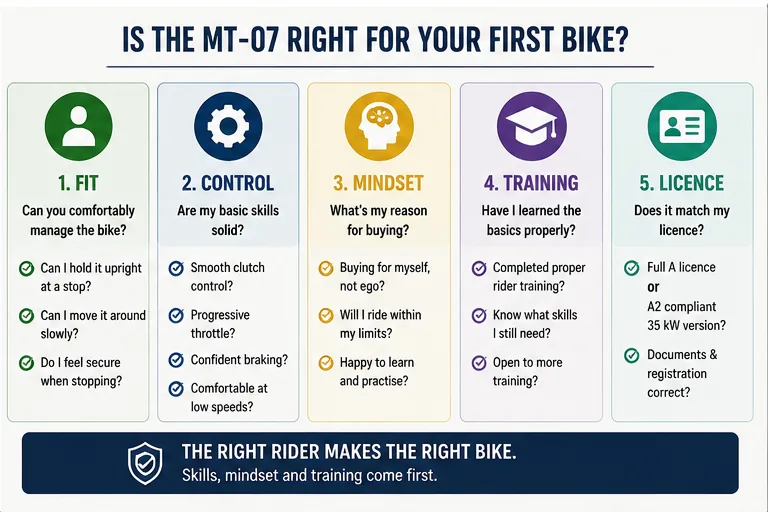
Before choosing an MT-07 as your first or early motorcycle, I’d ask yourself:
Physical fit
- Can I comfortably hold the motorcycle upright?
- Can I move it around slowly without panic?
- Do I feel reasonably secure when stopping?
Control
- Is my clutch control consistent?
- Can I use the throttle progressively?
- Am I comfortable braking firmly and smoothly?
- Can I complete slow turns without staring at the ground?
Mindset
- Am I buying this motorcycle because it suits me—or because I don’t want a “small” bike?
- Can I resist riding faster simply because the motorcycle makes it easy?
- Am I willing to practise?
Training
- Have I completed proper rider training?
- Do I know what skills I still need to improve?
- Would additional training be more useful than another modification?
Licence
- Does the exact MT-07 I’m considering match my licence category?
- If I’m on A2, is it genuinely the compliant 35 kW version and documented correctly?
If you’re uncomfortable answering several of those questions, that doesn’t automatically mean the MT-07 is wrong for you.
It might simply mean there is more value in training and experience before buying one.
FAQs
Is a Yamaha MT-07 too powerful for a beginner?
The unrestricted 2021 MT-07 produces 54 kW/73.4 PS and 67 Nm, so I wouldn’t describe it as low-powered. A well-trained and disciplined beginner may manage it well, but newer riders should respect the engine’s responsiveness rather than assuming the “beginner bike” label makes it harmless.
Is the MT-07 heavy for a beginner?
Yamaha lists the 2021 MT-07 at 184 kg wet. I find that relatively manageable in everyday use, although rider size, strength, technique and confidence all affect how a motorcycle feels.
What is the seat height of the 2021 Yamaha MT-07?
The official seat height is 805 mm. Whether that’s comfortable for you depends on more than height alone, so sitting on the motorcycle is far more useful than relying only on the number.
Can you ride an MT-07 with an A2 licence?
Yamaha offered the 2021 MT-07 in a 35 kW limited-power version. In the Netherlands, A2 motorcycles may have a maximum power of 35 kW. Always verify the exact motorcycle’s registration and restriction rather than assuming every MT-07 is A2 compliant.
Is the MT-07 a good motorcycle to grow into?
In my experience, yes. After roughly 10,000 km of ownership, I still find plenty to enjoy and learn from. But I wouldn’t choose a first bike only because you’re worried about “outgrowing” something smaller.
Related Reads
If you’re considering an MT-07 while developing your riding skills, continue with:
Living With a Yamaha MT-07: My 10,000 km Ownership Guide
Common Beginner Motorcycle Mistakes: What New Riders Should Avoid Early
20 Motorcycle Low-Speed Control Tips: Balance, U-Turns & Slow Riding