A lot of motorcycles are fun once the road opens up.
I think a more interesting test is what they’re like when the road doesn’t.
Traffic.
Junctions.
Low-speed manoeuvres.
Constant stops and starts.
Narrow spaces.
Short trips.
Ordinary weekday riding.
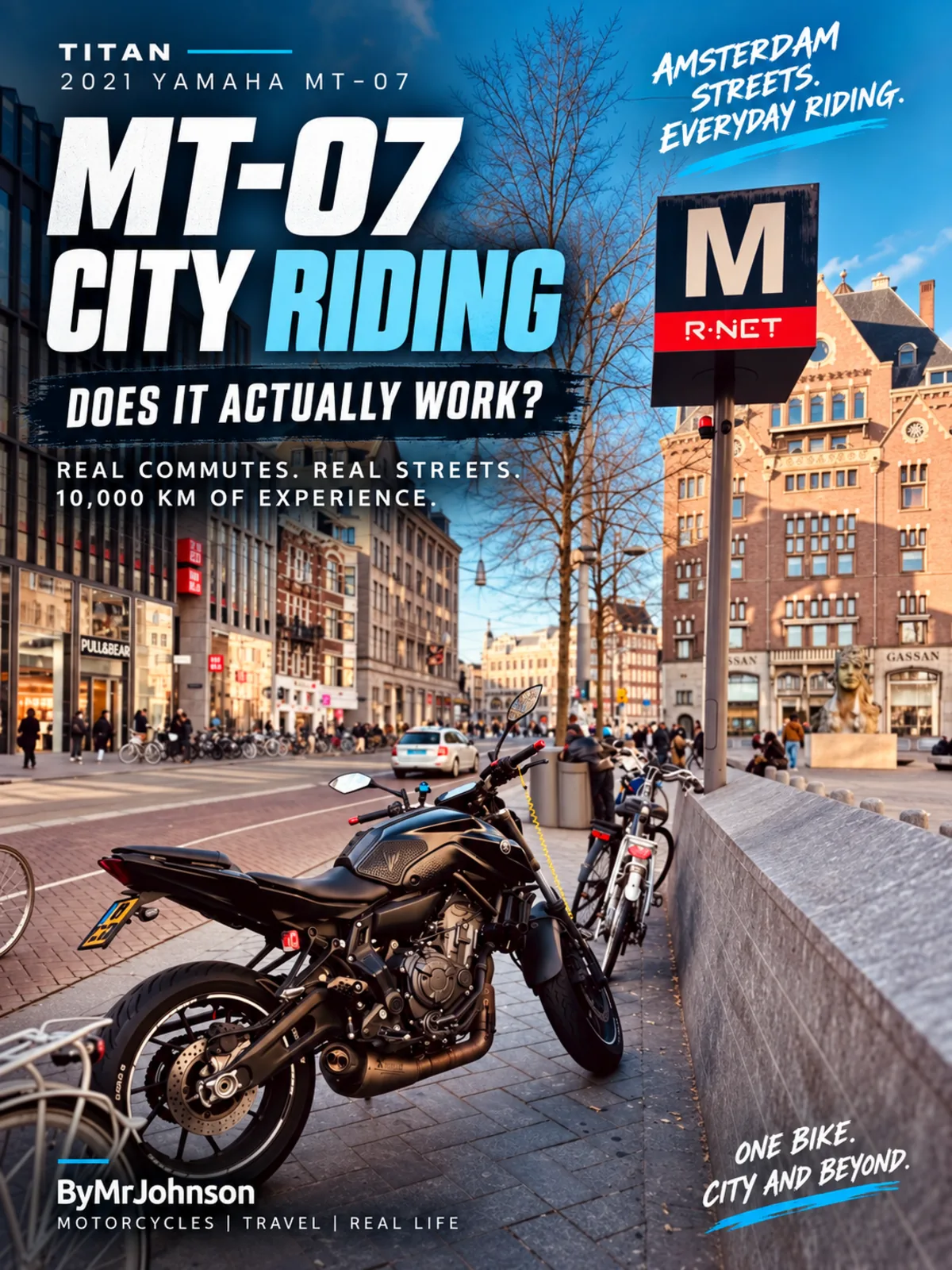
That’s a big part of how I use my 2021 Yamaha MT-07.
TITAN isn’t a motorcycle I only bring out for perfect weekend roads. After roughly 10,000 km together, plenty of our riding has involved normal city life around Amsterdam alongside the weekend escapes.
And if you ask me whether the Yamaha MT-07 is good for commuting and city riding, my answer is:
Yes. This is actually one of the areas where the MT-07 makes the most sense to me.
Not because it gives me 73 horsepower in traffic.
Most of the time, that isn’t particularly important.
What I value is that the motorcycle feels compact, relatively manageable, upright and responsive without making ordinary riding feel like hard work.
But there are compromises too.
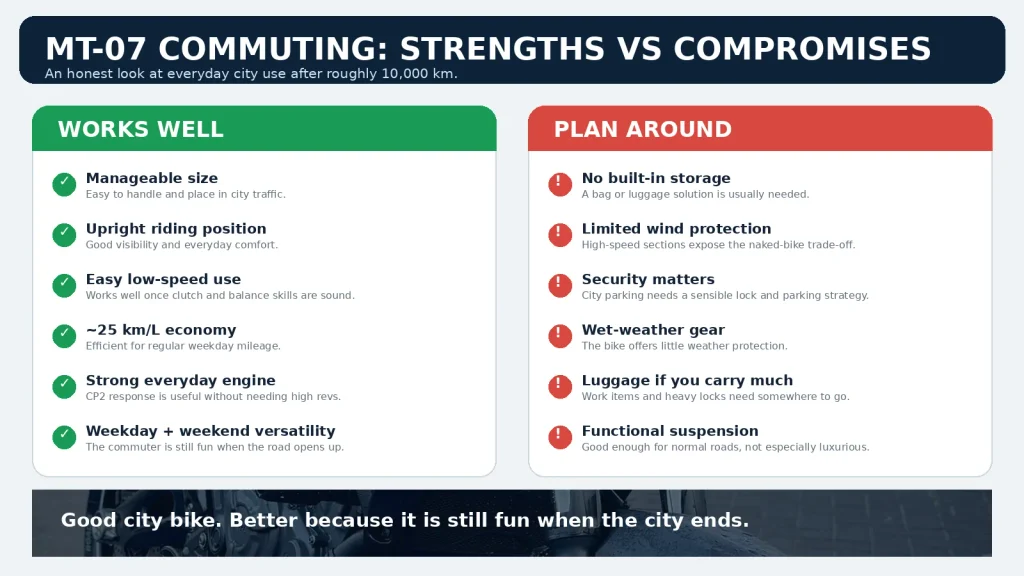
Wind protection is limited.
Built-in storage basically isn’t there.
Weather still matters.
Security matters.
And no motorcycle can make a rider good at navigating busy city traffic.
So let’s look at what the MT-07 actually brings to everyday urban riding.
My city-riding context
For some perspective, this is the motorcycle I’m talking about:
| Description | TITAN |
|---|---|
| Motorcycle | 2021 Yamaha MT-07 |
| Distance ridden by me | ~10,000 km |
| Typical riding | Weekdays + weekend getaways |
| Location | Amsterdam, Netherlands |
| Wet weight | 184 kg |
| Seat height | 805 mm |
| Overall width | 780 mm |
| Wheelbase | 1,400 mm |
| Fuel economy | ~25 km/L |
| Tank | 14 litres |
The numbers don’t automatically make a motorcycle a good commuter.
But they help explain why the MT-07 works the way it does.
The biggest advantage: it doesn’t feel unnecessarily large
This is probably the first thing I’d point to.
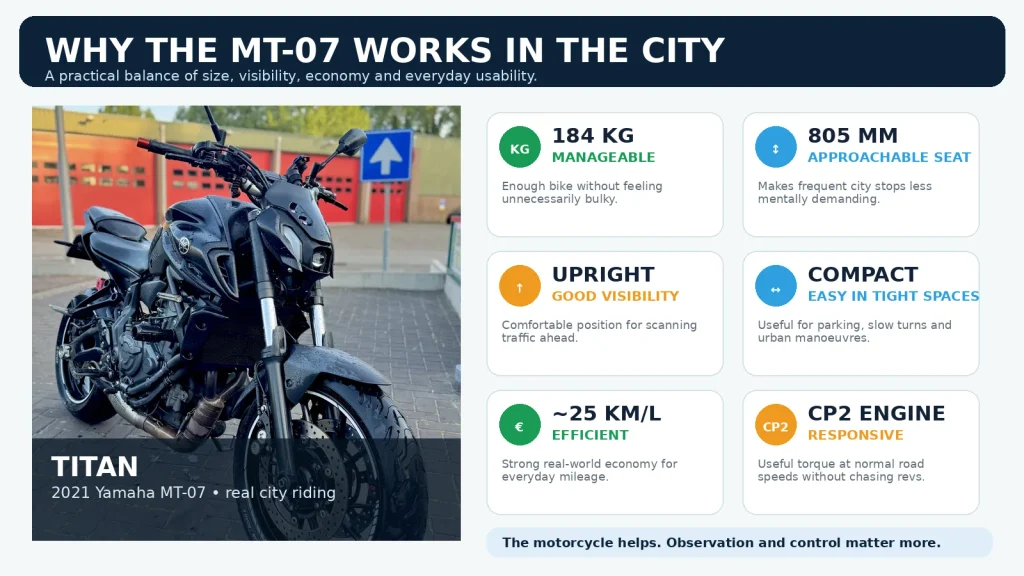
The MT-07 feels like enough motorcycle without feeling like I’m bringing more physical size into the city than I need.
Yamaha lists my 2021 model at 184 kg wet.
That isn’t featherweight.
But for a full-size 689 cc road motorcycle, I find it manageable.
And in city riding, manageability matters constantly.
You notice it when:
- pushing the motorcycle out of a parking space;
- making a tight turn;
- stopping on an awkward surface;
- changing direction at low speed;
- dealing with stop-start traffic;
- positioning the bike precisely;
- parking at the end of the ride.
Those things aren’t exciting enough to dominate motorcycle reviews.
But if you ride regularly in a city, they’re part of ownership every week.
A motorcycle that feels easy to handle during those ordinary moments becomes a motorcycle you’re more willing to use.
That’s something I’ve come to value a lot.
The 805 mm seat height works well for everyday stops
Seat height is always personal.
Leg length, seat shape and riding experience matter more than simply reading a number.
But the MT-07’s 805 mm seat height contributes to the generally approachable feel.
I don’t spend every traffic light thinking about how I’m going to manage the motorcycle when I stop.
That’s useful in urban riding because stopping isn’t an occasional event.
It’s constant.
Of course, being able to reach the ground doesn’t replace good stopping technique.
Looking ahead, choosing where you stop and keeping the bike balanced still matter.
But a motorcycle that feels physically manageable reduces unnecessary mental workload.
And the less attention I’m spending managing the motorcycle itself, the more attention I have for what’s happening around me.
The upright riding position makes sense in traffic
This might be one of the MT-07’s most useful city characteristics.
The riding position is relatively upright.
For me, that makes it easier to keep my head up and scan farther ahead.
In heavy traffic, I don’t want to be focused on the vehicle directly in front of me.
I’m trying to read several layers of traffic.
What are the cars farther ahead doing?
Is somebody approaching a junction?
Where are the cyclists?
Is there a pedestrian who might step out?
Is a vehicle drifting toward my space?
Where would I go if the lane suddenly stopped?
The motorcycle doesn’t answer those questions.
But an upright riding position makes it comfortable to keep looking.
If you’re developing those habits, my guide to riding a motorcycle safely in heavy traffic goes much deeper into the rider side of the equation.
The CP2 engine works surprisingly well when you’re not riding fast
One reason I enjoy the MT-07 so much is that its engine doesn’t demand huge speeds before it feels useful.
The 689 cc CP2 produces 67 Nm of torque, with plenty of useful response through normal road riding.
In city use, that means I don’t need to constantly chase revs to move naturally with traffic.
The motorcycle responds easily.
That can make short gaps, normal acceleration and everyday gear changes feel uncomplicated.
But this comes with an important warning.
Responsive doesn’t mean careless
The same engine response I enjoy can punish poor throttle control.
Especially for a newer rider.
The MT-07’s approachable size sometimes gives people the impression that everything about the motorcycle is gentle.
I don’t think that’s quite right.
It’s manageable.
But it still has a 689 cc twin producing more than enough torque for normal roads.
Smooth inputs matter.
I try to avoid treating the throttle like a switch.
Roll it on.
Keep the hands relaxed.
Stay deliberate.
In traffic, smoothness is useful not only for comfort but because predictable riding gives me more time to observe what’s happening.
The fastest possible response is rarely the response I actually need.
Slow-speed control matters more than horsepower
If somebody asked me what MT-07 skill matters most in a city, I wouldn’t say acceleration.
I’d probably say:
being comfortable below 20 km/h.
That sounds much less exciting.
But think about what city riding actually contains:
- slow queues;
- tight turns;
- parking;
- U-turns;
- manoeuvring around obstacles;
- short stops;
- pulling away smoothly;
- balancing at walking pace.
That’s why practising low-speed motorcycle control has been so useful for me.
The MT-07 gives me a manageable platform.
But clutch control, rear brake, throttle smoothness, balance and vision still determine whether slow riding feels calm.
If those are weak, even a relatively light motorcycle can feel heavy.
I’ve put the drills I use and think about into my 20 low-speed motorcycle control tips.
The width is useful without turning the bike into a tiny machine
Yamaha lists the 2021 MT-07 at 780 mm wide.
Again, a specification doesn’t tell the whole story.
Mirrors, bars and your own spatial awareness determine how the motorcycle actually feels in tight spaces.
But the overall package doesn’t feel bulky to me.
That’s useful when roads get busy or parking space is limited.
I still treat every gap deliberately.
A narrow motorcycle doesn’t mean a gap is safe.
And I’m not using dimensions as an excuse to squeeze through anywhere the bike physically fits.
Physical space and safe space aren’t the same thing.
That’s an important distinction in city riding.
Visibility matters more than being small
One potential downside of a relatively compact motorcycle is that other road users aren’t necessarily paying any more attention to you.
Sometimes probably less.
Being able to fit into traffic does not mean being noticed in traffic.
So I spend a lot of time thinking about where I place TITAN.
Can the driver ahead see me?
Am I sitting in a blind spot?
Does my position give me a view past the vehicle?
Does it give me somewhere to go if traffic suddenly stops?
Can somebody joining the road actually see me?
That connects directly to the riding habits I covered in Motorcycle Visibility Tips for Urban Riders and my guide to motorcycle lane positioning.
A manoeuvrable motorcycle gives you options.
Good positioning decides whether you use those options intelligently.
Stop-start traffic doesn’t make the bike miserable
Some motorcycles feel happiest only when they’re moving quickly.
The MT-07 doesn’t strike me that way.
Its upright layout and manageable proportions mean I don’t resent slower sections of a ride.
Obviously I’d rather be on an open road than sitting in congestion.
But the motorcycle itself isn’t fighting me.
This matters if commuting is part of your use.
A commuter motorcycle has to be tolerable on the bad days too.
Not just enjoyable on Sunday morning.
The downside: there is basically no storage
This is where a scooter immediately starts laughing at the MT-07.
Built-in practicality isn’t one of the bike’s strengths.
If I need to carry:
- work items;
- rain gear;
- a lock;
- groceries;
- camera equipment;
- extra layers;
then I need some kind of luggage solution.
Backpack.
Tank bag.
Tail bag.
Panniers.
Top box.
Something.
The standard motorcycle doesn’t provide much help.
This doesn’t stop the MT-07 being a good commuter.
It simply means you need to think honestly about what you carry.
Someone travelling to work with only a phone and wallet has a very different problem from someone carrying a laptop, clothes and heavy security equipment.
Security becomes part of commuting practicality
There’s another piece of city ownership that specifications don’t capture:
What happens when you get off the motorcycle?
A bike can be perfect in traffic and still create stress if you constantly worry about where you’re leaving it.
My own setup includes security equipment because city ownership doesn’t end when the engine switches off.
For now, I don’t want to turn this article into the full motorcycle-security guide.
That deserves its own treatment, particularly in the Amsterdam cluster.
But if you’re considering an MT-07 primarily for city riding, I would include security in the purchase budget.
Not as an optional afterthought.
As part of ownership.
Fuel economy is excellent for everyday use
TITAN has been averaging roughly:
25 km/L
or around:
4.0 L/100 km
That’s useful in city ownership because commuting mileage accumulates quietly.
Twenty kilometres here.
Thirty there.
Another ride tomorrow.
Fuel consumption matters more over a year than it feels like after one trip.
At my real-world costs, I’ve been spending roughly:
€10 of fuel per 100 km
I’ve broken the full numbers down in my MT-07 fuel economy and range guide.
For an engine that still gives me plenty of performance on weekends, I think that’s a very good balance.
The 14-litre tank is plenty for my weekday use
The 2021 bike has a 14-litre tank.
At my roughly 25 km/L average, the mathematical maximum works out to approximately 350 km.
In practice, I prefer to think about refuelling somewhere around 250–300 km.
For city riding, that means fuel stops are not something I need to think about constantly.
The range is more than sufficient for my normal use.
If anything, my own need for a break becomes more relevant on longer trips than the tank does.
Weather is probably the bigger commuting compromise
Living in the Netherlands means a commuter motorcycle needs to coexist with weather.
Rain.
Cold mornings.
Wind.
Wet roads.
Changing conditions.
The MT-07 itself handles normal wet-weather riding perfectly well when everything is maintained properly and the rider adjusts appropriately.
My Michelin Road 6 tyres are also part of my current setup.
But the motorcycle doesn’t give me weather protection.
There is no large fairing protecting my legs and torso.
That’s the trade-off of a naked bike.
So when people ask whether an MT-07 is a good commuter, I think the answer depends partly on:
How committed are you to riding when conditions aren’t ideal?
If you’re only commuting on dry days, the question is easy.
If you’re riding through a Dutch winter, gear and preparation become much more important.
My wet-weather motorcycle riding guide covers that side in more detail.
A naked bike means wind exposure
City speeds aren’t where I notice this most.
It’s the faster part of a commute.
Once you’re regularly using motorway or faster roads, the lack of wind protection becomes more obvious.
TITAN has a windscreen.
It helps a little.
But it doesn’t transform the motorcycle into a touring bike.
If your commute includes long periods of high-speed riding every day, I’d think carefully about whether a naked motorcycle is really the best tool.
The MT-07 can absolutely do it.
The better question is whether you want to do it every day.
Is the MT-07 comfortable enough for commuting?
For my use, yes.
Short and medium everyday rides aren’t something I find physically demanding.
The riding position is natural.
The controls are straightforward.
And the bike doesn’t feel cumbersome.
The limits appear more clearly once rides become much longer.
Seat comfort and wind exposure become more noticeable.
But for normal city use, those aren’t major complaints for me.
The suspension is good enough for normal city riding—but not luxurious
I’ve mentioned this in my MT-07 owner review.
The suspension works.
For normal riding, I don’t spend my time complaining about it.
But broken road surfaces and sharper bumps remind you that this isn’t a premium suspension setup.
City roads aren’t always perfectly smooth.
Manhole covers.
Repairs.
Uneven surfaces.
Different materials.
The best response isn’t always to start shopping for expensive suspension immediately.
Often it’s simply:
See the surface early.
Reduce unnecessary speed.
Keep the motorcycle settled.
Let the suspension work.
Again, the rider is part of the system.
The simplicity suits commuting
My 2021 MT-07 doesn’t require a pre-flight checklist of electronics before I start riding.
Start.
Helmet.
Gloves.
Go.
There are riders who love having multiple riding modes, connectivity and sophisticated displays.
Nothing wrong with that.
But for everyday use, I appreciate how little ceremony TITAN requires.
The motorcycle doesn’t feel like an event.
It feels accessible.
That is an underrated commuting characteristic.
What would make the MT-07 a better commuter?
If I were building an MT-07 specifically around everyday commuting, I’d prioritise function in roughly this order.
1. Security
Locks and whatever parking-security setup makes sense for your location.
2. Luggage
A solution that removes the need to carry everything on your body.
3. Weather protection
Not necessarily a giant touring screen, but whatever helps your particular commute.
4. Navigation / phone access
Only if you genuinely use it regularly.
5. Comfort
Address an actual discomfort after you’ve experienced it rather than modifying the motorcycle pre-emptively.
Notice what isn’t at the top of the list:
Performance modifications.
For commuting, the standard engine already has far more performance than I need.
Practicality is where accessories can add the most value.
What I wouldn’t change for commuting
The engine.
The general riding position.
The motorcycle’s basic size.
Those are some of the reasons it works in the first place.
It’s easy to get pulled into the idea that every motorcycle becomes better once enough aftermarket parts are installed.
I’m increasingly trying to avoid that mindset.
If something solves a real problem, good.
If it doesn’t, I’d rather spend the money on fuel and ride.
Is the MT-07 better than a scooter for commuting?
Purely as a commuter?
Not necessarily.
A scooter can offer:
- automatic transmission;
- built-in storage;
- weather protection;
- exceptional low-speed convenience;
- even easier urban manoeuvrability.
If the only objective is efficiently crossing a city every day, a good scooter makes an extremely strong case.
But that’s not the only reason I own TITAN.
I want the weekday practicality and the weekend motorcycle.
That’s where the MT-07 makes sense for me.
The bike I use around Amsterdam is also the bike I want to take farther away once I have more time.
That dual role is much more important to me than winning a pure commuting comparison.
MT-07 city riding versus weekend riding
This is probably the motorcycle’s biggest strength in my life.
Monday:
Normal city use.
Weekend:
Get out of town.
Same motorcycle.
I don’t need one machine for commuting and another one for fun.
The MT-07 shifts between those jobs easily enough that I don’t think much about it.
And after roughly 10,000 km, that’s something I value more than outright performance.
Versatility sounds boring until you live with it.
Then it becomes one of the best features a motorcycle can have.
Check Out : What everyday motorcycle life in Amsterdam is actually like
What newer riders should know
I can see why an MT-07 appeals to newer riders who live in cities.
It feels relatively manageable.
The seat isn’t extremely tall.
The bike isn’t enormous.
The riding position is comfortable.
But city riding itself can be demanding.
There is a lot of information arriving at once.
So I wouldn’t make the mistake of thinking:
manageable bike = easy traffic
Urban riding requires:
- observation;
- patience;
- low-speed control;
- lane positioning;
- braking;
- anticipation;
- restraint.
If you’re still developing those skills, the motorcycle can give you a good platform.
It cannot provide them for you.
That’s also why my answer to whether the MT-07 is a good beginner motorcycle is deliberately more nuanced than simply saying yes.
So, is the Yamaha MT-07 a good commuter?
For the kind of riding I do:
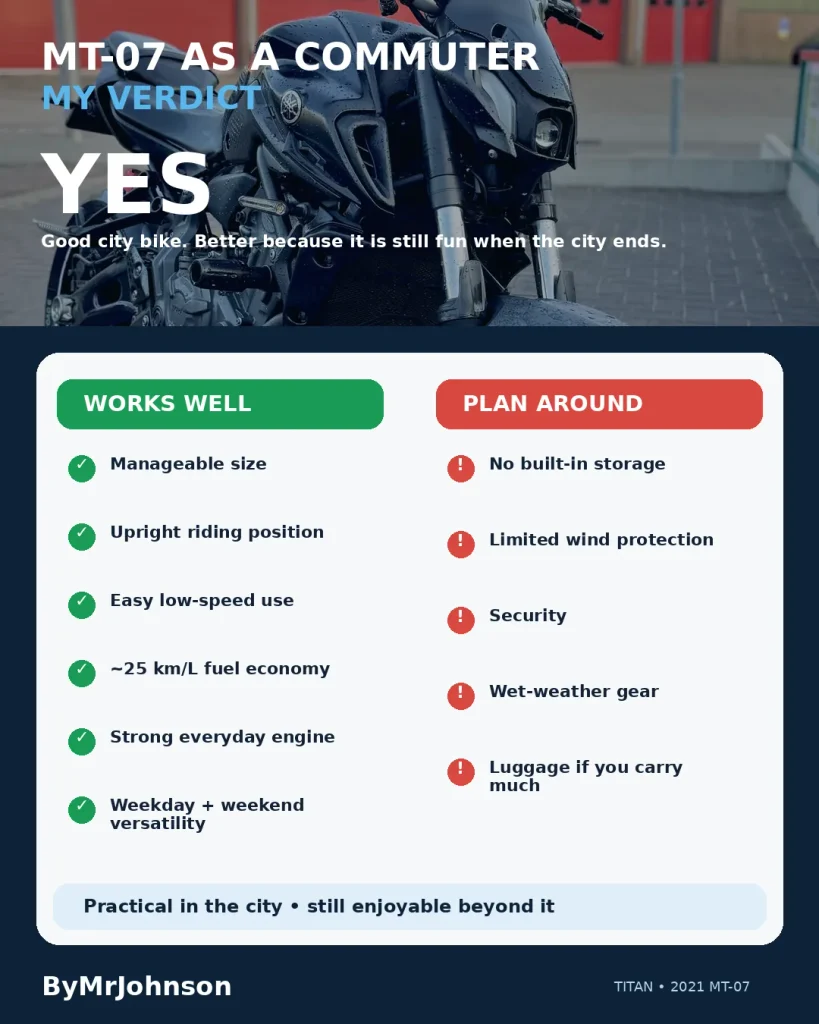
Yes. Very much so.
The qualities I appreciate most are:
- manageable physical size;
- comfortable upright position;
- strong but usable engine;
- good fuel economy;
- straightforward controls;
- easy low-speed behaviour once your technique is sound;
- enough versatility to remain fun after the commute ends.
The main compromises are:
- almost no built-in storage;
- limited wind and weather protection;
- city security needs;
- suspension that is functional rather than luxurious;
- carrying capacity that usually requires accessories.
Those aren’t deal-breakers for me.
They’re simply the price of using a relatively simple naked motorcycle as an everyday machine.
Would I choose TITAN again for city riding?
Yes.
And interestingly, city use is probably one reason I’ve become more attached to the MT-07 rather than less.
It’s easy to love a motorcycle on the perfect road.
I think you learn more about ownership on the ordinary ones.
Traffic.
Rain.
Short rides.
Awkward parking.
Going somewhere because you need to rather than because the road looks exciting.
TITAN works during those rides too.
Then, when the weekend arrives, the same motorcycle can take me somewhere completely different.
That’s why the MT-07 makes sense to me as an everyday bike.
Not because it is perfect at commuting.
Because it asks for relatively few compromises during the week without taking away the reason I wanted a motorcycle in the first place.
FAQs
Is the Yamaha MT-07 good for commuting?
In my experience, yes. The manageable size, upright riding position, responsive engine and good fuel economy make it well suited to everyday use. Storage and weather protection are the main practical compromises.
Is the MT-07 good in city traffic?
I find it very well suited to city traffic because it doesn’t feel unnecessarily bulky and is comfortable at normal road speeds. Rider observation, positioning and low-speed control still matter much more than the motorcycle itself.
Is the MT-07 heavy for city riding?
Yamaha lists the 2021 MT-07 at 184 kg wet. I find that manageable in normal city use, though how heavy a motorcycle feels depends strongly on rider size, technique and confidence.
Is the MT-07 economical for commuting?
My real-world average has been approximately 25 km/L, equivalent to around 4.0 L/100 km. Across my first roughly 10,000 km, that has translated to about €10 of fuel per 100 km.
Does an MT-07 have enough storage for commuting?
Not in standard form. If you regularly carry work equipment, rain gear or other items, you’ll probably want a backpack, tank bag, tail bag, panniers or top box.
Is the MT-07 comfortable in traffic?
For me, yes. The upright riding position and manageable dimensions work well in stop-start conditions. Long periods at higher speed expose the naked bike’s limited wind protection more clearly.
Is the MT-07 suitable for winter commuting?
The motorcycle itself can be used year-round, but cold, rain, wind, road conditions and rider gear become increasingly important. I would treat proper equipment, tyre condition and maintenance as part of winter commuting – not optional extras.
Related Reads
Continue with:
Riding in Heavy Traffic: Safety Tips for Urban Motorcyclists
Motorcycle Visibility Tips for Urban Riders
20 Motorcycle Low-Speed Control Tips
Yamaha MT-07 Fuel Economy and Range: What I Get in Real Riding