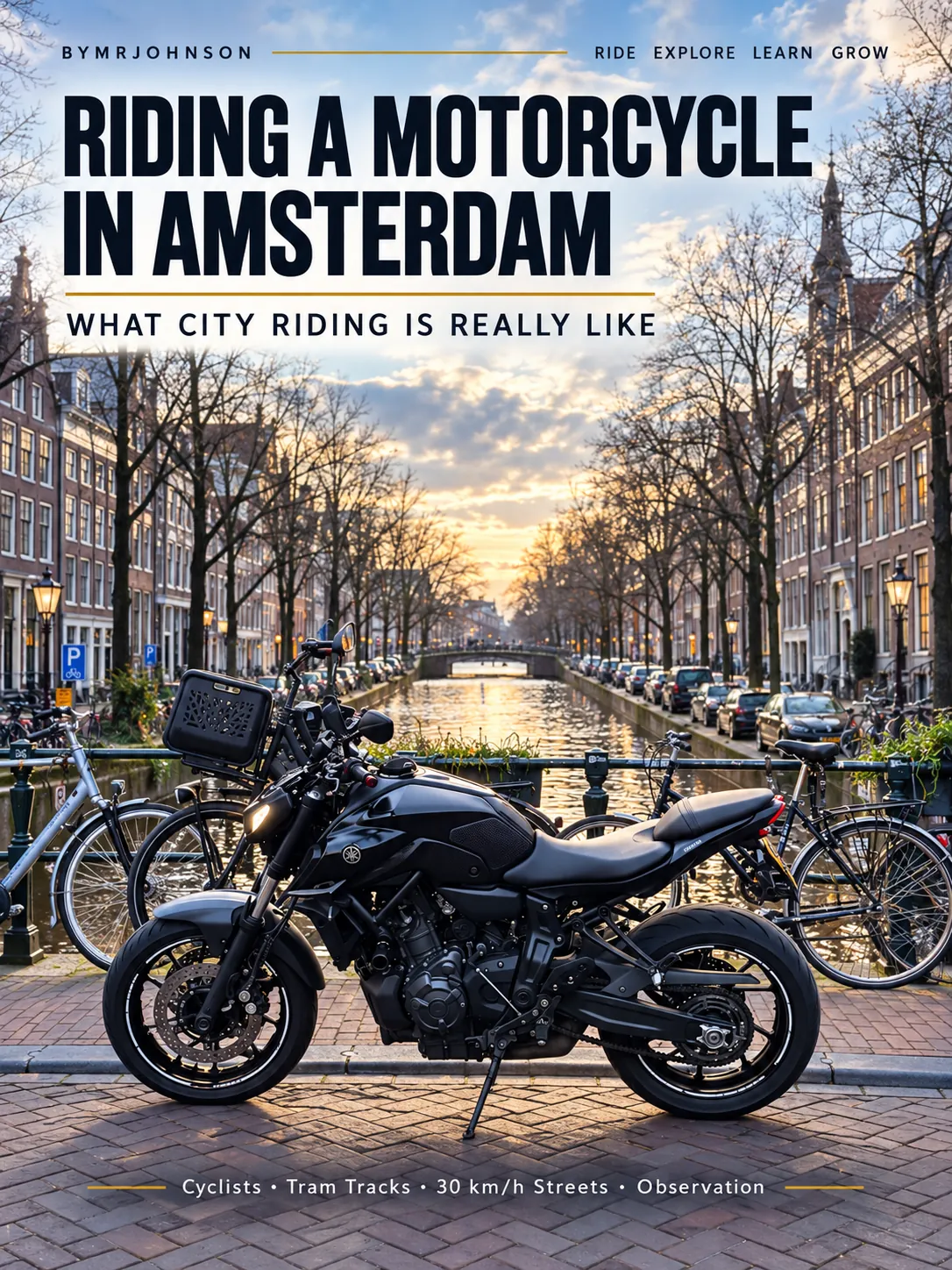
Amsterdam isn’t a particularly fast place to ride a motorcycle.
That does not mean it is always an easy place to ride one.
If anything, some of my most mentally busy riding happens at relatively low speeds.
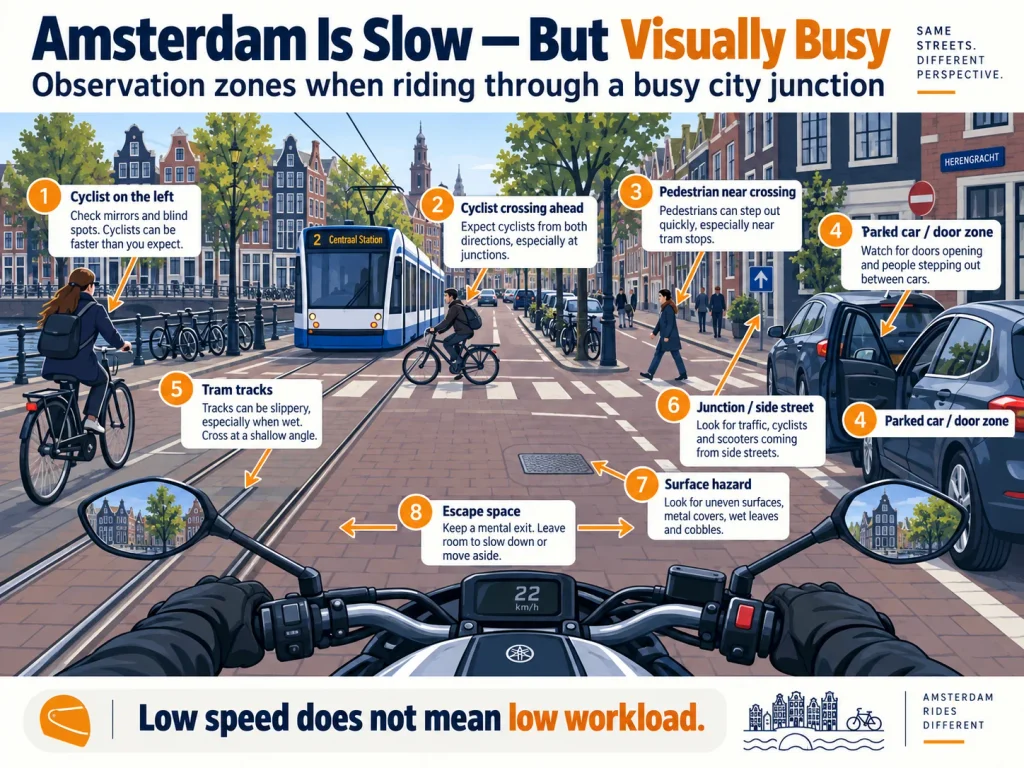
You can have a cyclist beside you, another crossing ahead, a pedestrian looking toward the opposite direction, a delivery van narrowing the road, tram rails underneath you and somebody approaching an intersection that you are not completely convinced has seen you.
None of those things needs to become dramatic.
But they all need attention.
That is what riding a motorcycle in Amsterdam has gradually taught me.
City riding here is less about speed and more about processing information.
I ride TITAN — my Yamaha MT-07 — regularly around Amsterdam, as well as using him for rides outside the city.
The two environments ask different things from me.
Once I leave Amsterdam, I can often settle into the rhythm of the road.
Inside the city, I spend much more time asking:
What could change in the next few seconds?
If you’re new to riding in the Netherlands generally, start with my Motorcycling in the Netherlands: Practical Guide for New & Expat Riders.
This article is about the next layer:
what Amsterdam itself feels like from the saddle.
Note: Amsterdam’s traffic layout and local rules continue to change. City-specific information in this article was checked in September 2026. Always follow current signs and official local guidance.
Amsterdam Is Slow — But Visually Busy
One of the interesting things about Amsterdam is that low speed can create a false sense of simplicity.
Much of the city now operates at 30 km/h.
Amsterdam introduced 30 km/h on many roads from December 2023 and continues modifying streets around that lower-speed approach. The municipality says the change is intended to give road users more time to process information and react to unexpected situations.
That description matches what city riding feels like to me.
The speedometer isn’t usually the difficult part.
The amount of information is.
At 30 km/h, you may be travelling slowly while still needing to monitor:
- cyclists
- pedestrians
- scooters
- buses
- trams
- parked cars
- doors
- junctions
- traffic lights
- narrow passages
- road markings
- tram rails
- changing surfaces.
That makes Amsterdam a good example of why slow does not necessarily mean relaxed.
The pace is lower.
The observation workload can be high.
Cyclists Become Part of Your Primary Scan
You obviously expect bicycles in Amsterdam.
Knowing that intellectually and riding among them are different things.
Cyclists aren’t occasional road users here.
They are part of the traffic environment.
So I don’t mentally treat bicycles as something I check for after I’ve looked for cars.
They’re part of the first scan.
Approaching a junction, I want to know:
Where is the cycle path?
Where could a cyclist come from?
Does somebody appear to be continuing straight?
Is anyone approaching from behind my shoulder?
Is my planned turn going to cross another person’s line?
That became one of the biggest changes in my observation habits after moving here.
Don’t Expect Everyone to Behave Like a Car
Cars are relatively predictable because their size restricts where they can physically go.
A bicycle has much more freedom.
A cyclist can be:
beside you,
behind you,
on a separate path,
crossing a junction,
or appearing from an angle you weren’t initially concentrating on.
That doesn’t make cyclists the problem.
It simply changes the way I scan.
I try not to think:
“I have right of way, therefore this space belongs to me.”
I would rather know whether somebody is about to enter the space regardless.
That philosophy is very similar to what I described in my Beginner’s Guide to Defensive Motorcycle Riding.
Right of way matters.
Avoiding the collision matters more.
The 30 km/h Limit Changes the Rhythm of Riding
The shift toward 30 km/h has another interesting effect.
It reduces some of the speed difference between motorcycles, cars and faster cyclists.
That can make traffic feel compressed.
Instead of motorcycles simply moving faster than everything around them, different road users can sometimes travel at relatively similar speeds.
And the street itself may reinforce that feeling.
Amsterdam has increasingly redesigned roads around walking and cycling. A very recent example is the completed Binnenring, a 7-kilometre route around the city centre. The municipality says the route gives more space to cyclists and pedestrians, includes 30 km/h sections, one-way sections for cars and Amsterdam’s first full cycling-street arrangement.
For a motorcyclist, the wider lesson is simple:
Don’t assume the street was designed around motorised traffic.
Read the environment you are actually in.
That may sound obvious, but it changes how I ride.
Lane Position Matters — But It Isn’t Fixed
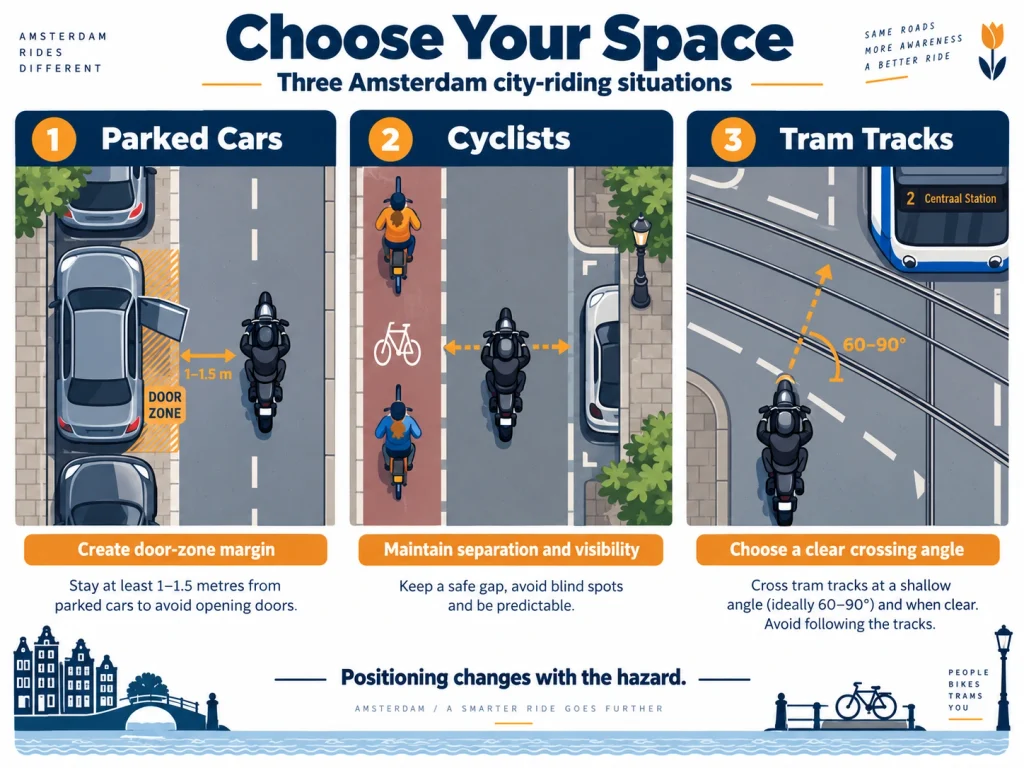
I already have a complete guide to motorcycle lane positioning, so I won’t repeat it here.
But Amsterdam demonstrates why I don’t think there is one permanent “best” part of the lane.
My position can change depending on:
- cyclists
- parked vehicles
- side streets
- oncoming traffic
- road surface
- tram tracks
- visibility
- pedestrian movement.
Sometimes visibility matters most.
Sometimes separation matters most.
Sometimes I need more room from parked cars.
Sometimes moving slightly within my lane makes me more visible to somebody waiting at a junction.
The useful question isn’t:
“Where should a motorcycle ride?”
It’s:
“What position gives me the best information and safety margin right now?”
That is why I treat lane positioning as something active rather than a rule I set once and forget.
Parked Cars Deserve More Attention Than Their Speed Suggests
A parked car is technically stationary.
That doesn’t make it inactive.
Doors can open.
Drivers can pull away.
People can step between cars.
A vehicle can block your view of a cyclist or pedestrian.
And Amsterdam has plenty of places where available road space becomes narrow very quickly.
So when I ride past parked cars, I prefer having enough space and enough speed margin to deal with somebody doing something unexpected.
This connects directly to riding in heavy traffic.
You don’t need to predict exactly what another person is going to do.
You need to avoid leaving yourself without an option when they do it.
Tram Tracks Change How I Look at the Road Surface
Tram rails are one of those features that can seem insignificant until you actually have to cross them on a motorcycle.
They’re narrow.
They’re smooth.
And they can become much more noticeable when wet.
The general principle I keep in mind is to cross rails with the motorcycle as upright as practical and avoid following them at a very shallow angle where a tyre can track along the rail.
But Amsterdam adds another complication:
You still need to watch the traffic around you while choosing a sensible crossing line.
So this becomes both a surface problem and an observation problem.
I am deliberately keeping this section short because later in this cluster we’ll have a dedicated article:
Riding Around Cyclists & Tram Tracks in Amsterdam: Practical Motorcycle Tips
That article will go much deeper into how I approach both.
Amsterdam Weather Makes the Surface More Interesting
Rain changes almost any city.
On a motorcycle, it changes what I pay attention to.
Painted markings.
Metal surfaces.
Manhole covers.
Leaves.
Tram rails.
Changes in road texture.
Braking distance.
Visibility.
None of those automatically makes riding dangerous.
They simply reduce how casually I can treat the surface.
If I know grip may be inconsistent, I try to keep my inputs smooth:
smooth braking,
smooth steering,
smooth throttle.
Amsterdam doesn’t require a completely different wet-weather technique from anywhere else.
It simply gives you plenty of reasons to actually use it.
I cover this much more fully in Wet Weather Motorcycle Riding Tips.
Low-Speed Control Matters More Than It Looks
City riding contains a surprising amount of low-speed motorcycle work.
Stopping.
Starting.
Tight turns.
Slow queues.
Parking manoeuvres.
U-turns.
Creeping through confined areas.
Balancing while looking for other road users.
That’s one reason I think low-speed practice has such a good return for everyday riders.
You may practise a tight turn in an empty car park.
But the benefit appears later when you’re carrying out an awkward manoeuvre with somebody waiting behind you and bicycles moving nearby.
Good low-speed control gives me more mental capacity.
If I’m not fighting the motorcycle, I can spend more attention on the environment.
That’s the practical value.
For drills and technique, see my 20 Motorcycle Low-Speed Control Tips.
Being Seen Matters More Than Being Loud
Amsterdam gives you plenty of opportunities to end up where another road user hasn’t registered you yet.
A driver’s attention may be on bicycles.
A pedestrian may be watching the tram.
Someone leaving a junction may be looking toward one stream of traffic but not yours.
That’s why I try to think about visibility, not just physical position.
Can the driver see me?
Am I sitting behind a vehicle’s pillar?
Am I hiding beside a van?
Can I reposition before entering the junction?
Have I given someone enough time to recognise that I’m there?
A motorcycle can be physically close to another road user and still be mentally invisible to them.
My Motorcycle Visibility Tips for Urban Riders goes deeper into this.
Don’t Ride the City Like You’re Trying to Win Space
This might be the biggest lesson Amsterdam has reinforced for me.
There are many moments where you could push into a gap.
That doesn’t mean the gap matters.
City riding becomes much calmer when I stop thinking in terms of defending every metre of road.
Sometimes another person goes first.
Sometimes I wait behind the cyclist.
Sometimes the car enters.
Sometimes the gap disappears.
Another gap will appear.
The motorcycle is already small and manoeuvrable.
I don’t need to prove that advantage constantly.
Patience gives me more time to observe.
And observation is the skill Amsterdam rewards most.
Read : Motorcycle Commuting Amsterdam: Gear, Weather & Practicality
What About Filtering Through Traffic?
Motorcycles can move through slow traffic in the Netherlands under the established filegedragscode guidance, but that deserves more explanation than one paragraph.
The commonly referenced Dutch guidance includes keeping the speed difference to roughly 10 km/h, using the gap between the two leftmost lanes where possible, and returning to normal traffic as traffic speeds increase.
The important thing inside Amsterdam is that not every slow queue creates a useful filtering opportunity.
Roads can be narrow.
Cyclists may occupy nearby space.
Junctions can be close together.
Visibility may be limited.
So I don’t see filtering as something I must do simply because I’m on a motorcycle.
We’ll cover this properly in:
Lane Filtering in the Netherlands: Rules and the 10 km/h Guideline
Parking Is Convenient — Until You Assume Too Much
One attractive part of using a motorcycle in a city is the potential convenience when you arrive.
But Amsterdam motorcycle parking is more nuanced than:
“It’s a bike, so I can leave it anywhere.”
I’ve deliberately separated parking from this article because local rules, permits, paid-parking situations and appropriate locations deserve proper research rather than a passing assumption.
The dedicated guide is coming next:
Motorcycle Parking in Amsterdam: Rules, Paid Parking & Practical Tips
The practical habit I follow in the meantime is simple:
check the actual location rather than assuming the rule.
Petrol Motorcycles Aren’t Currently Banned by Amsterdam’s Emission Zones
This is worth clarifying because motorcycles can easily be confused with mopeds and scooters when reading Amsterdam’s environmental rules.
As of September 2026, the City of Amsterdam states that motorcycles currently do not have a low-emission or zero-emission zone.
Different restrictions apply to mopeds and scooters.
So TITAN isn’t currently restricted by Amsterdam’s low- or zero-emission zones simply because he is a petrol motorcycle.
As always, local environmental rules can change, so this is something worth checking again in the future rather than relying on an old article indefinitely.
Why TITAN Works for My Amsterdam Riding
I didn’t buy TITAN purely as a city motorcycle.
That is part of why I enjoy him.
During the week, the MT-07 can deal with ordinary Amsterdam riding.
Then the same motorcycle can leave the city when I want a longer ride or weekend getaway.
Around Amsterdam, what I appreciate most isn’t outright performance.
It’s simply feeling comfortable with the bike at everyday speeds.
Starting.
Stopping.
Turning.
Moving through urban traffic.
Putting a foot down.
Getting moving again.
The motorcycle becomes familiar enough that most of my attention can go outside the bike.
That’s where I want it.
My 10,000 km MT-07 Ownership Guide covers that broader ownership experience.
Amsterdam Roads Keep Changing
One thing worth remembering if you’re visiting the city or returning after some time away is that Amsterdam’s road environment is not static.
Street layouts change.
Roadworks appear.
Cycling infrastructure evolves.
One-way arrangements change.
Speed limits change.
The newly completed Binnenring is a current example: after years of redesign, sections now give more space to cyclists and pedestrians, some car movements are one-way and the route operates at 30 km/h.
That reinforces something I already try to do on the motorcycle:
read the road that is in front of me rather than riding from memory.
Even if I know the area.
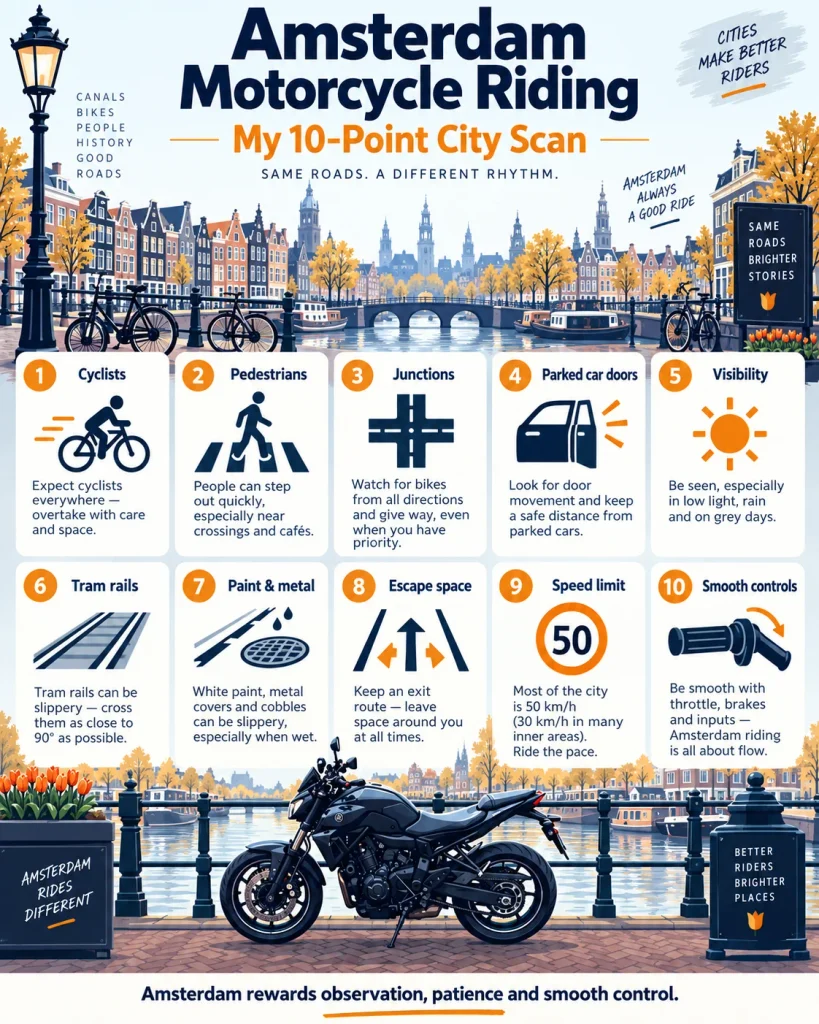
What I Watch for When Riding in Amsterdam
I don’t run through a formal checklist every five seconds.
But if I tried to summarise the things constantly moving through my attention, it would look something like this:
Ahead
Traffic lights.
Pedestrians.
Cyclists.
Stopping traffic.
Surface changes.
Rails.
Junctions.
Beside Me
Cyclists.
Scooters.
Cars.
Doors.
Side streets.
Behind Me
Fast-approaching traffic.
Cyclists or scooters before changing position.
Under Me
Paint.
Metal.
Leaves.
Wet surfaces.
Tram rails.
Around the Next Few Seconds
Who could enter my space?
Who hasn’t seen me?
Where would I go if the situation changed?
That’s defensive riding more than anything else.
Amsterdam simply gives me many opportunities to practise it.
Is Riding a Motorcycle in Amsterdam Stressful?
It can be.
Especially at first.
If you’re accustomed to wide roads and traffic dominated by cars, Amsterdam can feel like there are road users everywhere.
But familiarity changes that.
Cyclists stop feeling unusual.
Tram tracks stop being surprising.
Thirty-kilometre-per-hour streets become normal.
You start recognising where the real conflicts are likely to come from.
And eventually the city feels less chaotic because you’re seeing its patterns rather than only its movement.
I think the worst approach would be trying to solve the initial discomfort by riding more aggressively.
The better solution for me has been the opposite.
Slow the decision-making down.
Look farther ahead.
Give myself space.
Allow other people to make mistakes.
And keep the motorcycle smooth.
Would I Recommend a Motorcycle for Amsterdam?
It depends on what you expect it to do.
A motorcycle isn’t automatically the best transport option for every trip in Amsterdam.
Sometimes a bicycle, public transport or walking is easier.
That’s one of the realities of living in a city designed heavily around those forms of transport.
But I enjoy having the motorcycle because its usefulness doesn’t stop at the city boundary.
I can use TITAN around Amsterdam and then continue somewhere completely different.
That dual role matters more to me than trying to prove a motorcycle is always the fastest way across town.
We’ll explore the everyday practical side properly in:
Motorcycle Commuting in Amsterdam: Gear, Weather & Everyday Practicality
What Amsterdam Has Taught Me About Riding
When I first moved to the Netherlands, one of my biggest lessons was learning to empty the cup and adapt to a new riding environment.
Amsterdam continues that lesson.
The city doesn’t reward me for assuming I know what another road user will do.
It rewards observation.
It rewards patience.
It rewards smooth low-speed control.
And it rewards giving myself enough time to deal with something unexpected.
That’s what riding here really feels like to me.
Not particularly fast.
Not constantly dangerous.
Just busy enough that attention matters.
And maybe that isn’t a bad lesson to carry onto every other road.
Ride safe and enjoy the journey.
FAQs
Is it difficult to ride a motorcycle in Amsterdam?
The physical speeds are generally low, but Amsterdam can be mentally demanding because cyclists, pedestrians, trams, narrow roads and frequent junctions create a high observation workload. Familiarity and defensive riding make the environment considerably easier to read.
What is the speed limit in Amsterdam?
Many Amsterdam streets now have a 30 km/h limit, although some roads remain 50 km/h. Always follow the posted limit for the road you’re actually riding. Amsterdam continues adapting streets to its 30 km/h policy.
Are motorcycles allowed in Amsterdam’s zero-emission zone?
Amsterdam currently states that motorcycles do not have a low-emission or zero-emission zone. Different rules apply to mopeds and scooters.
Are tram tracks dangerous for motorcycles?
They deserve extra attention, particularly when wet or when you would cross them at a shallow angle. Smooth inputs and choosing a sensible crossing angle help reduce the risk of a tyre following or slipping on the rail. A dedicated Amsterdam tram-track guide is coming later in this series.
Can motorcycles filter through traffic in Amsterdam?
Filtering is accepted in the Netherlands under established traffic-jam guidance, but whether it is sensible depends on the road and conditions. Narrow city streets, cyclists and junctions can make some gaps unsuitable even when traffic is slow.
Is an MT-07 suitable for Amsterdam?
I use my MT-07, TITAN, regularly in and around Amsterdam and find it works well for the combination of city riding and trips beyond the city. That’s my ownership experience rather than a universal recommendation for every rider.
Related Reads
Motorcycling in the Netherlands: A Practical Guide for New & Expat Riders
Riding in Heavy Traffic: Safety Tips for Urban Motorcyclists
Lane Positioning for Motorcyclists: How to Choose the Safest Road Position
Motorcycle Visibility Tips for Urban Riders
Wet Weather Motorcycle Riding Tips: How to Ride Safely in the Rain