Sometimes the motorcycle you want isn’t in the Netherlands.
Maybe you’ve found a better example in Germany.
Maybe a used bike in Belgium is considerably cheaper.
Maybe you’re moving to the Netherlands and already own a motorcycle that you would rather bring with you than sell.
Or maybe you’ve found something special outside Europe.
All of those situations involve importing a motorcycle.
But they do not involve exactly the same process.
That is the first thing worth understanding.
Bringing an EU-registered motorcycle from Germany to the Netherlands can be relatively straightforward.
Importing a motorcycle from outside the EU without European type approval can become a much more expensive project.
And moving here with a motorcycle you have already owned for some time can fall under a completely different tax arrangement again.
So before asking:
“How much does importing a motorcycle cost?”
I would first ask:
“Which import route applies to this motorcycle?”
That answer determines much of what happens next.
Note: RDW, BPM, customs and tax rules can change. The information in this guide was checked in October 2026 using current RDW, Belastingdienst and Dutch government information. Always confirm the requirements for your specific motorcycle before purchasing or transporting it.
If you’re completely new to Dutch motorcycle ownership, my Motorcycling in the Netherlands: A Practical Guide for New & Expat Riders is the broader starting point.
The Three Motorcycle Import Situations
I find it easiest to separate motorcycle imports into three groups.
1. Buying a motorcycle from another EU or EFTA country
For example:
Germany.
Belgium.
France.
Italy.
Norway.
Switzerland.
The RDW has a relatively standard process for vehicles coming from another EU or EFTA country.
For these motorcycles, the process is largely about identifying the bike, checking its foreign registration documents and registering it in the Dutch system. (RDW)
2. Moving to the Netherlands with a motorcycle you already own
This is particularly relevant to expats.
If the motorcycle is genuinely part of your household possessions when relocating, you may qualify for a BPM relocation exemption.
That can completely change the cost calculation.
3. Importing from outside the EU/EFTA
This can be much more involved.
Customs.
Import duties.
VAT.
BPM.
RDW approval.
And potentially an individual technical approval if the motorcycle doesn’t already have suitable European type approval.
RDW explicitly warns that importing a vehicle without European approval from outside the EU/EFTA can take considerable time and money. (RDW)
That is not automatically a reason not to do it.
It is a reason to calculate first.
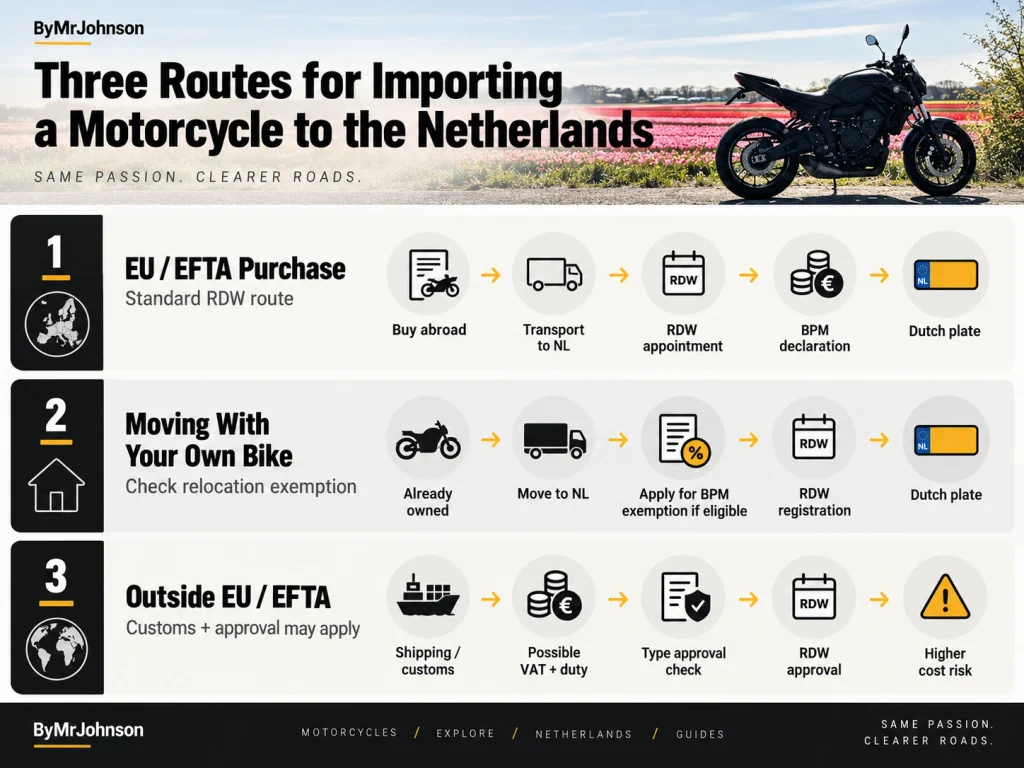
Importing a Motorcycle From Another EU or EFTA Country
For most riders looking at a used motorcycle in Germany, Belgium or another nearby country, this is the route that matters.
RDW says that if you buy a vehicle in another EU or EFTA country and want to use it in the Netherlands, you need to make an appointment at an RDW inspection station and apply for a Dutch registration.
As a private individual, you also need to be registered in the Dutch BRP — Basisregistratie Personen.
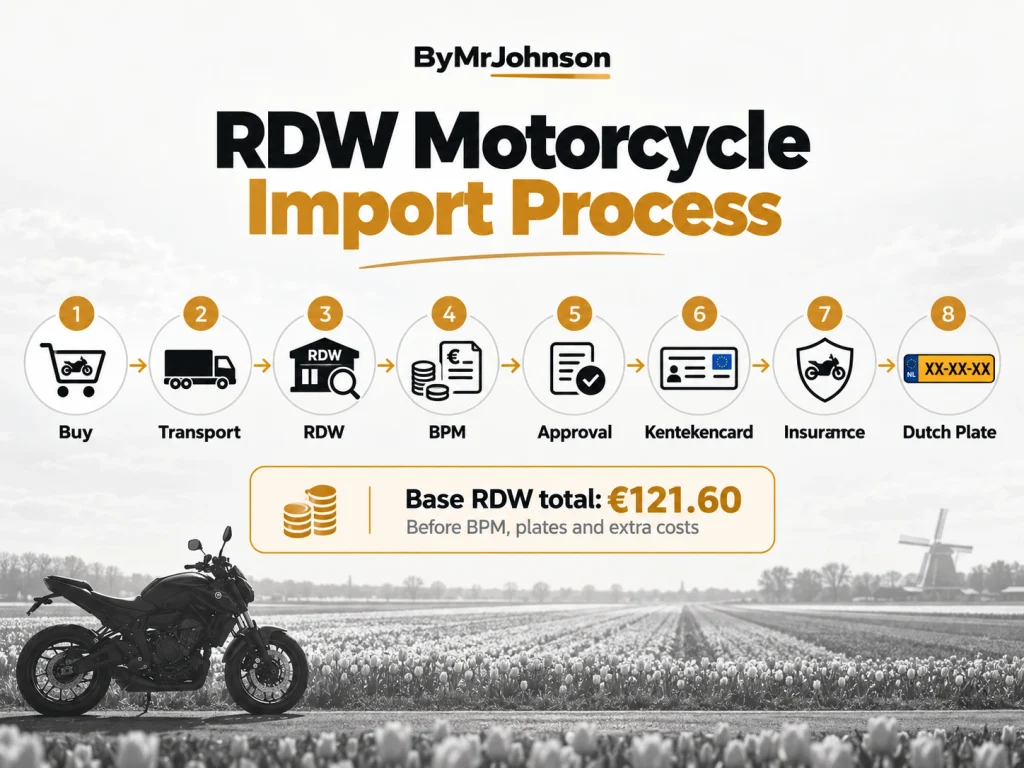
The basic process looks like this:
Buy the motorcycle abroad
↓
Bring it to the Netherlands / RDW
↓
RDW identifies the motorcycle and checks its documents
↓
Submit BPM declaration
↓
RDW + Belastingdienst approve registration
↓
Receive Dutch kentekencard
↓
Arrange WA insurance
↓
Have Dutch number plate made
That sounds more intimidating written out than it usually is.
Let’s go through it.
Step 1: Get the Foreign Motorcycle Documents Right
Before buying the motorcycle, I would make sure the seller can provide the complete original registration documents required in that country.
RDW asks you to bring the complete original foreign registration certificate to the inspection.
I would also want:
- purchase invoice or sales agreement
- VIN/chassis number
- proof of ownership where applicable
- service history
- any Certificate of Conformity available.
That last document is often called:
CoC — Certificate of Conformity
or in Dutch:
CvO — Certificaat van Overeenstemming.
RDW says the CoC is not mandatory for the standard EU/EFTA import appointment, but it can contain technical information useful for registration.
The broader lesson is the same one from my used-motorcycle buying guide:
Sort out paperwork before money changes hands.
Fixing missing documents after buying an imported motorcycle is rarely more enjoyable.
Step 2: Book the RDW Import Appointment
For an EU/EFTA vehicle, you make an appointment at an RDW inspection station.
RDW currently says the appointment normally takes around:
25 to 55 minutes.
The word inspection can create the impression that RDW is performing a full mechanical used-motorcycle inspection for you.
That isn’t what I would rely on it for.
For normal EU/EFTA imports, RDW says it identifies the vehicle and assesses the documents.
So you should still inspect the motorcycle mechanically before buying it.
RDW registration is not a substitute for checking:
tyres,
brakes,
chain,
bearings,
fork seals,
service history,
or crash damage.
Step 3: Bring the Motorcycle to RDW
This part needs planning.
RDW does not issue you a Dutch registration for the journey from another country into the Netherlands.
If the motorcycle needs temporary/export plates to travel from the country where you bought it, those arrangements need to be made under that country’s system.
Alternatively, transport it on:
a trailer,
van,
or motorcycle transporter.
RDW specifically says it does not provide a registration plate for driving the vehicle from abroad into the Netherlands.
That transport cost should be part of your import calculation.
A €500 saving on the purchase price starts looking different if:
transport costs €350,
travel costs another €150,
and the motorcycle then needs Dutch tax.
What Happens to the Foreign Registration at RDW?
There is another detail worth knowing before you arrive.
If you ride the motorcycle to the RDW appointment using its valid foreign registration and documents, RDW can take the foreign registration certificate during the import process.
After the inspection you generally cannot simply continue riding around on those foreign plates.
RDW allows you to request a free eendagskenteken — one-day registration for the relevant journey after arranging your inspection appointment.
So think about:
How am I getting the bike to RDW?
and:
How am I getting it home afterwards?
before the appointment.
Step 4: RDW Identifies the Motorcycle
At the inspection station, RDW checks the motorcycle’s identity and foreign documentation.
For vehicles from countries where traffic drives on the left, RDW also specifically tells owners to ensure mirrors and lighting are suitable for right-hand traffic.
That is particularly relevant for motorcycles coming from markets such as the UK.
Something as simple as lighting specification can become part of the import preparation.
Do Imported Motorcycles Need an APK?
No.
This is one advantage motorcycles have in the Dutch system.
Motorcycles currently have no APK periodic inspection requirement in the Netherlands.
RDW’s own obligation table lists motorcycles as:
WA insurance: yes
APK: no.
That means you don’t need to arrange a Dutch APK after importing a normal motorcycle.
But again:
no APK does not mean no mechanical responsibility.
You still need a roadworthy motorcycle.
Step 5: BPM — The Tax That Can Change the Calculation
After RDW has processed the motorcycle information, you normally need to submit a BPM declaration to the Belastingdienst.
BPM stands for:
Belasting van Personenauto’s en Motorrijwielen.
Despite the name sounding car-focused, motorcycles are included.
The Belastingdienst says motorcycles imported and registered in the Netherlands are subject to BPM where the tax rules apply.
This is often the part people underestimate.
You don’t simply pay Dutch tax on the price you happened to negotiate with the foreign seller.
How Is Motorcycle BPM Calculated?
For a normal combustion motorcycle, the current gross BPM calculation is based on the motorcycle’s Dutch net list price — netto-catalogusprijs.
That means the original Dutch consumer price excluding:
- BPM
- VAT
but including relevant:
- options
- accessories
- special-version costs.
The current motorcycle rates are:
| Net list price | Gross BPM calculation |
|---|---|
| Up to €2,133 | 9.6% |
| Above €2,133 | 19.4%, minus €210 |
So, for example, if the relevant net list price were:
€7,000
the gross BPM calculation would be:
€7,000 × 19.4% = €1,358
minus €210:
€1,148 gross BPM
That is also the example currently used by the Belastingdienst.
But for a used motorcycle, that is not necessarily what you finally pay.
Used Motorcycles Can Receive BPM Depreciation
This is where importing an older used motorcycle can become much more attractive.
The Belastingdienst applies depreciation to used imported motorcycles.
For BPM purposes, motorcycles with more than 3,000 km are in any case treated as used.
You can calculate the depreciation using an accepted method such as:
- the forfaitaire depreciation table
- a recognised price list
- in qualifying cases, a valuation report.
The remaining BPM after depreciation is what you pay.
So:
Gross BPM ≠ necessarily the final BPM bill.
This is why two imported motorcycles with the same original list price can create very different tax bills depending on:
age,
usage,
value,
and the permitted depreciation method.
Older Motorcycles Can Effectively Age Out of BPM
There is another useful point for older motorcycles.
The Belastingdienst states that if the vehicle’s date of first registration is at least 17 years and 10 months ago, no BPM remains when using the forfaitaire depreciation table.
That can make importing older motorcycles a very different financial proposition from importing something almost new.
Again, calculate before purchasing.
A Nearly New EU Motorcycle Can Also Create a VAT Issue
There is another tax question for very new motorcycles.
For private buyers, EU VAT rules can treat a vehicle as new when it is:
less than six months old
or:
has travelled no more than 6,000 km.
The Belastingdienst specifically warns that VAT may therefore also be due for recently acquired / low-mileage imported motorcycles.
So a nearly new bargain from another EU country deserves extra attention.
The comparison isn’t simply:
German asking price vs Dutch asking price.
It may become:
foreign purchase price
- transport
- RDW
- BPM
- potential VAT treatment
- plates
- insurance
- any modifications.
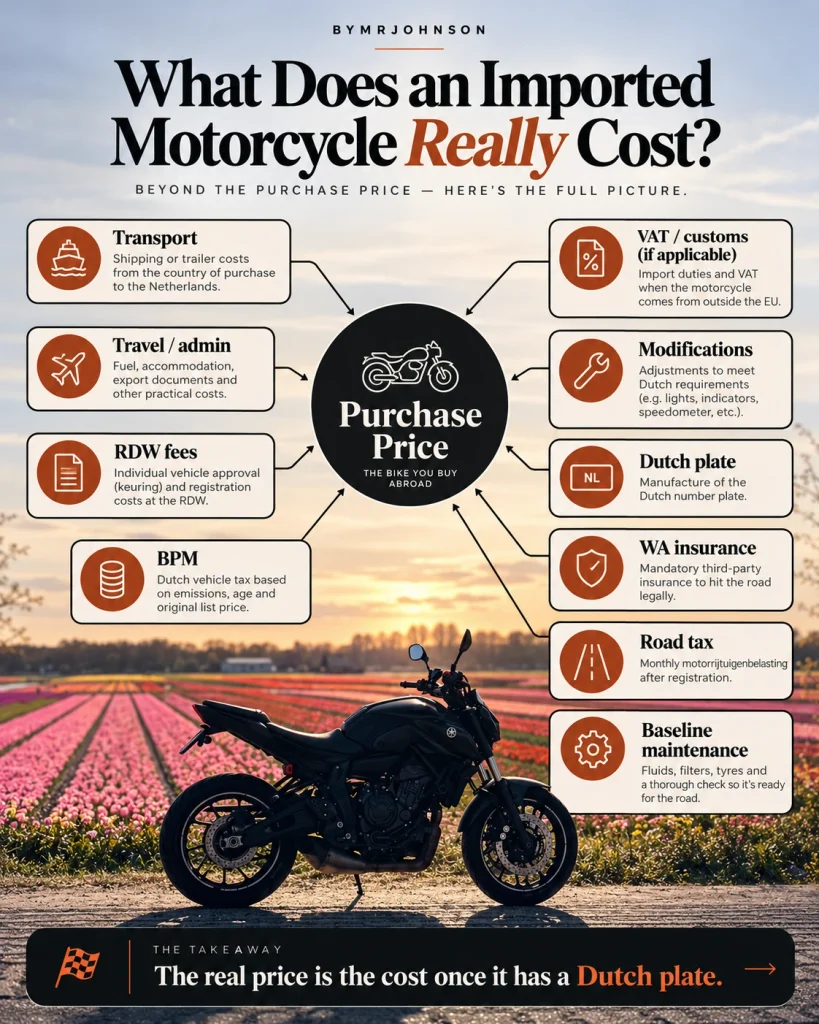
That’s the number that matters.
What Are the Basic RDW Import Costs?
For a normal motorcycle from an EU/EFTA country, the current standard RDW charges include:
| RDW item | 2026 fee |
|---|---|
| Vehicle identification ≤3,500 kg | €58.50 |
| Kentekenbewijs | €50.00 |
| Registration in your name | €13.10 |
| Basic RDW total | €121.60 |
A control inspection, where applicable, is listed at €42.
The recycling contribution listed on the same RDW page applies to passenger cars and light commercial vehicles, not ordinary motorcycles.
So for a straightforward EU motorcycle, RDW administration itself may not be the expensive part.
BPM, transport and the motorcycle’s condition can matter much more.
Don’t Forget the Number Plate
Once RDW and the Belastingdienst approve the registration, RDW sends the Dutch kentekencard.
RDW currently says this is normally sent within five working days after approval, with the complete tenaamstellingscode following separately around two working days later, subject to postal delivery.
Once the kentekencard arrives, you can take it to a recognised plate manufacturer and have the Dutch plate produced.
For a motorcycle that means the familiar yellow Dutch rear registration plate.
Only then does the bike really begin looking like it belongs here.
WA Insurance Starts With Dutch Registration
Once the motorcycle is registered in your name, the usual Dutch ownership obligations begin.
The motorcycle must have at least:
WA liability insurance.
RDW says insured vehicles need cover from the moment they are registered to you.
The insurer may ask for the meldcode, which consists of the final four digits of the VIN.
I explained the cover levels separately in:
Motorcycle Insurance in the Netherlands: WA, WA+ & All-Risk Explained.
Importing the motorcycle does not create a special insurance exemption.
Once it becomes a Dutch registered motorcycle, the normal insurance rules apply.
Road Tax Starts Automatically Too
Registering the motorcycle also places it into the normal Dutch motorrijtuigenbelasting — MRB system.
You do not normally make a separate MRB registration yourself.
The vehicle information passes through the Dutch registration system and the Belastingdienst sends the tax bill.
Again, this is why I would calculate the complete ownership cost rather than only the import bill.
Importing cheaper doesn’t automatically mean owning cheaper.
Moving to the Netherlands With Your Own Motorcycle
For expats, this is potentially much more important than importing a bike you just purchased.
Imagine you already own a motorcycle abroad.
You are moving to the Netherlands permanently.
Selling the motorcycle and buying another one here may seem unnecessary.
Fortunately, Dutch tax rules recognise that situation.
If the motorcycle genuinely belongs to your household possessions when you relocate, you may qualify for a verhuisboedelvrijstelling — relocation / household-goods BPM exemption.
BPM Relocation Exemption When Moving From Another EU Country
The Belastingdienst currently lists several key conditions.
You may qualify when:
- you move from another EU country to the NetherlandsMotor
- the motorcycle forms part of your household possessions
- you continue using it for the same purpose
- you owned and used it for at least six months before moving
- your normal residence had been outside the Netherlands for at least 12 months
- you apply within 12 months after moving.
This is a very different situation from:
I moved to Amsterdam last month, found a cheap bike in Germany yesterday and now want the relocation exemption.
The motorcycle needs to genuinely form part of the property you brought with you.
The Exemption Doesn’t Mean You Skip Registration
This distinction matters.
A BPM exemption does not mean:
keep the foreign plate forever.
RDW says someone moving to the Netherlands with a vehicle still needs to apply for a Dutch registration after the permitted period of foreign registration use.
You make an RDW appointment and have the motorcycle registered here.
If you’re applying for tax-free relocation treatment, RDW says you should apply for the BPM exemption with the Belastingdienst before the RDW inspection.
So the order matters.
You May Still Need to File a BPM Declaration
This is another detail that can sound contradictory at first.
If your relocation exemption is approved:
you may owe €0 BPM
but:
you can still need to file the BPM declaration.
RDW says that after the inspection, a BPM-liable vehicle being imported under the relocation exemption still requires a BPM return, which in this situation is handled on paper.
Exemption from payment and exemption from paperwork are not always the same thing.
Don’t Immediately Sell the Motorcycle After Using the Exemption
There is an important restriction.
If you receive the EU relocation exemption and then within 12 months:
sell,
rent,
or lend
the motorcycle in a way that breaches the exemption conditions, the Belastingdienst says BPM can become payable after all.
So the exemption is designed for:
I am genuinely relocating with my own motorcycle.
Not:
I am importing motorcycles tax-free to resell them.
Moving From Outside the EU Is Different Again
If you’re moving to the Netherlands from outside the EU, customs enters the picture.
Dutch Customs says a vehicle forming part of a genuine relocation may often qualify for relief from import taxes when the relevant relocation conditions are satisfied. BPM relief may also be available separately through the Belastingdienst.
But the process is not identical to moving from another EU country.
RDW says that when relocating with a vehicle from outside the EU/EFTA, customs formalities need to be handled before the RDW inspection.
If this were my situation, I would sort the customs and BPM exemption position before shipping the motorcycle.
The cost of discovering after arrival that the expected exemption doesn’t apply could be substantial.
Importing a Motorcycle From Outside Europe
Now we reach the route where I would be much more cautious with the calculator.
If you’re importing a motorcycle from somewhere such as:
the United States,
Japan,
or another non-EU/EFTA market,
you may face:
transport,
customs clearance,
import duty,
VAT,
BPM,
RDW approval,
technical modifications,
registration,
and insurance.
And potentially an individual approval test.
European Type Approval Makes a Huge Difference
The first question I would ask is:
Does this exact motorcycle have European type approval?
RDW says that where a motorcycle already has suitable national or European type approval — for example supported by a valid Certificate of Conformity or accepted European approval information — the route can be considerably simpler.
Without suitable type approval, the motorcycle may need individual approval.
That’s where the cost starts changing quickly.
Individual Motorcycle Approval Is Not Cheap
RDW currently lists the fee for an individual import approval of an L3e motorcycle at its test centre as:
€871
A reinspection is listed at:
€522.
And those numbers are only the RDW approval component.
They do not include:
shipping,
customs,
VAT,
BPM,
modifications,
registration documentation,
plates,
or repairs.
RDW itself warns that importing a vehicle from outside the EU without type approval can become expensive even if the motorcycle eventually fails approval.
That is why I would never buy a non-European motorcycle first and ask about approval afterwards.
A Cheap Motorcycle Abroad Can Become an Expensive Motorcycle Here
Imagine finding a motorcycle abroad for:
€5,000
when similar Dutch bikes sell for:
€7,000.
At first glance:
€2,000 saving.
But then imagine:
transport: €600
RDW / registration: €120+
BPM: €500
technical changes: €300
travel/admin: €200
You’re already around:
€6,720
before any unexpected problem.
If it requires individual non-EU approval, the margin can disappear entirely.
The exact numbers will obviously vary.
The point is the calculation.
Purchase price is not landed cost.
That is the import version of the lesson I learned from buying TITAN used:
the cheapest price at the beginning isn’t necessarily the cheapest ownership decision.
When Can Importing a Motorcycle Make Sense?
I think importing starts to make more sense in a few situations.
The motorcycle is significantly cheaper abroad
But only after calculating the complete landed cost.
The specification is difficult to find in the Netherlands
A particular colour.
Factory option.
Low-mileage example.
Rare model.
You already own the motorcycle
Particularly when relocating and potentially qualifying for an exemption.
The condition is substantially better
Paying similar money for a significantly better motorcycle can still make importing worthwhile.
The motorcycle is genuinely rare or special
At that point the calculation may be less about saving money and more about getting a motorcycle you simply can’t buy locally.
When Would I Be More Cautious?
I would slow down if:
the foreign documentation is incomplete,
the VIN history isn’t clear,
the bike is heavily modified,
the European type approval is uncertain,
the seller won’t supply documentation before purchase,
the apparent saving is only a few hundred euros,
or the entire calculation depends on assuming very low BPM.
And particularly:
I would not import a non-EU motorcycle simply because its foreign asking price looks cheap.
The price that matters is the cost of getting it legally registered in the Netherlands.
An Import Cost Checklist
Before buying, I would estimate:
Purchase
- motorcycle price
- currency conversion if relevant
- bank/payment costs.
Getting it here
- travel
- export or temporary registration
- transport
- trailer or shipping
- insurance during transport.
Dutch registration
- RDW identification
- kentekenbewijs
- registration in your name
- any additional inspection or approval.
Tax
- BPM
- VAT if applicable
- customs/import duty if outside the EU.
Technical preparation
- lighting changes
- mirrors
- exhaust/legal compliance
- other approval work.
After registration
- Dutch number plate
- WA insurance
- road tax
- baseline servicing
- tyres or maintenance.
Then compare that number with:
What would a genuinely comparable motorcycle cost me in the Netherlands?
Not the cheapest example on Marktplaats.
A genuinely comparable one.
Same year.
Mileage.
Condition.
Specification.
Service history.
That is a much fairer calculation.
EU Import: A Simple Step-by-Step Summary
For a normal used EU/EFTA motorcycle, the route is roughly:
1. Research the motorcycle
Check VIN, ownership, documents, service history and price.
2. Calculate BPM before buying
Don’t leave Dutch tax as a mystery.
3. Agree transport/export arrangements
RDW will not provide the registration you need to ride the bike from another country into the Netherlands.
4. Book RDW inspection
Bring the original foreign registration documents and identification.
5. RDW identifies the motorcycle
Technical/document data is entered into the Dutch registration system.
6. Submit BPM declaration
Do this after RDW has supplied the relevant data to the Belastingdienst.
7. Wait for approval
Both RDW and the Belastingdienst need to complete their side.
8. Receive kentekencard
Then have the Dutch motorcycle plate made.
9. Activate Dutch insurance
WA is compulsory once the vehicle is registered to you.
10. Ride
At which point the imported motorcycle is simply another Dutch-registered motorcycle.
Should You Use an Import Company?
You don’t have to.
A normal EU motorcycle import can absolutely be handled privately.
But an import specialist may make sense when:
you don’t speak Dutch,
the tax calculation is complicated,
the bike is outside Europe,
the type approval is unclear,
you don’t want to transport it yourself,
or your time is more valuable than the service fee.
What I would not do is automatically pay somebody simply because the paperwork looks unfamiliar.
First understand the process.
Then decide which parts are worth outsourcing.
The paperwork becomes much less intimidating once you see the sequence.
My Main Takeaway
Importing a motorcycle into the Netherlands isn’t one process.
It’s several possible processes hiding behind the same word:
import.
A straightforward used motorcycle from Germany with European approval is one situation.
Moving here with a bike you’ve already owned is another.
Bringing a Japanese-market motorcycle with no European approval is something else entirely.
The difference can mean hundreds or even thousands of euros.
So before falling in love with the advert, work backwards.
Ask:
Where is the motorcycle coming from?
Does it have European type approval?
What is the BPM?
Is VAT relevant?
What will transport cost?
Does a relocation exemption apply?
What does RDW need?
And then calculate:
What will this motorcycle cost me once it has a Dutch plate?
That is the real purchase price.
If the number still makes sense, importing can be a perfectly reasonable way to get the motorcycle you want.
If it doesn’t, there is nothing wrong with walking away and buying one that is already registered here.
Sometimes the smartest import decision is deciding not to import at all.
Ride safe and enjoy the journey.
FAQs
How do I import a motorcycle from the EU to the Netherlands?
Book an import appointment at an RDW inspection station, bring the complete original foreign registration documents and identification, have RDW identify and register the motorcycle’s data, submit your BPM declaration, wait for RDW and Belastingdienst approval, then receive the Dutch kentekencard, arrange WA insurance and have the Dutch plate made.
How much does RDW charge to import a motorcycle from the EU?
Current standard RDW charges include €58.50 for identification of a vehicle up to 3,500 kg, €50 for the kentekenbewijs and €13.10 to register it in your name — €121.60 in basic RDW charges before BPM, number plates and any additional inspections.
Do I pay BPM when importing a motorcycle?
Normally you must file a BPM declaration when importing and registering a motorcycle. How much you pay depends on factors including its original Dutch net list price and, for used motorcycles, applicable depreciation. Motorcycles old enough to have fully depreciated under the forfaitary table may have no remaining BPM payment.
How is motorcycle BPM calculated?
For normal combustion motorcycles with a net list price above €2,133, current gross BPM is 19.4% of the net list price minus €210. Used motorcycles can then receive depreciation relief. Different treatment applies to zero-emission motorcycles.
Can I bring my motorcycle when moving to the Netherlands without paying BPM?
You may qualify for a relocation exemption. For an EU move, current conditions include having owned and used the motorcycle for at least six months, having had your normal residence abroad for at least 12 months and applying within 12 months of the move. Other conditions also apply.
Do imported motorcycles need an APK?
No. Motorcycles currently do not have a Dutch APK periodic-inspection requirement, although they must still be safe and roadworthy.
Can I ride the motorcycle home from RDW on its foreign plates?
Do not assume so. RDW can take the foreign registration documents during the import process and states that after the inspection the vehicle may no longer be used on public roads under that arrangement. A free eendagskenteken can be requested for the appropriate journey.
Is importing a motorcycle from outside the EU expensive?
It can be. If the motorcycle lacks suitable European type approval it may require individual RDW approval. The current L3e motorcycle individual-approval fee is €871, with a €522 reinspection fee, before transport, customs, VAT, BPM and any necessary modifications.
Related Reads
Motorcycling in the Netherlands: A Practical Guide for New & Expat Riders
Buying a Used Motorcycle in the Netherlands: RDW Checks & Ownership Transfer
Motorcycle Insurance in the Netherlands: WA, WA+ & All-Risk Explained
How I Got My Dutch Motorcycle Licence as an Expat: Tests, Costs & Lessons Learned