Using a motorcycle for everyday travel sounds simple.
Get dressed.
Start the bike.
Ride to work.
Park.
Done.
But regular commuting is different from going out for a Sunday ride.
On a recreational ride, I can look outside, see miserable weather and decide:
Not today.
A commute doesn’t always give you that luxury.
There is somewhere you need to be.
At a particular time.
Possibly carrying:
a laptop,
work clothes,
lunch,
chargers,
documents,
or whatever else the day requires.
And when you arrive, you probably don’t want to walk into work soaked through, freezing cold and carrying half your motorcycle gear in your arms.
That is why I think motorcycle commuting is less about being a good rider and more about building a good system.
The riding part matters.
But so do:
weather,
gear,
storage,
parking,
security,
route choice,
and having a sensible Plan B.
Living and riding around Amsterdam has made one thing very clear to me:
A motorcycle can be a useful way to move around the city, but everyday practicality comes from reducing friction around the ride.
Let’s break down what that actually means.
Is a Motorcycle Practical for Commuting in Amsterdam?
It can be.
But I wouldn’t automatically say:
Motorcycle = fastest and easiest commute.
Amsterdam already has:
excellent cycling infrastructure,
extensive public transport,
trams,
metros,
buses,
trains,
and an increasingly restricted street environment.
Depending on where you live and where you work, a bicycle or train may genuinely be easier.
The motorcycle starts becoming particularly useful when your journey involves:
longer distances,
cross-city travel,
destinations outside the centre,
irregular working hours,
or routes that are awkward by public transport.
There is also the flexibility of leaving when you want instead of organising your day around a timetable.
But that flexibility comes with more preparation.
You don’t simply walk out of the office and jump on the bike.
You need to think about:
what you’re wearing,
what the weather has done while you were working,
where your gear is stored,
whether your bike is secure,
and whether the road conditions have changed.
So I see commuting by motorcycle as a trade:
more preparation in exchange for more mobility.
Whether that is worthwhile depends on your journey.
Amsterdam Currently Has No Emission Zone for Motorcycles
This is useful to know because Amsterdam’s emission-zone rules can look confusing if you’re new to the city.
The city currently operates environmental and zero-emission restrictions for several vehicle categories, including vans, trucks, scooters and mopeds.
But Amsterdam explicitly states:
there is currently no environmental or zero-emission zone for motorcycles.
A motorfiets is not treated the same way as a bromfiets or snorfiets under those current rules.
Of course, that may change in future.
So if you’re reading this article years from now, check the current City of Amsterdam information before assuming the same rule still applies.
For now, though, a conventional petrol motorcycle can still enter Amsterdam without a motorcycle-specific emission-zone restriction.
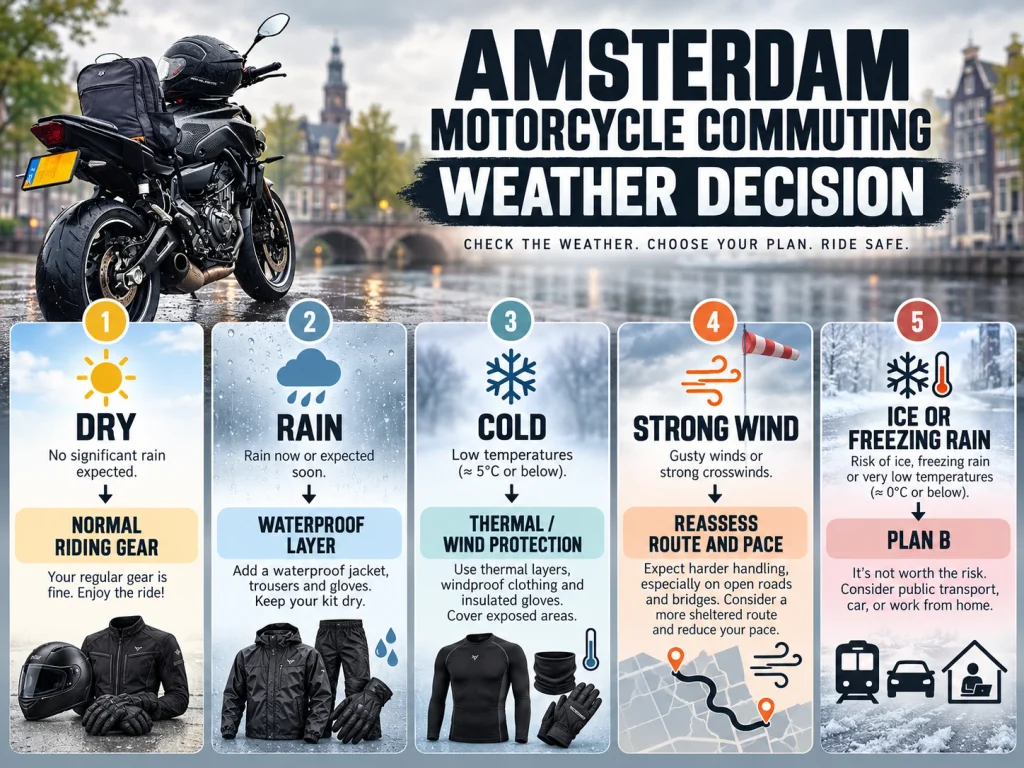
The Weather Is the Real Commuting Variable
If you want to commute regularly by motorcycle in the Netherlands, weather becomes part of the routine.
Not something you check occasionally.
Something you check every day.
The long-term KNMI climate data from Schiphol gives a useful indication of why.
During the 1991–2020 climate-normal period, Schiphol averaged about 189 days per year with at least 0.1 mm of precipitation.
That does not mean Amsterdam experiences 189 completely rainy days.
A shower can qualify.
Rain can arrive overnight.
The road may be dry again an hour later.
But it does mean that if your commuting plan depends on:
“I’ll only ride when there is absolutely no rain around,”
you may leave the motorcycle parked quite often.
A better setup is to be prepared for some rain.
Waterproof Gear Is More Useful Than Optimistic Weather Forecasting
For occasional riding, you can get away with waiting for perfect conditions.
For commuting, waterproofing changes the experience.
There are broadly two approaches.
Waterproof motorcycle gear
Your jacket, trousers, boots and gloves already provide the weather protection.
This is convenient because there is no extra rain layer to put on.
The downside is that not every supposedly waterproof motorcycle garment performs equally well after sustained use or heavy rain.
Separate waterproof outer layers
A rain jacket and over-trousers go over your normal riding gear.
This adds another step before riding.
But it can also give you an additional barrier without requiring your everyday riding suit itself to handle everything.
Neither system is automatically better.
The useful question is:
Can I arrive at work dry enough that riding didn’t create another problem?
For a deeper look at riding technique rather than commuting logistics, my Wet Weather Motorcycle Riding Tips guide covers traction, braking, visibility and surface hazards.
Keep Rain Gear Somewhere Accessible
A waterproof layer buried underneath everything else in your luggage is not very useful when the rain starts.
For commuting, I would want rain protection somewhere that can be reached quickly.
That might be:
a top case,
pannier,
tail bag,
or the top of a backpack.
Because the point isn’t merely owning waterproof gear.
It is actually putting it on before you’re already soaked.
This is the kind of small inconvenience that determines whether commuting remains enjoyable after the novelty wears off.
Your Work Clothes Need a System Too
Motorcycle clothing and office clothing solve different problems.
If your workplace is casual enough that riding clothes are acceptable, commuting gets much easier.
If you need:
smart trousers,
a shirt,
formal shoes,
or other work-specific clothing,
you need a changing strategy.
One of the simplest options is keeping part of your work wardrobe at work.
For example:
shoes,
a belt,
basic toiletries,
and perhaps one or two spare clothing items.
That reduces the amount you have to carry every morning.
Another option is wearing work clothes underneath your motorcycle gear where practical.
That works better with some combinations than others.
The important part is to think about the whole commute.
Not just:
How do I ride there?
But:
How do I arrive ready for the rest of my day?
Boots Are Often the Most Awkward Part
A motorcycle jacket can be taken off quickly.
Motorcycle trousers can usually be dealt with.
Boots often create more inconvenience.
Proper motorcycle boots are designed for riding protection.
That doesn’t necessarily make them comfortable for spending eight hours in an office.
So leaving normal shoes at work can make a huge difference.
It also means you aren’t trying to fit bulky shoes into your motorcycle luggage every single day.
Small systems like that make regular riding much easier.
Think About Where Your Gear Goes After You Arrive
A helmet alone is bulky.
Add:
jacket,
gloves,
rain gear,
motorcycle trousers,
and possibly boots,
and suddenly your desk has become a motorcycle wardrobe.
If your workplace has:
a locker,
changing room,
storage cupboard,
or somewhere secure for personal equipment,
commuting becomes significantly easier.
If it doesn’t, think about this before making the motorcycle your regular transport.
There is nothing wrong with walking into work carrying a helmet.
But carrying an entire suit around all day becomes old fairly quickly.
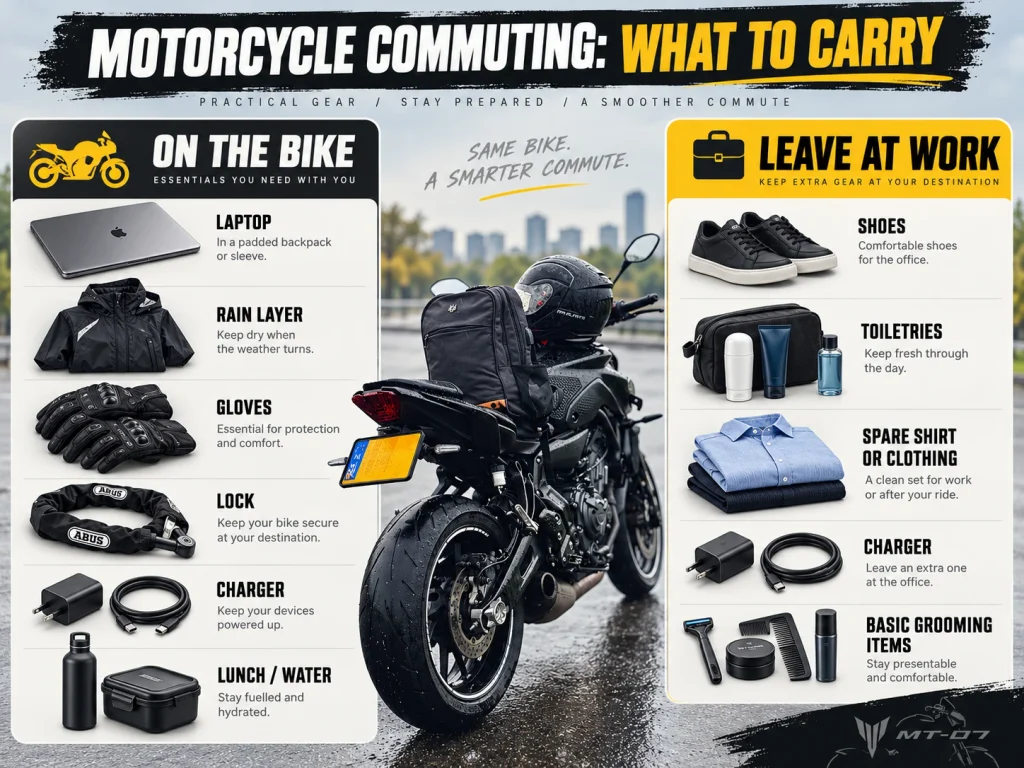
Luggage Changes Motorcycle Commuting
A recreational ride can be almost luggage-free.
A commute rarely is.
You may need to carry:
a laptop,
lunch,
water,
work clothes,
rain gear,
a lock,
chargers,
and personal items.
The easiest mistake is putting everything into a backpack.
That works.
But the heavier the backpack becomes, the more noticeable it is.
A proper motorcycle luggage setup takes the weight off your body.
Options include:
Tail bag
Simple and relatively compact.
Good for riders who don’t need large capacity.
Top case
Not everybody likes how they look.
But for commuting, practicality is difficult to argue with.
They can provide weather-resistant storage and let you leave some items with the motorcycle when appropriate.
Panniers
Useful when you need more capacity, although they add width.
That matters in city traffic and anywhere you move through narrow spaces.
Tank bag
Excellent for smaller items that you want easy access to.
The right answer depends on the bike and how much you carry.
I would start with:
What do I actually need every day?
Then buy storage around that.
Not the other way around.
Be Careful Carrying a Laptop
A laptop is one commuting item I would not casually throw into any bag.
Think about:
padding,
water resistance,
and how securely it sits inside the luggage.
A motorcycle experiences:
vibration,
bumps,
rain,
and movement.
The bag that works perfectly on a train may not be the best place for expensive electronics on a motorcycle.
A waterproof inner sleeve can also provide an inexpensive second layer even when the outer bag claims to be waterproof.
Leave More Time Than the Navigation App Says
One of the hidden differences between motorcycle commuting and driving is preparation time.
Google Maps might say:
25 minutes.
But your real journey may also include:
five minutes putting on gear,
unlocking the motorcycle,
getting the bike out,
packing the luggage,
parking,
locking it again,
and changing after arrival.
The riding time isn’t the whole commute.
If your motorcycle saves ten minutes on the road but adds fifteen minutes of preparation, that matters.
Likewise, a longer motorcycle journey can still be worthwhile if it gives you:
more flexibility,
a direct route,
or a better start to the day.
Measure the door-to-desk time, not just the riding time.
That’s the honest comparison.
Amsterdam Traffic Rewards Observation More Than Speed
City commuting encourages rushing.
You know the route.
You have ridden it dozens of times.
You know where the traffic lights are.
And you’re probably trying to arrive at a certain time.
That familiarity can become a problem.
Amsterdam gives you plenty to monitor:
bicycles,
pedestrians,
delivery vehicles,
buses,
trams,
tourists,
junctions,
roadworks,
and cars looking for parking.
So I would rather think of a good city commute as:
predictable and boring
than:
fast and exciting.
My Riding in Heavy Traffic and Riding a Motorcycle in Amsterdam guides go deeper into that side of city riding.
The commute itself isn’t the place where I want to prove anything.
I just want to arrive.
Familiar Routes Can Create Complacency
There is something psychologically different about riding the same road repeatedly.
A new road gets your attention.
A familiar commute can make your brain assume:
I know what happens here.
But the road isn’t actually the same.
A delivery van is parked somewhere different.
A cyclist runs a light.
Roadworks appear overnight.
Leaves cover the surface.
A tram blocks a junction.
Someone opens a car door.
The route is familiar.
The conditions aren’t.
That is worth remembering when everyday riding starts feeling automatic.
Filtering Can Help — But Don’t Turn the Commute Into a Race
When traffic slows heavily on Dutch motorways, motorcycle filtering can be useful.
But the Dutch filegedragscode recommends keeping the motorcycle’s speed difference to approximately 10 km/h, using the space between the two leftmost lanes on wider motorways and keeping adequate distance from another filtering motorcycle.
I covered that properly in Lane Filtering in the Netherlands.
The commuting-specific point is simpler:
Don’t let knowing you’re late change your filtering behaviour.
If the gap doesn’t look comfortable today, don’t take it because yesterday’s commute was faster.
Five minutes late is usually easier to explain than a collision.
Parking Needs to Be Part of the Commute Plan
The journey doesn’t finish when you reach the street where you work.
You still need somewhere to leave the motorcycle.
Amsterdam says paid parking applies on most streets, with the price and paid hours depending on the location.
Motorcycle parking also has some Amsterdam-specific nuance, particularly around pavement parking and historically tolerated practices.
Rather than repeating that entire subject here, see:
Motorcycle Parking in Amsterdam: Rules, Paid Parking & Practical Tips.
For commuting, I would answer three questions before making a destination part of my daily routine:
Where am I parking?
What does it cost?
Can I secure the motorcycle properly there?
If you have no clear answer to those, the commute isn’t fully planned yet.
Security Gets More Important When the Bike Sits All Day
A ten-minute stop is one thing.
Leaving your motorcycle in the same place for eight or nine hours is different.
It becomes predictable.
This is why commuting security deserves more thought than:
I’ll just use the handle lock.
Depending on the parking environment, your security layers might include:
an ART-rated lock,
anchoring to an appropriate fixed point,
a second lock or alarm,
tracking,
and insurance that actually covers theft under the conditions you’re using.
My full guide is here:
Motorcycle Security in Amsterdam: Locks, Anchors, Trackers & Theft Prevention.
One useful commuting principle is:
the security system has to be practical enough that you’ll use it twice every day.
A setup that takes fifteen frustrating minutes each time may eventually become a setup you stop using properly.
Visibility Matters More in the Dark Months
A commute that happens entirely in daylight during June can become:
dark in the morning,
dark in the evening,
or both,
later in the year.
That changes the riding environment.
Check:
headlight,
tail light,
brake light,
indicators,
visor condition,
and reflective elements.
The aim isn’t to cover yourself in fluorescent material unless you want to.
It is simply to understand that contrast and conspicuity matter more when you’re riding among wet roads, headlights and reflections.
My Motorcycle Visibility Tips for Urban Riders and Night Riding Safety articles go deeper into that.
Cold Weather Is More Than a Comfort Problem
Cold hands don’t just feel unpleasant.
They can make operating:
brake,
clutch,
throttle,
and switches
less comfortable and less precise.
The solution doesn’t have to be complicated.
Layer properly.
Block the wind.
Use insulated gloves when conditions require them.
Consider heated equipment if your commuting frequency justifies it.
The goal isn’t to prove you can tolerate cold.
It is to arrive while still having normal control of your hands.
Wind Can Matter More Than the Temperature
The Netherlands doesn’t need extreme temperatures to create an uncomfortable ride.
Wind can change everything.
A moderate temperature combined with sustained airflow at motorcycle speed feels very different from standing outside in the same weather.
Crosswinds can also become more tiring on open roads.
That is particularly noticeable around:
exposed motorway sections,
bridges,
open countryside,
and when passing large vehicles.
If strong wind is part of the forecast, my How to Ride Safely in Strong Wind guide covers positioning and riding technique in more detail.
For commuting, the most useful habit is simply checking the forecast before putting all the gear on.
Winter Means Road Salt
This is one of the less glamorous parts of year-round riding.
Rijkswaterstaat’s official winter road-service season runs from 1 October until 1 May.
When frost, snow or ice is expected, salt can be spread preventively across the road network.
That is good for reducing ice.
It is less exciting for a motorcycle.
Salt and winter grime can sit on:
fasteners,
brake components,
engine cases,
exhaust parts,
suspension,
and other exposed metal surfaces.
If you commute regularly during winter, cleaning stops being purely cosmetic.
I would rather do quick, frequent cleaning than wait until spring and discover months of road grime baked into everything.
Winter Cleaning Doesn’t Need to Become a Full Detail
You do not need to spend two hours polishing the bike after every commute.
A basic winter routine can be much simpler.
Rinse the worst contamination away.
Pay attention to areas where salty dirt collects.
Dry what you reasonably can.
Keep the chain maintained if your motorcycle uses one.
Check corrosion-prone areas regularly.
The important part is frequency.
Not perfection.
A commuter motorcycle is going to get dirty again.
That’s okay.
Ice Is Where I Would Change the Plan Completely
Rain can usually be managed.
Cold can usually be managed.
Ice deserves a different level of respect.
Rijkswaterstaat identifies several types of winter slipperiness, including frozen wet road surfaces, condensation frost and precipitation such as freezing rain, snow and hail.
It also specifically notes that bridges and viaducts can be susceptible because road-surface temperatures can fall below the dew point and freezing point.
On two wheels, the consequence of suddenly discovering ice is much less forgiving than in a car.
This is where my commuting principle becomes:
Having a motorcycle available doesn’t mean I have to use it.
If conditions are genuinely icy:
train.
bus.
car.
work from home if that’s an option.
Anything sensible.
There is no achievement unlocked for surviving an unnecessary icy commute.
Have a Plan B Before You Need It
This might be one of the biggest differences between casual riding and commuting.
A recreational ride can simply be cancelled.
Work usually cannot.
So a good motorcycle commuting system includes another transport option.
That could be:
public transport,
bicycle,
car,
or some combination.
Know the alternative route.
Know how long it takes.
Know which train or bus you would use.
Then the motorcycle remains an option rather than an obligation.
That takes a lot of pressure out of the decision.
Build a Small Commuter Kit
I like the idea of keeping the everyday setup deliberately simple.
A commuter kit might include:
- rain layer
- spare gloves
- visor cloth
- small microfiber cloth
- earplugs
- charging cable
- basic lock equipment
- water
- emergency contact information.
Not because every ride is an expedition.
Quite the opposite.
Keeping the essentials together means you aren’t rebuilding your luggage every morning.
Consider Leaving Duplicate Items at Work
This is one of the easiest ways to make commuting less annoying.
Depending on your workplace, you could leave:
shoes,
deodorant,
hair products,
charger,
basic toiletries,
a spare shirt,
or whatever you repeatedly carry.
The more permanent things you can leave at the destination, the less the motorcycle has to transport every day.
That means:
lighter luggage,
less packing,
less forgetting things.
A Small Pre-Ride Check Matters More When the Bike Is Used Daily
Frequent use can make you stop seeing the motorcycle.
You start it every morning.
It worked yesterday.
So you assume it will work today.
But daily mileage accumulates quickly.
Tyre pressure changes.
Chain tension changes.
Brake pads wear.
Lights fail.
Fluids move.
So I would keep a short routine.
Not a twenty-minute inspection.
Just enough to notice something obvious before it becomes a roadside problem.
Check things such as:
tyres,
lights,
chain,
brakes,
obvious leaks,
controls,
fuel or charge level.
Regular commuting makes consistency more useful than an occasional perfect inspection.
Fuel Stops Can Be More Annoying Than They Sound
A recreational rider can stop for fuel whenever they feel like it.
A commuter discovers the problem at:
07:35,
already slightly late,
with the fuel light on.
The easiest solution is turning fuel into part of the routine.
For example:
don’t park the motorcycle at home nearly empty.
Refuel on the way back rather than discovering the problem next morning.
Again, the goal is reducing friction.
Watch Your Tyres More Closely
Commuting can create a lot of relatively repetitive mileage.
Depending on your route, tyres may spend a lot of time:
upright,
on motorways,
in stop-start traffic,
and under regular braking.
That can create wear patterns that differ from weekend riding.
Don’t only look at tread depth.
Look at:
shape,
pressure,
damage,
and how the motorcycle feels.
A tyre that technically has tread remaining may still feel very different after thousands of commuting kilometres.
Commuting Will Change Your Running Costs
A motorcycle that covers:
3,000 km per year
and the same motorcycle covering:
12,000 km per year
do not have identical ownership costs.
More commuting means more:
fuel,
tyres,
chain maintenance,
services,
brake wear,
and depreciation.
That doesn’t automatically make commuting expensive.
It simply means the calculation should include distance, not just fixed costs such as insurance and road tax.
My MT-07 running-cost breakdown gives a real example of how maintenance, tyres and servicing affected my first year with TITAN.
The Commute Can Still Be the Best Part of the Workday
All of this practical detail can make motorcycle commuting sound like work.
Sometimes it is.
You put on more gear.
You check the rain.
You unlock the bike.
You lock it again.
You clean it more frequently.
But there is another side.
Even an ordinary journey can become a small separation between:
home
and:
work.
You’re doing something active rather than simply sitting inside a vehicle.
You are paying attention.
Moving.
Reacting.
And when the weather is good, the journey you previously wanted to get over with can become something you actually look forward to.
I think that’s one of motorcycling’s quieter advantages.
Not every ride needs to be an adventure.
Sometimes the motorcycle just takes you to work.
And that can still be a good ride.
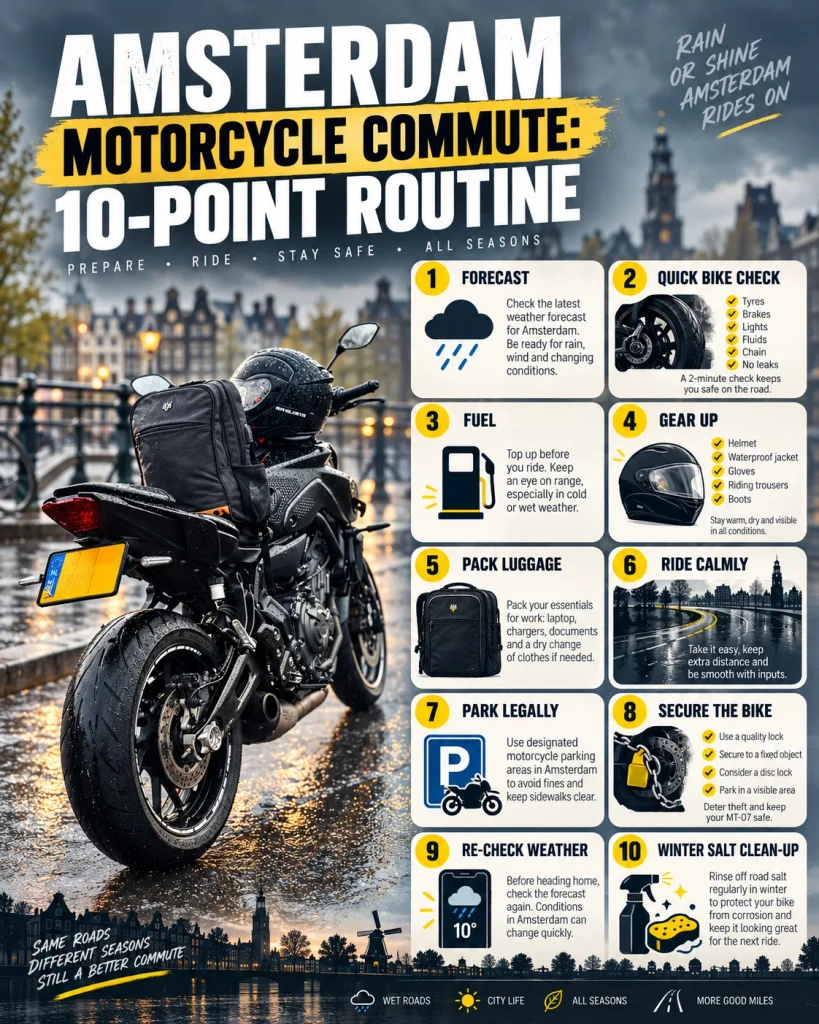
My Ideal Amsterdam Motorcycle Commuting Routine
If I were building a sustainable routine around regular motorcycle commuting, I would keep it simple.
The evening before
Check the forecast.
Make sure fuel is sufficient.
Pack anything unusual.
Before leaving
Quick motorcycle check.
Dress for the actual weather.
Load the luggage securely.
Unlock security equipment.
During the ride
Don’t let work timing dictate riding speed.
Keep the observation wide.
Treat familiar junctions as if something can still change.
At the destination
Park legally.
Secure the motorcycle properly.
Store your riding gear.
Change if necessary.
Before riding home
Check the weather again.
Especially wind, rain and winter temperature.
Make sure nothing has changed around the motorcycle.
After a winter ride
Remove heavy salt and road grime when practical.
That is enough.
The system shouldn’t be so elaborate that commuting becomes exhausting.
When I Would Leave the Motorcycle at Home
For me, the goal isn’t:
ride every possible day.
The goal is:
make the motorcycle useful when it makes sense.
I would strongly reconsider riding when conditions include:
significant ice,
freezing rain,
severe storm conditions,
dangerous visibility,
or circumstances where I simply don’t feel properly prepared.
Rijkswaterstaat itself advises road users in slippery winter conditions to monitor weather and traffic information, reduce speed where necessary and maintain additional distance.
On a motorcycle, I would go one step further.
Sometimes the correct speed is:
zero.
Take another form of transport.
The motorcycle will still be there tomorrow.
Is Motorcycle Commuting in Amsterdam Worth It?
It depends on the journey.
If you live five minutes from a tram that stops outside your office, putting on motorcycle gear may make very little sense.
If your trip crosses parts of the city or surrounding region poorly connected by public transport, the motorcycle can become much more attractive.
The calculation isn’t simply:
motorcycle vs car.
It might be:
motorcycle,
bicycle,
train,
metro,
car,
or some mixture depending on the day.
I don’t think there is anything inconsistent about commuting by motorcycle on Tuesday and taking the train on Wednesday because freezing rain is forecast.
That’s not giving up on motorcycling.
That’s simply using the right tool for the conditions.
Final Thoughts
Motorcycle commuting in Amsterdam can work very well.
But the motorcycle itself is only part of the system.
You also need to solve:
weather,
clothing,
luggage,
parking,
security,
winter grime,
and the simple question of what happens when riding isn’t the sensible choice.
For me, the most useful commuting setup would not be the one with the most expensive equipment.
It would be the one with the least friction.
Gear that is easy to put on.
Luggage that carries what you actually need.
A known parking location.
A security routine you use every time.
Waterproofing that keeps a shower from ruining the morning.
And another way to get to work when the roads are icy.
Build those pieces properly and commuting stops feeling like a logistics exercise.
It just becomes:
going to work on the motorcycle.
And on the right morning, that can make an ordinary journey feel a little less ordinary.
Ride safe and enjoy the journey.
FAQs
Is a motorcycle practical for commuting in Amsterdam?
It can be, particularly for longer cross-city or regional journeys where public transport is less direct. However, the real door-to-door time should include gearing up, parking, securing the motorcycle and changing at the destination.
Can petrol motorcycles enter Amsterdam’s environmental zone?
As of October 2026, Amsterdam explicitly states that it does not have an environmental or zero-emission zone for motorcycles. Different rules apply to other vehicle categories such as scooters, mopeds, vans and trucks.
Can you commute by motorcycle year-round in the Netherlands?
Some riders do, but weather and road conditions should decide whether a particular ride makes sense. Rain and cold can often be managed with suitable equipment, while ice and freezing rain can make another transport option much more sensible.
How often does it rain around Amsterdam?
Using nearby Schiphol as the KNMI reference, the 1991–2020 climate normal recorded around 189 days per year with at least 0.1 mm of precipitation. This includes brief or light precipitation and does not mean 189 full days of continuous rain.
What motorcycle gear is useful for commuting?
At minimum, use proper protective motorcycle gear suitable for the conditions. For regular Dutch commuting, waterproofing, cold-weather layers, spare gloves and a practical way to store work clothing can make the routine considerably easier.
Do Dutch roads get salted in winter?
Yes. Rijkswaterstaat uses road salt to combat frost, snow and ice. Its normal winter-service season runs from 1 October to 1 May, although salting can occur outside that period if required.
Should I wash my motorcycle after winter commuting?
You don’t need to fully detail it after every ride, but regularly removing road salt and winter grime is sensible. Pay particular attention to exposed metal and keep the chain maintained if your motorcycle uses one.
What is the best motorcycle luggage for commuting?
There is no single best solution. Tail bags work for lighter loads, top cases offer practical everyday capacity, panniers work for larger loads and tank bags are useful for small items. Choose around what you actually carry rather than maximum possible storage.
Related Reads
Riding a Motorcycle in Amsterdam: What City Riding Is Really Like
Motorcycle Parking in Amsterdam: Rules, Paid Parking & Practical Tips
Motorcycle Security in Amsterdam: Locks, Anchors, Trackers & Theft Prevention
Wet Weather Motorcycle Riding Tips: How to Ride Safely in the Rain
How to Ride a Motorcycle Safely in Strong Wind
Motorcycle Visibility Tips for Urban Riders
Riding in Heavy Traffic: Safety Tips for Urban Motorcyclists