One of the things I came to appreciate after getting my Dutch motorcycle licence was how useful it became outside the Netherlands.
I had already ridden motorcycles before moving here.
But getting licensed again meant adapting to a different riding system, different road positioning and, quite literally, the opposite side of the road from what I had previously been used to.
Later, that same Dutch licence became part of another experience:
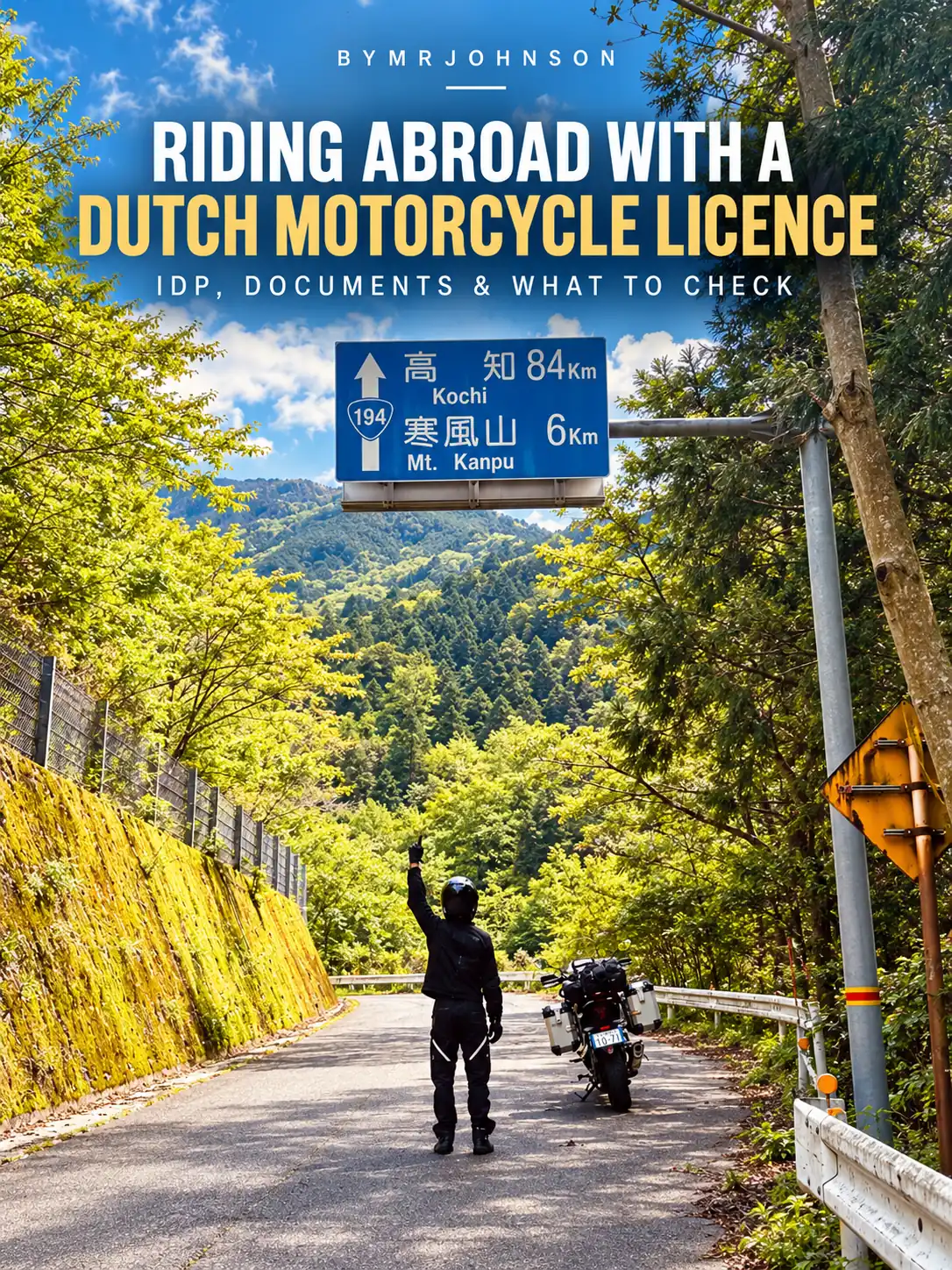
a motorcycle trip in Japan.
To ride there, I applied for an International Driving Permit — IDP in the Netherlands and carried it together with my Dutch licence.
That experience taught me something that sounds obvious in hindsight:
Having a motorcycle licence does not automatically mean you can ride anywhere in the world.
Your licence category matters.
The destination matters.
The type of International Driving Permit matters.
The rental company can have additional rules.
And if you’re taking your own motorcycle across borders, registration and insurance documents become part of the equation too.
So before riding abroad, I now think about the paperwork almost like another piece of riding gear.
You hope it stays in your bag for most of the trip.
But you really want it to be correct when somebody asks for it.
Note: International driving rules change and can differ by country, region and even rental company. This guide was checked against current information in October 2026. Always verify the destination before travelling.
Can You Ride Abroad With a Dutch Motorcycle Licence?
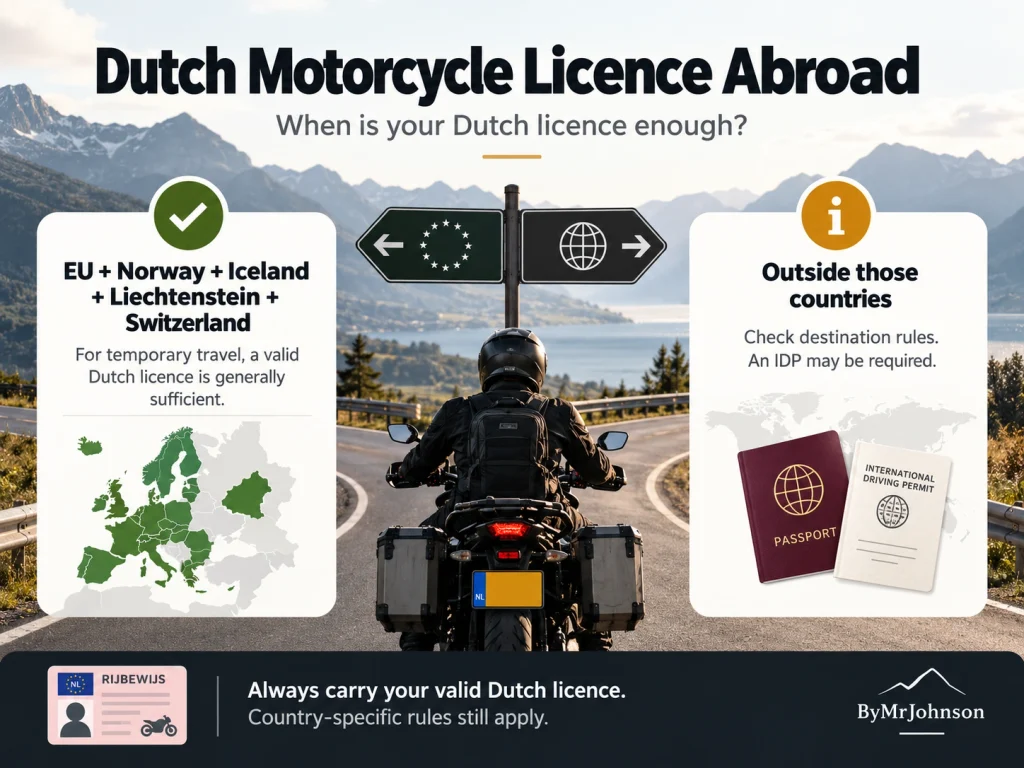
Usually, yes — but the answer depends on where you’re going.
For temporary travel, a valid Dutch driving licence is accepted throughout the European Union, as well as:
- Norway
- Iceland
- Liechtenstein
- Switzerland.
You do not need an International Driving Permit simply to drive in the EU with a valid Dutch licence.
Outside the EU, things become much less uniform.
Some countries accept the Dutch licence by itself.
Some require the Dutch licence plus an IDP.
Some recognise one specific IDP convention but not another.
And a smaller number require additional local documentation or a local licence.
So my first rule would be:
Never assume that “internationally recognised” means “accepted everywhere without additional documents.”
Check the specific destination.
What Is an International Driving Permit?
An International Driving Permit is not a replacement motorcycle licence.
It is essentially a standardised multilingual document that helps authorities abroad understand:
who you are
and:
which vehicle categories your normal licence allows you to drive.
NetherlandsWorldwide describes the IDP as a translation of your Dutch driving licence into several languages.
It is only valid together with your Dutch licence.
You should not leave your Dutch licence in the hotel because:
“I have the international one.”
The IDP does not replace it.
Think of the pair as:
Dutch licence = actual driving entitlement
IDP = internationally recognised translation / supporting document
Depending on the country, you may need to show both.
There Isn’t Just One International Driving Permit
This is where things become surprisingly important.
The Netherlands issues multiple IDP models based on different international road-traffic conventions.
ANWB currently offers:
| IDP model | Current price | Standard validity |
|---|---|---|
| 1968 model | €24.95 | Up to 3 years* |
| 1949 model | €18.95 | 1 year |
| 1926 model | €18.95 | 1 year |
*The validity can still be limited by the validity of the underlying Dutch driving licence and the rules of the destination country.
The important part isn’t deciding that:
1968 is newer, therefore 1968 must always be better.
That’s not how it works.
Different countries recognise different conventions.
You need the model accepted by the place where you’re actually going.
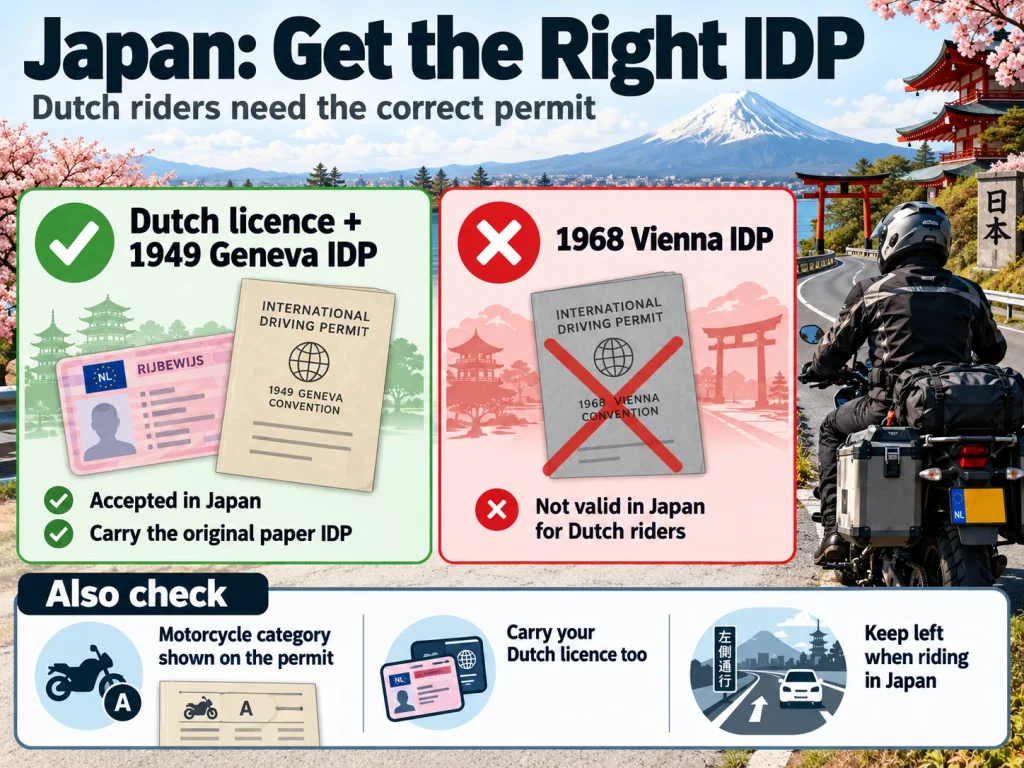
Japan Is a Perfect Example
When I went to Japan for a motorcycle trip, I needed an IDP.
Japan does not accept the Dutch licence by itself for this purpose.
For Dutch residents, ANWB currently states that Japan requires:
IDP model 1949
together with the Dutch driving licence.
And there is an important trap here.
The Japanese National Police Agency’s current country-specific information for the Netherlands confirms that:
Dutch 1949 Geneva-format IDP → VALID
Dutch 1968 Vienna-format IDP → INVALID
for driving in Japan.
So if I had simply thought:
“I’ll get the newer three-year IDP.”
I could have arrived with the wrong document.
That’s why the country comes first and the IDP model second.
Japan Also Requires the Original Paper IDP
A photo on your phone is not enough.
Japan’s National Police Agency specifically says that a digital version of an international driving permit displayed on a phone cannot be used.
You need the proper original document.
I would apply that mindset more broadly when travelling anyway.
Keep the originals.
Keep digital copies as backups.
But don’t assume the backup has the same legal status as the document itself.
Your Motorcycle Category Must Be Correct
This is another detail riders shouldn’t overlook.
An IDP doesn’t simply say:
licensed driver.
It also shows the classes of vehicle you’re authorised to operate.
Japan’s police guidance is very clear that you may only drive vehicle categories correctly indicated on the international permit.
A stamp in one vehicle category does not automatically authorise another category.
So before leaving the ANWB shop, I would check:
Does the IDP correctly show my motorcycle entitlement?
Do not discover a missing or incorrect category at the rental counter on the other side of the world.
If you’re planning to hire a bike during your trip, my guide to renting a motorcycle abroad explains what to check about insurance, deposits, rental conditions and motorcycle inspections before booking.
How Do You Get an IDP in the Netherlands?
For Dutch residents, International Driving Permits are issued through ANWB.
NetherlandsWorldwide currently says you apply in person at an ANWB shop and bring:
- your Dutch driving licence
- two passport photographs meeting Dutch passport-photo requirements.
The IDP can normally be issued while you’re there.
ANWB also advises checking which model you need not only for your final destination, but for countries you may travel through during the trip.
That matters much more when you’re travelling overland.
Your final destination may accept one arrangement.
A transit country might not.
Within Europe, Things Are Much Simpler
For normal temporary travel within the EU, your Dutch driving licence is generally enough.
The same applies to Norway, Iceland, Liechtenstein and Switzerland.
ANWB’s country guidance confirms this for common motorcycle destinations such as Belgium and other EU countries: your valid Dutch licence is accepted and an IDP isn’t normally required.
That makes an international motorcycle trip from the Netherlands relatively straightforward.
But licence recognition is only one part of the trip.
The local traffic rules still change.
Your Dutch Licence Does Not Export Dutch Traffic Rules
This is one of the most important things I learned from adapting to riding in different countries.
The licence may travel.
The road system doesn’t.
Different countries can have different rules for:
speed limits,
filtering,
helmet requirements,
equipment,
parking,
alcohol limits,
tolls,
road signs,
winter equipment,
and what you’re required to carry.
Even something as basic as the side of the road can change.
The Netherlands drives on the right.
Japan drives on the left. Japan’s National Police Agency explicitly reminds foreign drivers to keep left.
Before moving to the Netherlands, I had been used to riding on the left.
Then I had to adapt to the European right-hand traffic environment while working towards my Dutch licence.
Japan brought me back into a left-side road environment again.
I want to explore that experience properly in a separate Japan article rather than squeeze the whole trip into this guide.
But the larger lesson applies anywhere:
Arrive ready to learn the local road again.
Don’t assume experience at home automatically translates into local knowledge abroad.
Renting a Motorcycle Adds Another Layer
Being legally allowed to ride a motorcycle in a country does not guarantee that a rental company has to rent one to you.
Rental companies can impose their own conditions.
ANWB notes that foreign rental companies may require things such as:
a minimum or maximum rider age,
a minimum number of years you’ve held your licence,
passport or ID,
an IDP,
and usually a credit card.
This distinction is important.
There are really two separate questions:
Am I legally licensed to ride this motorcycle in this country?
and:
Will this rental company allow me to rent this motorcycle?
You need yes to both.
Check the Exact Motorcycle Class Before Booking
This becomes especially relevant with larger or more powerful motorcycles.
Don’t simply search:
motorcycle rental Japan
or:
motorcycle rental Italy
and book something you like.
First confirm that your licence category covers the bike.
Then confirm the IDP reflects that category correctly.
Then confirm the rental company accepts your licence, age and riding experience.
The booking website accepting your credit-card details doesn’t necessarily mean the documentation has already been approved.
I would rather email the company a question beforehand than argue at the rental desk after arriving.
The Rental Company’s Insurance Matters Too
Rental insurance deserves its own future article because the terminology varies significantly.
But at minimum, I would check:
What liability insurance is included?
What happens if I damage the motorcycle?
What is the excess / deductible?
Is theft covered?
Does the cover change if I cross a border?
Are tyres, wheels, mirrors or other parts excluded?
Does somebody else need to be named if they will ride the bike?
ANWB notes that in vehicle rental contracts, only drivers properly listed in the contract may be insured under the rental arrangement.
The cheapest motorcycle-rental price can look much less attractive once a very large deductible is added.
If You’re Taking Your Own Motorcycle Abroad
This creates a different checklist.
Your driving licence is still important.
But now you also have to prove that the motorcycle itself belongs on the road.
One document I would definitely carry is the physical Dutch:
kentekencard — vehicle registration card
RDW states that the registration certificate must always be carried when the vehicle is abroad.
That is worth remembering if you’ve recently bought a motorcycle.
Inside the Netherlands, RDW gives you a short period before you are required to physically carry the newly issued card.
Abroad, you need the registration certificate.
So don’t plan an international trip immediately after the ownership transfer without checking that you actually have the document.
Carry Your Insurance Information Too
Within the EU, compulsory third-party motor insurance issued in one EU country remains valid when you temporarily travel in another EU country.
The EU guidance explicitly states that this applies to all types of motor vehicles, not just cars.
That covers the legal liability baseline.
But optional cover is another question.
Things such as:
theft,
damage to your own motorcycle,
roadside assistance,
and comprehensive cover
can have different territorial limitations or conditions.
So before riding abroad, I would ask my insurer:
Is my exact cover valid in every country I’m visiting?
Not just:
Am I insured?
Those questions are not identical.
What About the Green Card?
Within the EU, a Green Card is not normally required as proof in the same way it once was, but carrying insurance documentation can still make things much easier.
EU guidance says the Green Card remains internationally recognised proof of insurance and can simplify matters after an accident.
If you don’t carry one, carry your insurance certificate.
Once you’re travelling outside the EU, I would check the specific destination with the insurer.
Coverage territory and documentation requirements can change by country.
Your Travel Documents Are Separate From Your Driving Licence
A Dutch driving licence is not a travel document.
NetherlandsWorldwide specifically reminds travellers that a driving licence does not replace a passport or identity card for international travel.
That means a normal motorcycle-trip document setup may involve several separate things:
Passport or ID
Proves who you are / satisfies border requirements.
Dutch driving licence
Proves your domestic entitlement to ride.
IDP where required
Supports the Dutch licence internationally.
Registration certificate
Proves the vehicle’s registration when taking your own motorcycle.
Insurance documentation
Shows your cover and helps if something happens.
Different documents.
Different jobs.
Don’t Forget the Countries You Ride Through
Suppose your destination is somewhere several borders away.
It isn’t enough to research only the final country.
If you’re riding through:
Belgium,
France,
Switzerland,
Italy,
and then somewhere else,
you are subject to the relevant rules while you are in each one.
ANWB specifically recommends checking countries that you may cross when working out IDP requirements.
I would extend that to:
tolls,
required equipment,
speed rules,
filtering,
insurance territory,
and environmental zones.
The journey is part of the trip.
Not simply the space between home and the destination.
Check That Your Dutch Licence Is Actually Valid
This sounds almost too basic to mention.
But an IDP does not rescue an expired Dutch licence.
NetherlandsWorldwide states that you may only drive abroad with a valid licence.
Japan’s police guidance similarly ties the validity of international-driving permission to the underlying domestic driving licence.
So before an expensive international motorcycle trip, check the expiry date.
Not at the airport.
Before booking.
Don’t Assume a Digital Copy Will Save You
I keep digital copies of important documents because they can still be useful if something is lost.
But I would treat them as:
backups
rather than:
replacements.
Japan explicitly requires the original physical Geneva-format IDP rather than a phone version.
RDW also says to carry the vehicle registration certificate when taking your Dutch vehicle abroad.
So my approach would be:
carry the required originals securely,
keep digital copies separately,
and perhaps leave another copy somewhere you can access remotely.
A Simple Pre-Trip Document Routine
Before riding internationally, I would work through the trip in this order.
Destination
Check whether the Dutch motorcycle licence is accepted.
IDP
If required, identify the correct convention:
1949?
1968?
or another arrangement?
Licence category
Make sure both the Dutch licence and IDP correctly cover the motorcycle you plan to ride.
Rental conditions
If renting, check:
age,
years licensed,
credit card,
deposit,
motorcycle category,
and insurance.
Your own motorcycle
If taking your bike, check:
registration card,
insurance territory,
roadside assistance,
and any country-specific requirements.
Local road rules
Learn the rules that will actually change your riding.
Documents
Carry the originals where required and keep backups separately.
It isn’t complicated once you separate the questions.
What I Would Carry When Riding My Own Motorcycle Abroad
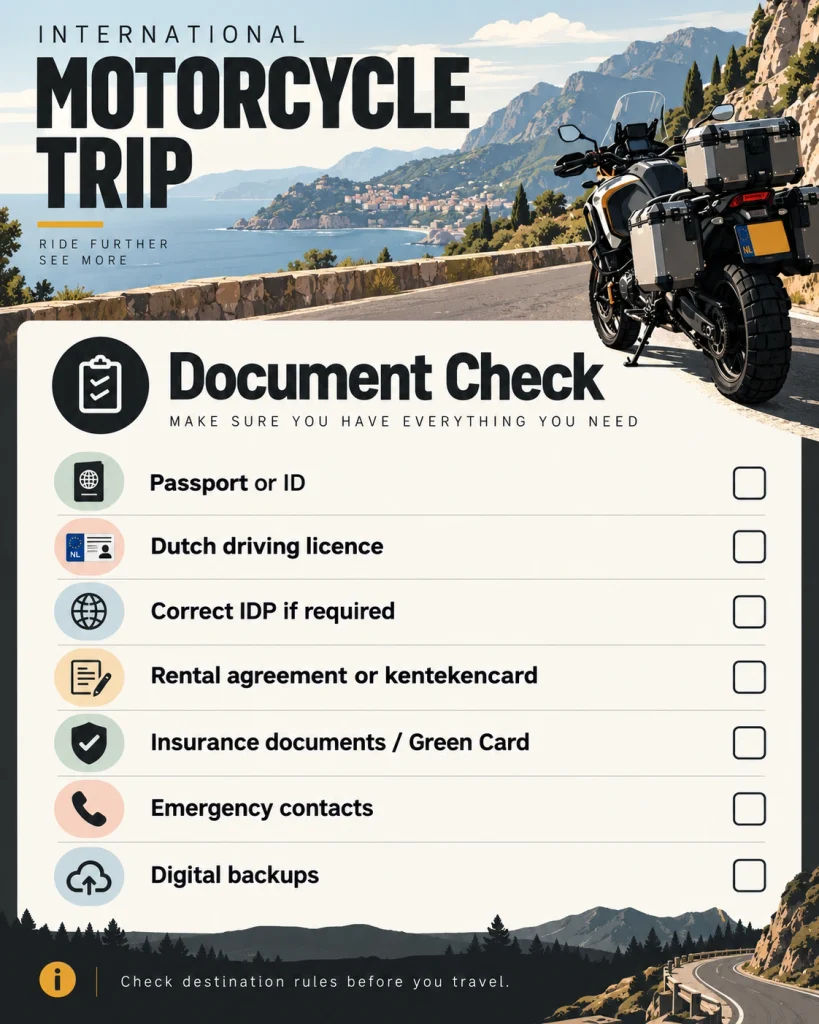
For a European trip on my own Dutch-registered motorcycle, my basic document set would include:
- passport or permitted national ID
- Dutch motorcycle licence
- IDP if the destination or transit country requires it
- physical kentekencard
- insurance certificate / Green Card where useful or required
- breakdown-assistance details if covered
- emergency contact details
- digital backups stored separately.
The exact list still needs to be checked against the destination.
But this would be my starting point.
What I Would Carry When Renting Abroad
If I’m flying somewhere and renting the motorcycle there, the vehicle documents normally belong to the rental operation.
My personal preparation becomes:
Dutch motorcycle licence,
correct IDP,
passport,
credit card,
rental confirmation,
insurance details,
emergency numbers,
and proof of anything the company specifically requested.
Then I would check the rental motorcycle itself before leaving.
Damage.
Tyres.
Brakes.
Lights.
Controls.
Fuel policy.
Documents.
And photographs of its existing condition.
That deserves its own full guide.
My Japan Experience Changed How I Look at the Dutch Licence
When I first went through the Dutch motorcycle-licence process, the immediate goal was straightforward:
I wanted to ride legally in the Netherlands.
At the time, there was a lot to adapt to.
European traffic.
Right-side riding.
Dutch road behaviour.
The licensing system itself.
Later, being able to take that licence, arrange the proper international permit and use it for a motorcycle trip in Japan gave the whole process another dimension.
The licence wasn’t just permission to ride TITAN around Amsterdam.
It had become a document I could use to open up motorcycle experiences somewhere completely different.
Read : My Motorcycle Trip in Japan
But Japan also reinforced the other side of that freedom:
international riding rewards preparation.
The right IDP mattered.
The correct category mattered.
The local traffic system mattered.
And the fact that I had a Dutch licence did not remove the responsibility to learn how things worked there.
That is probably the part of international motorcycling I’m most interested in exploring next.
Not:
“Look how many countries you can ride in.”
But:
“How do you arrive somewhere unfamiliar and ride responsibly?”
One Lesson From Getting Licensed Again Applies Internationally Too
When I moved to the Netherlands, I already knew how to ride a motorcycle.
But I still had to unlearn habits.
I had to empty the cup a little.
Getting comfortable with another country’s road system required being willing to stop assuming that the way I already knew was the only way.
I think the same mindset is useful when riding internationally.
You can have:
years of experience,
a full motorcycle licence,
good control,
and thousands of kilometres behind you.
Then cross a border and become a beginner in certain ways again.
Different signs.
Different expectations.
Different road positioning.
Different driving culture.
Different hazards.
The motorcycle skills come with you.
The local knowledge doesn’t.
That has to be rebuilt.
My Main Takeaway
A Dutch motorcycle licence makes international riding relatively straightforward in many places.
Within the EU and several neighbouring European countries, the licence itself is generally enough.
Outside Europe, you need to investigate the destination properly.
An IDP may be required.
And even then:
the correct IDP matters.
My Japan trip is the clearest example.
A Dutch rider needs the 1949 Geneva-model IDP, together with the Dutch licence.
The 1968 model may be newer and valid for longer, but Japan does not accept it for this purpose.
That single detail captures the whole lesson.
Don’t prepare for an international motorcycle trip based on assumptions.
Check:
the country,
the licence,
the IDP,
the motorcycle category,
the rental conditions,
the insurance,
the vehicle documents,
and the local rules.
Then the paperwork can disappear into your luggage.
And you can concentrate on the reason you arranged all of it in the first place:
riding somewhere new.
Ride safe and enjoy the journey.
FAQs
Can I ride a motorcycle in Europe with a Dutch motorcycle licence?
Yes. For temporary travel, a valid Dutch driving licence is accepted throughout EU countries as well as Norway, Iceland, Liechtenstein and Switzerland. You normally do not need an IDP for these countries.
Do I need an International Driving Permit to ride a motorcycle abroad?
It depends on the country. You do not normally need one within the EU, but many countries outside the EU require an IDP together with your Dutch driving licence. Always check the destination before travelling.
Which International Driving Permit do I need for Japan?
Japan accepts the 1949 Geneva Convention IDP issued in the Netherlands. Japan does not accept the Dutch 1968 Vienna-model IDP for this purpose. You must also carry your valid Dutch driving licence.
Can I use a digital International Driving Permit in Japan?
No. Japan’s National Police Agency states that a digital IDP displayed on a mobile phone is not valid. Carry the original physical document.
How much does an IDP cost in the Netherlands?
As of October 2026, ANWB lists the 1968 model at €24.95 and the 1949 and 1926 models at €18.95 each. The correct model depends on the country you’re visiting.
Does an IDP replace my Dutch motorcycle licence?
No. It is used together with your Dutch licence. The IDP acts as an internationally recognised translation/supporting document and is not a replacement for the underlying licence.
Can a motorcycle rental company refuse me even if my licence is valid?
Yes. Rental companies can impose additional conditions such as minimum or maximum age, minimum time holding the licence, credit-card requirements and their own insurance conditions.
What documents should I carry if I ride my Dutch motorcycle abroad?
At minimum, check requirements for your passport or ID, Dutch driving licence, IDP if required, registration certificate and insurance documentation. RDW specifically states that you must carry the vehicle registration certificate when the vehicle is abroad.
Is my Dutch motorcycle insurance valid elsewhere in the EU?
Compulsory third-party motor insurance is valid when temporarily travelling within other EU countries. Optional cover such as theft or damage to your own motorcycle can have additional territorial conditions, so check your policy before travelling.
Related Reads
How I Got My Dutch Motorcycle Licence as an Expat: Tests, Costs & Lessons Learned
Motorcycling in the Netherlands: A Practical Guide for New & Expat Riders
Motorcycle Insurance in the Netherlands: WA, WA+ & All-Risk Explained