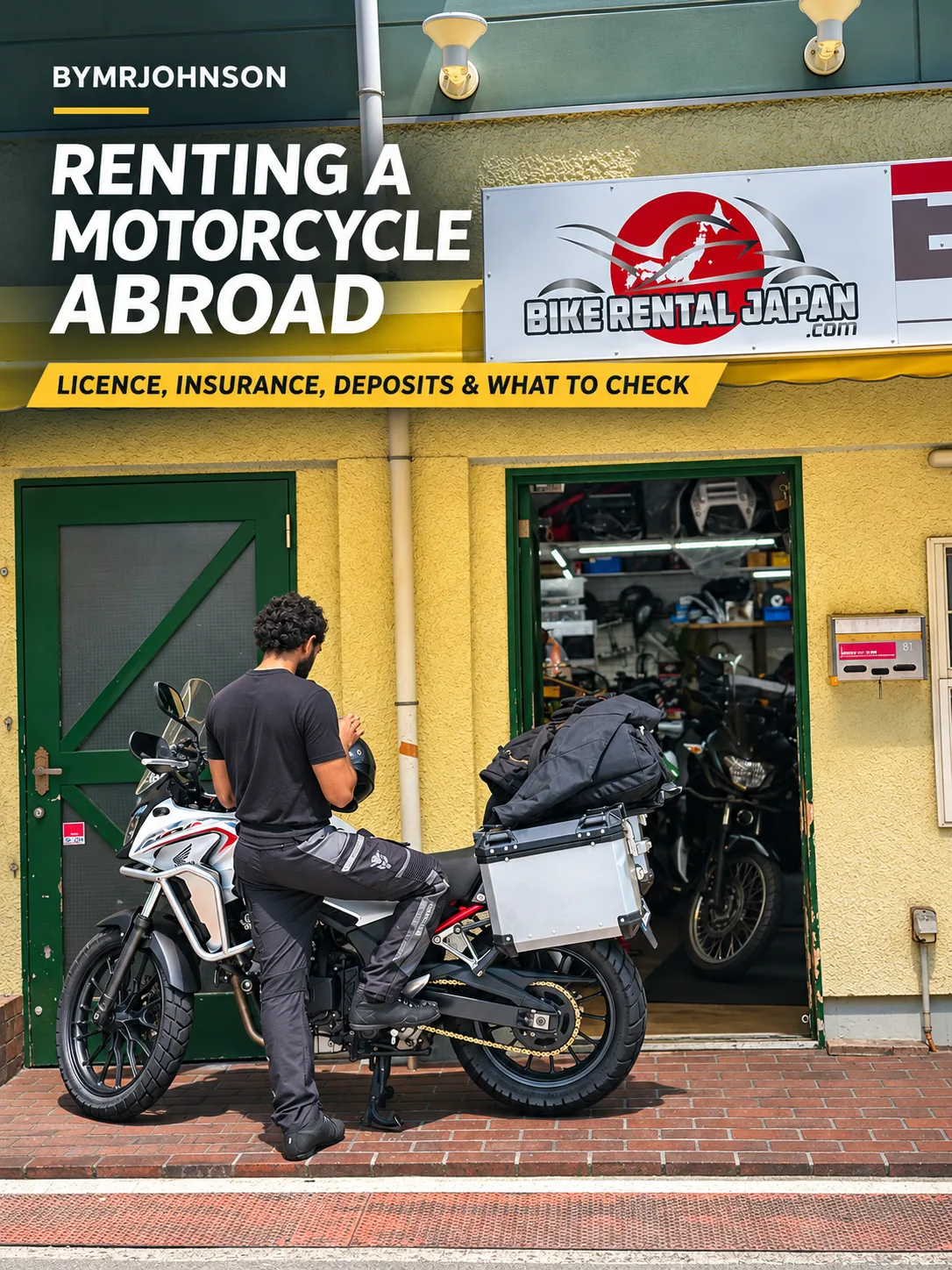
Renting a motorcycle abroad sounds like a fantastic way to explore a new country.
You arrive somewhere unfamiliar, collect the keys to a motorcycle, and suddenly you’re no longer experiencing the place from a train window or the back seat of a car.
You’re riding through it.
That freedom is one of the things I enjoy about motorcycling.
But renting a motorcycle in another country introduces a few responsibilities that are easy to overlook when you’re excited about the trip.
Is your motorcycle licence accepted?
Do you need an International Driving Permit?
What insurance is included?
How much money could you lose if the motorcycle is damaged?
And what should you inspect before riding away?
These questions matter just as much as which motorcycle you choose.
After getting my motorcycle licence in the Netherlands, I later travelled to Japan for a motorcycle trip. Preparing the correct International Driving Permit was part of making that experience possible.
It reinforced something I had already learned while getting licensed in the Netherlands: riding somewhere new means being willing to learn the local system rather than assuming everything works as it does at home.
This guide walks through the practical side of renting a motorcycle abroad, from choosing the right bike to understanding insurance, deposits and the handover inspection.
Note: Licence requirements, insurance conditions and rental policies differ by country and provider. This guide was researched in October 2026. Always confirm the exact requirements with the rental company and relevant local authorities before booking.
1. Check Whether Your Motorcycle Licence Is Valid Abroad
Before looking at motorcycles, I would start with the licence.
A rental company may advertise everything from lightweight scooters to large touring motorcycles.
But the availability of a motorcycle doesn’t mean you’re legally entitled to ride it.
There are two separate questions:
Does the destination country recognise my driving licence?
And:
Does my licence category cover this particular motorcycle?
Both need a clear answer.
Riding Within Europe
For riders with a valid Dutch motorcycle licence, travelling within the European Union is generally straightforward.
A Dutch licence is also recognised for temporary travel in Norway, Iceland, Liechtenstein and Switzerland.
You normally don’t need an International Driving Permit simply to ride in these countries.
The official NetherlandsWorldwide driving-licence guidance explains where Dutch licences are recognised.
But recognition of the licence doesn’t automatically mean the rental company must accept your booking.
Rental providers can apply additional conditions.
A1, A2 and Full A Licences
If you have a restricted motorcycle licence, pay particular attention to the motorcycle’s specifications.
A1, A2 and full A categories permit different types of motorcycles.
An A2 licence, for example, does not automatically entitle you to rent an unrestricted large-capacity touring motorcycle.
The correct category depends on the motorcycle’s power and other relevant specifications, not simply the fact that it has two wheels.
Also, don’t assume that a scooter automatically falls within your existing entitlement.
A 125cc scooter may legally count as a motorcycle.
Some countries have specific domestic scooter allowances for car-licence holders, but those do not necessarily transfer to visiting riders.
Confirm the motorcycle’s licence category before paying the booking deposit.
2. Do You Need an International Driving Permit?
Outside Europe, the rules become more complicated.
Some countries accept a Dutch licence.
Others require an International Driving Permit, usually shortened to IDP.
An IDP is not a replacement for your normal licence.
It is an internationally recognised supporting document that helps authorities understand the driving categories you are authorised to operate.
You generally need to carry the original domestic licence alongside it.
There is also more than one type of IDP.
The Netherlands issues permits based on different international conventions, including the 1949 Geneva and 1968 Vienna models.
Different countries recognise different models.
This is why I wouldn’t simply apply for the longest-validity IDP without first checking the destination.
My guide to riding abroad with a Dutch motorcycle licence explains the documentation side in more detail.
My Japan Example
When preparing for my motorcycle trip in Japan, I applied for an International Driving Permit using my Dutch motorcycle licence.
For Dutch riders, Japan recognises the 1949 Geneva Convention IDP.
It does not accept the Dutch 1968 Vienna-model IDP for this purpose.
You also need to carry the original paper permit, not just a photograph on your phone.
Japan’s National Police Agency explains these requirements, and ANWB’s Japan guidance identifies the correct permit model for Dutch travellers.
Before leaving the ANWB office, I would check that the permit correctly shows the motorcycle category as well.
A permit with the wrong category is not much use at the rental counter.
3. Check the Rental Company’s Requirements
Being legally allowed to ride in a country is not the same as satisfying a rental company’s conditions.
A company may require:
- A minimum rider age
- A certain number of years holding a motorcycle licence
- A full A licence for particular motorcycle models
- A valid passport or identity document
- An IDP
- A credit card in the primary rider’s name
- A refundable security deposit.
These conditions can vary even between rental branches operating in the same country.
For example, BMW Motorrad’s Rent A Ride platform notes that individual rental partners determine their own insurance, deposit and service conditions.
So I would never treat the information on a general booking website as the entire contract.
Check the requirements for the specific rental location and motorcycle.
One useful habit is to email the rental company before making a non-refundable booking.
Ask them to confirm in writing that your licence and documentation are accepted for the motorcycle you intend to rent.
That small step can save an expensive disappointment after arriving.
4. Choose a Motorcycle That Suits the Trip
It is tempting to rent the most exciting motorcycle available.
Especially if you’re travelling somewhere you’ve dreamed of riding.
But I think choosing a rental motorcycle deserves a slightly different mindset from choosing your own.
At home, you know the machine.
You know how it responds.
You know its dimensions, controls and riding position.
With a rental motorcycle, you’re learning all of that while also adjusting to unfamiliar roads.
That’s an additional mental load.
Read : Renting a Motorcycle in Japan
Start With a Familiar Type of Motorcycle
If you normally ride a lightweight naked motorcycle, jumping straight onto a fully loaded 300 kg touring motorcycle may not be the most relaxed way to explore a new country.
That doesn’t mean you should never try a different bike.
It means choosing something appropriate for your current skills, the route and the luggage you need to carry.
Consider:
Seat height: Can you manage the bike confidently during stops and low-speed manoeuvres?
Weight: Will tight parking spaces or steep roads become difficult?
Riding position: Can you comfortably spend several hours on it?
Luggage: Is there room for the equipment you actually need?
Weather protection: Will you be riding exposed roads or long motorway distances?
Tyres: Are they suitable for the roads you intend to use?
The aim is not to rent the biggest motorcycle.
It is to rent one you can enjoy riding.
Think About the Route Before Choosing the Bike
A trip through a busy Japanese city has different requirements from a week exploring mountain roads.
Likewise, a European motorway tour is different from short coastal rides.
I’d rather choose the motorcycle around the trip than build the trip around an unnecessarily difficult motorcycle.
5. Understand Motorcycle Rental Insurance Before Booking
This is probably the most financially important part of renting a motorcycle abroad.
Insurance terminology can make a booking look reassuring even when significant risks remain with the renter.
The three questions I would ask are:
What damage is covered?
What damage is excluded?
How much might I personally have to pay?
Don’t assume that a booking advertised as fully insured means you cannot receive a large bill after an accident.
Third-Party Liability Insurance
This is the basic protection for your legal liability if you injure somebody or damage their property.
Within the EU, compulsory third-party motor insurance is part of the legal insurance framework for registered motor vehicles.
But the limits and practical handling of a rental claim still deserve checking.
The European Commission’s rental guidance explains the importance of understanding liability and insurance before booking.
That guidance is primarily written around car rentals, so always verify motorcycle-specific terms with your provider.
Damage to the Rental Motorcycle
The next question is whether damage to the rented motorcycle itself is covered.
This is often where you’ll encounter terms such as:
Collision Damage Waiver — CDW
Comprehensive cover
All-Risk
Damage protection
Different companies use different terminology.
The name isn’t enough.
You need to know what the policy actually does.
For example, an insurance option might cover accidental collision damage but still leave you responsible for certain exclusions or a substantial excess.
Theft Cover
Also check whether theft is covered.
Motorcycle theft protection may come with conditions covering:
where you park,
which locks you use,
whether the keys were secured,
and how quickly an incident must be reported.
Never assume a rental motorcycle is automatically covered against theft simply because it comes with comprehensive insurance.
Read the conditions.
6. Know the Difference Between a Deposit and an Excess
These are two important figures, and they are not the same thing.
Security Deposit
The deposit, or borg, is money or a card authorisation held as security during the rental.
Depending on the provider, it may be temporarily blocked on your credit card.
If you return the motorcycle in accordance with the agreement, the deposit is normally released or refunded.
But you should check how long that takes.
Insurance Excess
The excess, or eigen risico, is the amount you may need to pay yourself when a covered insurance claim occurs.
For example, a motorcycle rental might have:
Security deposit: €500
Damage excess: €1,500
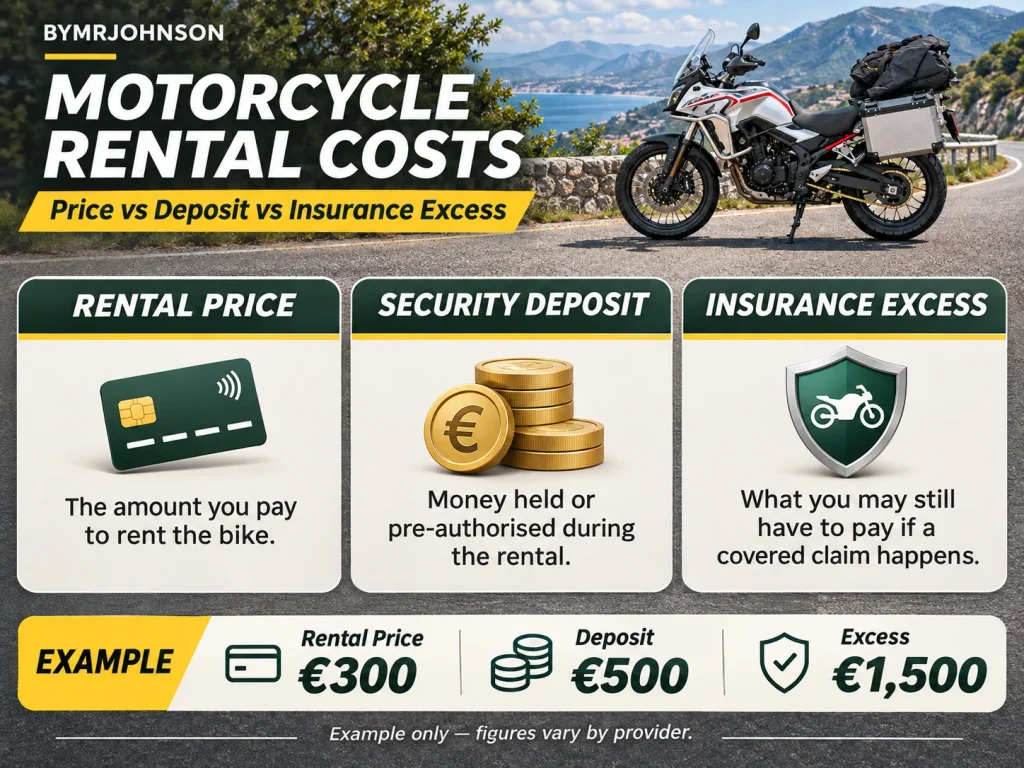
These are illustrative numbers, not standard rental rates.
Even though only €500 was held at collection, you could still be liable for a much larger amount following covered damage, depending on the contract.
That is the distinction to remember:
The deposit is not necessarily your maximum financial liability.
Some companies offer paid options to reduce the excess.
Before buying that option, calculate what you’re paying for the extra protection and whether any exclusions remain.
7. Read the Insurance Exclusions
I would pay particular attention to the things an insurance policy does not cover.
Depending on the provider, exclusions may involve:
- Off-road riding
- Riding on unauthorised surfaces
- Racing or track use
- Unauthorised riders
- Riding without the correct licence
- Alcohol or drug impairment
- Certain tyres, wheels or accessories
- Failure to follow the company’s theft-security conditions
- Use outside the permitted rental area.
These are examples of conditions worth checking, not a universal exclusion list.
A particularly important question for motorcycle travellers is:
Are unpaved roads permitted?
Some beautiful riding destinations include gravel access roads, mountain routes and remote parking areas.
A motorcycle may be physically capable of travelling on those surfaces while the rental agreement prohibits it.
Your riding route and your insurance conditions need to agree.
8. Travel Insurance Is Not Motorcycle Rental Insurance
This distinction is easy to overlook.
You might already have annual travel insurance and assume that you’re fully protected while riding abroad.
But travel insurance, vehicle insurance and personal medical coverage solve different problems.
A travel policy may help with:
medical expenses,
personal belongings,
trip interruption,
or other travel-related incidents.
It does not necessarily cover damage to a rental motorcycle.
And even if the policy covers travel accidents generally, it may have conditions around motorcycling, licence entitlement, engine capacity or types of riding.
For example, ANWB’s travel-insurance information distinguishes medical, baggage, accident, breakdown and other optional covers rather than treating them as one universal policy.
So I would ask the travel insurer directly:
Am I covered for recreational road riding on a legally rented motorcycle of this size in this destination?
Then separately ask the rental company:
What damage to this motorcycle am I responsible for?
If travelling somewhere with potentially expensive medical treatment, also check medical evacuation and repatriation cover.
Getting those answers in writing is much better than guessing.
9. Check the Rental Company’s Breakdown Support
Mechanical problems happen.
And dealing with one on a rental motorcycle in another country is very different from dealing with a problem on TITAN near home.
Before booking, I would find out:
Who do I call if the motorcycle won’t start?
What happens after a puncture?
Is roadside assistance included?
Will somebody recover the motorcycle?
Do I receive a replacement bike?
What happens to accommodation and travel plans if the motorcycle cannot continue?
These details matter particularly on multi-day trips.
Also, don’t assume your normal Dutch breakdown cover applies to a foreign rental motorcycle.
For instance, ANWB’s own travel-insurance vehicle-assistance terms distinguish privately owned vehicles from rentals.
Check the actual protection you’re buying.
10. Understand the Full Rental Price
The advertised daily rate is rarely the entire story.
Possible additional costs include:
Mileage: Are kilometres unlimited or is there a daily allowance?
Luggage: Are panniers or a top case included?
Helmet: Does the price include one?
Additional rider: Can somebody else ride the bike, and is there a fee?
Navigation: Is a GPS device or phone mount included?
Insurance upgrade: Is lower-excess protection optional?
Fuel: Full-to-full or another arrangement?
Cleaning: Are there special return conditions?
Late return: What happens if you arrive after closing?
Cross-border travel: Is permission required or charged separately?
BMW Motorrad Rent A Ride, for example, explains that additional mileage and rental conditions may vary by individual partner.
The cheapest daily rental can become less attractive once those costs are considered.
I would compare the complete cost of the trip rather than the number shown first in the search results.
11. Check Cross-Border Restrictions
This matters especially in Europe.
Imagine renting a motorcycle in Germany and deciding to take it through Austria, Italy and Switzerland.
That sounds like a perfectly normal motorcycle trip.
But the rental company might have restrictions on where the motorcycle can be taken.
You may need:
written permission,
additional insurance,
breakdown arrangements,
or specific vehicle documentation.
Crossing a border without permission can create serious insurance and contractual complications.
The European Commission’s guidance for vehicle rentals says travellers should notify their rental provider when planning to drive through other countries so the correct documents and cover can be arranged.
For motorcycle rentals, I would confirm every planned country with the operator.
Don’t assume European freedom of travel means unrestricted use of a rental motorcycle.
12. Inspect the Motorcycle Before Riding Away
Now we reach the actual handover.
This is where I would slow the process down.
Not because I expect every rental company to be dishonest.
But because you’re accepting responsibility for a motorcycle that somebody else has been using.
The condition needs to be clear to both parties.
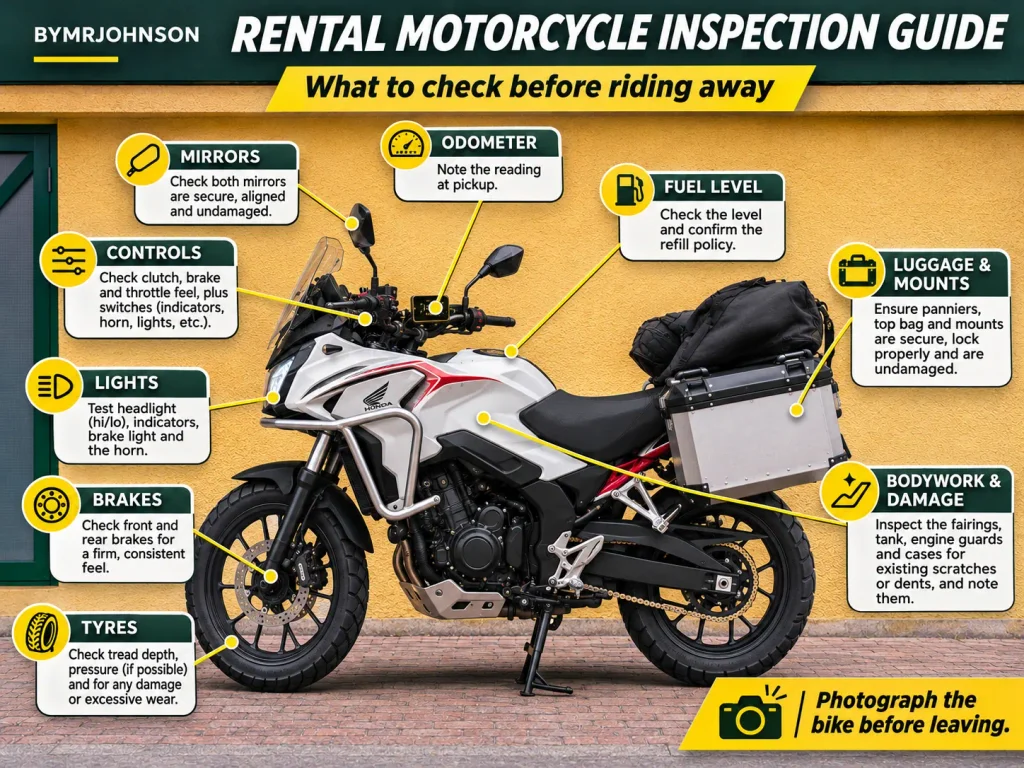
Photograph the Motorcycle
Before moving it, take photographs of:
- Both sides of the motorcycle
- Front and rear
- Mirrors
- Handlebars and levers
- Fuel tank
- Engine covers
- Exhaust
- Wheels
- Panniers and luggage
- Windscreen
- Existing scratches or dents.
Photograph the odometer and fuel level too.
If possible, take a short walk-around video in addition to the photographs.
Do this with the rental representative present where practical.
And make sure existing damage is recorded on the handover document.
Check the Tyres
Inspect both tyres for:
obvious damage,
remaining tread,
uneven wear,
and appropriate inflation.
If you’re unsure about tyre pressures, ask the provider to confirm them against the motorcycle manufacturer’s recommendations.
You do not want to discover a damaged tyre after riding into a remote mountain area.
Check the Brakes
Inspect the visible components for obvious problems.
Then carefully check how the front and rear brakes feel before entering normal traffic.
If there is anything obviously wrong with their operation, stop and ask the rental company to address it.
Check the Controls
Make sure you understand:
clutch operation,
throttle response,
gear selection,
indicator controls,
engine kill switch,
starter,
parking or handle lock,
and any electronic riding modes.
This matters even more on an unfamiliar motorcycle.
Check the Lights
Headlight.
Brake light.
Tail light.
Indicators.
Make sure they work.
Check the Luggage
Open the panniers.
Check the locks.
Make sure the mounting system is secure.
Understand how to remove and reinstall the luggage if necessary.
Ask About Known Issues
If the motorcycle has a warning light or something unusual about the controls, ask before leaving.
Don’t accept:
“It’s probably fine.”
A rental bike needs to be mechanically sound and safe to ride.
If it isn’t, ask for the issue to be corrected or request another motorcycle.
My free motorcycle pre-ride checklist covers a simple general inspection routine, while our upcoming motorcycle rental inspection article will go deeper into handover-specific checks.
13. Check the Riding Gear Provided by the Rental Company
Some rental providers offer:
helmets,
jackets,
gloves,
and other equipment.
But availability and quality can vary.
I wouldn’t assume a provided helmet will automatically fit correctly.
If you plan to use rental gear, check:
helmet certification,
fit,
visor condition,
strap condition,
jacket and trouser sizing,
armour,
gloves,
and boots.
A helmet that is too loose or uncomfortable isn’t suddenly appropriate because it’s included free.
If you’re unsure about helmet fitting, my motorcycle helmet sizing guide covers the main points.
For a longer motorcycle trip, bringing your own properly fitted protective gear may be preferable when luggage space allows.
14. Take Time to Familiarise Yourself With the Motorcycle
I think this is one of the most underrated parts of renting.
You’re about to ride:
an unfamiliar machine,
on unfamiliar roads,
possibly on the opposite side of the road,
while following unfamiliar signs.
That’s a lot of new information.
So before heading towards the exciting roads, spend a little time getting comfortable with the motorcycle.
Check:
where the biting point is,
how smoothly the throttle responds,
how the brakes feel,
the turning circle,
the weight at low speed,
and how the mirrors are positioned.
If the bike has riding modes or adjustable suspension, ask for an explanation rather than immediately experimenting with settings you don’t understand.
I’d also choose a relaxed first section of the route where possible.
The first ten minutes of a rental should be about getting comfortable.
Not proving how quickly you can ride.
15. Learn the Local Road Rules Before the Trip
A motorcycle licence doesn’t bring your home country’s road rules with it.
This is particularly important when crossing between left-hand and right-hand traffic systems.
My riding experience before moving to the Netherlands had been on the left.
When I moved here, I had to adapt to riding on the right and the Dutch approach to road use.
Later, Japan meant another left-side traffic environment.
Those changes are about more than road position.
They affect:
junctions,
roundabouts,
lane positioning,
overtaking,
and where you’re naturally expecting danger to appear.
Before renting abroad, check local rules for:
speed limits,
filtering,
road signs,
parking,
tolls,
helmet requirements,
and restrictions on particular roads.
Don’t assume a Dutch riding habit automatically applies somewhere else.
Upcoming article on riding on the opposite side of the road will cover that adjustment separately.
16. Have a Plan if Something Goes Wrong
Before leaving the rental location, make sure you know what to do after:
a breakdown,
a puncture,
an accident,
or a theft.
Save the rental company’s emergency number.
Ask whether you need to contact the police after an accident.
Find out whether the rental company requires you to complete a particular incident form.
Know what evidence the insurer expects.
And understand whether you’re allowed to authorise repairs yourself.
In general, I wouldn’t agree to substantial repair work on a rental motorcycle without the rental company’s instructions, except where an immediate emergency requires action.
If you’re injured or in danger, safety and emergency assistance come first.
The paperwork can follow.
17. Return the Motorcycle Properly
The end of the rental deserves almost as much attention as the beginning.
Before returning the bike:
Check the fuel policy.
Remove personal belongings.
Confirm that all provided keys and equipment are present.
Take photographs of the motorcycle’s condition.
Photograph the odometer.
Ask the rental representative to inspect the bike with you.
Where possible, request written confirmation that the motorcycle was returned and that no additional damage was recorded.
The European Consumer guidance for rental vehicles specifically recommends inspection at collection and return, together with a written return record.
For a motorcycle, that is a habit worth following.
And check that the deposit is released according to the agreed terms.
18. What I Would Check Before Booking Any Motorcycle Abroad
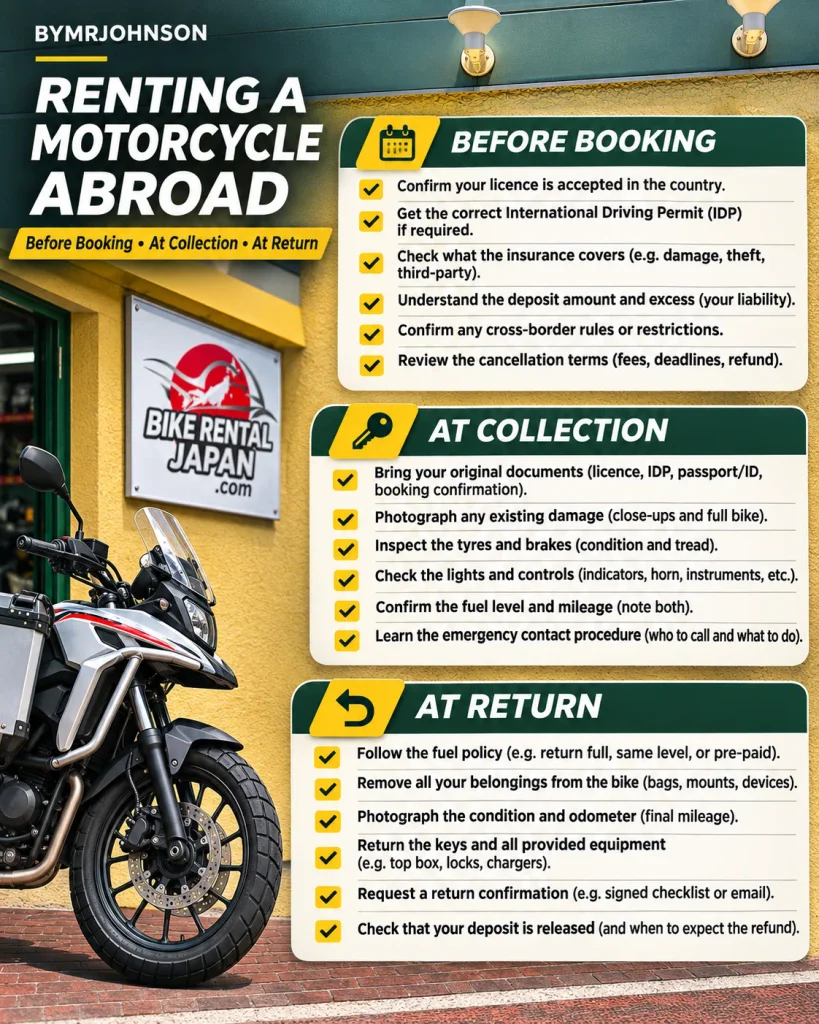
If I had to simplify the process, I would work through it in three stages.
Before Booking
- Confirm the destination accepts my motorcycle licence.
- Apply for the correct IDP if required.
- Check motorcycle category and rental eligibility.
- Compare suitable motorcycles.
- Read the insurance cover and exclusions.
- Check the excess.
- Check the deposit and card requirements.
- Calculate extra costs.
- Confirm permitted routes and countries.
- Check cancellation terms.
At Collection
- Bring original required documents.
- Read the final agreement.
- Photograph existing damage.
- Inspect tyres, brakes, controls and lights.
- Confirm fuel and mileage.
- Check luggage and equipment.
- Understand emergency procedures.
- Familiarise myself with the bike.
At Return
- Follow the fuel policy.
- Photograph the condition and odometer.
- Return all equipment.
- Complete the inspection with the provider.
- Obtain return confirmation.
- Verify deposit release and final charges.
That is the whole process in a much more manageable form.
19. Would I Choose the Cheapest Motorcycle Rental?
Not automatically.
I would rather have a slightly more expensive rental with:
clear insurance,
transparent deposit conditions,
a properly maintained motorcycle,
responsive support,
and a straightforward damage policy
than save a relatively small amount with a provider whose conditions I don’t understand.
There is nothing wrong with looking for value.
But the rental price is only one part of that value.
A motorcycle trip should be about the experience of riding somewhere new.
Not spending the whole time wondering whether a small scratch is going to cost you €1,500.
20. My Main Takeaway
Renting a motorcycle abroad opens up experiences that would otherwise be difficult to have.
It gives you the chance to explore somewhere unfamiliar in a way that feels completely different from ordinary tourism.
But that freedom works best when the preparation is handled properly.
Check your licence.
Get the right IDP.
Understand the insurance.
Know the excess.
Understand the deposit.
Choose a motorcycle that suits your experience.
Inspect it carefully.
Learn the local rules.
And give yourself time to get comfortable before heading out.
For me, the most useful lesson from preparing to ride internationally is simple:
The more uncertainty you remove before the trip, the more attention you can give to the ride itself.
That is where the enjoyment should be.
Not in rushing through the rental counter.
Not in guessing what the insurance covers.
And certainly not in discovering your documentation is wrong after arriving in another country.
Prepare properly.
Then go enjoy the roads.
Ride safe and enjoy the journey.
FAQs
Do I need an International Driving Permit to rent a motorcycle?
It depends on the destination. An IDP is not normally necessary within the EU for a valid Dutch licence, but many countries outside Europe require one. Check which permit model is recognised before travelling.
Is the rental deposit the same as the insurance excess?
No. The deposit is security held during the rental, while the excess is the amount you may have to contribute towards a covered claim. The excess may be higher than the deposit.
Which International Driving Permit do I need for Japan?
Japan accepts the 1949 Geneva Convention IDP issued in the Netherlands. Japan does not accept the Dutch 1968 Vienna-model IDP for this purpose. You must also carry your valid Dutch driving licence.
Should I photograph a rental motorcycle before riding away?
Yes. Photograph existing damage, tyres, wheels, controls, luggage, fuel level and odometer. Make sure pre-existing damage is documented in the rental agreement or inspection record. Repeat the process when returning the motorcycle.
Does motorcycle rental insurance cover damage to the bike?
Not always. Basic third-party liability insurance is primarily designed to cover liability for injury or damage caused to others. Damage to the rented motorcycle depends on the rental insurance or damage-waiver terms, including exclusions and the applicable excess.
Can I take a rental motorcycle across international borders?
Only if the rental agreement and applicable rules allow it. Ask the rental company beforehand and obtain any necessary permission, insurance or additional vehicle documentation.
Does regular travel insurance cover motorcycle rental damage?
Do not assume so. Travel insurance may cover different risks, such as medical expenses or baggage, while damage to a rental motorcycle is normally governed by separate vehicle-rental or insurance conditions. Check both policies.
What happens if I damage a rental motorcycle abroad?
Follow the rental company’s incident procedure, seek medical help if necessary, and contact the appropriate authorities when required. Your financial responsibility depends on the contract, insurance, excess and any exclusions.
Can I rent a motorcycle abroad with a Dutch motorcycle licence?
Yes, in many countries. A valid Dutch motorcycle licence is generally recognised throughout the EU and in Norway, Iceland, Liechtenstein and Switzerland for temporary visits. Other countries may require an International Driving Permit or additional documents. Rental companies can also have separate eligibility requirements.
Related Reads
Riding a Motorcycle Abroad With a Dutch Licence: IDP, Documents & What to Check
How I Got My Dutch Motorcycle Licence as an Expat
Motorcycle Insurance in the Netherlands: WA, WA+ & All-Risk Explained