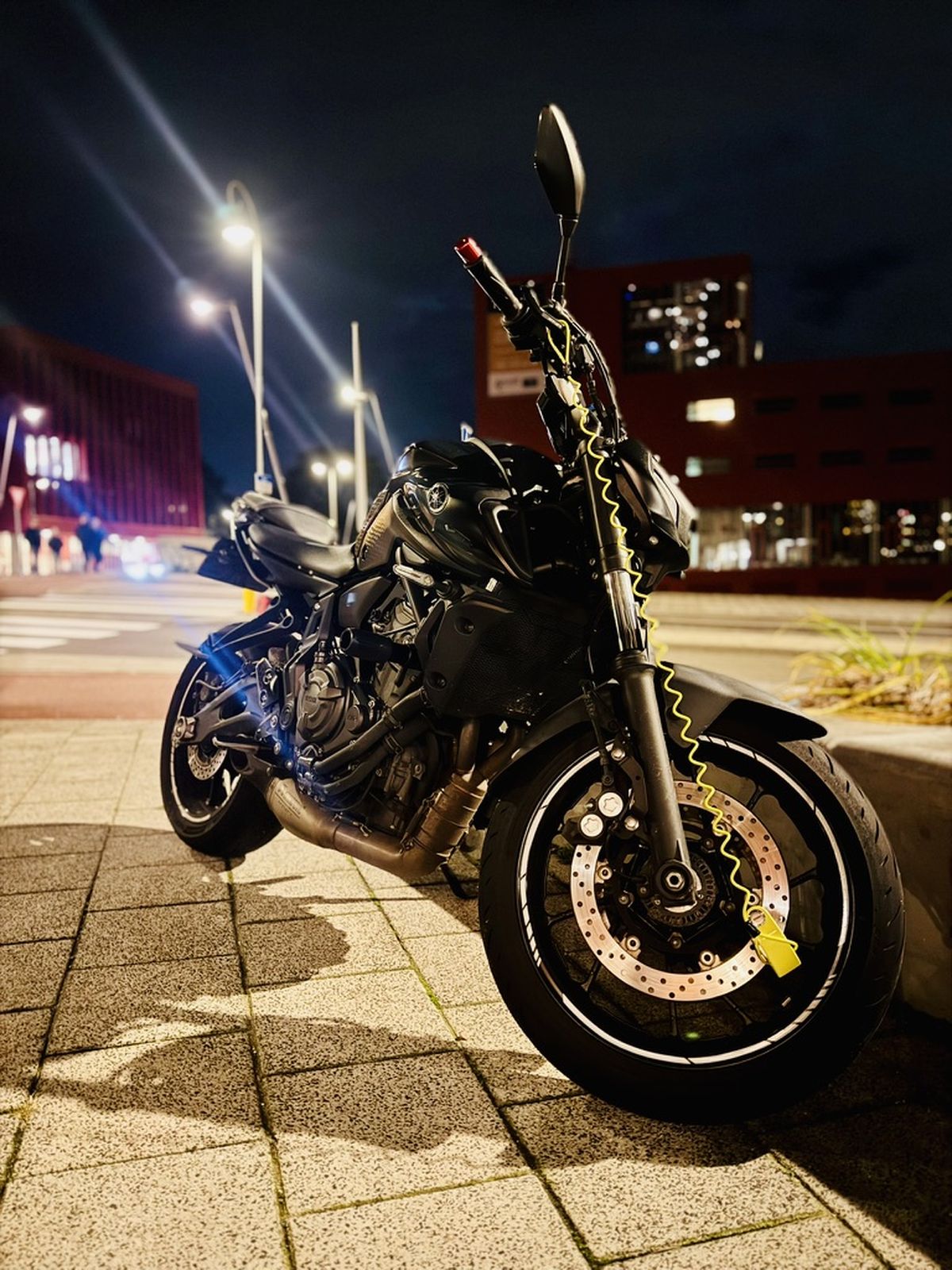
Riding a motorcycle at night can feel completely different from riding the same road during the day.
Your headlight reveals only part of the road. Distance becomes harder to judge. Corners seem tighter, road surfaces become difficult to read, and pedestrians or cyclists can disappear into the background.
At the same time, other road users may struggle to identify your motorcycle’s speed and distance among all the surrounding lights.
Night riding is not automatically unsafe, but it gives you less visual information and less time to process what is happening.
The solution is not simply to concentrate harder.
You need to reduce your speed, increase your space, improve your visibility, and make sure you can stop within the section of road you can clearly see.
This guide covers the most important motorcycle night riding safety habits, from checking your lights and visor to dealing with glare, fatigue, dark corners, and Amsterdam’s tram tracks.
Quick Answer
How Do You Ride a Motorcycle Safely at Night?
To ride a motorcycle safely at night:
- Check your headlight, brake light, and indicators before leaving.
- Use a clean, clear visor rather than a dark or tinted one.
- Reduce your speed to match how far ahead you can see.
- Increase your following distance.
- Use high beam only when it is legal and will not dazzle anyone.
- Position yourself where other road users can see you.
- Watch carefully for pedestrians, cyclists, and vehicles at junctions.
- Avoid staring directly at oncoming headlights.
- Take fatigue seriously and stop when your concentration declines.
- Slow down further when darkness is combined with rain, fog, or unfamiliar roads.
The safest night-riding speed is one that allows you to stop before reaching the edge of what you can clearly see.
Why Motorcycle Riding Feels Different at Night
During daylight, you can use the whole scene to judge speed, distance, and the shape of the road.
At night, much of that information disappears.
Your vision becomes dependent on:
- Your motorcycle’s headlight
- Street lighting
- Other vehicles’ lights
- Reflective signs and road markings
- Small differences between light and shadow
The road itself may also look misleading.
A dark patch could be water, fresh asphalt, oil, or simply a shadow. A corner may appear more open than it really is. A single headlight could belong to a motorcycle nearby or a car much farther away.
This uncertainty is why night riding requires more margin than daytime riding.
1. Check the Motorcycle Before Leaving
This does not need to take 20 minutes. A simple one-minute habit can prevent problems.
If you rely on phone navigation after dark, set the route, reduce unnecessary notifications and make sure your phone mount for motorcycle navigation keeps the display visible without blocking the instruments.
Do not wait until you are on an unlit road to discover that part of your lighting system is not working.
Before leaving, check:
- Low-beam headlight
- High-beam headlight
- Tail light
- Brake light using both brake controls
- Indicators
- Number-plate light
- Mirrors
- Tyres and tyre pressures
- Fuel level or available range
Clean the headlight lens if it is covered with dirt or insects. Even a working headlight becomes less useful when the lens cannot project a clear beam.
Make sure your mirrors are clean and adjusted before the ride. Constantly adjusting them after dark takes your attention away from the road.
If your motorcycle has a dash cam fitted, check that the lenses are clean and the system is recording before leaving.
Motorcycle dash cam setup guide explains what to look for when choosing a permanent front-and-rear system.
2. Use a Clear and Clean Visor
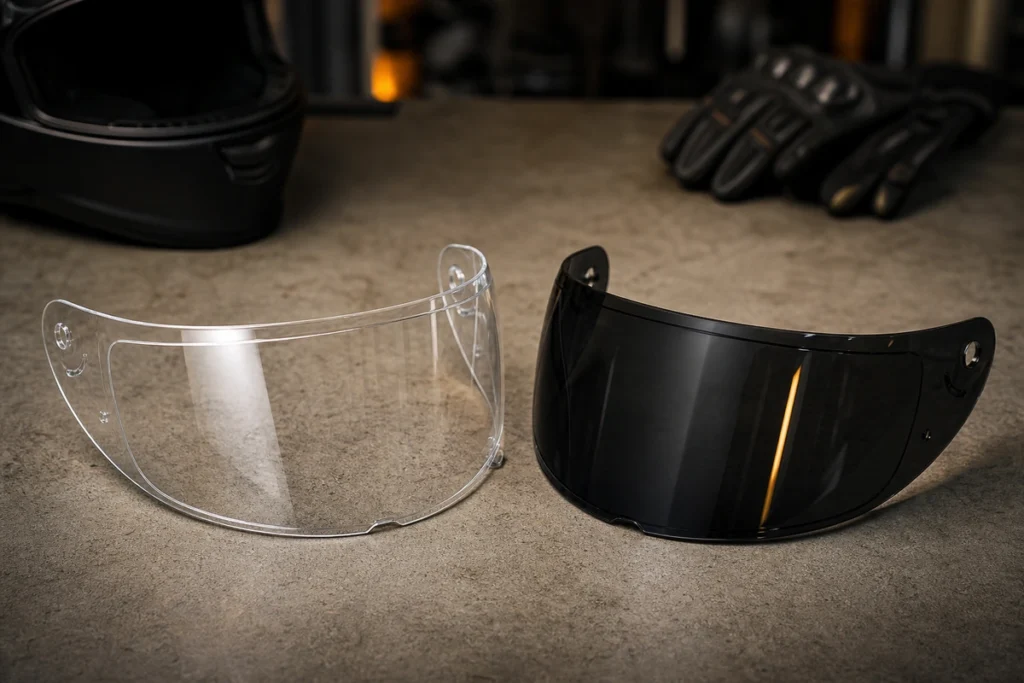
A dark visor that feels comfortable during a sunny afternoon can severely reduce your vision after sunset.
Use a clear visor for night riding.
Before leaving:
- Clean both sides of the visor
- Remove insects and road dirt
- Check for scratches
- Make sure the helmet vents work
- Fit a compatible anti-fog insert if necessary
- Carry a clean microfibre cloth
Scratches scatter light from cars, street lamps, and illuminated signs. A visor that seems acceptable during the day may produce distracting glare at night.
Avoid wearing tinted glasses underneath a clear visor unless they are specifically suitable for low-light conditions.
3. Do Not Outride Your Headlight
Outriding your headlight means travelling too fast to stop within the distance illuminated clearly in front of you.
Imagine that a fallen object, animal, or stopped vehicle appears at the edge of your headlight beam.
Could you recognise the hazard, react, and stop before reaching it?
When the answer is uncertain, reduce your speed.
This becomes especially important on:
- Unlit country roads
- Unfamiliar roads
- Tight bends
- Roads surrounded by trees
- Roads with elevation changes
- Areas where animals may enter the road
Your high beam may improve your view when there is no traffic ahead, but it does not turn night into daylight.
Use it only when legal and appropriate. Dip the light early when approaching another road user or following a vehicle so that you do not reduce their vision.
Do not follow a faster rider or car into a dark corner simply because their lights are ahead of you.
Ride according to what you can see.
4. Increase Your Following Distance
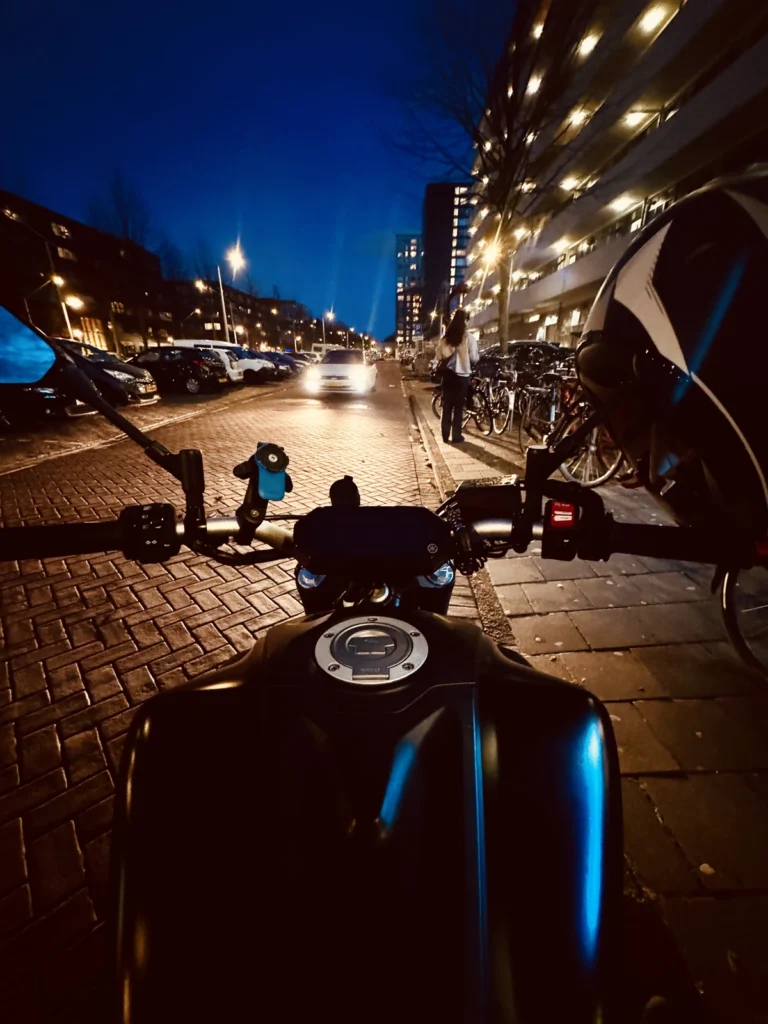
Distance and closing speed are harder to judge after dark.
Leave more space between yourself and the vehicle ahead than you would during daylight.
The additional space gives you:
- More time to identify brake lights
- A better view of the road surface
- More room for progressive braking
- An escape path if the vehicle stops suddenly
- Less glare and distraction from its lights
Avoid following so closely that the vehicle blocks your entire view.
Its headlights may reveal bends or bumps farther ahead, but you should use that information only as an additional clue. Do not depend on the other driver to choose a safe speed or line for you.
If the vehicle disappears around a corner faster than you are comfortable following, let it go.
5. Position Yourself to See and Be Seen
Your lane position should help you look ahead while making the motorcycle easier for others to notice.
Move within your lane when necessary to:
- Improve your view around a vehicle
- Avoid another driver’s blind spot
- Create space from parked cars
- Make yourself visible in mirrors
- Increase your separation from oncoming traffic
- Prepare for a junction or corner
Do not remain beside a car or truck longer than necessary. A dark motorcycle can become almost invisible beside a larger vehicle, especially when the driver is surrounded by headlights and reflections.
Use your indicators early and cancel them after the manoeuvre. A flashing indicator left on can mislead a driver waiting at a junction.
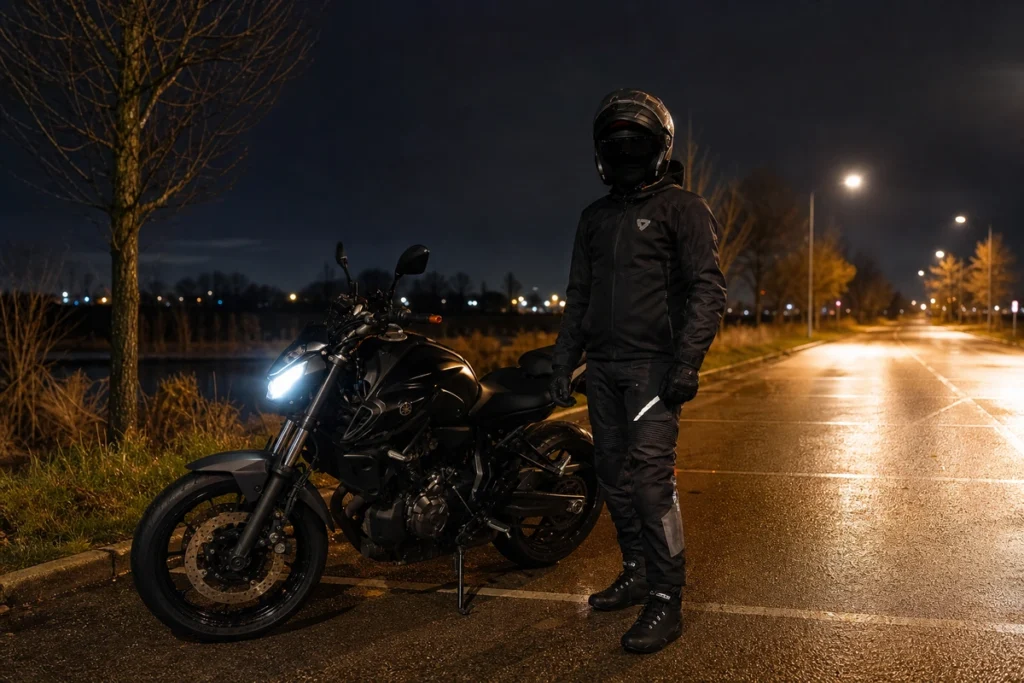
Reflective strips on your jacket, helmet, backpack, or motorcycle can make you more noticeable when another vehicle’s headlights reach you.
Read : Motorcycle Visibility At Night & In Traffic
6. Manage Glare Without Losing Your Line
Oncoming headlights can temporarily reduce your ability to see the road.
Do not stare directly into them.
Keep your main attention on your intended path and use the edge of your lane as an additional reference when glare becomes intense.
At the same time:
- Reduce your speed
- Increase the space ahead
- Avoid making a sudden steering correction
- Keep your eyes moving
- Allow your vision time to recover
Glare can also come from vehicles behind you.
Adjust your mirrors slightly when necessary, but do not position them so poorly that you lose awareness of traffic behind.
A clean visor makes a major difference. Dirt, water droplets, and scratches can spread one bright light across much of your field of view.
When the glare becomes severe enough that you cannot see your path, slow down and stop somewhere safe rather than continuing blindly.
7. Approach Junctions With Extra Caution
Junctions are already high-workload areas during daylight.
At night, drivers may see your headlight without correctly judging how far away you are or how quickly you are approaching.
Watch for:
- Vehicles waiting to turn across your path
- Cars emerging from side roads
- Vehicles leaving parking spaces
- Cyclists crossing between traffic
- Pedestrians wearing dark clothing
- Delivery riders making sudden stops
- Drivers focusing on surrounding car headlights
Reduce your speed early and prepare the controls when a vehicle appears likely to move.
Look at its wheels as well as the driver. The first rotation of a wheel may reveal movement before the whole vehicle changes position.
Do not assume eye contact means the driver has understood your speed or intends to wait.
Read Beginner’s Guide to Defensive Motorcycle Riding for more guidance on junctions, blind spots, and escape routes.
8. Scan for Amsterdam’s Night Hazards
Amsterdam remains active long after sunset.
Cyclists, pedestrians, taxis, trams, and delivery vehicles may all be sharing the same limited road space.
Pay particular attention to:
- Cyclists without effective lighting
- Pedestrians crossing near tram stops
- Wet tram tracks
- Painted cycle crossings
- Cars opening doors
- Taxis stopping suddenly
- Construction barriers
- Temporary road diversions
Do not focus only on the brightest light.
Your attention may naturally move towards an approaching tram or car while a less visible cyclist or pedestrian enters from the side.
Search the dark spaces between the lights.
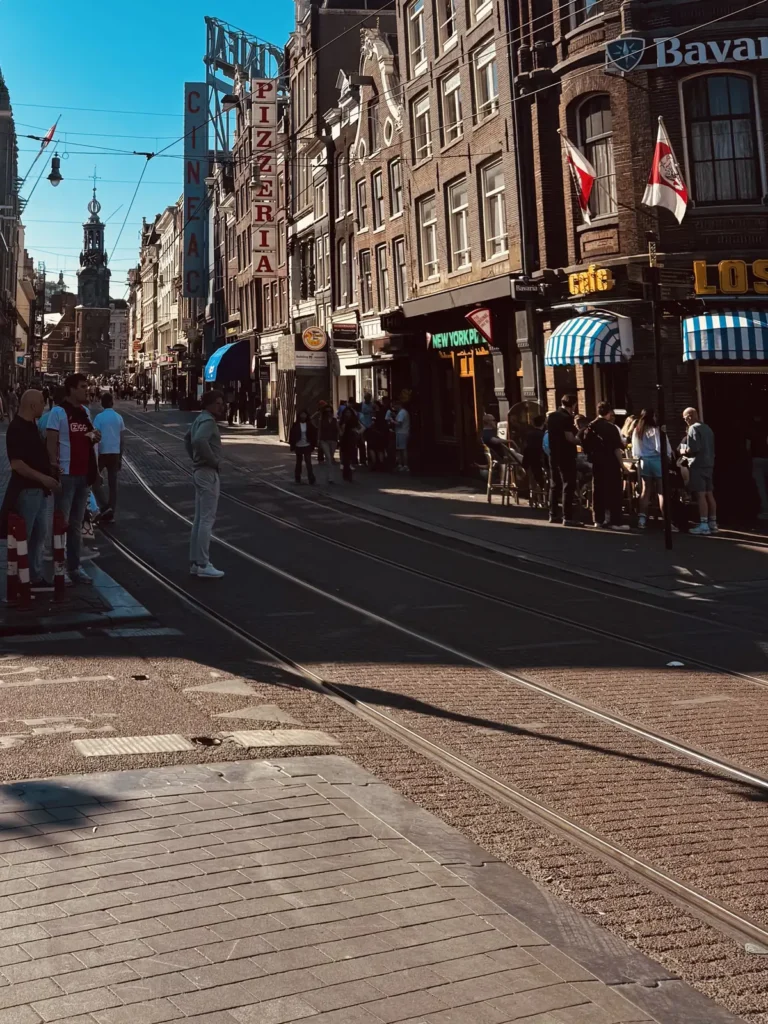
When crossing tram tracks, establish your angle early and keep the motorcycle controlled. Avoid braking sharply or making an abrupt steering input directly on the rail, especially when it is wet.
9. Slow Before Dark Corners
Night is not the time to discover how quickly you can enter an unfamiliar corner.
Reduce speed while the motorcycle is upright and before reaching the turn.
A dark corner may hide:
- Gravel
- Standing water
- Mud
- Leaves
- A tightening radius
- A stopped vehicle
- A cyclist
- An animal
- A damaged road surface
Look through the corner as far as your headlight and the road allow.
Avoid riding close to the centre line. An oncoming vehicle may cross slightly into your lane, particularly on a narrow or poorly marked road.
If an approaching vehicle’s headlights prevent you from seeing through the bend, reduce your speed further.
Read How to Corner Safely on a Motorcycle to strengthen your entry-speed, vision, and line-selection habits.
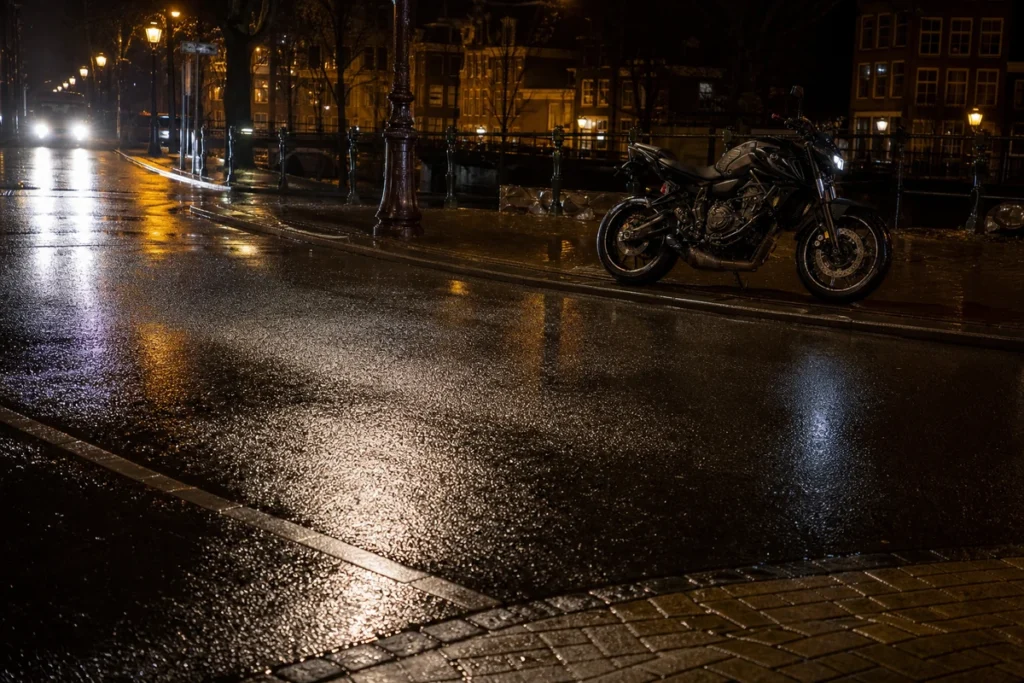
10. Combine Darkness and Rain With Extra Margin
Rain at night creates several problems at once.
Water droplets scatter light across the visor. Wet roads reflect signs and headlights. Lane markings become harder to follow, while paint, metal covers, and tram tracks may provide less grip.
When rain begins:
- Reduce speed further
- Increase your following distance
- Use smooth braking and throttle inputs
- Keep the visor ventilated
- Avoid deep standing water
- Cross paint and metal with minimal lean
Do not let the lights of the vehicle ahead pull you into a speed that exceeds your own visibility.
Read Wet Weather Motorcycle Riding Tips and How to Handle Gravel, Sand & Slippery Roads before planning a ride in poor nighttime weather.
11. Take Fatigue Seriously
Night riding may happen at the end of a full working day, after socialising, or during a long journey when your energy is already low.
Fatigue can cause:
- Slower reactions
- Poor speed judgement
- Missed road signs
- Target fixation
- Delayed braking
- Wandering lane position
- Irritability
- Repeated yawning
- Difficulty remembering the last few kilometres
Do not use cold air or loud music as proof that you are alert enough to continue.
When your concentration begins to fade, stop somewhere safe. Rest, drink water, and honestly reassess whether you should continue.
Sometimes the most skilled night-riding decision is leaving the motorcycle parked and travelling another way.
Read : How To Ride In Strong Winds
Common Mistakes
| Mistake | Why It Creates Risk | Better Habit |
|---|---|---|
| Riding at normal daytime speed | Visibility and distance judgement are reduced | Match your speed to the road you can clearly see |
| Using a tinted visor | Removes useful light and detail | Change to a clean, clear visor |
| Following another rider too closely | Their lights and speed can influence your decisions | Keep your own safe distance and pace |
| Staring at oncoming headlights | Pulls attention away from your path | Look along your intended line and reduce speed |
| Remaining in blind spots | Makes an already small motorcycle harder to notice | Change position or create space |
| Using high beam near other traffic | Can dazzle another road user | Dip the beam early |
| Entering dark corners too fast | Leaves little margin for hidden hazards | Slow before the turn |
| Wearing only dark, non-reflective gear | Reduces nighttime visibility | Add reflective details |
| Ignoring a dirty visor | Increases glare and reduces contrast | Clean it before leaving |
| Continuing while fatigued | Reduces judgement and reaction speed | Stop safely and reassess the journey |
| Watching only vehicle lights | Less visible riders and pedestrians may be missed | Scan the dark spaces around the lights |
| Trusting street lighting completely | Lighting can end suddenly or leave deep shadows | Continue riding within your own visible distance |
Night Riding Safety Checklist
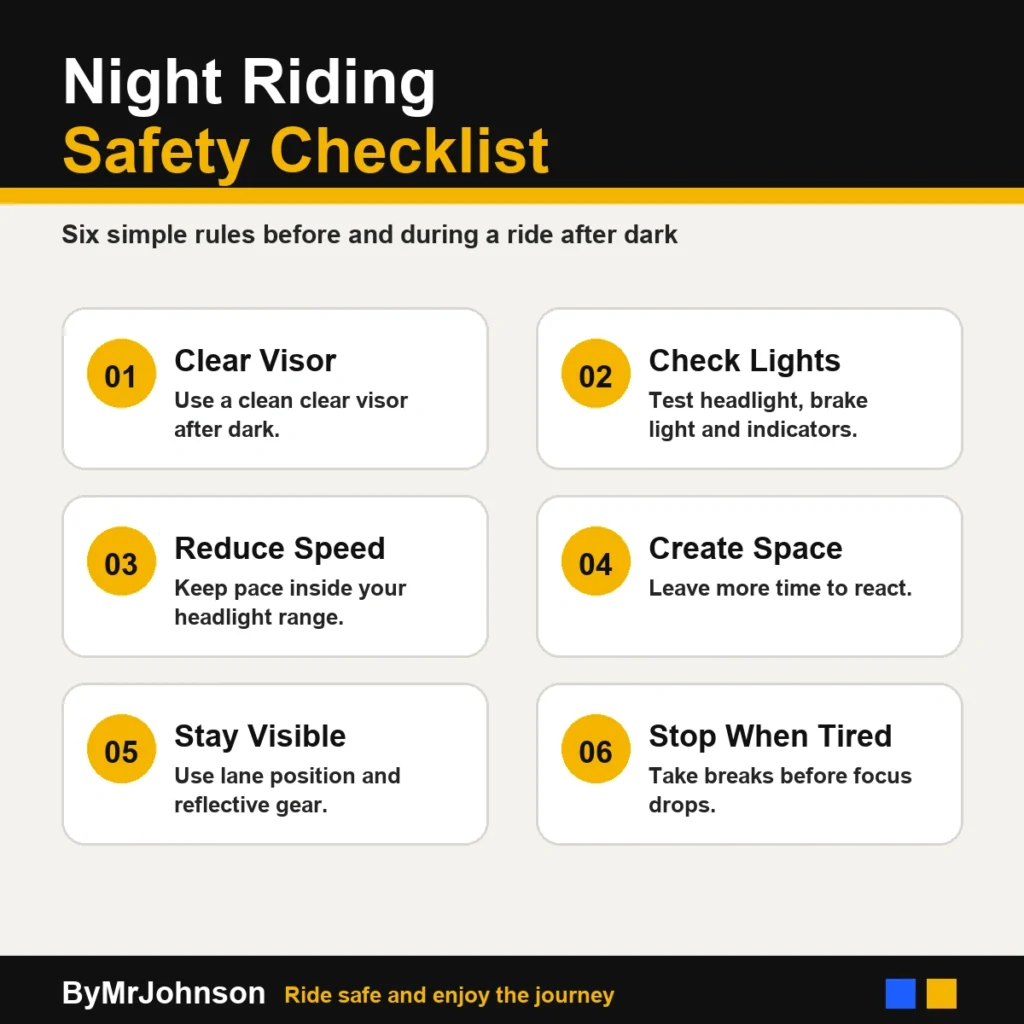
Before the ride:
- Check the headlight and high beam
- Test the tail light and both brake switches
- Check the indicators
- Clean the headlight lens
- Use a clear visor
- Clean and adjust the mirrors
- Check tyres and pressures
- Wear reflective details
- Plan a familiar route where possible
- Confirm you are alert enough to ride
During the ride:
- Reduce speed
- Increase your following distance
- Scan beyond the headlight beam
- Avoid blind spots
- Dip the high beam for other road users
- Look away from direct glare
- Slow before corners and junctions
- Watch for pedestrians and cyclists
- Maintain an escape path
- Stop when fatigue or visibility becomes unsafe
After the ride:
- Clean insects and dirt from the lights
- Clean the visor
- Check that reflective gear remains visible
- Note any headlight or visibility problems
- Replace damaged or badly scratched equipment
Final Thoughts: Night Riding Requires More Margin
Night riding can be calm, memorable, and enjoyable.
The roads may be quieter. The air feels different, and familiar places can take on an entirely new atmosphere.
But darkness removes information.
You cannot see as far, judge every surface as clearly, or assume that other road users have identified you correctly.
Respect that limitation.
Check your lights. Use a clear visor. Create more space. Reduce your speed before the corner and keep searching beyond the brightest objects in your vision.
Most importantly, do not ride faster than your headlight, experience, or concentration can support.
You do not need to prove anything to the darkness.
The goal is to enjoy the ride, stay calm, and arrive with enough margin left for the hazard you never expected to see.
Ride smart. Stay visible. Come home safe.
FAQs
Is it safe to ride a motorcycle at night?
Motorcycles can be ridden safely at night when the rider, motorcycle, and conditions are suitable. Reduce your speed, increase following distance, improve your visibility, and avoid riding when tired or unable to see the road clearly.
Can I wear a tinted visor at night?
A dark visor reduces the amount of available light reaching your eyes. Use a clean, clear visor for night riding and avoid tinted eyewear that restricts your vision.
How fast should I ride at night?
Ride slowly enough to stop within the section of road you can clearly see. Your safe speed will depend on your headlight, weather, road layout, traffic, and familiarity with the route.
How can I make my motorcycle more visible at night?
Keep all lights clean and working, use clear signals, avoid blind spots, and add reflective materials to your clothing, helmet, luggage, or motorcycle.
What should I do when oncoming headlights blind me?
Avoid staring directly at the light, reduce your speed, and keep your attention on your intended path. Stop somewhere safe when the glare prevents you from seeing the road clearly.
Is night riding more tiring than daytime riding?
It can be. Reduced visibility increases concentration demands, and many night rides happen when the rider is already tired. Stop when you notice yawning, delayed reactions, missed signs, or difficulty maintaining concentration.
How should I ride through an unlit corner?
Reduce your speed before entering, look as far through the corner as possible, and avoid exceeding the distance illuminated by your headlight. Keep extra space from the centre line and prepare for hidden surface hazards.
Is riding in rain more dangerous at night?
Rain adds glare, reflections, reduced grip, and visor problems to the existing limitations of darkness. Reduce your speed further, create more space, and stop when visibility becomes unsafe.
Related Reads
Motorcycle Vision Techniques: How to Look Through the Corner Correctly
Beginner’s Guide to Defensive Motorcycle Riding
How to Corner Safely on a Motorcycle