Last reviewed: August 2026
The best motorcycle gloves protect your hands without preventing you from feeling and operating the motorcycle’s controls properly.
Maximum protection matters, but so do fit, dexterity, weather and secure retention.
A bulky winter glove may be useful in freezing rain but frustrating on a warm urban commute. A short ventilated glove may feel excellent in summer but provide less wrist and forearm coverage than a full gauntlet.
The right choice depends on where, when and how you ride.
This guide compares some of the best motorcycle gloves for protection in 2026, including Level 2 sport gloves, waterproof touring options, summer gloves and cold-weather protection.
These are researched recommendations. I have not personally owned or tested every glove listed, so certification and manufacturer specifications are kept separate from personal experience.
Affiliate Disclosure: This article may contain affiliate links. If you buy through one, I may earn a commission at no extra cost to you. See my disclosure for more info.
Quick Answer
Best Motorcycle Gloves for Protection
| Glove | Best For | Certification |
|---|---|---|
| Five RFX1 EVO | Maximum sport and road protection | CE Level 2 KP |
| Five TFX1 GTX | Waterproof touring and adventure riding | CE Level 2 KP |
| Alpinestars SP-8 V3 | Accessible long-cuff road protection | EN 13594 Level 1 KP |
| REV’IT! Sand 5 | Ventilated summer and everyday riding | EN 13594 Level 1 KP |
| Held Air n Dry II GTX | Changeable three-season weather | EN 13594 certified |
| REV’IT! Taurus 2 GTX | Cold and wet winter riding | EN 13594 Level 1 KP |
No glove in this table is the universal winner.
The Five RFX1 EVO provides much more race-oriented protection than the Sand 5, but the lighter Sand 5 may be easier to wear during a hot urban journey.
Your aim should be to find the highest suitable protection level that still lets you control the motorcycle confidently.
How I Selected These Gloves
The shortlist prioritises:
- EN 13594 certification
- Level 1 or Level 2 performance
- Knuckle-impact testing
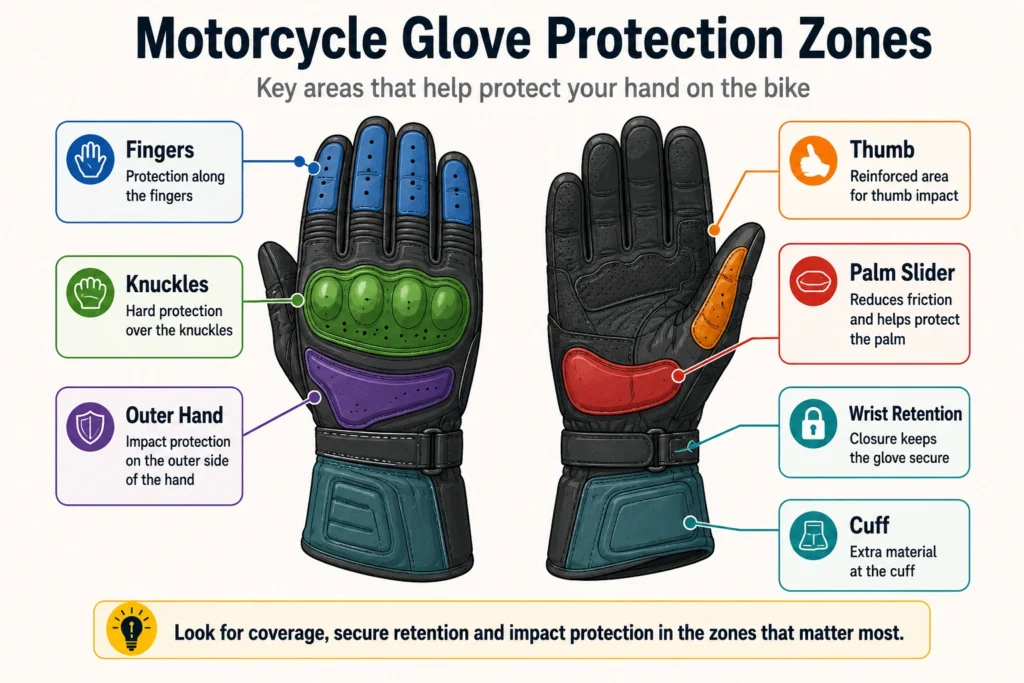
- Secure wrist retention
- Palm and outer-hand reinforcement
- Appropriate cuff coverage
- Practical control feel
- Different weather conditions
- Current European product availability
- Dedicated or extended sizing where available
EN 13594 is the European standard covering protective gloves for motorcycle riders. It includes requirements for areas such as ergonomics, restraint, seam strength, abrasion resistance and impact protection.
The standard contains two performance levels.
Level 1 is intended to balance protection with lower ergonomic penalties. Level 2 applies higher protection requirements but may create more weight or restriction.
The KP marking confirms that the glove includes tested knuckle-impact protection.
Level 2 gloves must meet the knuckle-impact requirement. Level 1 gloves can be marked KP when they have also passed the applicable knuckle test.
1. Best Maximum-Protection Glove: Five RFX1 EVO
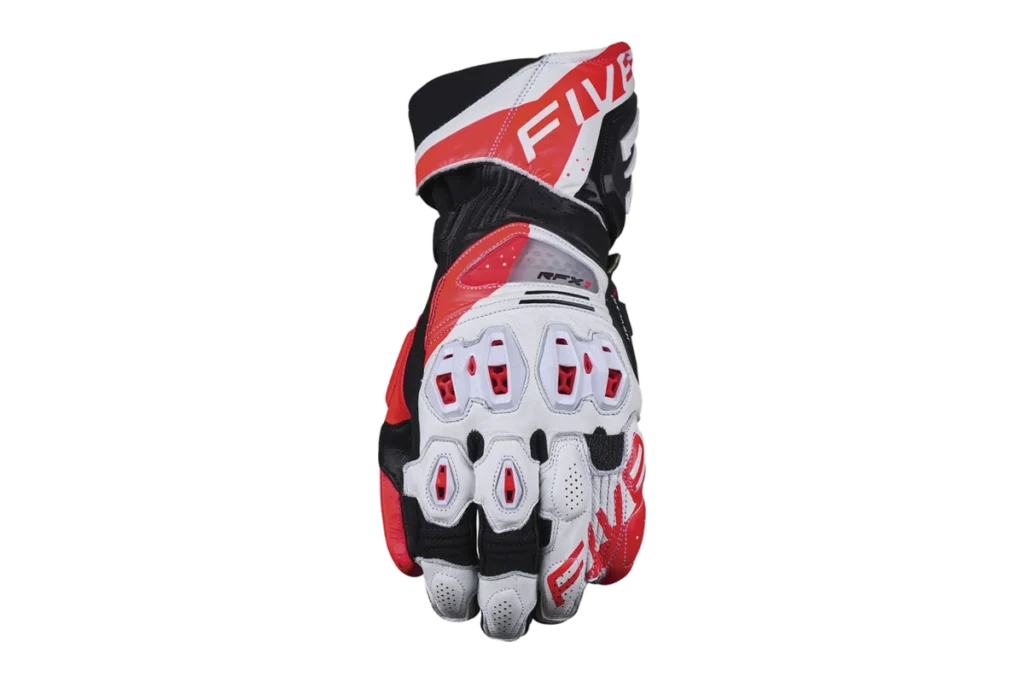
The Five RFX1 EVO is a race-style glove for riders prioritising strong abrasion, impact and wrist protection.
It is certified to CE Level 2 KP. Its construction combines cowhide, goat leather, stretch Kevlar, SuperFabric reinforcement, a palm slider, finger protection and an anti-twist connection between the little and ring fingers.
MotoCAP has independently awarded the RFX1 EVO a four-star protection rating, with a reported overall score of 4.8 out of five.
Why it stands out
- Level 2 KP certification
- Independent MotoCAP testing
- Full gauntlet
- Double wrist and cuff closure
- Palm slider
- Extensive finger and outer-hand reinforcement
- Anti-twist little-finger connection
- Leather and abrasion-resistant textile construction
Consider before buying
This is a serious race-influenced glove.
It will normally feel more structured, expensive and restrictive than a lightweight road glove. It is not waterproof and may be excessive for riders who mainly make short, low-speed urban journeys.
Five also produces a women-specific RFX1 EVO version, giving riders another fit option rather than simply asking them to size down in the standard glove.
Best suited to: Sport, fast road and occasional track riders who accept additional bulk in exchange for a high protection specification.
2. Best Protective Waterproof Glove: Five TFX1 GTX
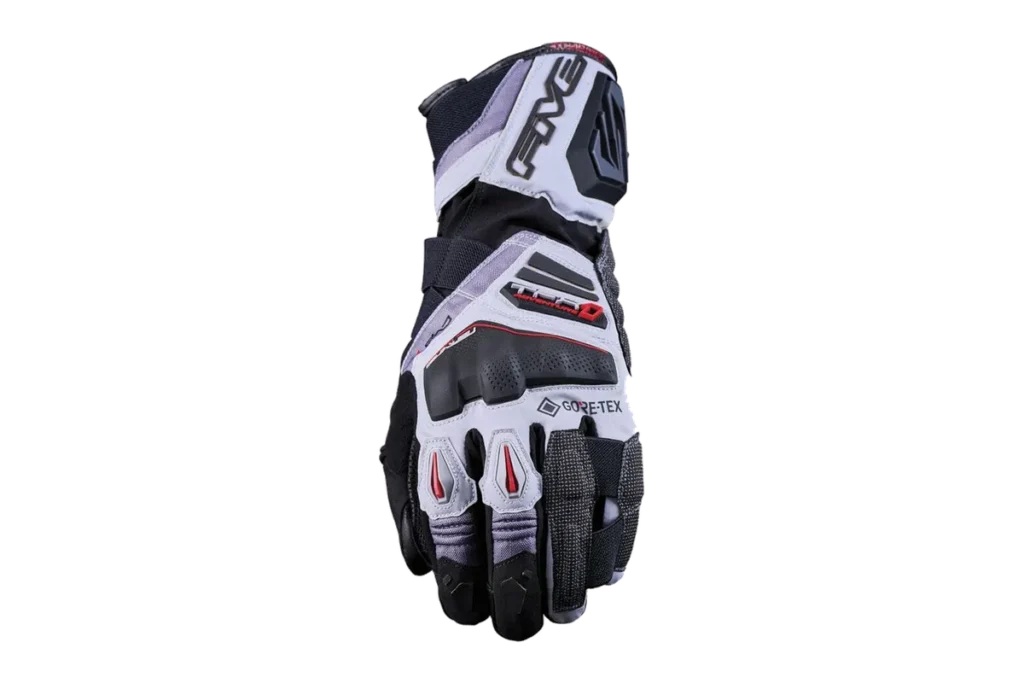
The Five TFX1 GTX combines waterproof touring construction with CE Level 2 KP certification.
It uses a GORE-TEX Grip membrane, goat-leather palm, SuperFabric reinforcement and protective elements across the knuckles, fingers, forearm and outer edge of the hand.
This is unusual because many weather-focused touring gloves are certified at Level 1.
Why it stands out
- Level 2 KP certification
- Waterproof GORE-TEX Grip construction
- Long cuff
- Palm and outer-hand reinforcement
- Forearm protection
- Double closure
- Visor-wiping panel
- Touchscreen-compatible fingers
- Reflective details
The bonded GORE-TEX Grip construction is intended to reduce movement between the outer glove and waterproof liner, helping maintain control feel in wet conditions.
Consider before buying
The TFX1 GTX is a premium, highly specified glove.
Its long cuff and layered waterproof construction may feel heavier than a simple summer glove. Riders should test lever reach and finger movement before buying.
It may also be too warm for the hottest summer journeys.
Best suited to: Touring and adventure riders who regularly face rain but still prioritise a Level 2 glove.
Read Wet Weather Motorcycle Riding Tips for more advice on maintaining control and visibility in rain.
3. Best-Value Long-Cuff Road Glove: Alpinestars SP-8 V3
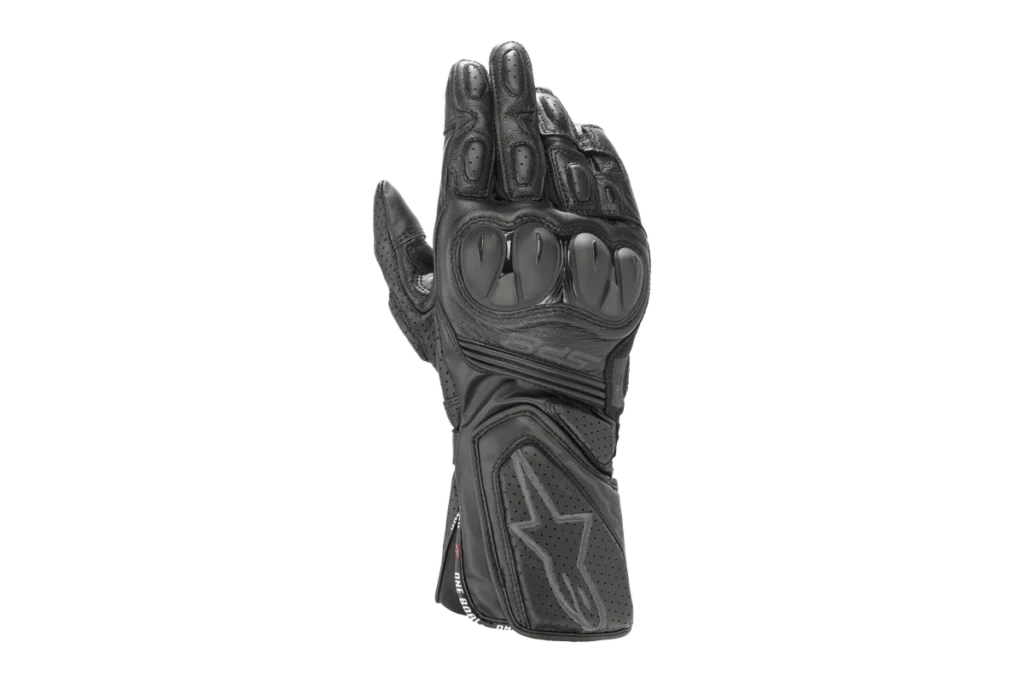
The Alpinestars SP-8 V3 offers a useful middle ground between a lightweight everyday glove and a premium racing gauntlet.
It is certified to EN 13594 Level 1 KP. Its construction uses full-grain goat leather and synthetic reinforcement, with a dual-density knuckle protector and extended cuff.
Why it stands out
- Level 1 KP certification
- Long cuff
- Leather-dominant construction
- Dual-density knuckle protection
- Reinforced palm and thumb area
- Pre-curved fingers
- Secure wrist closure
- Widely available model
It provides more wrist coverage than most short summer gloves without reaching the price or bulk of a Level 2 racing model.
Consider before buying
It does not meet the higher Level 2 requirements of the Five RFX1 EVO or TFX1 GTX.
It is also not a waterproof glove. Perforation and ventilation help in warmer conditions but make it less suitable for sustained rain or cold weather.
A women-specific Stella SP-8 V3 is also available and carries Level 1 KP certification.
Best suited to: Beginners and road riders looking for an accessible leather gauntlet with tested knuckle protection.
4. Best Ventilated Everyday Glove: REV’IT! Sand 5
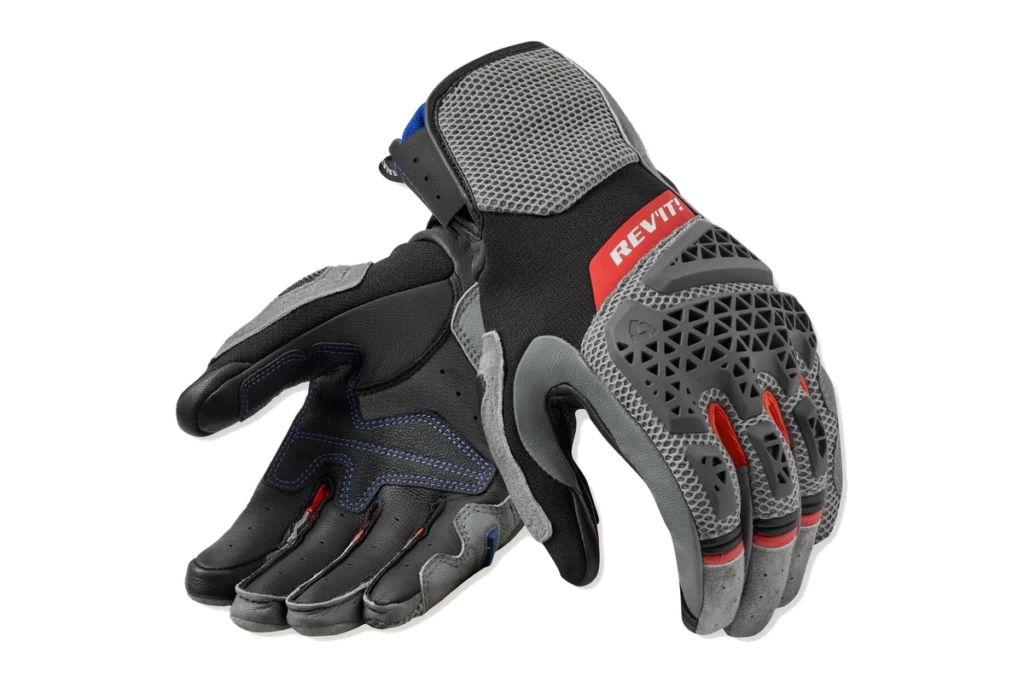
The REV’IT! Sand 5 is a short-cuff glove designed for ventilation, flexibility and warm-weather touring or everyday riding.
It is certified to EN 13594 Level 1 KP and combines leather with ventilated 3D mesh. Protection includes a palm slider, thumb protector, finger protection and a tested knuckle protector.
Why it stands out
- Level 1 KP certification
- Strong ventilation
- Short, convenient cuff
- Hard-shell palm slider
- Knuckle, thumb and finger protection
- Touchscreen-compatible fingertip
- Men’s and women-specific versions
This glove makes sense for riders who would otherwise be tempted to wear an ordinary thin glove during warm weather.
Consider before buying
The short cuff leaves less overlap with the jacket sleeve than a gauntlet glove.
Its mesh construction and airflow also make it unsuitable for cold weather, while the standard Sand 5 is not waterproof.
The Sand 5 Ladies uses a fit specifically developed for smaller or differently proportioned hands rather than relying only on reduced overall sizing.
Best suited to: Warm-weather commuting, urban rides and summer touring where ventilation and easy movement are priorities.
5. Best Variable-Weather Glove: Held Air n Dry II GTX
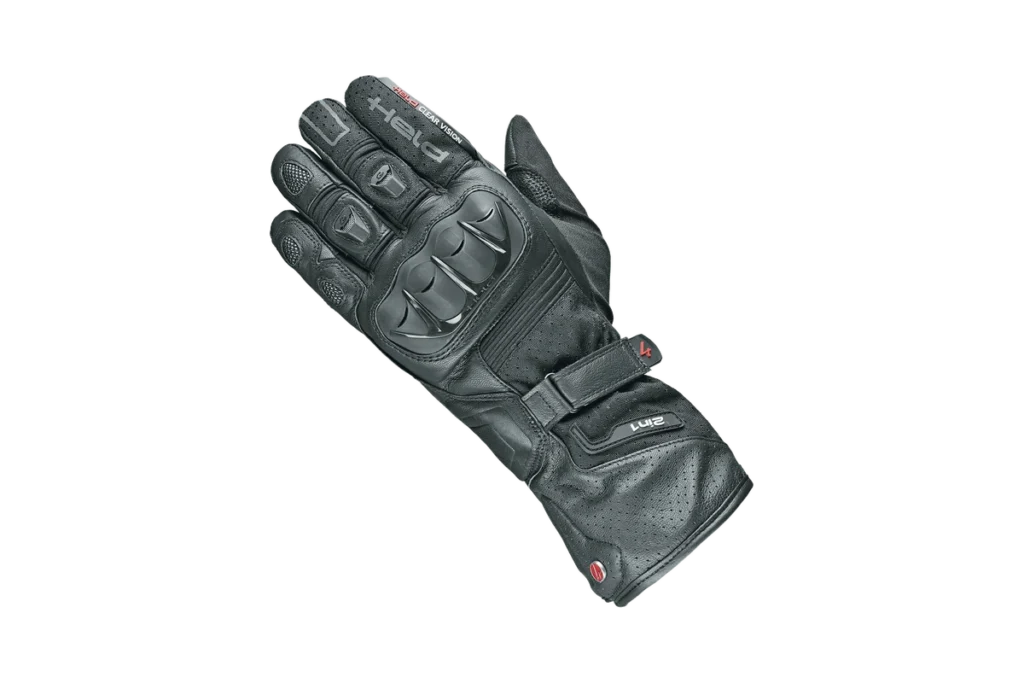
The Held Air n Dry II uses a two-chamber design.
One chamber is unlined and ventilated for warmer, drier riding. The second uses a GORE-TEX membrane and lining for wet-weather protection.
Its construction includes a kangaroo-leather palm, knuckle protection, reinforcement along the edge of the hand and a visor wiper.
The official product page confirms certification under EN 13594:2015 and tested knuckle-impact protection. It does not clearly state a Level 1 or Level 2 designation on the page, so buyers should check the complete sewn label and declaration of conformity before purchasing.
Why it stands out
- Two separate riding chambers
- Waterproof GORE-TEX option
- Ventilated unlined option
- Kangaroo-leather palm
- Knuckle-impact protection
- Reinforced outer hand
- Standard, short and long finger sizes
- Men’s and women-specific sizing
The extended sizing is especially useful because palm circumference and finger length do not always increase at the same rate.
Consider before buying
A two-chamber glove is more complex and expensive than a simple summer or waterproof glove.
Riders must also make sure their fingers enter the intended chamber correctly when putting the glove on.
Because the manufacturer page does not publish the glove’s complete EN 13594 level designation, confirm it on the physical product before treating it as equivalent to a clearly marked Level 2 glove.
Best suited to: Riders who regularly move between warm, dry conditions and moderate rain during the same journey.
6. Best Cold-Weather Glove: REV’IT! Taurus 2 GTX
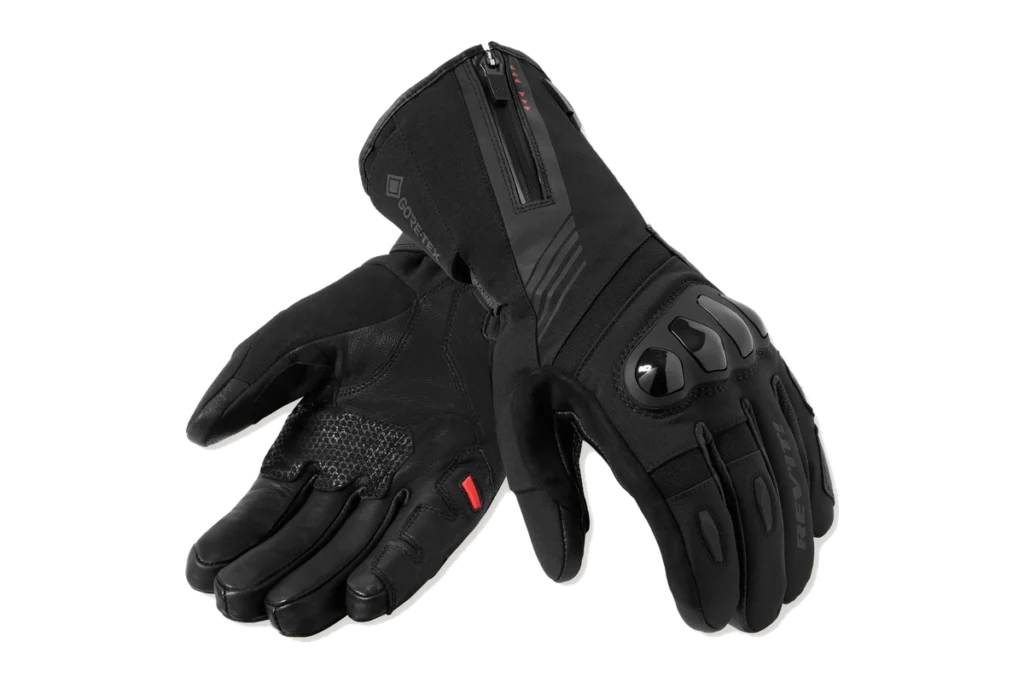
The REV’IT! Taurus 2 GTX is designed for cold and wet winter riding.
It is certified to EN 13594 Level 1 KP and combines GORE-TEX waterproofing with substantial PrimaLoft insulation. It also includes a palm slider, hard knuckle, double cuff and reflective sections.
Why it stands out
- Level 1 KP certification
- Waterproof GORE-TEX construction
- Heavy winter insulation
- Hard-shell knuckle
- Palm slider
- Double-cuff closure
- Visor wipers
- Touchscreen-compatible fingertip
- Reflective details
Cold hands can reduce comfort, concentration and precise control input. A dedicated winter glove can therefore be more useful than trying to fit a thick casual liner underneath a tight summer glove.
Consider before buying
Insulation reduces direct feel at the levers and switches.
The Taurus 2 GTX may also be uncomfortably warm outside winter conditions. Riders who only encounter moderate cold may prefer the less insulated Held Air n Dry II or another three-season touring glove.
Best suited to: Winter commuters and touring riders who continue riding in sustained cold and rain.
Read How to Stay Focused on Long Motorcycle Rides for more guidance on fatigue and physical discomfort during demanding journeys.
How Should Motorcycle Gloves Fit?
Motorcycle gloves should feel secure without preventing normal movement.
Check that:
- Your fingertips reach close to the end without being compressed
- Excess material does not fold under your palm
- The knuckle protector sits over your knuckles
- Seams do not create painful pressure
- You can fully operate the clutch, brake and switches
- The wrist restraint can be tightened securely
- The glove cannot easily be pulled off
- The cuff works with your jacket sleeve
Try the gloves while holding motorcycle-style grips when possible.
A glove can feel comfortable with an open hand but become tight across the knuckles when your fingers wrap around the controls.
The restraint system matters because the glove cannot provide useful protection when it comes off during a slide. EN 13594 includes specific retention testing for this reason.
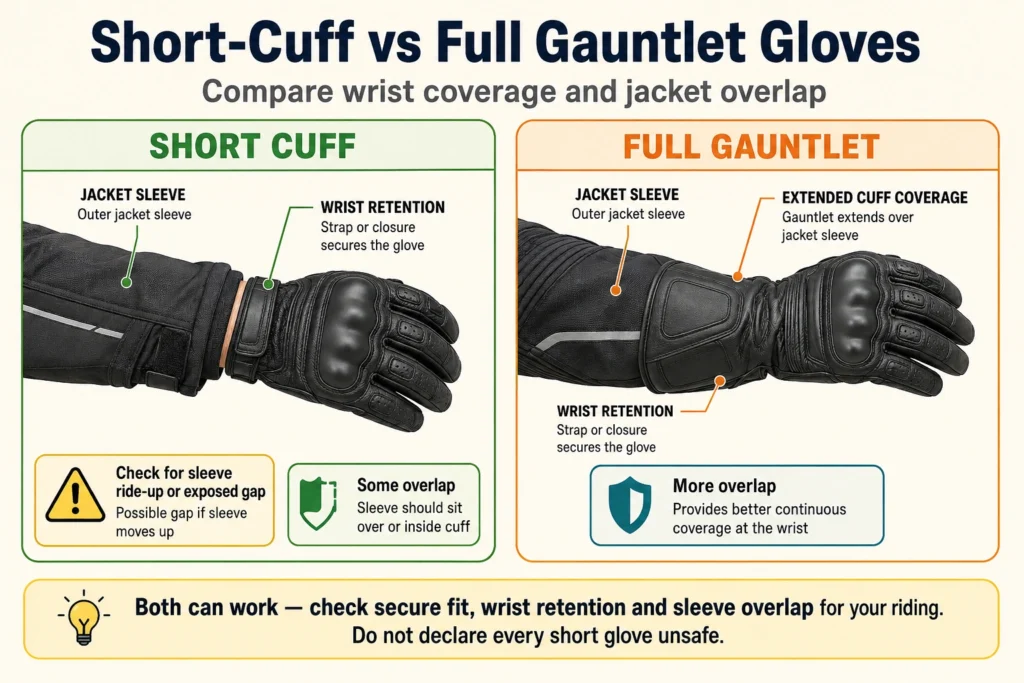
Short Cuff or Full Gauntlet?
A short-cuff glove is usually:
- Easier to put on
- Cooler in summer
- Less bulky
- Convenient for urban riding
A full-gauntlet glove normally provides:
- More wrist and lower-forearm coverage
- Greater overlap with the jacket
- A more substantial closure system
- Better weather sealing
- More space for additional protective components
A short glove is not automatically unsuitable.
The decision depends on its certification, construction and your riding. However, riders prioritising maximum coverage should normally compare long-cuff options first.
Check whether the gauntlet fits over or underneath your jacket sleeve according to the manufacturer’s design. The two pieces should overlap without creating a large opening for wind, rain or road contact.
Leather or Textile Motorcycle Gloves?
Leather remains common in protective gloves because it can provide strong abrasion resistance while maintaining useful control feel.
Textile materials can improve:
- Ventilation
- Stretch
- Waterproof construction
- Drying time
- Weight
Many of the best gloves combine materials rather than relying entirely on one.
The label, protective design and certification provide more useful information than simply choosing “leather” or “textile.”
A poorly secured leather fashion glove is not equivalent to an EN 13594-certified motorcycle glove.
Read CE Ratings Explained: Helmets, Jackets, Gloves and Armour before comparing certification labels.
Common Mistakes
Common Motorcycle-Glove Buying Mistakes
| Mistake | Why It Creates a Problem | Better Approach |
|---|---|---|
| Buying only by brand | Different models have different certification and construction | Check the full glove label |
| Assuming every knuckle protector is tested | Appearance alone does not confirm impact performance | Look for the KP marking |
| Buying gloves with excess finger length | Material may fold around the controls | Try another size or glove shape |
| Choosing an extremely tight glove | Pressure can cause pain and reduce control | Look for a secure, even fit |
| Ignoring the wrist strap | The glove may come off during a slide | Tighten and test the restraint |
| Buying one pair for every season | Weather compromises may become too large | Build a small seasonal rotation |
| Wearing ordinary winter gloves | Warmth does not confirm abrasion or impact protection | Choose certified motorcycle gloves |
| Assuming Level 2 is always comfortable | Higher protection may add bulk or restriction | Test control movement carefully |
| Choosing short gloves without checking sleeve overlap | A gap may expose the wrist | Test them with your riding jacket |
| Ordering online without a return plan | Finger length and palm shape vary widely | Use a retailer with easy exchanges |
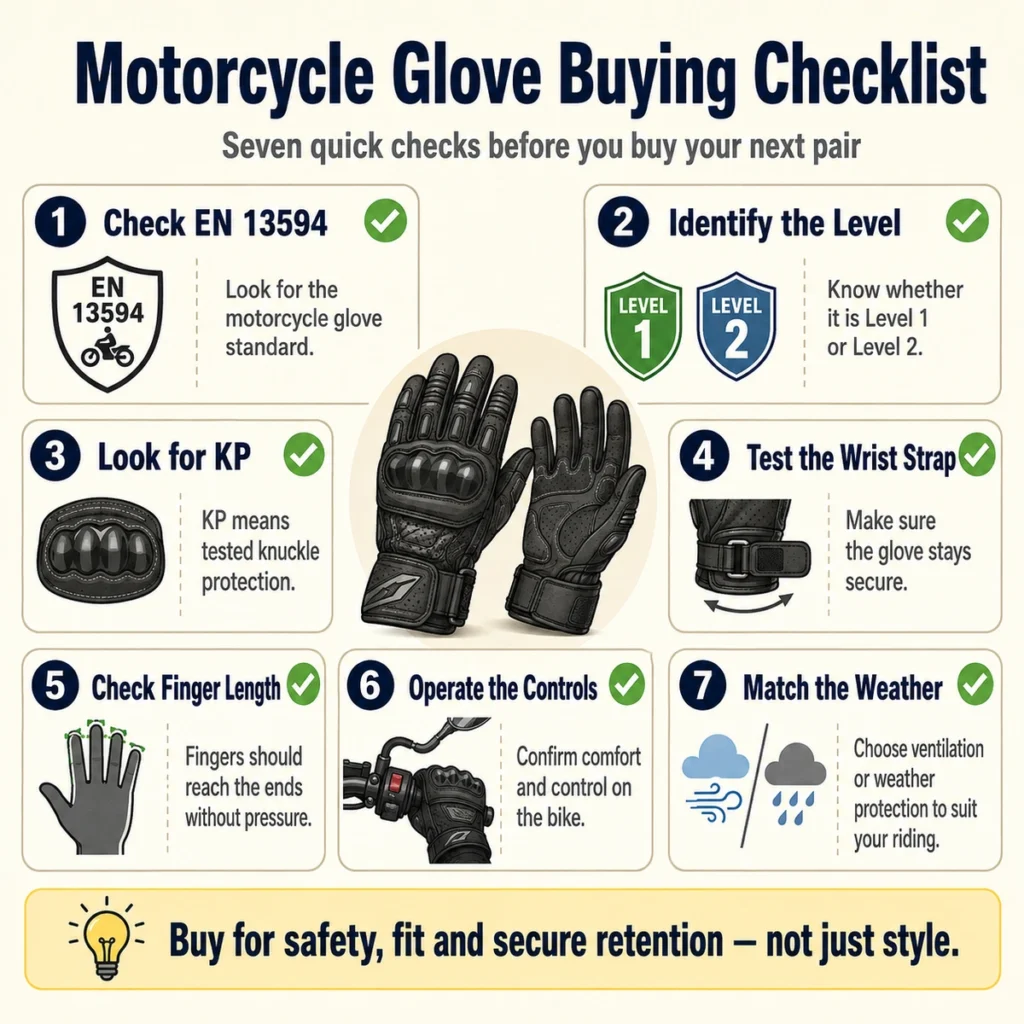
Motorcycle-Glove Buying Checklist
Before buying:
- Check for EN 13594 certification
- Identify Level 1 or Level 2
- Look for the KP marking
- Check palm and outer-hand reinforcement
- Test the wrist restraint
- Operate motorcycle-style controls
- Check finger length
- Check cuff overlap with your jacket
- Match insulation to the season
- Confirm waterproofing when needed
- Review return and exchange conditions
- Check that replacement or warranty support exists
Before riding:
- Fasten the wrist closure
- Secure the gauntlet
- Check that the lining is correctly positioned
- Confirm full brake and clutch movement
- Inspect damaged seams
- Replace gloves after serious damage or when protection has been compromised
Final Thoughts: Protect the Hand Without Losing Control
The Five RFX1 EVO provides the strongest sport-focused evidence in this shortlist, combining Level 2 KP certification with a four-star MotoCAP result.
The Five TFX1 GTX brings Level 2 protection into a waterproof touring glove. The Alpinestars SP-8 V3 offers a more accessible leather gauntlet, while the REV’IT! Sand 5 provides a practical ventilated option.
The Held Air n Dry II suits variable weather, and the REV’IT! Taurus 2 GTX is designed for riders continuing through winter.
But the label alone cannot choose your glove.
Your fingers must reach the controls properly. The glove must remain secured around your wrist, and the protection must sit in the correct position.
Choose the highest appropriate certification you can wear comfortably and operate correctly.
A protective glove left at home offers no protection at all.
FAQs
What are the safest motorcycle gloves?
Level 2 KP gloves meet higher EN 13594 requirements than Level 1 gloves. Products such as the Five RFX1 EVO and Five TFX1 GTX combine Level 2 certification with substantial wrist, palm and knuckle protection.
What does Level 2 KP mean?
Level 2 represents the higher of the two EN 13594 performance levels. KP confirms tested knuckle-impact protection, which is mandatory at Level 2.
Are leather motorcycle gloves safer than textile gloves?
Not automatically. Certification, seam strength, abrasion performance, reinforcement and secure retention matter more than one material name. Many protective gloves combine leather and technical textiles.
Are short motorcycle gloves safe?
A certified short glove can provide useful protection, but it gives less wrist and forearm coverage than a full gauntlet. Check its certification and jacket overlap.
Should motorcycle gloves fit tightly?
They should fit securely without compressing your fingertips or restricting lever movement. Avoid excess material in the fingers and palm.
Are waterproof motorcycle gloves less comfortable?
Waterproof membranes and insulation can add bulk and reduce direct control feel. Modern bonded constructions may reduce liner movement, but each glove still needs to be tested on the controls.
What motorcycle gloves are best for beginners?
Beginners should prioritise certified gloves with secure wrist retention, good palm protection and comfortable control movement. A Level 1 KP leather gauntlet such as the Alpinestars SP-8 V3 is one option worth comparing.
Related Reads
Best Motorcycle Safety Gear for Every Rider
Motorcycle Safety Gear Explained: What Each Piece Actually Does
CE Ratings Explained: Helmets, Jackets, Gloves and Armour