Last reviewed: August 2026
The best motorcycle boots protect your feet and ankles without making normal control of the motorcycle unnecessarily difficult.
A rigid racing boot may offer substantial support but feel excessive during a short commute.
A casual motorcycle shoe may be comfortable away from the bike but provide less shin and lower-leg coverage than a full-height boot.
Touring riders also need to consider waterproofing, walking comfort and whether the boot remains wearable after several hours on the road.
The right choice depends on the protection level, fit, weather and riding you actually do.
This guide compares motorcycle boots worth considering for road and touring use in 2026. It also explains how to read the EN 13634 label so that you can compare tested performance rather than relying only on appearance or marketing.
These are researched recommendations. I have not personally owned or ridden in every boot listed, so official certification and manufacturer specifications are kept separate from personal experience.
Affiliate Disclosure: This article may contain affiliate links. If you buy through one, I may earn a commission at no extra cost to you. See my disclosure for more info.
Quick Answer
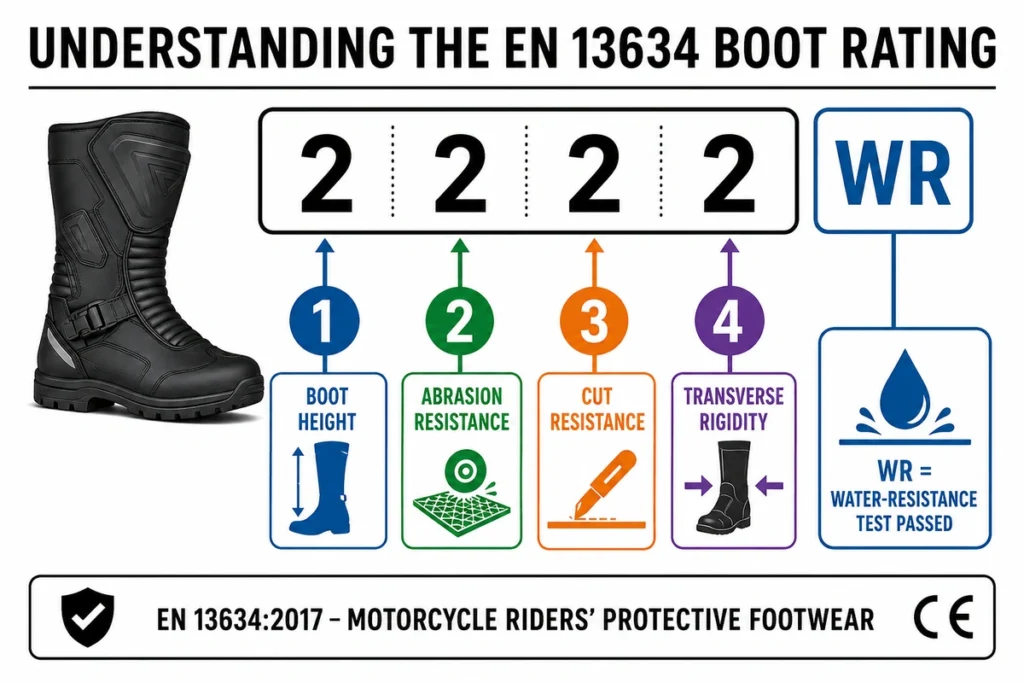
Understanding the EN 13634 Boot Rating
Motorcycle footwear sold as protective equipment in Europe should carry the relevant certification label.
EN 13634:2017 uses four main performance numbers:
- Height of the upper
- Impact-abrasion resistance
- Impact-cut resistance
- Transverse rigidity
Each position normally shows Level 1 or Level 2.
Level 2 represents the higher test requirement, but that does not mean every Level 2 boot will be comfortable or suitable for every rider.
The transverse-rigidity test measures the boot’s resistance to being compressed sideways. TCX explains that Level 1 requires at least 1.0 kN to deform the footwear by 20 mm, while Level 2 requires at least 1.5 kN. The standard also uses higher thresholds for Level 2 abrasion and cut resistance.
You may also see additional markings.
WR indicates that the boot passed a water-penetration-resistance test involving continuous flexing while partially immersed for 80 minutes.
Do not judge the boot only by whether it looks thick or strong.
Open the label and check the actual numbers.
Read CE Ratings Explained: Helmets, Jackets, Gloves and Armour for a wider explanation of protective-equipment certification.
Motorcycle Boots for Road and Touring Riders
| Boot | Best For | Certification Information |
|---|---|---|
| Alpinestars SMX-6 V3 | Sporty road riding | EN 13634:2017 certified |
| Dainese Fulcrum 4 Gore-Tex | Traditional all-weather touring | EN 13634 certified |
| REV’IT! Expedition GTX | Maximum adventure-touring specification | EN 13634:2017, Level 2/2/2/2, IPS and WR |
| TCX Hero 2 WP | Urban riding and walking comfort | EN 13634-certified motorcycle boot |
| REV’IT! Odyssey H2O Ladies | Women-specific waterproof touring | EN 13634:2017, Level 2/2/2/1 and WR |
This is not a ranking from safest to least safe.
The Expedition GTX has the strongest published four-part EN 13634 result in this shortlist, but it is also a tall and highly structured adventure boot. It may be unnecessary for a rider who mainly commutes through Amsterdam and walks between appointments.
The correct boot is the one that gives you appropriate certified protection while allowing you to operate the gear lever, rear brake and foot controls properly.
1. Sporty Road Choice: Alpinestars SMX-6 V3
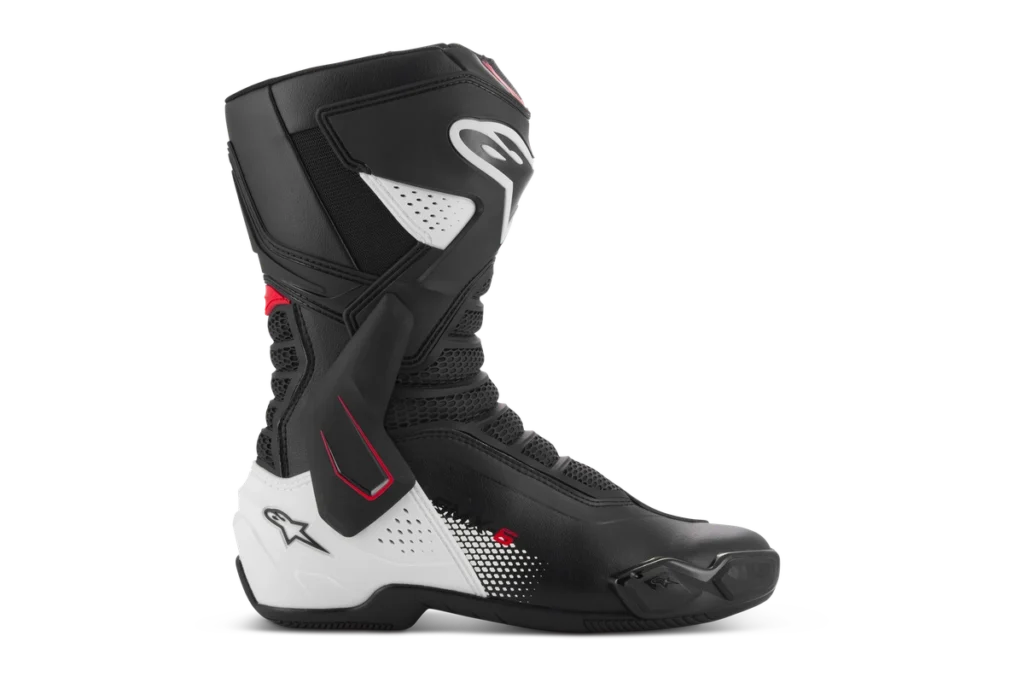
The Alpinestars SMX-6 V3 sits between an everyday road boot and a highly specialised racing boot.
It is certified to EN 13634:2017 and includes a lateral ankle-brace system, shin protection, ankle protectors and a replaceable toe slider. Alpinestars also redesigned the flex zones and upper to improve forward and backward movement and walking comfort.
Why it stands out
- Full-height sport-road construction
- EN 13634:2017 certification
- Lateral ankle support
- Shin protection
- Replaceable toe slider
- Reinforced gear-shift area
- Structured heel and ankle coverage
- Sizes extending across a broad range
The SMX-6 V3 is less complex than Alpinestars’ flagship Supertech R but still includes visibly substantial sport-derived protection.
Consider before buying
It is not the most discreet option for walking around town.
The standard SMX-6 V3 is also not waterproof. Gore-Tex and Drystar versions are available, but their pricing, ventilation and feel differ.
Check that the toe height works with your gear lever and that the ankle support does not interfere with your normal foot position.
Best suited to: Road and sport-touring riders who want more ankle and shin structure than an urban boot.
2. Traditional Touring Choice: Dainese Fulcrum 4 Gore-Tex
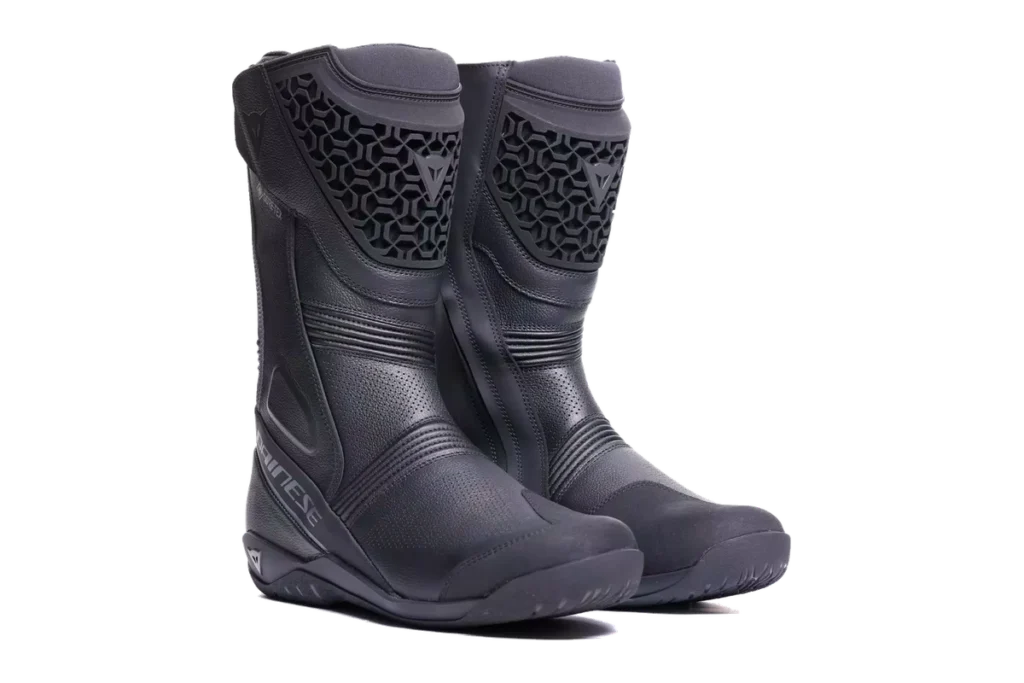
The Dainese Fulcrum 4 Gore-Tex follows a more traditional touring-boot design.
It uses a cowhide upper, Gore-Tex ePE membrane, rigid ankle inserts and an internal zip. Dainese lists the boot as CE Category II footwear certified to EN 13634.
Why it stands out
- Full-height touring construction
- EN 13634 certification
- Gore-Tex waterproof membrane
- Cowhide upper
- Rigid ankle inserts
- Internal zip
- Adjustable calf straps
- Touring and walking-oriented sole
- Broad published size range
The calf adjustment is useful because two riders with the same foot size may have very different lower-leg proportions.
Consider before buying
Dainese’s public product page confirms the standard but does not display the complete four-part performance code.
Check the physical label or declaration of conformity before comparing it directly with a boot that publishes all four EN 13634 levels.
The traditional leather construction may also require more break-in time than a lightweight textile or urban boot.
Best suited to: Road-tourers wanting a conventional waterproof leather boot for changing European weather.
Read Wet Weather Motorcycle Riding Tips when preparing the rest of your rain-riding setup.
3. Maximum Adventure-Touring Specification: REV’IT! Expedition GTX
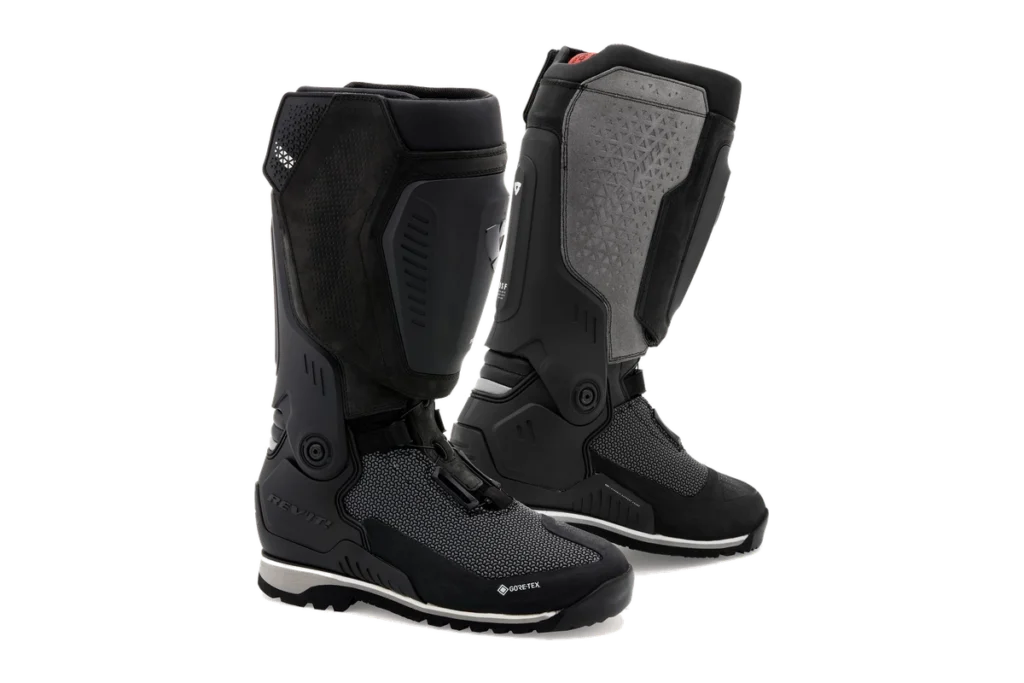
The REV’IT! Expedition GTX has the clearest high-level certification result in this shortlist.
Its label is published as:
Level 2 | 2 | 2 | 2 | IPS | WR
under EN 13634:2017. It also uses a Gore-Tex liner, external shin protection, a BOA closure and a Vibram sole designed for adventure riding and walking.
Why it stands out
- Level 2 in all four published EN 13634 categories
- Additional IPS marking
- WR water-resistance marking
- Gore-Tex construction
- External shin protection
- BOA closure
- Structured adventure sole
- High boot coverage
This is the strongest option here for riders who prioritise published certification levels and substantial lower-leg structure.
Consider before buying
The Expedition GTX is expensive, tall and visually substantial.
It may limit ankle movement more than a road-tour boot, particularly before it has broken in. The sole and upper are also designed partly around adventure use and standing on the foot pegs.
A rider who remains almost entirely on paved roads may find a lighter touring boot easier to live with.
Best suited to: Adventure and long-distance touring riders who want a high published EN 13634 result and waterproof construction.
4. Urban Road and Walking Choice: TCX Hero 2 WP
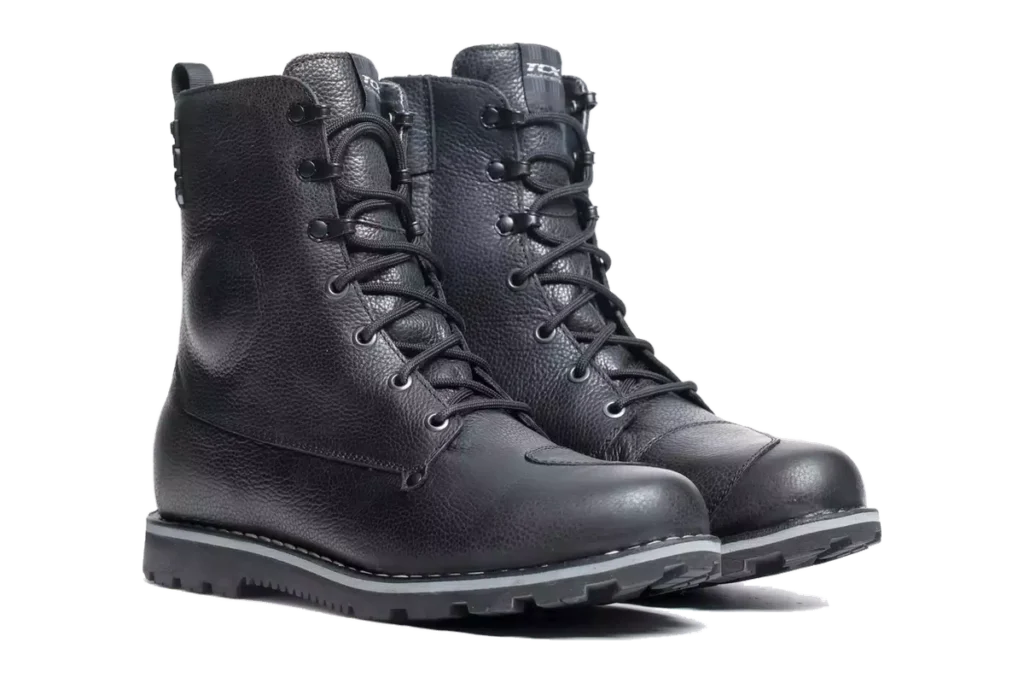
The TCX Hero 2 WP looks closer to a traditional lace-up leather boot than a technical touring product.
It is nevertheless sold as certified motorcycle footwear and includes reinforcement at the ankle, toe and heel. The full-grain leather upper is combined with a T-Dry waterproof membrane, side zip and reinforced gear-shift area.
Why it stands out
- Certified motorcycle construction
- Ankle, toe and heel reinforcement
- Waterproof membrane
- Full-grain leather
- Side zip and laces
- Walking-friendly styling
- Sizes from 36 to 48 on the current product page
- Deep-tread rubber sole
This makes it easier to use for commuting, work and short journeys where the rider will spend significant time away from the motorcycle.
Consider before buying
The Hero 2 WP is a half-height boot.
It does not provide the same shin or lower-leg coverage as the Fulcrum, Expedition or SMX-6.
Laces also need to be secured properly so that they cannot catch on a foot control or motorcycle component.
The product page confirms certification but does not publish the complete four-number EN 13634 code. Check the sewn label before comparing its test levels with another boot.
Best suited to: Urban riders and commuters who need motorcycle-specific protection without wearing a tall technical boot all day.
5. Women-Specific Waterproof Touring Choice: REV’IT! Odyssey H2O Ladies
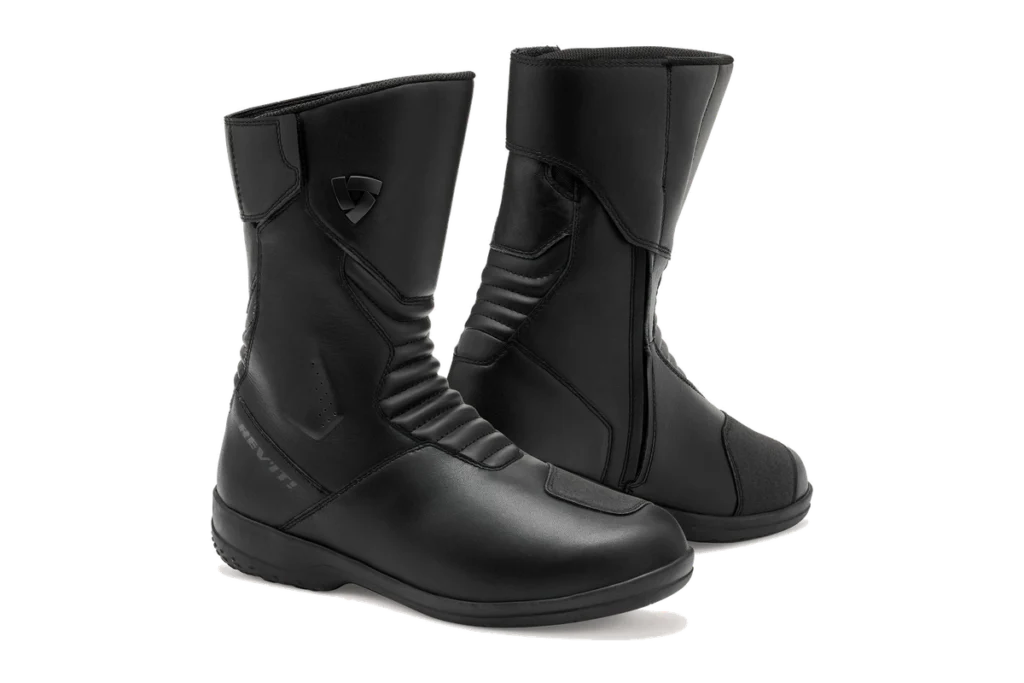
The REV’IT! Odyssey H2O Ladies is a women-specific waterproof touring boot.
It carries the EN 13634:2017 result:
Level 2 | 2 | 2 | 1 | WR
and includes ankle protection, heel and toe reinforcement, shin protection and a waterproof liner. The closure combines an internal zip, hook-and-loop adjustment and calf adjustment.
Why it stands out
- Women-specific touring fit
- Level 2 height, abrasion and cut results
- Level 1 transverse rigidity
- WR water-resistance marking
- Ankle, heel, toe and shin protection
- Adjustable calf closure
- Full-grain leather construction
- Sizes 36 to 42
This option is useful because women should not be expected to solve fit problems simply by buying a smaller version of a men’s boot.
Consider before buying
A women-specific label still does not guarantee the correct fit.
Check calf space, ankle position, heel movement and whether the toe box works with the motorcycle’s foot controls.
Its published transverse-rigidity result is Level 1 rather than Level 2, which should be considered when comparing it with more structured boots.
Best suited to: Women wanting a certified waterproof touring boot with published EN 13634 test levels.
Tall Boot or Motorcycle Shoe?
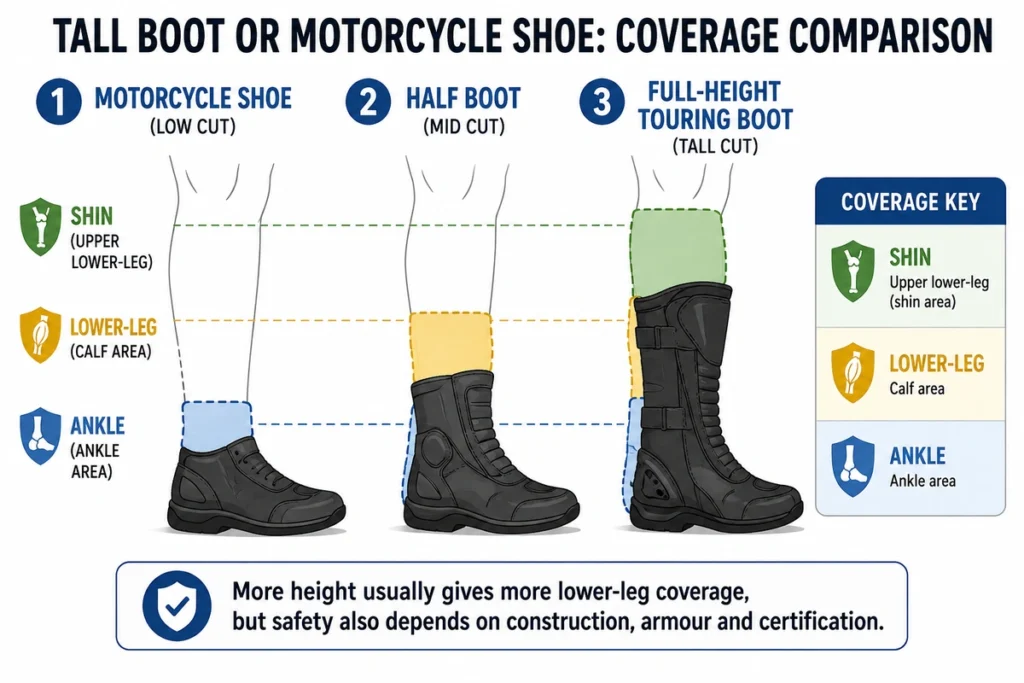
A taller boot generally provides more coverage around the shin and lower leg.
It may also allow:
- More structured ankle support
- A longer closure system
- Better overlap with riding trousers
- More space for shin protection
- Improved weather sealing
A shorter motorcycle shoe or half boot may offer:
- Easier walking
- Less weight
- Better ventilation
- More discreet styling
- Greater convenience for commuting
The EN 13634 label helps identify the tested height category, but height alone does not describe the complete protection.
A tall boot with weak rigidity or poor fit is not automatically the better purchase.
For regular touring, motorway riding and longer journeys, I would normally begin by comparing full-height boots. For urban trips that include a lot of walking, a properly certified half boot may provide the more realistic balance.
Waterproof or Ventilated?
A waterproof boot is useful when you regularly ride through rain or changing touring weather.
However, waterproof membranes can reduce airflow and make a boot warmer in summer.
Before buying, ask:
- How often do I ride in sustained rain?
- Do I already use waterproof overshoes?
- Will this be my only pair?
- Do my feet become uncomfortably warm?
- How long will I walk in the boots?
- Does the product carry the
WRmarking?
A manufacturer describing a boot as waterproof is useful product information.
A published WR marking provides additional evidence that the footwear passed the water-resistance test specified by the standard.
Many frequent riders eventually use two pairs: a ventilated or lighter road boot for warm conditions and a waterproof touring boot for wet or cold journeys.
How Should Motorcycle Boots Fit?
Try the boots with the socks you normally wear.
Then check:
- Your heel does not lift excessively
- Your toes are not compressed
- The ankle protection sits over the joint
- The closure remains secure
- The boot cannot easily pull off
- You can place your foot under the gear lever
- You can feel and operate the rear brake
- The sole grips the foot peg
- The boot overlaps properly with your trousers
- Walking does not create severe pressure
Sit on your motorcycle when possible.
A boot can feel comfortable while standing but restrict ankle movement once your knees are bent and your feet are on the pegs.
Do not buy a larger size simply to make a rigid boot feel soft. Excess movement inside the boot can create poor control and allow the protective structure to move away from the foot.
Common Mistakes
Common Motorcycle-Boot Buying Mistakes
| Mistake | Why It Creates a Problem | Better Approach |
|---|---|---|
| Buying ordinary work boots | Tough appearance does not confirm motorcycle testing | Look for EN 13634 certification |
| Checking only whether the boot is CE marked | The four performance levels provide more detail | Read the full label |
| Buying a size too large | The foot and protectors may move excessively | Look for a secure heel and ankle fit |
| Ignoring transverse rigidity | Sole and boot stiffness affect crush resistance | Check the fourth EN 13634 number |
| Choosing a tall boot without trying the controls | Toe and ankle bulk may interfere with shifting | Test the boot on the motorcycle |
| Assuming every waterproof boot has a WR result | Manufacturer waterproofing and standard testing are separate details | Check the label |
| Prioritising walking comfort alone | A soft boot may provide less structure | Balance comfort with certified protection |
| Leaving laces loose | They can catch on controls or components | Secure them completely |
| Ignoring trouser overlap | Rain or road contact may reach an exposed gap | Test boots and trousers together |
| Ordering without an exchange option | Boot shape varies significantly | Use a retailer with practical returns |
Motorcycle-Boot Buying Checklist
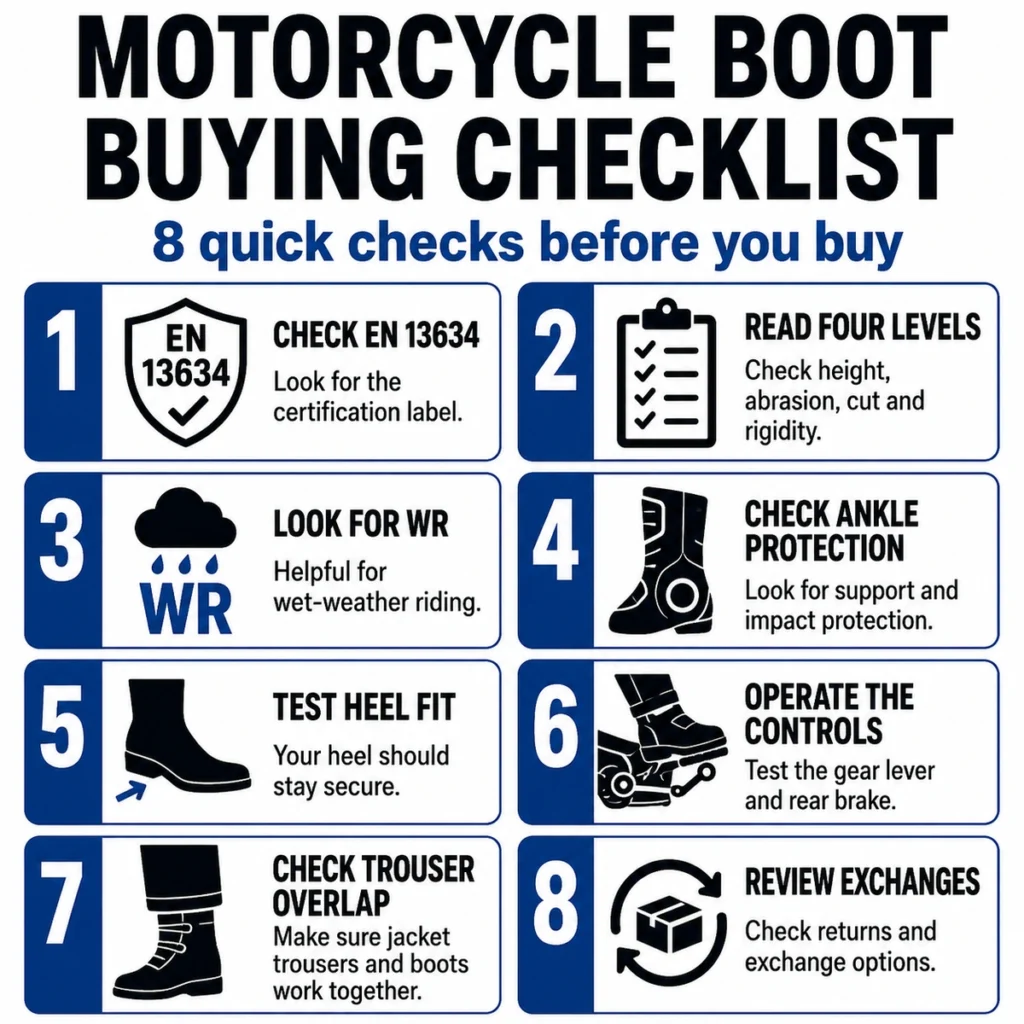
Before buying:
- Look for EN 13634 certification
- Read all four performance numbers
- Check for the WR marking when waterproofing matters
- Confirm ankle, heel and toe protection
- Decide whether you need shin coverage
- Test gear-lever and brake movement
- Check heel lift
- Try the boots with riding socks
- Test the overlap with your trousers
- Compare walking comfort
- Check replacement parts and closure support
- Review the retailer’s exchange policy
Before every ride:
- Close every zip, buckle and strap
- Secure all laces
- Check the sole for separation
- Inspect damaged stitching
- Confirm the boot still operates the controls properly
- Allow wet boots to dry according to the manufacturer’s instructions
- Replace or professionally assess boots after serious damage
Final Thoughts: Read the Label, Then Test the Fit
The Alpinestars SMX-6 V3 provides a sportier road option with substantial ankle and shin structure.
The Dainese Fulcrum 4 Gore-Tex offers a traditional leather-touring design, while the REV’IT! Expedition GTX publishes the strongest four-part EN 13634 result in this shortlist.
The TCX Hero 2 WP provides a more practical urban and walking-oriented option. The REV’IT! Odyssey H2O Ladies adds a women-specific waterproof touring fit with clearly published test levels.
None of these products can be selected from a specification table alone.
Read the certification label. Put both boots on. Sit on the motorcycle and operate every foot control.
The best motorcycle boot is not the stiffest or most technical-looking product.
It is certified footwear that fits properly, matches the journey and remains secure when you need its protection.
FAQs
What are the safest motorcycle boots?
Look for EN 13634-certified boots with strong published results for abrasion, cut resistance and transverse rigidity. Fit, height and ankle or shin protection also matter.
What do the four numbers on a motorcycle-boot label mean?
They represent the boot’s height, impact-abrasion resistance, impact-cut resistance and transverse rigidity, in that order.
Are touring boots safer than motorcycle shoes?
Touring boots normally provide more shin and lower-leg coverage, but individual test levels and fit still vary. Compare the full EN 13634 label.
Should motorcycle boots cover the ankle?
Motorcycle footwear should protect and remain secured around the ankle. Taller boots normally provide additional shin and lower-leg coverage.
Are waterproof motorcycle boots worth buying?
They are useful for commuting and touring in changing weather. Check comfort, breathability and whether the label includes the WR water-resistance marking.
How should motorcycle boots fit?
They should hold the heel and ankle securely without crushing the toes. You should be able to operate the gear lever and rear brake normally.
Can protective motorcycle boots be comfortable for walking?
Some urban and touring boots are designed for walking comfort, but increased protection can add structure and weight. Test both riding and walking comfort before buying.
Related Reads
Best Motorcycle Safety Gear for Every Rider
Motorcycle Safety Gear Explained: What Each Piece Actually Does
CE Ratings Explained: Helmets, Jackets, Gloves and Armour