Last reviewed: August 2026
The safest motorcycle helmet is not automatically the most expensive model or the one with the highest specification sheet.
It is a properly approved helmet that fits your head securely, remains comfortable and suits the type of riding you actually do.
A five-star helmet that creates painful pressure points is not the right choice for you. Neither is a premium touring helmet that moves around because its internal shape does not match your head.
This guide compares some of the best motorcycle helmets for safety in 2026 using current European approval, independent SHARP results and practical riding needs.
These are researched recommendations. I have not personally owned or tested every helmet listed, so manufacturer specifications and independent safety-test results are clearly separated from personal experience.
Affiliate Disclosure: This article may contain affiliate links. If you buy through one, I may earn a commission at no extra cost to you. See my disclosure for more info.
Quick Answer
Which Motorcycle Helmets Are Worth Comparing?
My current 2026 shortlist
| Helmet | Best For | Approval | SHARP Rating |
|---|---|---|---|
| HJC C10 | Affordable everyday protection | ECE 22.06 | 4 stars |
| AGV K1 S | Budget riders wanting a five-star result | ECE 22.06 | 5 stars |
| AGV K6 S | Lightweight road and sport-touring use | ECE 22.06 | 5 stars |
| Shoei NXR2 | Premium road and sporty riding | ECE 22.06 | 5 stars |
| Shoei GT-Air 3 | Touring with an integrated sun visor | ECE 22.06 | 5 stars |
| Shoei Neotec 3 | Premium modular touring | ECE 22.06, P/J | 5 stars |
| Arai Tour-X5 | Adventure and mixed-road riding | ECE 22.06 | 4 stars |
This shortlist does not mean every helmet will fit you.
SHARP recommends trying several helmets, identifying those that fit correctly and then comparing the safety results of the suitable models.
How I Selected These Helmets
The shortlist prioritises:
- Current ECE 22.06 approval
- Published SHARP results
- Availability in European sizes
- A secure retention system
- Different budgets and riding styles
- Replaceable visors and interior components
- Practical everyday usability
SHARP conducts 30 linear and two oblique impact tests on each tested model. Its one-to-five-star system is intended to compare performance beyond the minimum legal approval requirements.
Not every ECE-approved helmet has been tested by SHARP.
The absence of a SHARP result does not automatically mean a helmet is unsafe. It means this particular additional comparison data is unavailable.
For this article, however, independently tested models make it easier to support recommendations without depending entirely on manufacturer marketing.
1. Best Affordable All-Round Helmet: HJC C10
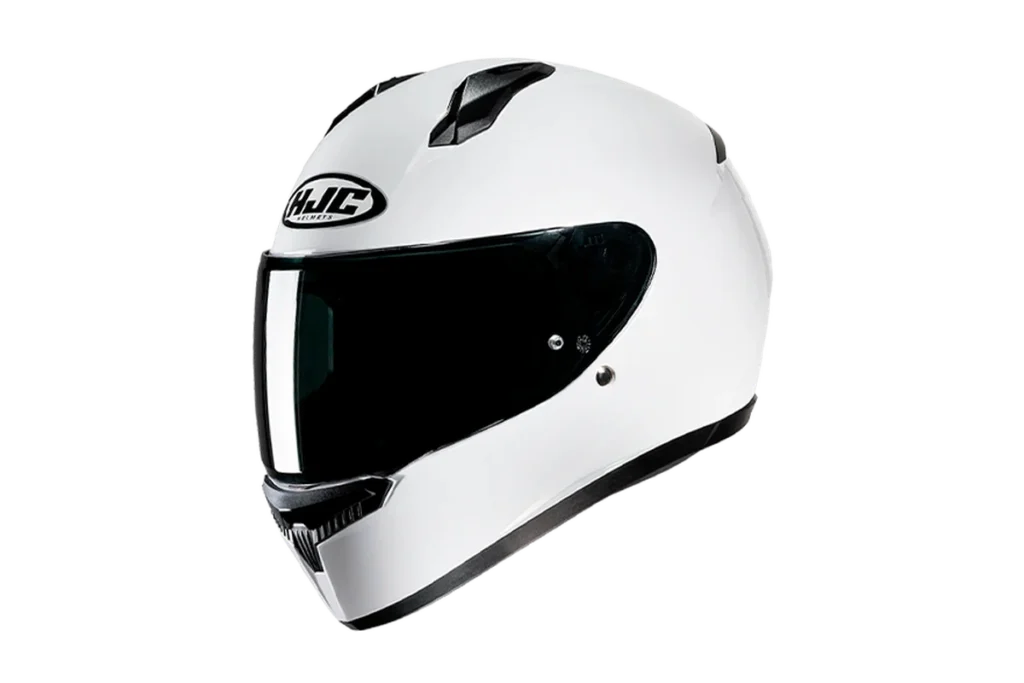
The HJC C10 is one of the strongest starting points for riders on a limited budget.
It meets ECE 22.06 and received four stars from SHARP. The official European price for the basic solid version has been around €110, although retailer prices and stock can change.
Why it stands out
- Four-star independent result
- Current European approval
- Broad size range
- Removable interior
- Pinlock-ready visor
- Accessible price
The C10 shows why helmet price alone should not be used as a safety score.
Its polycarbonate construction and simpler specification help control the cost, but it still meets the same ECE 22.06 approval baseline as much more expensive helmets.
Consider before buying
The C10 does not offer the lighter composite shell or premium interior adjustment available in more expensive helmets.
It also lacks an integrated sun visor, so riders may need a separate tinted visor or appropriate eyewear where legally permitted.
Best suited to: Beginners, commuters and riders who want a straightforward full-face helmet without spending heavily.
2. Best Budget Five-Star Helmet: AGV K1 S
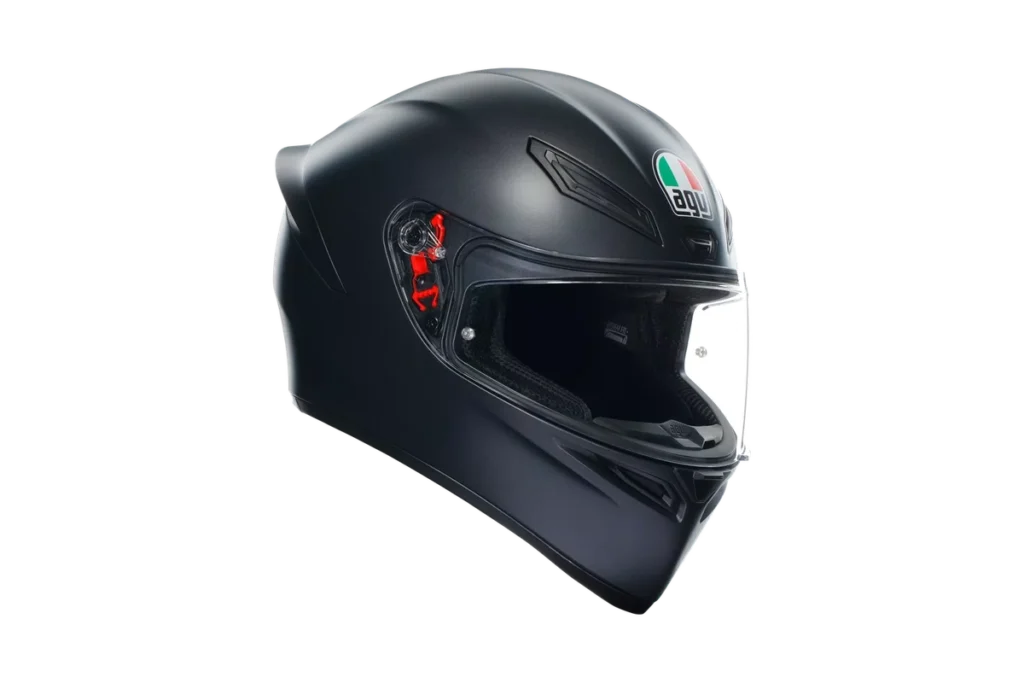
The AGV K1 S is worth comparing when independent impact performance is the priority but the budget does not stretch to a premium composite helmet.
It is ECE 22.06 approved and received five stars from SHARP. AGV constructs it from thermoplastic material and uses a Double-D retention system.
Why it stands out
- Five-star SHARP result
- Relatively accessible price
- Wide field of vision
- Double-D closure
- Sport-focused ventilation and aerodynamics
- Pinlock-ready visor
The K1 S demonstrates that a thermoplastic shell and moderate price do not prevent a helmet from achieving a strong independent result.
Consider before buying
Its race-influenced shape and spoiler may not be the first choice for riders who want a subtle urban or classic style.
It may also feel heavier than a premium composite helmet, and the fit will not suit every head shape.
Best suited to: Budget-conscious road and sport riders who want a five-star SHARP-tested option.
3. Best Lightweight Road Helmet: AGV K6 S
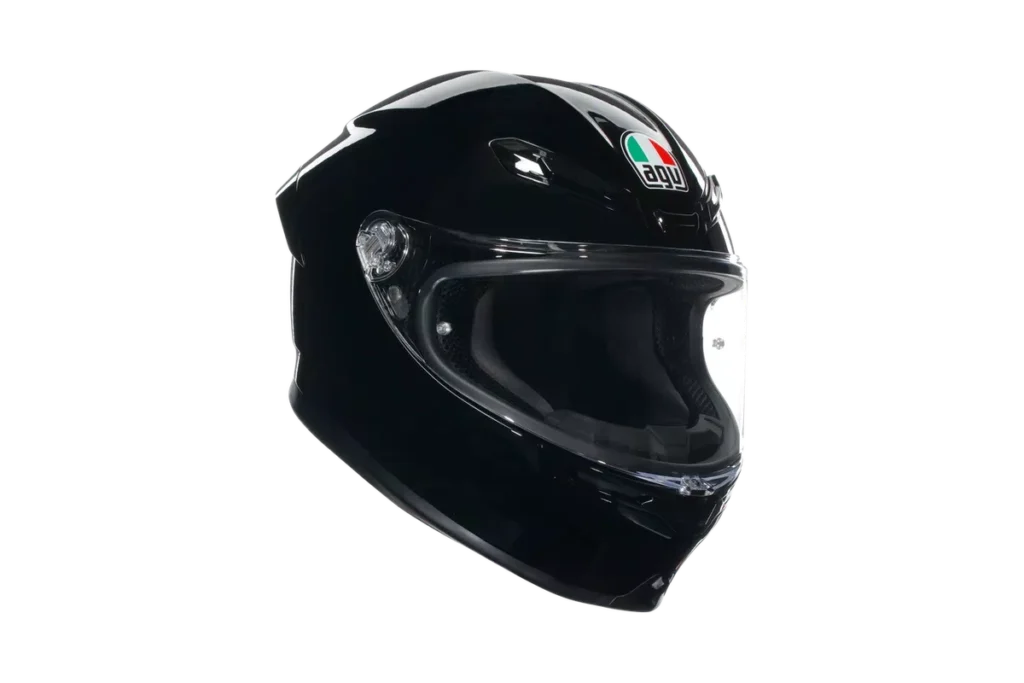
Helmet weight becomes increasingly noticeable during longer journeys, especially when combined with wind pressure and muscular fatigue.
The AGV K6 S is ECE 22.06 approved, received five SHARP stars and weighs approximately 1.2–1.3 kilograms depending on size and specification. Its shell uses composite materials and a Double-D closure.
Why it stands out
- Five-star SHARP result
- Very low weight
- Composite shell
- Broad road and sport-touring use
- Double-D closure
- Wide visor opening
- Pinlock compatibility
The K6 S is less aggressively specialised than a pure racing helmet, making it suitable for riders who combine urban roads, weekend rides and longer journeys.
Consider before buying
The lighter composite construction places it in a substantially higher price tier than the C10 or K1 S.
Low weight is useful only after fit has been confirmed. A light helmet with the wrong internal shape can still create pressure, movement and distraction.
Best suited to: Road and sport-touring riders who notice helmet weight during longer rides.
Read How to Stay Focused on Long Motorcycle Rides for more ways to manage physical and mental fatigue.
4. Best Premium Sport-Road Helmet: Shoei NXR2
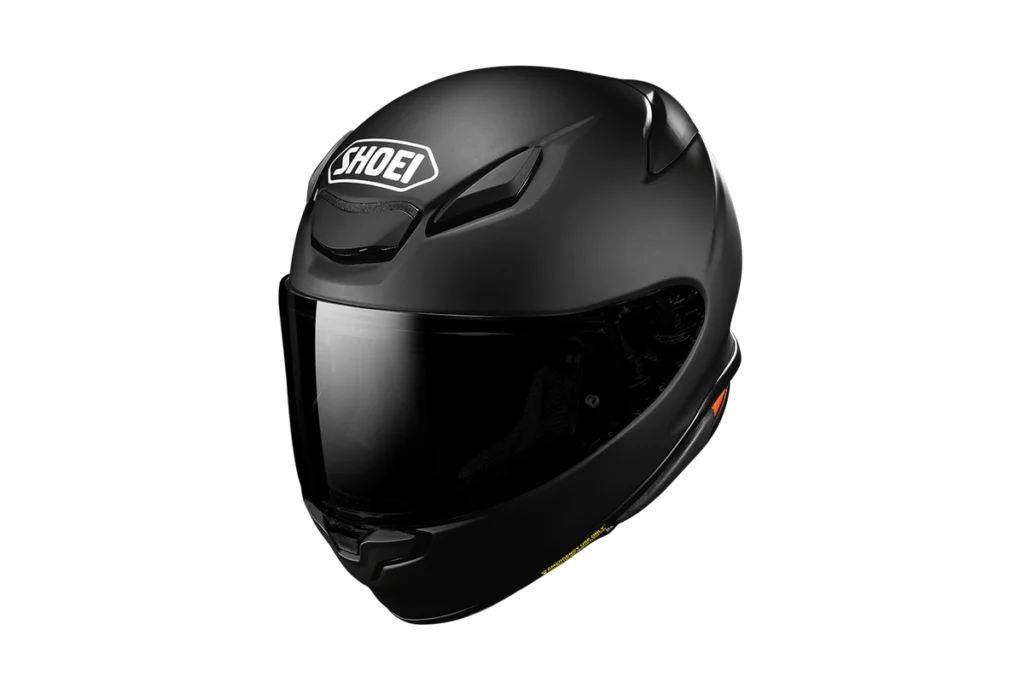
The Shoei NXR2 is a compact premium full-face helmet designed for road, sport and touring use.
It received five stars from SHARP. Shoei lists an approximate weight of 1,390 grams and uses its AIM composite shell construction.
Why it stands out
- Five-star SHARP rating
- Composite shell
- Compact road-focused design
- Approximately 1,390 grams
- Double-D retention
- Emergency cheek-pad release system
- Replaceable interior components
The availability of different interior and cheek-pad thicknesses may also help an authorised dealer refine the fit after the correct shell size has been selected.
Consider before buying
The NXR2 does not include an internal sun visor. Riders who strongly value that feature may prefer the heavier GT-Air 3.
It also sits in the premium price category, so the additional cost should be justified by fit, comfort and features rather than the brand name alone.
Best suited to: Riders wanting a premium, streamlined road helmet without an internal sun visor.
5. Best Full-Face Touring Helmet: Shoei GT-Air 3
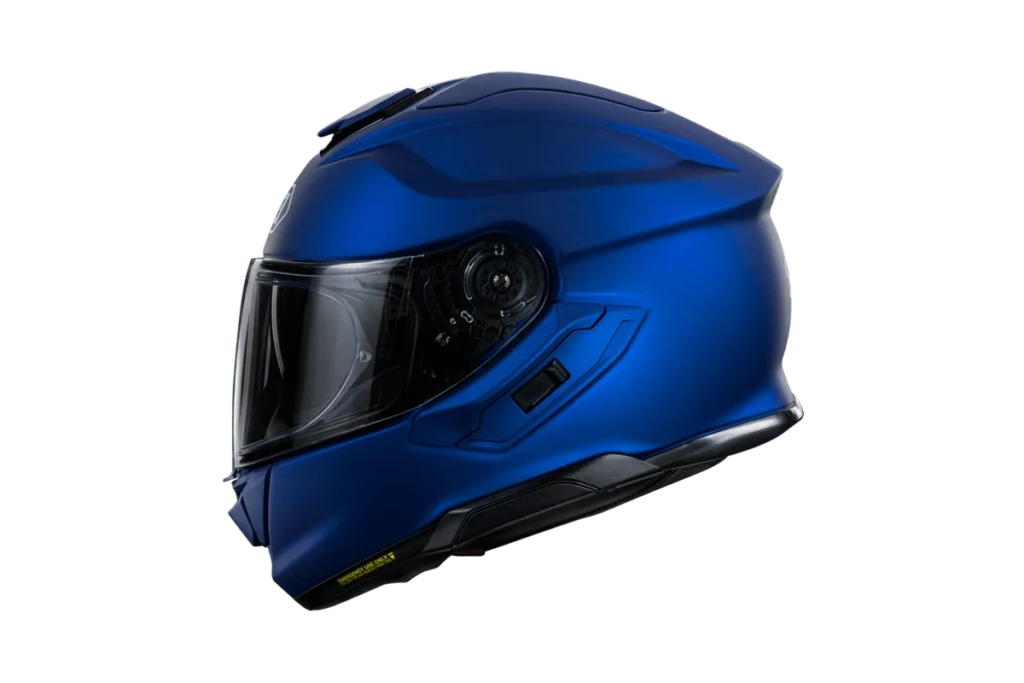
The Shoei GT-Air 3 is intended for riders who want full-face coverage combined with touring-oriented convenience.
It is ECE 22.06 approved and received five stars from SHARP. Shoei lists an approximate weight of 1,700 grams and includes an internal sun visor and preparation for its integrated communication system.
Why it stands out
- Five-star SHARP result
- Touring-focused full-face construction
- Integrated sun visor
- Pinlock-compatible main visor
- Communication-system preparation
- Replaceable interior components
- Micrometric retention system
The internal sun visor can be particularly practical when light conditions change during a long journey.
Consider before buying
The GT-Air 3 is considerably heavier than the AGV K6 S and does not provide the opening chin bar of the Neotec 3.
Integrated communication preparation can also encourage riders to buy a specific compatible system, so include that additional cost when comparing alternatives.
Best suited to: Touring, commuting and road riders who value an internal sun visor and integrated features.
6. Best Modular Helmet: Shoei Neotec 3
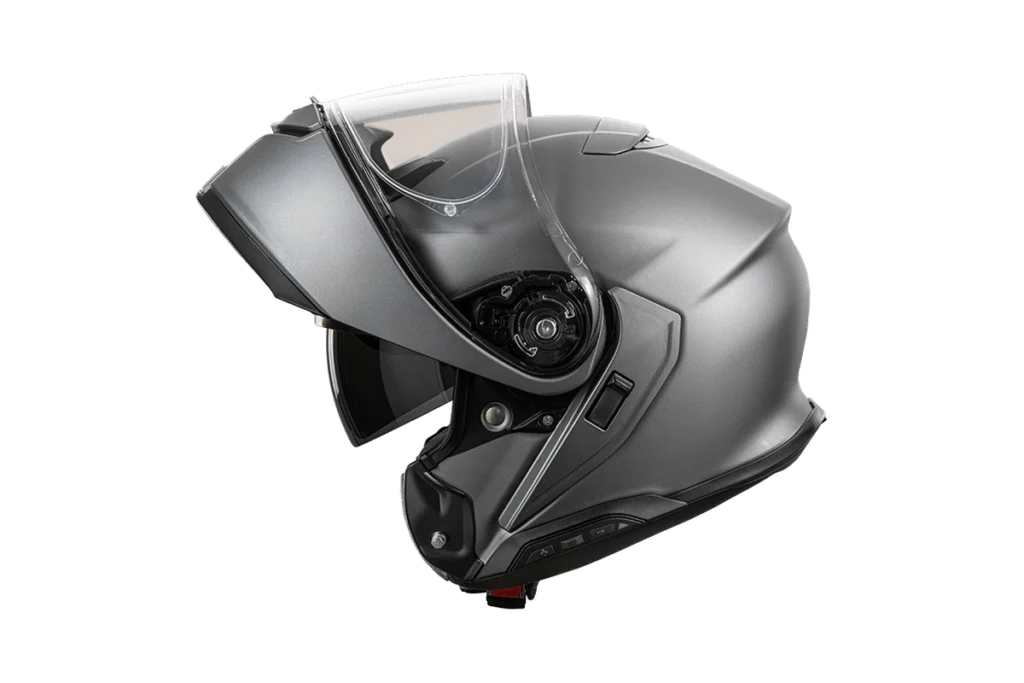
A modular helmet can make fuel stops, communication and touring more convenient, but the chin-bar mechanism adds complexity and weight.
The Shoei Neotec 3 is ECE 22.06 approved with P/J homologation, allowing approved use in both closed and open configurations where local rules permit.
It received five SHARP stars. In SHARP’s impact testing, its chin guard remained fully locked in 93% of the relevant impacts.
Why it stands out
- Five-star SHARP result
- 93% chin-bar locking result
- ECE 22.06 P/J approval
- Integrated sun visor
- Touring-oriented ventilation
- Micrometric closure
- Communication-system preparation
The 93% result is important because SHARP reports the proportion of impacts in which the face guard remained fully locked for modular helmets.
Consider before buying
At approximately 1,700 grams, the Neotec 3 is not a lightweight helmet.
It is also one of the most expensive helmets in this shortlist. Riders who do not regularly use the flip-up function may find a lighter full-face helmet more suitable.
Keep the chin bar closed while riding unless the helmet’s approval and the applicable road rules permit open-face use.
Best suited to: Touring riders who genuinely benefit from a modular design and are comfortable with the additional weight and cost.
7. Best Adventure Helmet: Arai Tour-X5
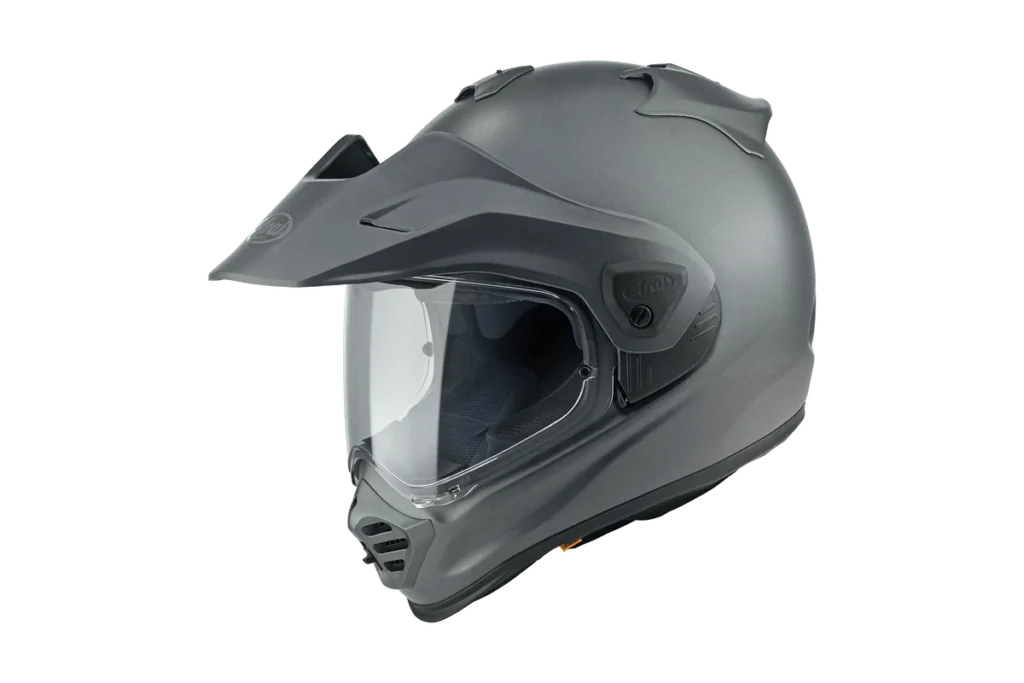
The Arai Tour-X5 is designed for riders who want one helmet that can be configured for adventure, off-road-style or normal road use.
It meets ECE 22.06 and received four stars from SHARP. It uses a composite shell and Double-D retention system.
Why it stands out
- Four-star SHARP result
- Current ECE approval
- Multiple visor-and-peak configurations
- Composite shell
- Double-D closure
- Wide field of view
- Adventure-oriented ventilation
The removable peak and visor allow the helmet to be configured for different types of riding.
Consider before buying
Adventure peaks can create additional wind load at speed, particularly during head checks or strong crosswinds.
The Tour-X5 also sits in the premium price category and will not suit every head shape.
Riders who spend almost all their time on normal roads may be better served by a dedicated road helmet without a peak.
Best suited to: Adventure and mixed-road riders who will genuinely use its multiple configurations.
Full-Face or Modular: Which Is the Safer Choice?
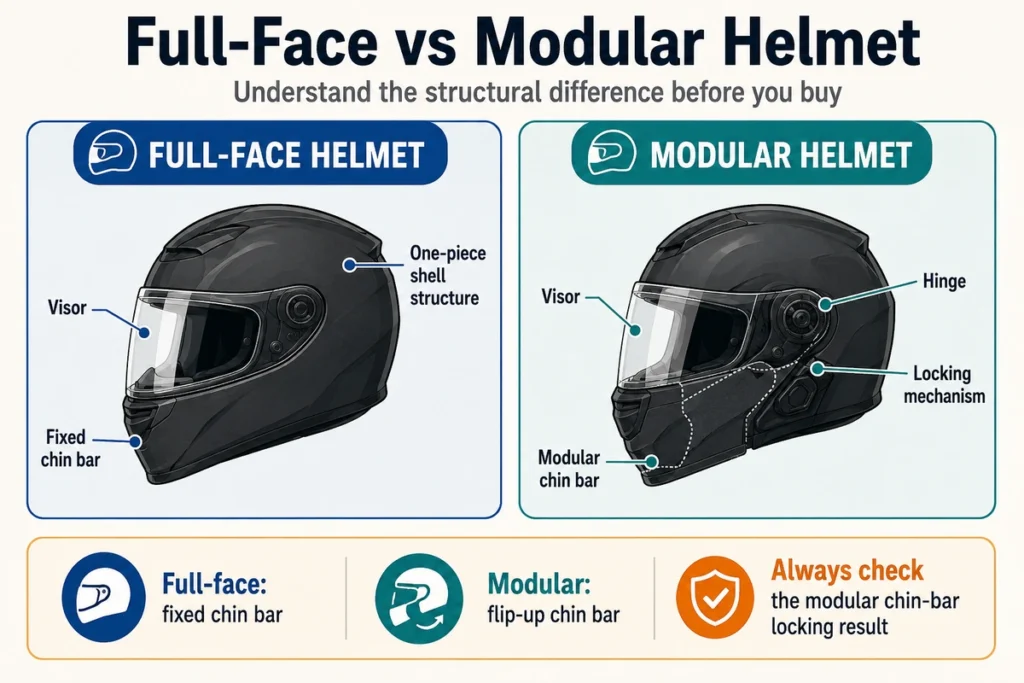
A conventional full-face helmet has no opening chin-bar mechanism.
A modular helmet adds convenience but also introduces hinges and a locking system. This is why SHARP publishes a separate percentage showing how often the face guard remained fully locked during testing.
A modular helmet can still achieve a five-star result, as the Neotec 3 demonstrates. However, riders should check both:
- The overall star rating
- The chin-bar locking percentage
Choose a modular helmet because its convenience meaningfully supports your riding—not simply because opening the front looks useful in a showroom.
For riders prioritising simplicity, low weight and permanent chin coverage, a conventional full-face design remains the clearer choice.
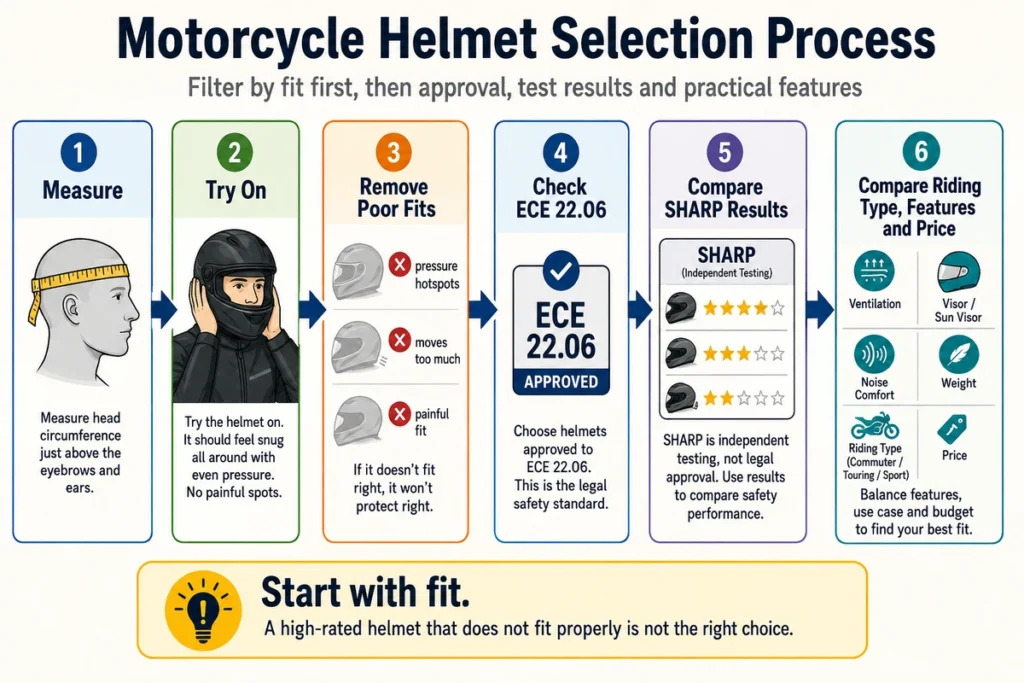
How to Choose Between These Helmets
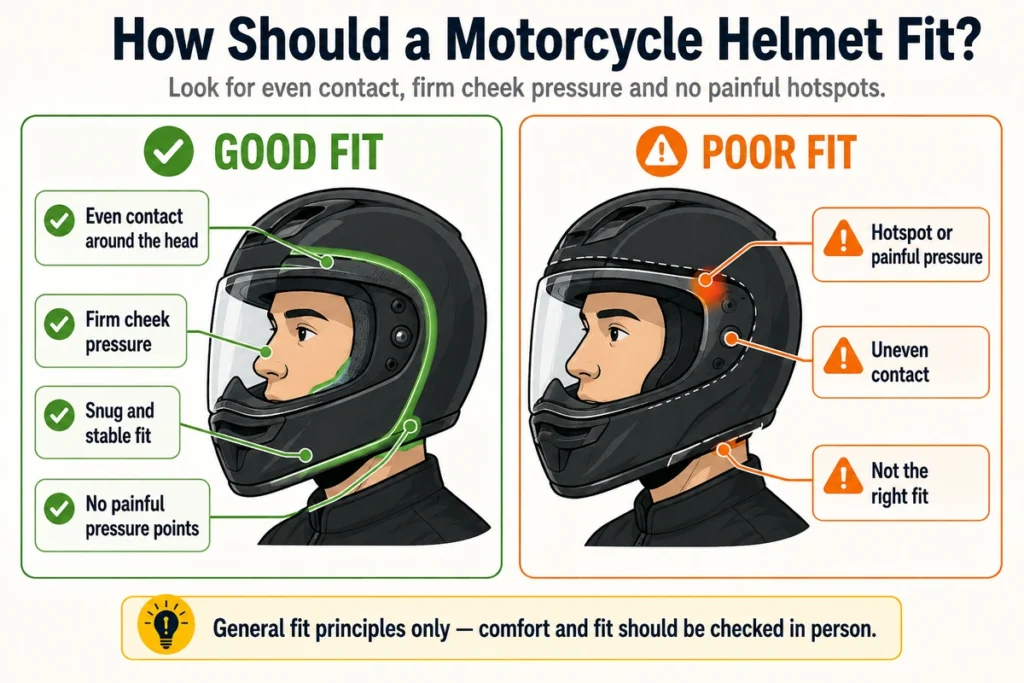
1. Establish your head shape and size
Measure your head and try several models.
The helmet should feel evenly secure without one severe pressure point. It should not rotate independently when you move the shell with the chin strap fastened.
Read How to Choose the Right Motorcycle Helmet Size before ordering.
2. Remove helmets that do not fit
Do this even when the product has excellent reviews or a five-star result.
A safety rating cannot compensate for a loose or painful fit.
3. Check the approval label
For a current European road helmet, look for the relevant ECE 22.06 label.
Read CE Ratings Explained for help understanding motorcycle-equipment labels.
4. Compare independent results
Once several helmets fit correctly, use SHARP to compare tested models.
SHARP itself recommends choosing from the helmets that fit properly and then selecting the strongest available safety performance.
5. Match the features to the journey
Ask whether you actually need:
- An internal sun visor
- A modular chin bar
- Communication-system preparation
- A removable adventure peak
- Very low weight
- Race-focused aerodynamics
Every added feature can affect cost, weight or complexity.
Does a More Expensive Helmet Mean More Safety?
No.
Price can buy lighter materials, quieter aerodynamics, better ventilation, adjustable interior components, premium finishing and integrated features.
It does not guarantee a higher independent impact rating.
SHARP has specifically highlighted that price is not an indicator of performance in its testing. Affordable and premium helmets can both earn five stars.
Spend enough to obtain:
- Correct fit
- Current approval
- A secure retention system
- Practical comfort
- The features you will use
After those needs are met, a higher price may improve refinement rather than measurable impact performance.
Common Mistakes
Motorcycle Helmet Buying Mistakes
| Mistake | Why It Creates a Problem | Better Approach |
|---|---|---|
| Buying only by star rating | The helmet may not fit your head | Establish fit first |
| Ordering your usual size without measuring | Sizes vary between brands and models | Measure and use the model’s chart |
| Assuming expensive means safer | Price includes comfort, materials and branding | Compare approval and independent results |
| Choosing a loose helmet for comfort | The interior will normally settle further with use | Start with a secure, even fit |
| Buying a used helmet | Its impact and storage history may be unknown | Buy new from a trusted seller |
| Prioritising graphics | Colours do not correct poor fit or certification | Choose the helmet first, graphics second |
| Ignoring visor availability | A damaged or worn visor may become difficult to replace | Check replacement-part support |
| Adding an unsuitable camera mount | Accessories can affect aerodynamics or approval conditions | Follow helmet-manufacturer guidance |
| Buying a modular helmet without checking the latch result | The overall rating does not tell the complete modular story | Check the SHARP locking percentage |
| Keeping a helmet after a significant impact | Damage may not be clearly visible | Follow manufacturer replacement guidance |
Final Thoughts: Fit First, Rating Second
There is no single safest motorcycle helmet for every rider.
The HJC C10 offers strong value. The AGV K1 S delivers a five-star result at a relatively accessible price. The K6 S focuses on low weight, while the NXR2 provides a premium sport-road option.
The GT-Air 3 and Neotec 3 add touring convenience, and the Tour-X5 serves riders who genuinely need an adventure configuration.
But none of these recommendations matters when the helmet does not fit.
Start by identifying the models that match your head shape. Check the approval label. Compare independent results and then decide which features support your riding.
Do not buy a logo.
Do not buy a star rating in the wrong size.
Buy the safest suitable helmet that fits correctly and that you will wear properly on every ride.
FAQs
What is the safest motorcycle helmet in 2026?
There is no universal safest model because fit varies between riders. Among current SHARP-tested helmets, models such as the AGV K1 S, AGV K6 S, Shoei NXR2, GT-Air 3 and Neotec 3 have received five stars.
Is a five-star SHARP helmet safer?
Five stars represent the highest performance category in SHARP’s testing. However, the helmet must also fit correctly and meet the relevant approval requirements.
Is ECE 22.06 better than ECE 22.05?
ECE 22.06 is the newer approval and introduces additional impact points, speeds and oblique testing requirements. Current European buyers should prioritise helmets carrying the appropriate 22.06 approval.
Is an expensive motorcycle helmet safer?
Not automatically. Expensive helmets may provide lighter materials, better ventilation and more refined interiors, but price does not guarantee a higher SHARP result.
Are modular motorcycle helmets safe?
A modular helmet can achieve strong test results. Check its ECE approval, overall SHARP rating and the percentage of impacts in which the chin guard remained locked.
Should beginners buy a full-face helmet?
A full-face helmet provides coverage around the chin and face as well as the skull. It is the most straightforward starting category for beginners prioritising road protection.
How should a motorcycle helmet fit?
It should feel firmly and evenly secure without creating severe localised pain. With the strap fastened, the helmet should not rotate freely around your head.
Related Reads
How to Choose the Right Motorcycle Helmet Size
Best Motorcycle Safety Gear for Every Rider
Motorcycle Safety Gear Explained: What Each Piece Actually Does
CE Ratings Explained: Helmets, Jackets, Gloves and Armour
Night Riding Safety: How to Ride a Motorcycle Safely After Dark