Low-speed motorcycle control is one of the most underrated riding skills.
It does not look exciting.
It does not sound impressive.
It does not feel as dramatic as cornering, braking, or riding on open roads.
But every rider needs it.
You need low-speed control when you leave a parking spot.
You need it when turning around on a narrow street.
You need it in slow traffic.
You need it at fuel stations.
You need it on tight roundabouts.
You need it when filtering where legal.
You need it when riding with luggage or a passenger.
You need it when the road gets crowded, narrow, or awkward.
Many beginner riders feel fine once the motorcycle is moving, but tense up when the speed drops. The bike suddenly feels heavy. The handlebars feel awkward. The eyes drop. The clutch hand becomes tense. The feet want to come down early.
That is normal.
Motorcycles become easier to balance as speed increases. At walking pace, the rider has to be more precise with clutch, throttle, rear brake, vision, body position, and calm inputs.
The good news is that low-speed control can be trained.
You do not need natural talent.
You do not need a lightweight bike.
You do not need to be physically strong.
You need patience, space, repetition, and the right technique.
This guide covers practical motorcycle low-speed control tips for beginner riders who want better balance, smoother U-turns, more confidence in traffic, and calmer slow riding.
Build your overall riding foundation with Motorcycle Safety for Beginners: The Complete Guide to Riding Smart
Quick Answer
How Do You Improve Low-Speed Motorcycle Control?
To improve low-speed motorcycle control, keep your eyes up, look where you want to go, use the clutch friction zone, maintain a little steady throttle, control speed with the rear brake, relax your upper body, turn your head fully for tight turns, and practice slowly in a safe empty area.
The key us smooth control. Not strength, not panic, but smooth control.
Why Low-Speed Control Feels Difficult
Low-speed riding feels difficult because the motorcycle has less natural stability.
At higher speeds, the bike feels more stable and responds smoothly to small inputs. At walking speed, balance becomes more obvious. Every small movement matters.
Common beginner problems include:
- Looking down
- Gripping the handlebars too tightly
- Letting the clutch out too quickly
- Chopping the throttle
- Using too much front brake
- Not using the rear brake enough
- Turning the bars while tense
- Forgetting to breathe
- Putting feet down too early
- Trying to hold the bike up with strength
Low-speed control is not about muscling the motorcycle.
The bike may feel heavy, but the solution is not to fight it. The solution is to coordinate your inputs.
Clutch.
Throttle.
Rear brake.
Vision.
Body position.
Relaxation.
When those work together, slow riding becomes calmer.
This is why structured practice helps so much.
Motorcycle Safety Courses: Are They Worth It?
Practice in a Safe Empty Area First
Before practicing low-speed control, choose the right place.
Do not practice tight U-turns for the first time in traffic.
Do not practice emergency-style maneuvers beside parked cars.
Do not practice slow riding where pedestrians, cyclists, or vehicles can surprise you.
Find a safe empty area such as:
- Empty parking lot
- Quiet industrial area
- Training ground
- Wide empty road section where practice is allowed
- Private area with permission
Wear full protective gear.
Start slow. Keep the exercises simple. Do not try to master everything in one session.
The goal is not to exhaust yourself.
The goal is to build control gradually.
Low-speed practice can be mentally tiring because it requires focus. Short, consistent sessions are better than one long frustrating session.
A simple 20-minute practice session can teach you a lot if you stay calm and focused.
Tip 1: Keep Your Eyes Up
This is the first rule of low-speed control:
Keep your eyes up.
When beginner riders feel unstable, they often look down at the front wheel or the ground directly in front of the bike.
That makes balance worse.
Looking down pulls your head down. Your shoulders follow. Your arms become tense. The motorcycle feels heavier. You react late because you are not looking where you want to go.
Instead, keep your eyes up.
Look ahead.
Look through the turn.
Look at the exit.
Look where you want the motorcycle to go.
Your eyes lead your balance.
If you are doing a U-turn, do not stare at the ground in front of your tire. Turn your head and look toward the exit of the turn.
Check out : Motorcycle Vision Techniques
Tip 2: Turn Your Head, Not Just Your Eyes
For tight turns and U-turns, moving only your eyes is usually not enough.
Turn your head.
If you want the bike to turn left, turn your head left. Look over your shoulder toward where you want to end up.
This may feel exaggerated at first, but it works.
Your head position affects your shoulders, arms, body, and steering. When you turn your head properly, your body gives the motorcycle clearer direction.
A common beginner mistake is turning the handlebars but keeping the head and chest pointed forward.
That creates tension.
The motorcycle is trying to turn, but the rider’s body is not fully committed.
For slow turns, use this reminder:
Head first. Bike follows.
Look at the exit before you reach it.
Your motorcycle needs direction before it needs correction.
Tip 3: Use the Clutch Friction Zone
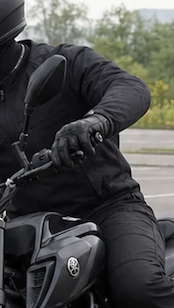
The clutch friction zone is where low-speed control lives.
The friction zone is the point where the clutch starts transferring power from the engine to the rear wheel, but is not fully engaged yet.
At low speeds, you do not want the clutch fully in or fully out all the time. You often need to work within the friction zone to control power smoothly.
Think of the clutch as a fine-control tool.
Too much clutch out too quickly can make the bike lurch.
Too much clutch in can remove drive and make the bike unstable.
A smooth friction zone gives the bike gentle forward pull.
Practice finding the friction zone slowly:
- Start in first gear
- Keep your right hand steady
- Slowly release the clutch
- Feel when the bike begins to pull
- Hold it there
- Pull it slightly in to reduce drive
- Release slightly to increase drive
This is one of the most important beginner motorcycle skills.
The smoother your clutch control, the calmer your slow riding becomes.
Tip 4: Keep a Little Steady Throttle
Many beginner riders chop the throttle at low speed.
They open it.
Then close it.
Then open it again.
Then panic when the bike feels jerky.
At slow speed, a little steady throttle is usually better than constantly rolling on and off.
The clutch controls how much of that power reaches the rear wheel.
This creates smoother movement.
A useful technique is:
Set a little throttle. Control speed with clutch and rear brake.
This does not mean revving aggressively. It means giving the engine enough steady power so the bike does not feel like it is about to stall.
Small, steady throttle.
Smooth clutch.
Gentle rear brake.
That combination gives control.
Jerky throttle creates jerky balance.
Smooth throttle creates calm balance.
Tip 5: Use the Rear Brake for Stability
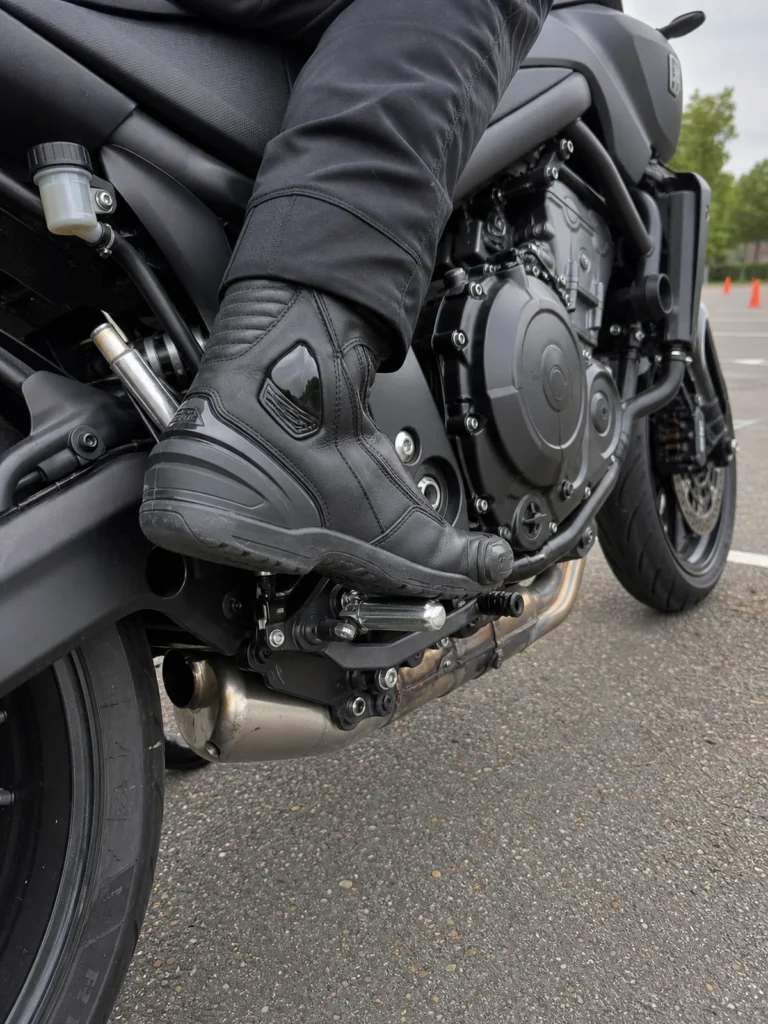
The rear brake is very useful at low speeds.
At walking pace, dragging a little rear brake can help stabilize the motorcycle, especially during slow turns, U-turns, and stop-and-go riding.
The rear brake helps control speed without upsetting the bike as much as grabbing the front brake might.
This is important:
At low speed, avoid sudden front brake use while the handlebars are turned.
A sharp front brake input with the bars turned can make the bike dip or feel unstable.
The rear brake is smoother for slow control.
Think of low-speed control as a three-part balance:
- Throttle gives steady power
- Clutch controls drive
- Rear brake controls speed and stability
This takes practice, but once you feel it, slow riding becomes much easier.
For deeper braking techniques – How to Brake Safely on a Motorcycle: Front vs Rear Explained
Tip 6: Relax Your Grip
When riders feel nervous, they grip the handlebars harder.
That makes the bike feel worse.
A tight grip transfers tension into the motorcycle. Your arms become stiff. Steering becomes less smooth. Small corrections become bigger than needed.
Try to keep your elbows slightly bent and your grip light.
You should control the motorcycle, not strangle it.
A relaxed upper body helps the bike move naturally underneath you.
This matters especially during U-turns and tight maneuvers.
If your arms are locked, the motorcycle cannot turn smoothly. If your shoulders are tense, your head may not turn properly. If your hands are tight, your clutch and throttle inputs become rough.
Use this reminder:
Loose arms. Soft hands. Eyes up.
It sounds simple, but it works.
Tip 7: Use Counterweighting at Very Low Speeds
At normal road speeds, motorcycle body position is different from slow-speed maneuvering.
At very low speeds, especially during tight turns, riders often use counterweighting.
Counterweighting means allowing the motorcycle to lean slightly into the turn while your upper body stays more upright or slightly to the outside.
For example, in a slow left U-turn, the bike may lean left while your body stays more upright.
This helps balance the motorcycle at low speed.
Do not overthink it at first.
Start with the basics:
- Look where you want to go
- Turn your head
- Use clutch control
- Keep a little throttle
- Use rear brake
- Stay relaxed
Counterweighting will start to feel natural as your slow turns improve.
The mistake is trying to lean your whole body dramatically into a slow U-turn like a fast corner. At very low speeds, that can make the bike feel like it wants to fall inward.
Low-speed technique has its own rhythm.
Read : My experience with the MT-07 as an everyday motorcycle
Tip 8: Do Not Rush the U-Turn
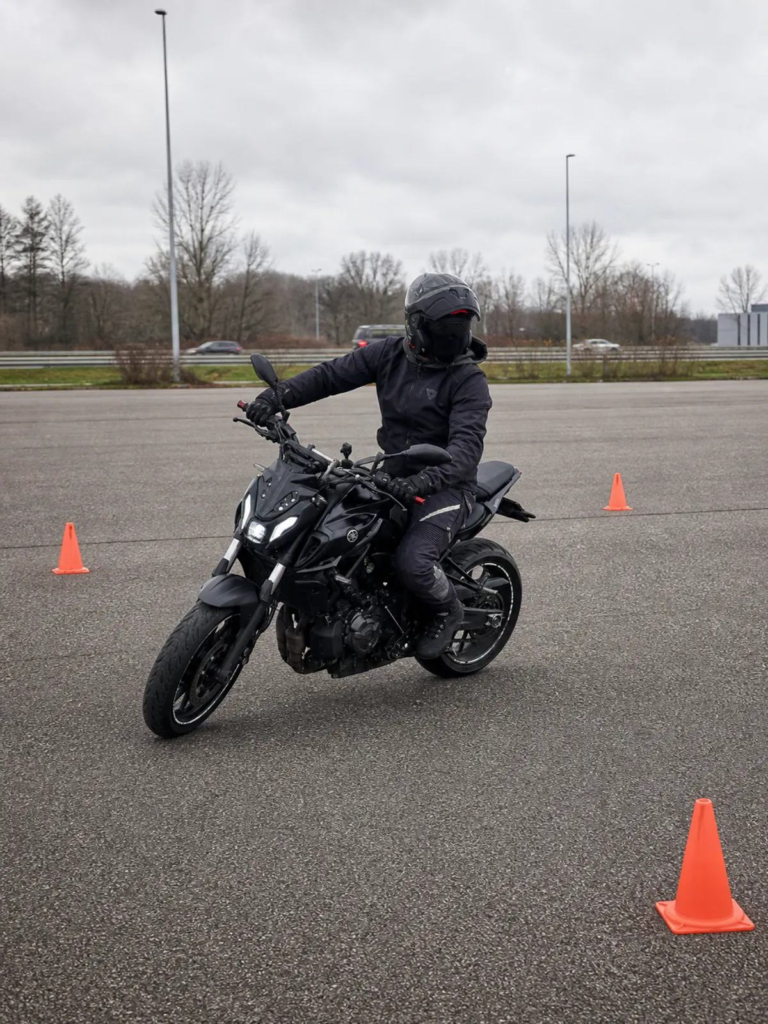
U-turns make many beginner riders nervous.
The space feels small. The bike feels heavy. The handlebars feel awkward. The rider looks down. Then the turn becomes wider than expected.
A good U-turn needs calm setup.
Before the U-turn:
- Slow down early
- Choose enough space
- Check surroundings
- Use first gear
- Set steady throttle
- Find the friction zone
- Cover the rear brake
- Turn your head fully
- Look at the exit
During the U-turn:
- Keep your eyes up
- Turn your head
- Stay relaxed
- Use smooth clutch
- Control speed with rear brake
- Avoid grabbing front brake
- Keep breathing
The most important part is vision.
If you look at the curb, you may ride toward the curb. If you look at the exit, your body has a better chance of guiding the bike there.
Many failed U-turns start with staring at the wrong place.
Read : How to Avoid Target Fixation While Riding
Tip 9: Practice Slow Straight-Line Riding
Before practicing tight turns, practice riding slowly in a straight line.
This builds balance and clutch control without adding turning pressure.
Find an empty area and try to ride as slowly as possible in a straight line while keeping both feet on the pegs.
Use:
- Slight throttle
- Clutch friction zone
- Gentle rear brake
- Eyes up
- Relaxed arms
How to Avoid Target Fixation While Riding
Try not to rush.
The goal is not speed.
The goal is control.
You may wobble at first. That is normal. Small wobbles are part of learning. Do not panic. Keep your eyes up and continue smoothly.
This exercise teaches you how much control you can have at walking pace.
Once slow straight riding feels better, U-turns and figure-eights become easier.
Tip 10: Practice Wide Circles Before Tight Circles
Do not start with the tightest possible U-turn.
Start with wide circles.
Ride a large circle slowly in one direction. Then ride the same circle in the other direction.
Focus on:
- Looking through the circle
- Keeping steady throttle
- Using the friction zone
- Light rear brake
- Relaxed arms
- Smooth balance
Once wide circles feel comfortable, make them slightly smaller.
Do not rush this.
Your confidence grows as the circle becomes smaller over time.
Practice both directions.
Most riders have one side that feels easier. That is normal. Spend extra gentle practice on the weaker side, but do not force it when frustrated.
Low-speed control improves through calm repetition.
Not pressure.
Tip 11: Practice Figure-Eights
Figure-eights are one of the best low-speed motorcycle exercises.
They combine left turns, right turns, vision, clutch control, rear brake, and balance.
Start with large figure-eights.
Do not make the space too tight at first.
Focus on turning your head before each direction change. As you transition from one circle to the other, move your eyes to the next exit.
A good figure-eight should feel smooth, not rushed.
Practice:
- Eyes up
- Head turn
- Smooth clutch
- Slight throttle
- Rear brake
- Relaxed arms
- Controlled direction change
If you feel tense, make the figure-eight bigger.
Bigger is fine.
Clean control matters more than small size.
Over time, your figure-eights will naturally become tighter.
Learn : Beginner Motorcycle Balance Exercises
Tip 12: Learn Smooth Starts and Stops
Low-speed control is not only about turning.
Starts and stops matter too.
A smooth start helps you move away without wobbling, stalling, or rushing.
A smooth stop helps you arrive calmly without dropping your eyes or grabbing the brake.
Practice starts:
- Look ahead
- Find the friction zone
- Add gentle throttle
- Release clutch smoothly
- Keep both feet up once moving
- Stay relaxed
Practice stops:
- Look ahead
- Roll off smoothly
- Brake progressively
- Pull clutch in near the stop
- Put one foot down calmly
- Keep the bike straight
- Avoid looking down
Many riders become unstable at the final moment before stopping because they look down or turn the bars slightly.
Keep the bike straight.
Eyes up until the stop is complete.
Tip 13: Choose Which Foot Goes Down
When stopping, have a plan for your foot placement.
Many riders use the left foot down and right foot on the rear brake, especially when stopping on level ground. This allows the rider to hold the bike with the rear brake while keeping first gear ready.
But real life changes things.
On a slope, uneven surface, gravel, or cambered road, you may choose the foot that gives better support.
The key is not to panic and throw both feet down randomly.
Plan the stop.
Look at the road surface before you arrive.
Check if the ground slopes.
Avoid oil, gravel, or potholes.
Stop with the bars straight.
Put your foot down smoothly.
A calm stop is part of low-speed control.
Not just the moving part.
Tip 14: Do Not Let the Bike Get Too Slow Without Drive
At very low speed, the bike needs some controlled drive to feel stable.
If you pull the clutch fully in and coast too slowly, the bike may feel floppy or unstable.
This is especially common in U-turns.
Riders get scared, pull in the clutch, lose drive, slow too much, and then the bike starts falling inward. Then they put a foot down or grab the brake.
Instead, try to keep a little controlled drive through the turn.
Use the friction zone.
Use rear brake if needed.
Do not remove all power unless you are actually stopping.
A motorcycle often feels more stable with gentle drive than with no drive at all.
This is one of the biggest low-speed lessons.
Tip 15: Avoid Front Brake Panic at Full Lock
The front brake is powerful and important, but at very low speeds with the handlebars turned, sudden front brake use can upset the bike.
This does not mean “never use the front brake at low speed.”
It means be careful with abrupt front brake input during tight turns.
For slow maneuvers, the rear brake is usually smoother for speed control.
If you are practicing U-turns and feel the bike falling inward, grabbing the front brake may make things worse.
Instead:
- Keep your eyes up
- Add a little drive if needed
- Use rear brake gently
- Stay relaxed
- Finish the turn smoothly
This takes practice.
The goal is not to fear the front brake.
The goal is to use the right brake at the right time.
Tip 16: Use Your Body Calmly, Not Dramatically
Beginner riders sometimes overcorrect with body movement.
They feel the bike lean and suddenly throw their body around. That can make the motorcycle feel less stable.
At low speed, your body should be calm and intentional.
Use gentle counterweighting when needed, but avoid dramatic movement.
Keep your upper body relaxed. Keep your head turned. Let the bike lean slightly underneath you when appropriate.
Your body should support the maneuver, not fight it.
If you feel like you are wrestling the bike, simplify the exercise.
Make the turn wider. Slow your breathing. Reset your clutch and throttle. Try again.
Low-speed riding should become smoother over time.
Not more aggressive.
Tip 17: Practice With Cones or Simple Markers
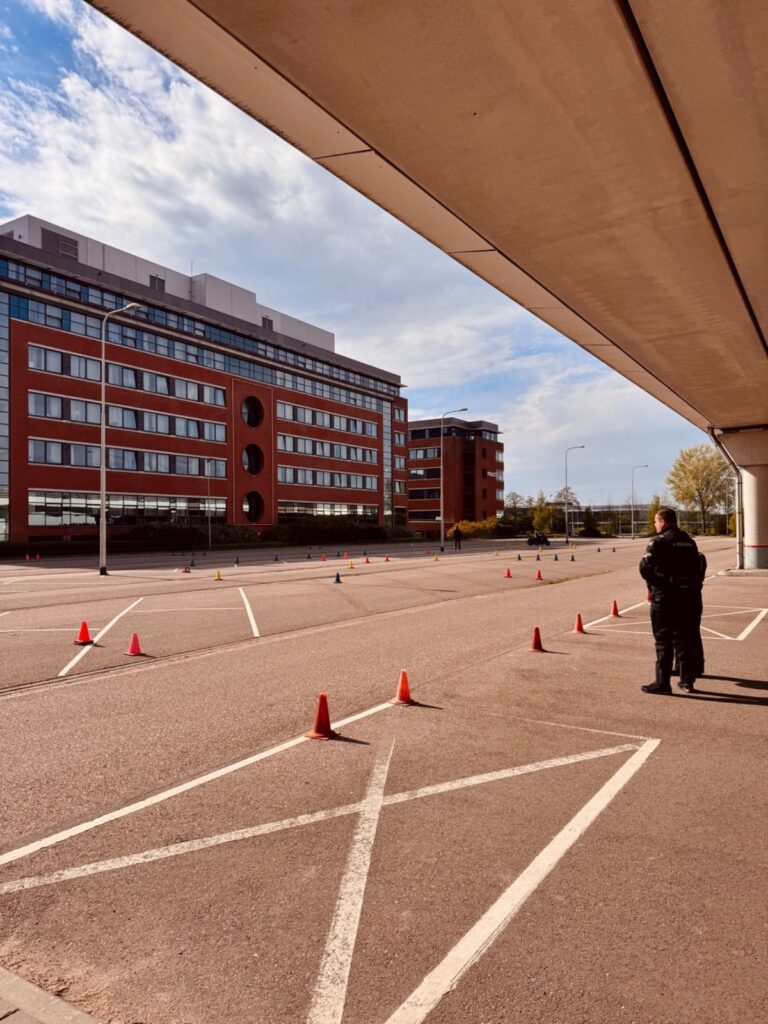
You do not need fancy equipment to practice.
You can use small cones, water bottles, chalk marks, or safe visual markers.
Set up simple exercises:
- Straight slow ride
- Wide circle
- Smaller circle
- Figure-eight
- Stop box
- U-turn box
- Weaving between markers
Start with generous spacing.
Tight exercises are not the goal at first.
Good technique is the goal.
As your control improves, you can reduce the space gradually.
Do not measure progress only by how tight your turn is.
Measure progress by how calm you feel.
Can you keep your eyes up?
Can you avoid panic?
Can you control the clutch smoothly?
Can you use the rear brake gently?
Can you finish the maneuver without rushing?
That is real improvement.
Tip 18: Practice on Both Sides
Most riders have a stronger turning side.
Maybe left turns feel easier. Maybe right turns feel easier.
That is normal.
But you should practice both.
In real riding, you do not get to choose only your comfortable side. You may need to turn around in a narrow street, enter a tight parking space, handle a roundabout, or move through slow traffic in either direction.
Practice wide circles and figure-eights in both directions.
When one side feels weaker, slow down the exercise and give yourself more space.
Do not attack the weak side with frustration.
Train it calmly.
Smooth repetition builds confidence.
Tip 19: Do Not Practice When You Are Mentally Fried
Low-speed practice requires concentration.
If you are tired, angry, rushed, hungry, or mentally overloaded, your technique will suffer.
You may grip harder.
You may rush.
You may get frustrated.
You may make sloppy inputs.
You may stop learning.
Practice when your mind is fresh enough to focus.
For you, this could even become a short weekend skill session rather than squeezing it into a tired evening.
Keep the session small:
20 minutes.
One skill.
No ego.
Stop while you still feel in control.That is sustainable progress.
Slow is smooth. Smooth is fast.
Tip 20: Take a Course If You Keep Struggling
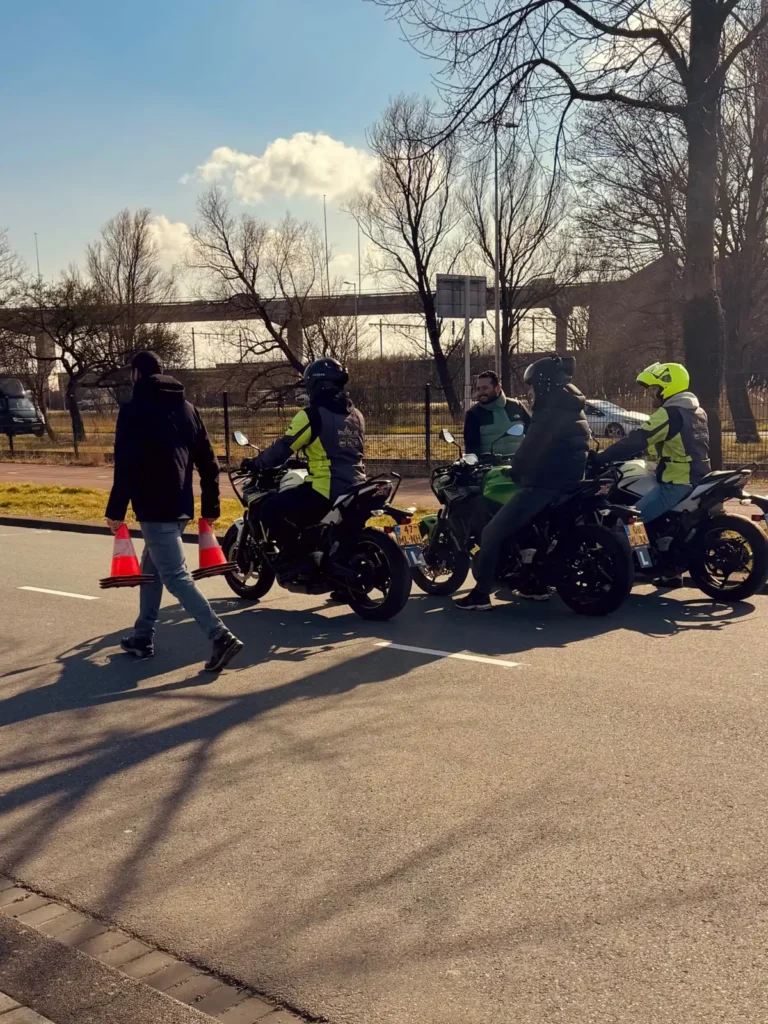
Some skills are easier with an instructor watching.
If low-speed control keeps feeling scary, a course or coaching session can help quickly.
An instructor can see things you may not notice:
- Eyes dropping
- Arms locking
- Clutch released too quickly
- Too little throttle
- Wrong brake use
- Body position problems
- Looking at the wrong place
- Turning too late
- Fear taking over
Sometimes one correction changes everything.
There is no shame in getting help.
Actually, low-speed control is one of the smartest reasons to take training because it improves everyday riding confidence.
If you are confused about taking training – Are Motorcycle Courses Worth Your Time?
Low-Speed Control in Traffic
Low-speed control is not just for parking lots.
It matters in real traffic.
Read : How I use those skills on an MT-07 in city riding
In heavy traffic, you may need to crawl forward slowly, balance between stops, turn tightly around obstacles, manage clutch and throttle smoothly, and stay calm while cars, cyclists, and scooters move around you.
Good low-speed control helps you:
- Avoid stalling
- Reduce wobbling
- Move smoothly in traffic
- Stop without panic
- Start without rushing
- Keep better balance
- Stay calm in narrow gaps
- Avoid putting feet down constantly
- React better in slow urban situations
This is especially useful in busy cities where traffic does not flow smoothly.
Riding in Heavy Traffic: Safety Tips for Urban Motorcyclists
Low-Speed Control and Lane Positioning
Lane positioning matters even at low speed.
In slow traffic or narrow streets, you still need to think about:
- Door zones
- Cyclists
- Pedestrians
- Road surface
- Tram tracks
- Painted lines
- Oil patches
- Escape routes
- Blind spots
- Large vehicles
Do not become so focused on clutch control that you forget the road around you.
Low-speed control is physical and mental.
You are balancing the bike while still reading the environment.
Learn : How to Choose the Safest Road Position
Low-Speed Control in Group Rides
Low-speed control also matters during group rides.
Group rides often involve slow starts, fuel stops, parking areas, regrouping, traffic lights, and tight turning spaces.
If your low-speed control is weak, group rides can feel stressful because you may feel watched or pressured.
The solution is not to rush.
Ride your own ride. Give yourself space. Avoid following too closely. Do not copy another rider’s tight turn if you are not comfortable.
In group situations:
- Keep enough space
- Avoid sudden stops
- Signal clearly
- Do not crowd other riders
- Turn at your own comfort level
- Put a foot down if needed
- Stay calm in parking areas
Group Riding Etiquette: How to Stay Safe and Ride in Formation
Common Mistakes
Mistake 1: Looking Down
Looking down makes the bike feel heavier and reduces balance.
Better habit: keep your eyes up and look where you want to go.
Mistake 2: Releasing the Clutch Too Quickly
This can make the bike lurch or stall.
Better habit: work smoothly in the friction zone.
Mistake 3: Chopping the Throttle
On-off throttle creates jerky balance.
Better habit: use a little steady throttle and control speed with clutch and rear brake.
Mistake 4: Grabbing the Front Brake in Tight Turns
Sudden front brake use with turned handlebars can upset the bike.
Better habit: use gentle rear brake for slow-speed control.
Mistake 5: Holding the Bars Too Tight
Tension makes steering rough.
Better habit: relax your grip and keep elbows slightly bent.
Mistake 6: Trying to Force the Bike With Strength
Motorcycles respond better to technique than muscle.
Better habit: coordinate clutch, throttle, rear brake, vision, and body position.
Mistake 7: Practicing Too Tight Too Soon
This creates frustration and fear.
Better habit: start wide, then gradually reduce space.
Mistake 8: Not Practicing Both Directions
One side often becomes weaker.
Better habit: practice left and right turns equally.
Mistake 9: Practicing When Tired
Tired practice can become sloppy.
Better habit: use short focused sessions when mentally fresh.
Mistake 10: Avoiding Practice Completely
Low-speed control does not improve by avoiding it.
Better habit: practice small and often.
Beginner Low-Speed Practice Routine
Here is a simple routine you can use in a safe empty area.
Warm-Up: 5 Minutes
Ride slowly in a straight line.
Focus on:
- Eyes up
- Smooth clutch
- Gentle throttle
- Rear brake feel
- Relaxed arms
Exercise 1: Smooth Starts and Stops
Practice starting and stopping calmly.
Focus on:
- Friction zone
- Progressive braking
- Straight handlebars at the stop
- One foot down calmly
- Looking ahead
Exercise 2: Wide Circles
Ride wide circles left and right.
Focus on:
- Head turn
- Eyes through the circle
- Steady throttle
- Light rear brake
- Smooth clutch
Exercise 3: Large Figure-Eights
Practice large figure-eights.
Focus on:
- Turning your head early
- Smooth direction change
- No rushing
- Calm breathing
Exercise 4: Controlled U-Turns
Practice U-turns with plenty of space.
Focus on:
- Setup
- Head turn
- Friction zone
- Rear brake
- Looking at the exit
Cool Down: 3 Minutes
Ride slowly and smoothly without pressure.
End the session before you become frustrated.
This routine is enough.
Do not overload yourself.
Small, calm practice wins.
Low-Speed Control Checklist
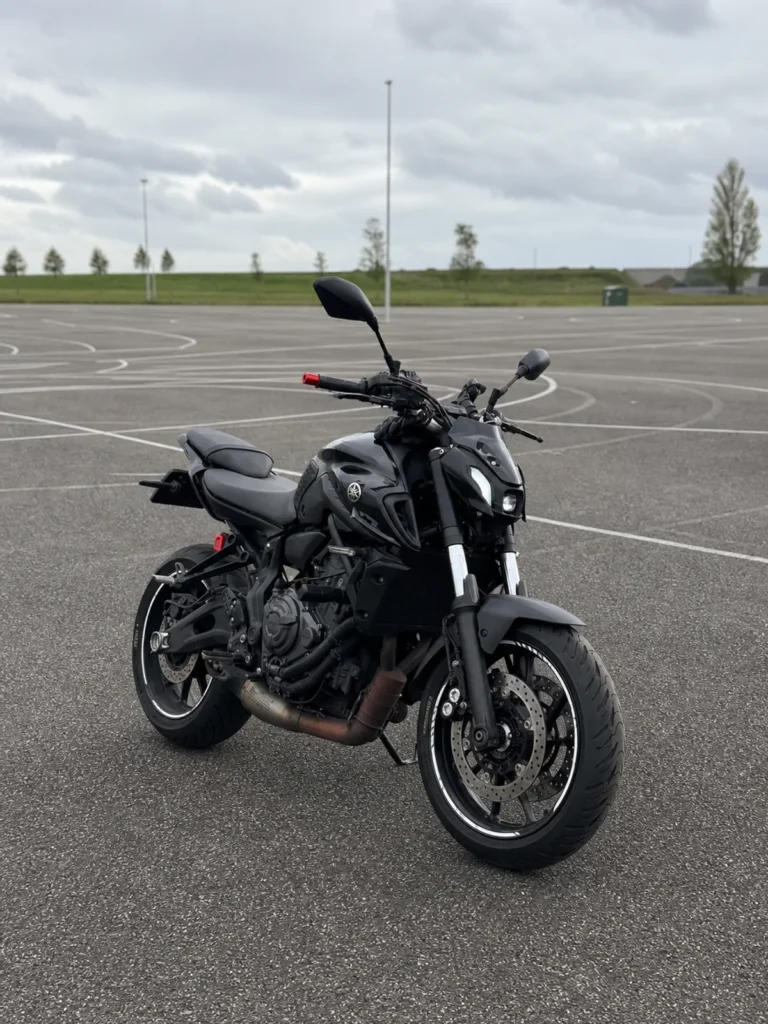
Before and during practice, ask:
- Am I practicing in a safe area?
- Am I wearing proper gear?
- Are my eyes up?
- Am I looking where I want to go?
- Am I turning my head fully?
- Am I using the clutch friction zone?
- Am I keeping a little steady throttle?
- Am I using the rear brake gently?
- Are my arms relaxed?
- Am I breathing?
- Am I starting with enough space?
- Am I practicing both sides?
- Am I stopping before frustration takes over?
This checklist is not complicated.
But if you follow it consistently, your slow riding will improve.
Final Thoughts: Slow Control Builds Real Confidence
Low-speed control is not glamorous, but it changes how you feel on a motorcycle.
When you can ride slowly with control, the bike feels less intimidating. Traffic feels less stressful. Parking lots feel easier. U-turns feel less scary. Tight streets feel manageable. Fuel stops feel calmer. Group rides feel less pressured.
That confidence matters.
Not loud confidence.
Quiet confidence.
The kind that says:
“I can control the bike.”
“I do not need to rush.”
“I know how to reset.”
“I can turn my head and guide the motorcycle.”
“I can use clutch, throttle, and rear brake smoothly.”
“I can practice this until it feels natural.”
Low-speed control teaches patience.
And patience is one of the best riding skills you can build.
So find a safe place. Keep it simple. Practice for a short time. Focus on one skill. Stop before you get frustrated.
Do that consistently, and your riding will change.
Ride smart. Stay smooth. Come home safe.
FAQs
How do I improve low-speed motorcycle control?
Improve low-speed motorcycle control by practicing in a safe empty area, keeping your eyes up, using the clutch friction zone, maintaining a little steady throttle, controlling speed with the rear brake, relaxing your arms, and turning your head toward where you want to go.
Why is my motorcycle hard to balance at low speed?
Motorcycles feel harder to balance at low speed because they have less natural stability. Balance depends more on clutch control, throttle, rear brake, vision, body position, and smooth inputs.
Should I use the front brake during low-speed turns?
Be careful with sudden front brake use during tight low-speed turns, especially when the handlebars are turned. For slow maneuvers, gentle rear brake control is usually smoother and more stable.
What is the clutch friction zone?
The clutch friction zone is the point where the clutch begins transferring power to the rear wheel but is not fully engaged. It helps riders control the motorcycle smoothly at low speeds.
How do I practice motorcycle U-turns?
Practice U-turns in a safe empty area. Start wide, keep your eyes up, turn your head toward the exit, use the clutch friction zone, keep slight throttle, control speed with the rear brake, and stay relaxed.
Why do I keep looking down during slow riding?
Looking down is a natural reaction when you feel unstable, but it makes balance worse. Train yourself to look ahead and toward your exit because the motorcycle follows your vision.
Is low-speed motorcycle control important for city riding?
Yes. Low-speed control is very important for city riding because traffic, junctions, tight streets, parking, cyclists, scooters, and stop-and-go movement all require smooth slow control.
Related Reads
Motorcycle Safety for Beginners: The Complete Guide to Riding Smart
Motorcycle Safety Courses: Are They Worth It?
How to Brake Safely on a Motorcycle: Front vs Rear Explained
Motorcycle Vision Techniques: How to Look Through the Corner Correctly
Riding in Heavy Traffic: Safety Tips for Urban Motorcyclists