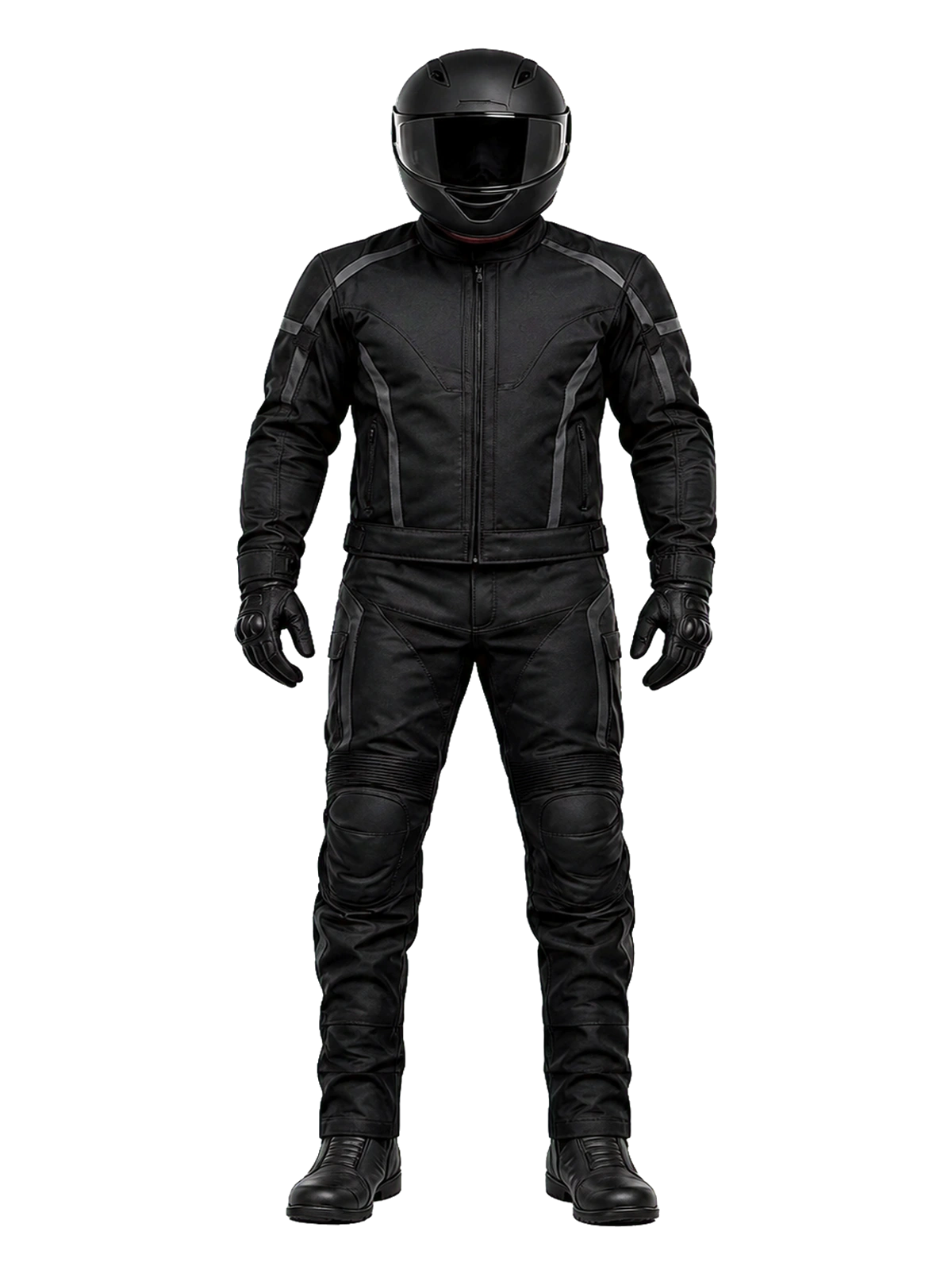
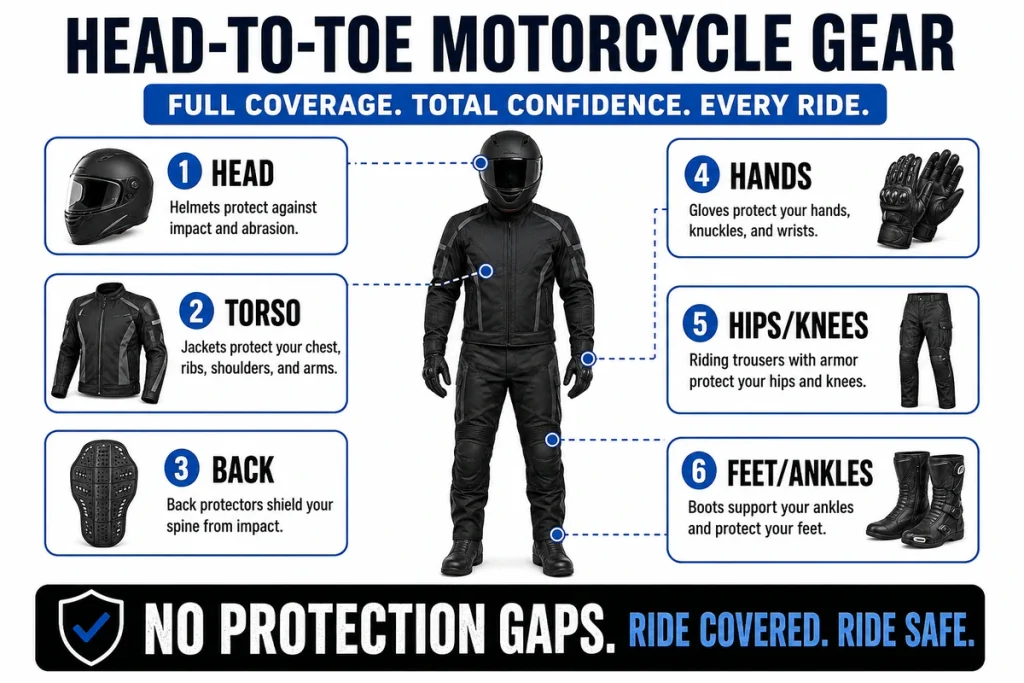
Buying motorcycle gear becomes much easier when you stop thinking in brands and start checking your body from head to toe.
Helmet.
Torso.
Back.
Hands.
Hips and knees.
Feet and ankles.
If one of those areas is still covered only by ordinary clothing, your gear setup is not complete yet.
That does not mean every new rider needs premium racing equipment, an airbag vest and four different jackets before leaving the driveway.
It means your first goal should be complete motorcycle-specific coverage, followed by upgrades as your riding, budget and weather demands develop.
This motorcycle safety gear checklist gives you a practical way to check that setup.
For riders in the Netherlands, an approved helmet with an E-mark is legally required when riding a motorcycle. The rest of this checklist goes beyond that legal minimum and focuses on sensible protective equipment for real-world riding.
Quick Answer
Quick Motorcycle Safety Gear Checklist
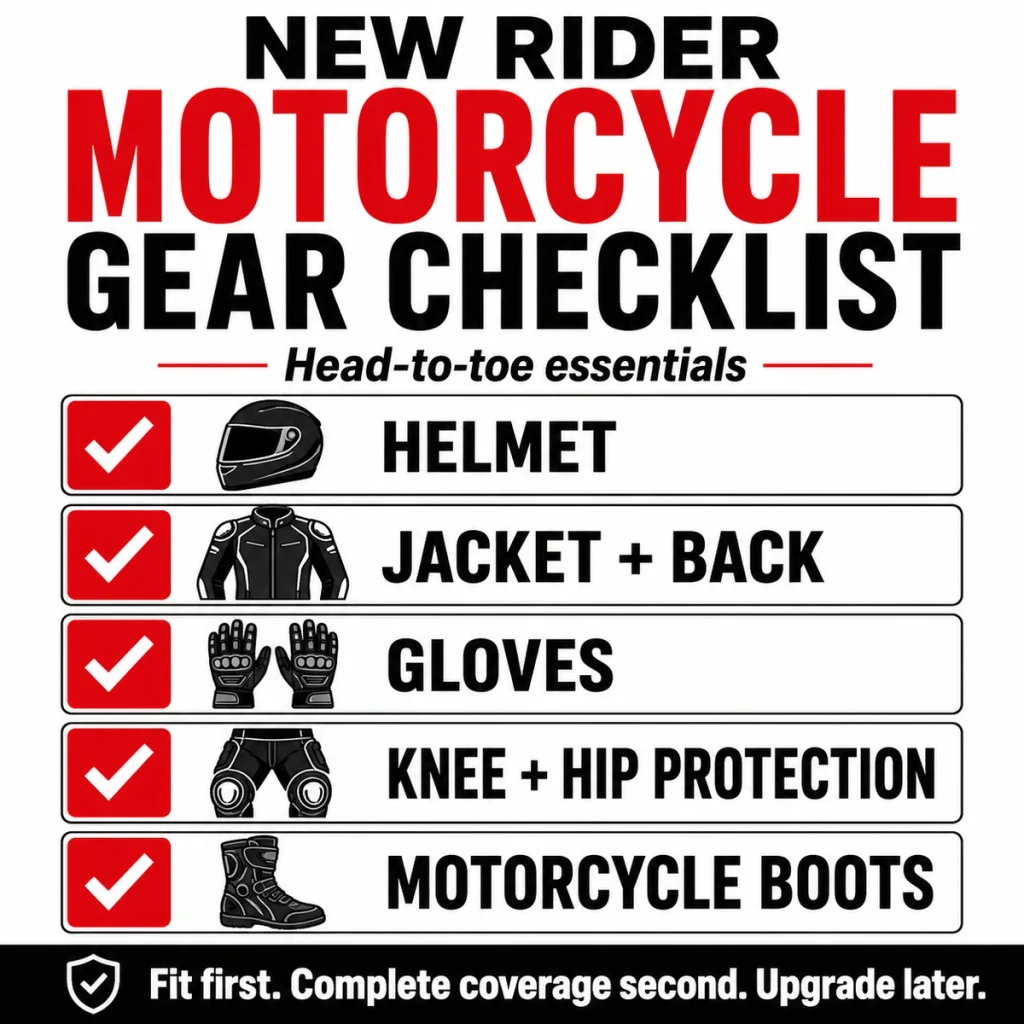
Before considering your core setup complete, check that you have:
- A correctly fitted approved motorcycle helmet
- A CE-certified motorcycle jacket
- Shoulder and elbow armour
- Proper back protection
- CE-certified motorcycle gloves
- CE-certified motorcycle trousers or riding jeans
- Knee protection
- Hip protection
- Certified motorcycle boots covering the ankles
Useful later upgrades can include:
- Airbag protection
- Hearing protection
- Dedicated waterproof layers
- Winter gloves
- Summer-specific gear
- Additional chest protection
- Reflective or high-visibility elements
The important distinction is:
Core protection first. Specialised upgrades second.
1. Helmet: Start With Fit
Your helmet is the first item I would choose—but not simply because it has the highest price or the most impressive graphics.
Start with fit.
SHARP recommends trying several helmets, finding the models that fit correctly and feel comfortable, and only then using independent safety ratings to help choose between the suitable options.
Helmet checklist
- Approved road-motorcycle helmet
- Correct head circumference
- Even pressure around the head
- No severe pressure points
- Cheek pads hold the face securely
- Helmet does not rotate loosely
- Chin strap adjusts securely
- Visor gives a clear field of vision
- Ventilation works for your riding
- Replacement visor and parts are available
For a new helmet, I would prioritise a current ECE 22.06 model. SHARP notes that 22.06 represents the newer approval requirements compared with 22.05.
Do not buy the wrong size because a helmet is discounted.
A correctly fitted lower-priced helmet can be a much better purchase than an expensive model that moves around your head.
Read How to Choose the Right Motorcycle Helmet Size before ordering.
If you are already comparing specific models, continue with Choosing a Safe Motorcycle Helmet
2. Jacket: Check the Garment and the Armour Separately
Do not stop at the word motorcycle jacket.
Look at the actual certification.
The current EU harmonised standards include EN 17092 classifications for motorcycle garments, including AAA, AA and A. They also continue to recognise motorcycle-specific standards for gloves and footwear.
Jacket checklist
- EN 17092 garment classification
- Shoulder armour included
- Elbow armour included
- Back protector included or compatible
- Armour remains centred in riding position
- Sleeves remain long enough with arms extended
- Secure wrist closures
- Secure waist adjustment
- Adequate abrasion-resistant coverage
- Jacket-to-trouser connection where practical
- Suitable ventilation for your climate
- Waterproof strategy if you ride regularly in rain
A common mistake is assuming the jacket’s AAA or AA rating tells you everything about the armour.
It does not.
The garment classification and impact protectors are different parts of the protection system.
That is why a jacket can carry a strong garment class while still being sold with an empty back-protector pocket.
Read CE Ratings Explained before comparing those labels.
For specific options, see Which Motorcycle Jackets Offer the Best Protection?.
3. Back Protection: Check What Is Actually Inside the Jacket
Turn the jacket around and check the back.
Is there a real protector?
Or only foam?
Or an empty pocket?
Back protectors are assessed separately from the garment itself. EN 1621-2 is the relevant motorcycle back-protector standard.
Back-protection checklist
- Actual motorcycle back protector fitted
- Correct size for the jacket
- Correct orientation
- Securely positioned
- Does not create painful pressure
- Does not distort the jacket fit
- Level clearly identified
Do not insert a random protector because it happens to fit inside the pocket.
Use the size and shape specified for the jacket.
For a new rider building a limited-budget setup, I would rather add the correct back protector to an affordable certified jacket than spend that money on cosmetic accessories.
4. Gloves: Make Sure They Stay On
Hands are easy to underestimate because almost any glove feels more protective than bare skin.
That does not make it motorcycle PPE.
The EU’s current harmonised-standards list includes EN 13594:2015 for motorcycle gloves.
Motorcycle-glove checklist
- EN 13594 certification
- Secure wrist retention
- Appropriate knuckle protection
- Reinforced palm
- Correct finger length
- No excess material folding under the palm
- Full clutch movement
- Full brake movement
- Secure overlap with jacket sleeve
- Suitable ventilation or waterproofing
The wrist closure is particularly important.
A glove cannot provide its intended protection if it slides off during a fall.
If you are comparing summer, waterproof, sport or touring options, see Motorcycle Gloves for Protection: Top Options and Buying Advice.
5. Riding Trousers: Ordinary Jeans Are Not the Checklist
This is one of the easiest gaps in a beginner setup.
Helmet: motorcycle-specific.
Jacket: motorcycle-specific.
Gloves: motorcycle-specific.
Legs: ordinary jeans.
Protective motorcycle trousers are assessed as complete garments under the same EN 17092 system used for jackets. Current harmonised standards include AAA, AA and A classes.
Riding-trouser checklist
- Motorcycle-specific garment
- EN 17092 class identified
- Knee armour included
- Hip armour included
- Knee protectors sit correctly while seated
- Hip protectors remain centred
- Secure waist
- Correct inseam
- Proper overlap with boots
- Jacket connection where appropriate
- Suitable weather protection
Do not judge knee-armour position while standing only.
Sit on the motorcycle.
Your knees bend, the trouser leg moves and the protector may shift into—or away from—the correct location.
Motorcycle riding jeans and trousers guide explains AAA, AA, armour levels and different construction styles in more detail.
6. Boots: Protect More Than the Sole of Your Foot
Ordinary trainers are another common weak point.
Motorcycle footwear should remain securely attached and provide motorcycle-specific protection around the foot and ankle.
EN 13634:2017 is the current harmonised standard for motorcycle protective footwear in the EU list.
Motorcycle-boot checklist
- EN 13634 certification
- Secure ankle coverage
- Heel reinforcement
- Toe reinforcement
- Boot cannot easily pull off
- Sole gives good peg grip
- Gear lever can be operated normally
- Rear brake can be operated normally
- Secure closure
- Laces cannot catch on controls
- Proper overlap with riding trousers
More structure is not automatically better if the boot prevents you from controlling the motorcycle properly.
Fit both boots and test the controls.
For more detail, see Motorcycle Boots for Road and Touring: What to Look For.
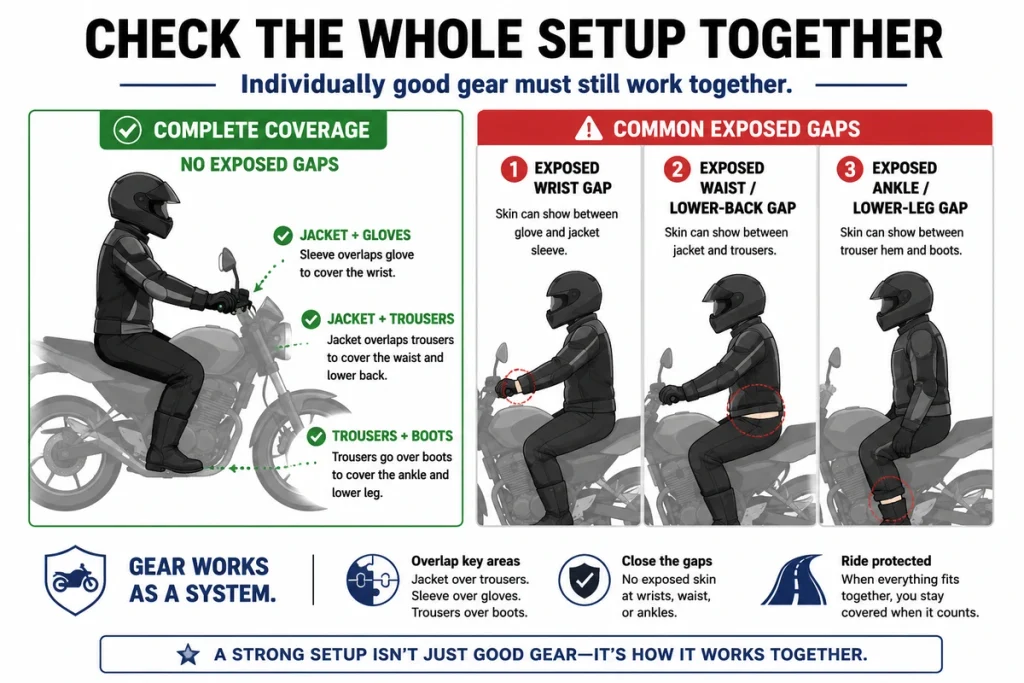
7. Check the Whole Setup Together
Do not evaluate every item in isolation.
Put everything on at the same time.
Then sit on the motorcycle.
Check:
- Does the jacket overlap the trousers?
- Do the gloves overlap the sleeves?
- Do the trousers overlap the boots?
- Does anything expose skin when you lean forward?
- Does armour move when your body position changes?
- Can you turn your head freely?
- Can you reach every control?
- Can you move your ankles?
- Does anything become painfully tight?
- Does anything catch on the motorcycle?
A jacket and trousers can each fit individually but work badly together.
The same is true of gloves and sleeves, trousers and boots, or a helmet and jacket collar.
Think in terms of a system, not six separate purchases.
8. Match the Gear to Your Real Riding
Once the core protection is covered, adapt it to your normal environment.
Mostly urban riding
Prioritise:
- Easy movement
- Ventilation
- Gear that is easy to put on
- Comfortable boots for walking
- Clear visor
- Weather layer you can carry easily
Touring
Add:
- Better weather protection
- Hearing protection
- All-day helmet comfort
- Additional storage
- Waterproof boots and gloves
- Layering flexibility
Summer riding
Prioritise:
- Ventilated certified jacket
- Ventilated trousers
- Breathable gloves
- Helmet airflow
Do not respond to heat by removing protective equipment.
Change the equipment.
Cold and wet riding
Prioritise:
- Waterproof outer layers
- Warm gloves
- Waterproof boots
- Dry base layers
- Anti-fog visor strategy
Read Wet Weather Motorcycle Riding Tips when preparing for regular rain.
9. What Can Wait Until Later?
Not every useful item belongs in the first shopping basket.
Once the core setup is complete, consider:
Airbag protection
A motorcycle airbag can add another layer of upper-body protection.
It should normally come after you already have the basic helmet, jacket, trousers, gloves and boots covered.
See Motorcycle Airbag Vests & Jackets when you reach that stage.
Hearing protection
Wind noise can become tiring and harmful during sustained riding.
Earplugs are inexpensive and especially useful for motorway and touring rides.
Secondary weather gear
Your first setup does not need to solve every temperature from 35°C summer traffic to freezing winter rain.
Build for your main riding season first.
Upgrade later.
10. What If Your Budget Is Limited?
Then prioritise complete coverage.
Do not spend €400 on a helmet and discover you have only €100 left for your entire body.
Look for:
- Previous-season colours
- Outlet stock
- End-of-line models
- Reputable retailer discounts
- Less expensive certified brands
- Gear with included armour
Save on:
- Graphics
- Brand prestige
- Premium finishes
- Integrated electronics
before you save on:
- Proper fit
- Certification
- Back protection
- Hip protection
- Motorcycle boots
- Motorcycle gloves
If €500 is roughly your starting budget, see Beginner Motorcycle Gear Under €500 for an example of how I would divide the money.
Common Mistakes
Common Beginner Gear Checklist Mistakes
| Mistake | Why It Matters | Better Approach |
|---|---|---|
| Buying by brand first | Brand does not guarantee correct fit | Start with fit and certification |
| Spending most of the budget on the helmet | Leaves large protection gaps | Build complete coverage |
| Wearing ordinary jeans | Lower-body protection remains weak | Buy certified riding trousers |
| Using trainers | Limited motorcycle-specific foot/ankle protection | Choose certified motorcycle footwear |
| Forgetting the back protector | Many jackets contain only a pocket | Check what is actually installed |
| Ignoring hip armour | Some trousers sell it separately | Include it in the complete price |
| Buying oversized gear | Armour may move away from joints | Check fit in riding position |
| Buying very tight gear | Can restrict movement and controls | Look for secure, usable fit |
| Building only for looks | Gear may not work in your climate | Match equipment to actual riding |
| Buying accessories before protection | Consumes budget without closing protection gaps | Finish the core setup first |
Final Motorcycle Safety Gear Checklist
Head
- Approved motorcycle helmet
- Correct fit
- Chin strap secure
- Clear visor
- No painful pressure points
Upper body
- Certified motorcycle jacket
- Shoulder armour
- Elbow armour
- Back protector
- Secure closures
Hands
- Certified motorcycle gloves
- Knuckle protection
- Palm reinforcement
- Secure wrist strap
- Full control movement
Lower body
- Certified motorcycle trousers or jeans
- Knee armour
- Hip armour
- Armour stays positioned while seated
Feet and ankles
- Certified motorcycle boots
- Ankle protection
- Heel/toe reinforcement
- Secure closure
- Full gear-lever and brake movement
Whole setup
- No exposed gaps
- Jacket and trousers work together
- Trousers and boots overlap correctly
- Gear matches your main weather conditions
- You can comfortably operate the motorcycle
If every box is covered, you have the foundation.
Everything after that is refinement.
Final Thoughts: Finish the System Before Upgrading It
Motorcycle gear can become an endless buying category.
There is always a lighter helmet.
A more expensive jacket.
A stronger glove.
A smarter airbag.
A better waterproof membrane.
But new riders do not need to solve every future gear problem immediately.
Start by covering the whole body.
Get the helmet fit right.
Add proper torso, back, hand, leg and foot protection.
Check that the equipment stays positioned when you actually sit on the motorcycle.
Then ride.
As your experience grows, you will learn what your setup genuinely needs next.
Maybe that is rain protection.
Maybe better summer ventilation.
Maybe an airbag.
Maybe nothing for a while.
A complete, correctly fitted basic setup is more useful than one premium item surrounded by gaps.
FAQs
What motorcycle gear does a beginner really need?
Start with an approved helmet, motorcycle jacket with armour and back protection, certified gloves, protective trousers with knee and hip armour, and motorcycle boots.
What motorcycle gear should I buy first?
Choose the helmet first because fit can require trying several models, but budget for the whole setup before spending heavily on any one item.
Is a helmet and jacket enough?
No. Your hands, hips, knees, feet and ankles also need appropriate motorcycle-specific protection.
Is AA motorcycle clothing good enough?
AA is an established protective garment class under EN 17092 and often provides a useful balance between protection and everyday usability. AAA has higher garment requirements, but fit and suitability still matter.
Does a motorcycle jacket need a back protector?
I recommend fitting proper back protection. Many jackets provide only a compatible pocket, so check whether the protector is actually included.
Do motorcycle trousers need hip armour?
I would include it. Check whether hip protection comes with the trousers or is sold separately.
How much should a beginner spend on motorcycle gear?
There is no universal number. Spend enough to achieve complete, correctly fitted motorcycle-specific coverage before paying for premium materials, electronics or accessories.
Related Reads
Motorcycle Safety Gear Explained: What Each Piece Actually Does
Motorcycle Safety Gear for Every Rider: What to Buy
CE Ratings Explained: Helmets, Jackets, Gloves & Armour